Brass Lead and Drinking Water Rules by Country
Markets regulate lead in brass drinking water parts in two ways. The US, Canada and Australia cap the weighted average lead of wetted surfaces at 0.25 percent. The EU, Germany and the UK accept only listed compositions or approved materials. The rule of the market decides the grade, so read it before you draw the part.
As of October 2026. Rows marked “check” summarise rules we have not yet researched in full for a detail page. Not legal advice: confirm with your certifier.
The matrix
| Market | Type of rule | Lead or material rule | Approval, listing or mark | Test on the product | Key date | Detail |
|---|---|---|---|---|---|---|
| United States | Weighted average | 0.25 percent over wetted surfaces, SDWA Section 1417 | Third-party certification, NSF/ANSI/CAN 372 and 61 | Leaching under NSF/ANSI/CAN 61 | Certification required since 1 September 2023 | United States |
| Canada | Weighted average | NSF/ANSI/CAN 372 and 61 in use, check the provincial plumbing code | Listing by an accredited certifier | Leaching under NSF/ANSI/CAN 61 | Check | Planned |
| European Union | Positive list | Composition named in Annex II of Decision (EU) 2024/367 | EU certificate from a notified body, common marking | Final material tests under Decision (EU) 2024/368 | Applies from 31 December 2026, national attestations to 31 December 2032 at the latest | 4MS positive list |
| Germany | Positive list | UBA metal list until the EU list takes over | Certificate from an accredited certifier | Per UBA criteria, then EU | Leaded listed brasses out of new installations from 12 January 2028 | Germany |
| United Kingdom | Approved materials and fittings | Fittings and materials suitable for drinking water contact, check the scheme | WRAS approval or another accepted route | Per scheme | Check | WRAS approval route |
| France | Positive list and attestation | Copper alloys per the French list, moving to the EU list | ACS attestation for the product, check | Per scheme | EU list from 31 December 2026 | Planned |
| Netherlands | Positive list and certificate | Moving to the EU list | Kiwa certification is common | Per scheme | EU list from 31 December 2026 | DVGW, Kiwa and EU marks |
| Australia | Weighted average | 0.25 percent for copper alloy products, NCC clause A5G4 | WaterMark certification as lead free | AS/NZS 4020 | Only lead free products certified from 1 May 2026. Lead Free WaterMark required for installation from 1 May 2028, earlier in some states | Planned |
| Japan | Leaching | Leaching limits for water supply equipment set by ministry standard | Third-party or self certification | JIS S 3200-7 | Check | Planned |
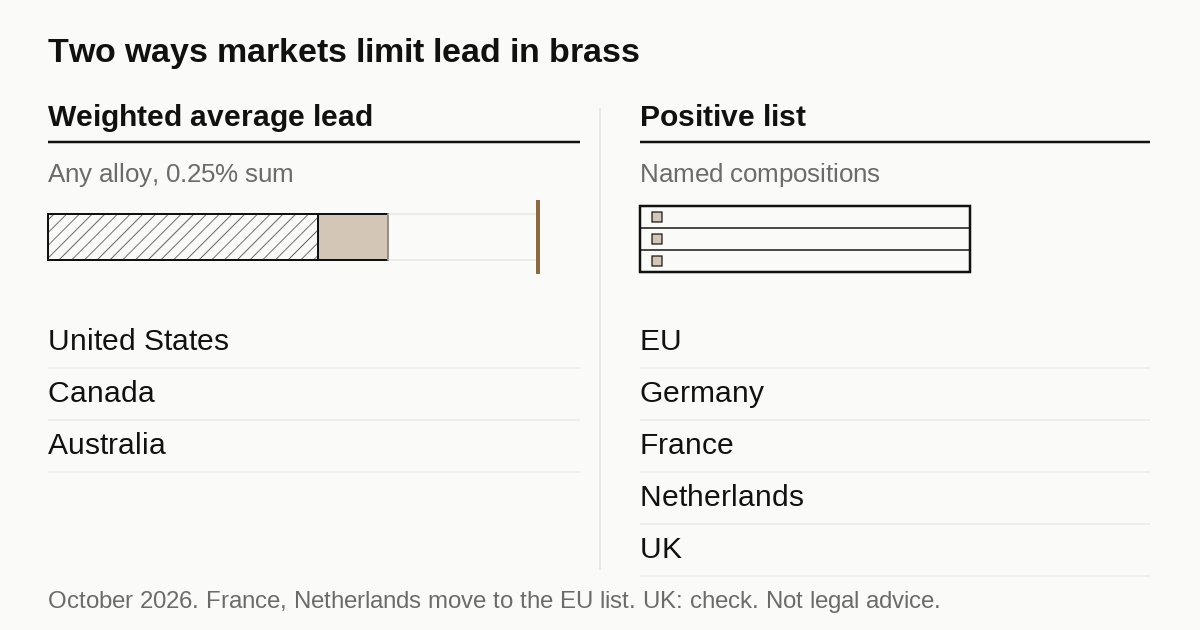
Two kinds of rule, two ways to draw the part
Weighted average markets (US, Canada, Australia) judge the finished product by arithmetic. Any alloy is allowed if the sum of each wetted part’s maximum lead, weighted by its share of the wetted area, stays at 0.25 percent or less. The drawing names the rule and leaves the alloy open where the rule decides it. See NSF/ANSI 372.
List markets (EU, Germany, France, the Netherlands) accept only named compositions for each product group. A grade that has very little lead can still be refused if it is not named. The drawing names the alloy and the list entry.
A product sold in both kinds of market needs a grade that clears both. In practice that is silicon brass, see lead-free brass alloys.
Dates to watch
| Date | Market | What changes |
|---|---|---|
| 1 May 2026 | Australia | Only lead free copper alloy plumbing products certified |
| 1 December 2026 | US and Canada | Certifiers report that reports must move to the 2024 edition of NSF/ANSI/CAN 372, check yours |
| 31 December 2026 | EU | European positive lists, certification and marking apply |
| 12 January 2028 | Germany | 5 micrograms per litre lead, listed leaded brasses out of new installations |
| 1 May 2028 | Australia | Lead Free WaterMark required for installation, per ABCB |
| 31 December 2032 | EU, Germany | Last day for national attestations |
| 12 January 2036 | EU | Lead parametric value of 5 micrograms per litre to be met at the latest |
How to use this hub
- Find every market the finished product will be sold in, not only the first one.
- Read the type of rule for each. If any market is a list market, the grade must be named on that list.
- If all markets use a weighted average, name the rule on the drawing and leave the alloy open to any grade that clears the sum.
- Ask the product maker which certifier will test the product, and read that certifier’s own requirements.
- Put the market, the rule and the grade on the RFQ, so a shop can say plainly whether it can source the bar.
Which page to read first
| Your situation | Start with |
|---|---|
| US plumbing product | Brass parts for the US, then NSF/ANSI 372 |
| German or EU plumbing product | Germany, then the 4MS positive list |
| One product for the US and the EU | Lead-free brass alloys |
| Hot or aggressive water | ISO 6509 dezincification test |
| Checking a certificate | Brass verification |
What every market has in common
- The approval belongs to the finished product and its maker, never to a bare machined part.
- A mill certificate with lead per lot is the shop’s contribution. See material certificates.
- Leaded and lead-free bar must be kept apart in the shop. See segregation.
- Rules move. Every row here carries the month we read it, and the corrections log records changes.
For the use side of the same rules, see brass plumbing fittings for drinking water.
Frequently asked questions
Is there one brass grade accepted everywhere for drinking water?
Silicon brass comes closest. As CW724R it is named on the European positive list, and as C69300 its lead is far below the 0.25 percent weighted average used in the US and Australia. Check the copper range, because a C69300 bar is not automatically a CW724R bar, and check each certifier's own requirements.
Do these rules apply to brass parts outside drinking water?
No. They cover products in contact with water for human consumption. Other rules reach other brass parts: RoHS for electrical equipment in the EU, REACH for lead in articles, Proposition 65 in California and children's product limits in the US.
Who holds the approval for a brass fitting?
The maker of the finished product, through a certifier or approval body. A machine shop supplies the alloy, the mill certificate and parts to the drawing. We hold no approval and never say that a part or a shop is approved.
Sources
- EPA, Use of lead free pipes, fittings, fixtures, solder and flux for drinking water epa.gov
- EUR-Lex, Commission Implementing Decision (EU) 2024/367, European positive lists eur-lex.europa.eu
- UBA, Hygienic requirements of materials in contact with drinking water, transitional regulations (REV02) umweltbundesamt.de
- EUR-Lex, Directive (EU) 2020/2184, Article 11 and Annex I Part B (lead) eur-lex.europa.eu
- ABCB, Update: transition to lead free plumbing products (2026) ncc.abcb.gov.au
- WRAS Approvals, scheme and directory wrasapprovals.co.uk
Standards and rules are cited as references. Nothing here says that a part, a shop or this site meets them. Not legal advice.
Reference hub. Last reviewed 22 October 2026. Corrections log
Have a brass part to quote?
Send the drawing with the market and the rule it must meet. We reply within 24 business hours with one itemised quote for the finished parts, or a clear no.
Send your RFQ