Guides / Compliance
EU 4MS Positive List for Brass: What Changes on 31 December 2026 and How to Cite It
Published October 20, 2026. Reviewed for the facts in the corrections log.
From 31 December 2026 the European positive list of metallic compositions in Implementing Decision (EU) 2024/367 applies to materials in contact with drinking water. It grew out of the 4MS common approach. Only listed compositions go into new products. The brasses named are narrower than older national lists, so check the entry before you draw a grade.
From 31 December 2026 the European positive list of metallic compositions applies to materials in contact with drinking water in the EU. It is Annex II of Commission Implementing Decision (EU) 2024/367. It grew out of the 4MS common approach that France, Germany, the Netherlands and the UK started in 2011, and it is narrower than some of the national lists it replaces. This post is part of our guide to lead free brass, and it covers the brass entries, the dates and the wording for a drawing.
We do not certify parts or give legal advice. Everything below is read from the official texts and a UBA notice opened in October 2026. Check the current text before you rely on it.
Checked October 2026.
What 4MS is and what replaces it
The 4MS Initiative is the work of France, Germany, the Netherlands and the UK, formally announced in January 2011, to harmonize hygiene tests for products in contact with drinking water (UBA, approval and harmonization page). Its common approach for metallic materials has three parts: methods for accepting compositions, a positive list of compositions (Part B) and methods for testing finished products. Denmark joined later. The Part B list is what brass buyers mean by “the 4MS list”.
The UBA page says the common approaches were submitted to the Commission as proposals for the implementing and delegated acts under article 11 of the revised Drinking Water Directive, and that only the positive lists were still being updated until a European list is available. Implementing Decision (EU) 2024/367 is that European list. From its application date, the national lists stop being the reference for new approvals.
Dates that matter
Six dates matter to a brass buyer. They come from three documents and they do not all apply to every product, so the table gives the source of each.
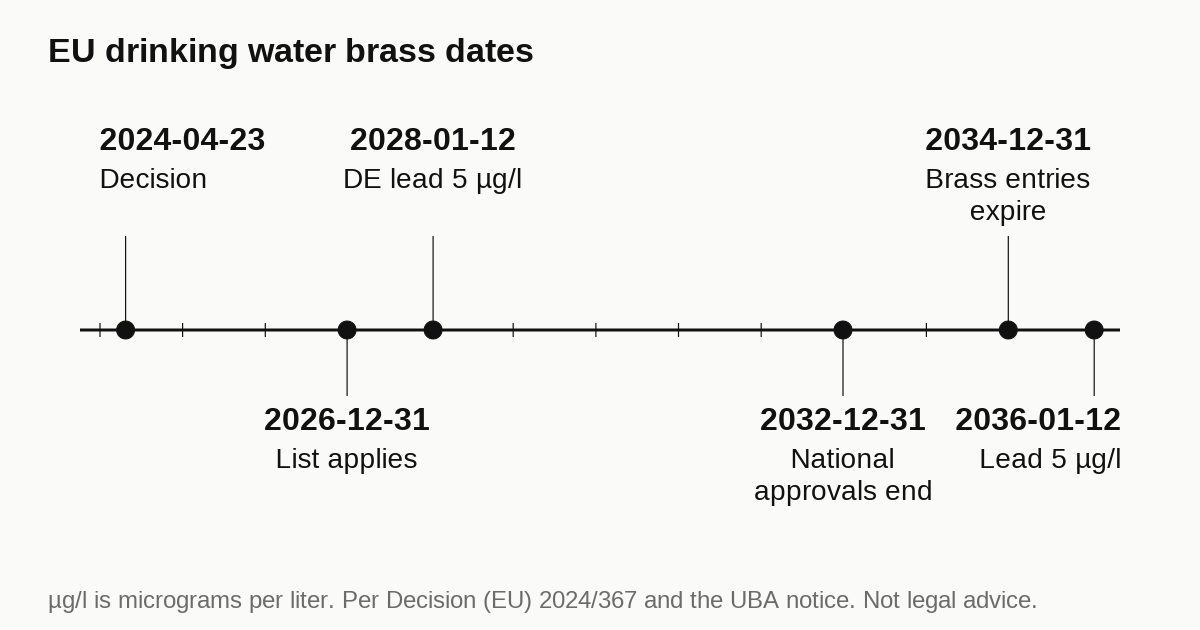
| Date | What happens | Source |
|---|---|---|
| 23 April 2024 | Decision (EU) 2024/367 published in the Official Journal | EUR-Lex |
| 31 December 2026 | The Decision applies. National systems apply until then | Decision, article 4 and recital 9 |
| 12 January 2028 | Germany: 5 micrograms per liter lead applies. Listed leaded alloys can no longer be installed there. Attestations for them run to 11 January 2028 | UBA notice, section 4.3 and 5.2 |
| 31 December 2032 | Compositions approved nationally from 13 July 2021 to 31 December 2026 may be used until this date, if they meet 5 micrograms per liter at the tap. From this date at the latest, only products that comply with the European rules and carry the marking may be placed on the market | Decision, article 3. UBA notice, section 3.2 |
| 31 December 2034 | Expiry date on the named brass entries. Group entry 1691 expires 31 December 2031 | Decision, Annex II |
| 12 January 2036 | Lead parametric value of 5 micrograms per liter to be met at the latest. It is 10 until then | Directive, Annex I Part B |
Dates as read in October 2026. The expiry dates are the Commission’s, set from ECHA recommendations, and entries can be renewed or removed.
What the list holds for brass
Annex II table 1 lists individual compositions by an EUPL number, a notation, the product groups it is relevant to, conditions and an expiry date. The copper-zinc entries I read:
| EUPL | Notation | Product groups | Lead and notes | Expiry |
|---|---|---|---|---|
| 1645 | CW506L-DW (CuZn33) | B to D | impurity, 0.05 maximum | 31 Dec 2034 |
| 1647 | CW508L-DW (CuZn37) | B to D | impurity, 0.1 maximum | 31 Dec 2034 |
| 1648 | CW509L-DW (CuZn40) | B to D | impurity, 0.2 maximum | 31 Dec 2034 |
| 1649 | CW510L-DW (CuZn42) | B to D | impurity, 0.2 maximum | 31 Dec 2034 |
| 1658 | CW724R (CuZn21Si3P) | B to D | impurity, 0.1 maximum. Copper 75.0 to 77.0, silicon 2.7 to 3.5 | 31 Dec 2034 |
| 1659 | CC768S (CuZn21Si3P-C), cast | B to D | condition on boron and zirconium | 31 Dec 2034 |
Percent by weight. Source: Annex II of Implementing Decision (EU) 2024/367, text as published 23 April 2024. The table also holds CW501L-DW and CW507L-DW, two arsenic brasses (CW707R, CW702R) and other cast compositions.
Two readings follow. The “-DW” brasses carry lead only as an impurity limit, so they are plain brasses and not free-cutting grades. And the silicon brass on the list is CW724R, whose copper range is narrower than the datasheet range for the US grade C69300 (73.0 to 77.0). A bar sold as C69300 is not automatically a CW724R bar.
Annex II also has a group entry, number 1691, for other copper alloys, which applies to product group D only and carries a lead maximum of 1.8 percent.
What is not named
In the Annex II text I read, no entry is named CW511L, CW602N, CW617N, CW614N, CW603N or CW612N, and no bismuth brass appears. That is a statement about the text, not about every national scheme.
It does not match everything else. The 17th revision of the 4MSI Part B (10 January 2023) lists CW511L (CuZn38As) for product groups B to D, CW617N and CW612N for B to D with some elements further restricted and CW614N and CW603N for C and D. Our standards page says CW617N and CW614N are not on the 4MS list for wetted parts. Those two statements differ, and a later revision of Part B may exist that I could not open. So “on the list” depends on the revision, the product group and the country.
The UBA notice adds one more point: its national list currently includes low-lead materials that are not yet in the European list, and until a material is added no EU certificate can be issued for components made from it. I could not tell which materials it means.
Need a quote for this part? Get a quote for your brass parts
Product groups and who decides
The letters A to D in the “relevant product groups” column match the product groups of the 4MSI document. The Decision text I read does not define them, so the definitions below come from the 4MSI Part B (rev 17).
| Group | Examples of products | Assumed contact surface |
|---|---|---|
| A | Pipes in building installations | 100 percent |
| B | Fittings and ancillaries in building installations, such as pump, valve and water meter bodies | 10 percent |
| C | Components of group B products, such as spindles, and fittings in water mains and treatment works | 1 percent |
| D | Components of fittings in water mains and treatment works | not stated in the table I read |
A turned brass part may be a body (B) or a component (C or D) depending on the product it goes into. The product maker decides that. The shop only quotes the alloy and the drawing.
Certification, marking and who owns what
According to the UBA notice, the European regime has five more acts beside the list: testing of final materials (2024/368), conformity assessment (2024/370) and marking (2024/371), plus the methodology and application procedure. Certificates are issued by notified conformity assessment bodies from 31 December 2026 at the earliest, and products certified under the European rules carry a common marking. Products placed on the market for the first time from that date have to be certified and labelled under the European procedure, while products with a national attestation on 31 December 2026 may continue until 31 December 2032, according to the same notice.
None of that falls on the machine shop. The shop supplies the alloy, the mill certificate and traceability. The product maker owns the product certificate.
What to write on the drawing
EU drinking water, wetted part.
Composition listed in the European positive list,
Implementing Decision (EU) 2024/367, Annex II.
Alloy: CW724R (EUPL 1658), product group as set by
the product maker, or buyer-approved equivalent.
Mill certificate EN 10204 3.1 per lot, composition shown.
- Cite the alloy by its EU notation and EUPL number, and the expiry date if the part is long-lived.
- Name the product group only if you have decided it.
- Ask for the mill certificate to show the composition against the listed limits.
- Leave the alloy open to an equivalent only with written approval, because a US grade name is not an EU entry.
Common misreadings
- “4MS is EU law.” It is a common approach by four states. The Decision is the EU law.
- “31 December 2026 stops everything.” The Decision applies from that date, with a transition to 31 December 2032 for products already attested under national rules.
- “A listed alloy means an approved part.” The list limits compositions. Products are tested and certified separately.
- “Every brass on the old list is on the new one.” The comparison above shows it is not.
- “Bismuth brass is lead-free, so it is allowed.” Lead-free is not the test; being listed is.
Where to go next
Use this post as the EU section of our guide to lead free brass. For the US rule, see NSF/ANSI 61 and 372 for brass fittings and the standards index. Have an EU drinking water part to quote? Send the drawing with the market named. We quote the finished parts within 24 business hours and place the work with one of the partner shops that turn brass.
See also: DVGW, Kiwa and EU marks on brass fittings and WRAS approval for brass fittings.
Frequently asked questions
When does the EU positive list for metallic materials apply?
Commission Implementing Decision (EU) 2024/367 applies from 31 December 2026, according to its article 4. Member States' national systems apply until that date. Products with a national attestation on 31 December 2026 may keep using it until 31 December 2032, which is the end of the transition in the UBA notice.
Is CW511L on the European positive list?
I found no entry named CW511L in Annex II of Decision (EU) 2024/367 as published on 23 April 2024. The 17th revision (January 2023) of the 4MS list I read did name it, and the UBA notice says some low-lead materials from its national list are not yet in the European list. Check the current entry, and any amendment, before you draw it.
Is bismuth brass accepted for EU drinking water?
I found no bismuth brass named in Annex II of the Decision or in the 17th revision (January 2023) of the 4MS list. That is a statement about what I read, not about every national scheme. For an EU drinking water part, confirm the composition on the current European list before you specify bismuth brass.
Can a machine shop certify a part to the positive list?
No. The list limits compositions. Products are assessed and certified by conformity assessment bodies, and the certificate belongs to the product maker. A shop can supply the alloy, a mill certificate that shows its composition and traceability from bar to part.
Alloys in this guide
| Alloy | Lead % | Mach. | DZR |
|---|---|---|---|
| CW511L lead-free brassC27450 (nearest, without arsenic) · CuZn38As / CW511L | under 0.2 | 40 | High |
| C69300 silicon brassC69300 · CuZn21Si3P / CW724R | under 0.09 | 80 | High |
| CW617N CuZn40Pb2C37700 (nearest) · CuZn40Pb2 / CW617N | 1.6 to 2.5 | 80 | Poor |
| C360 free-cutting brassC36000 · CuZn36Pb3 / CW603N | 2.5 to 3.7 | 100 | Poor |
Published typical values for the alloy. Machinability against C360 at 100. Not a promise from a shop.
Sources
- EUR-Lex, Commission Implementing Decision (EU) 2024/367, European positive lists, Annex II metallic compositions eur-lex.europa.eu
- EUR-Lex, Directive (EU) 2020/2184, Article 11 and Annex I Part B (lead) eur-lex.europa.eu
- UBA, Hygienic requirements of materials in contact with drinking water, transitional regulations (REV02, effective 13 October 2025) umweltbundesamt.de
- UBA, Approval and harmonization, the 4MS Initiative umweltbundesamt.de
- 4MSI Common Approach, Part B, positive list of compositions for metallic materials (17th revision, January 2023) caleffi.com
Need a quote for this part?
Send the drawing. We read it, send one itemised quote for the finished parts within 24 business hours and place the work with a partner shop that turns brass. Brass only.
Get a quote for your brass parts