Guides / Compliance
Lead-Free Brass for Machined Parts: Which Alloy, Which Rule and What to Write on the Drawing
Published November 21, 2026. Reviewed for the facts in the corrections log.
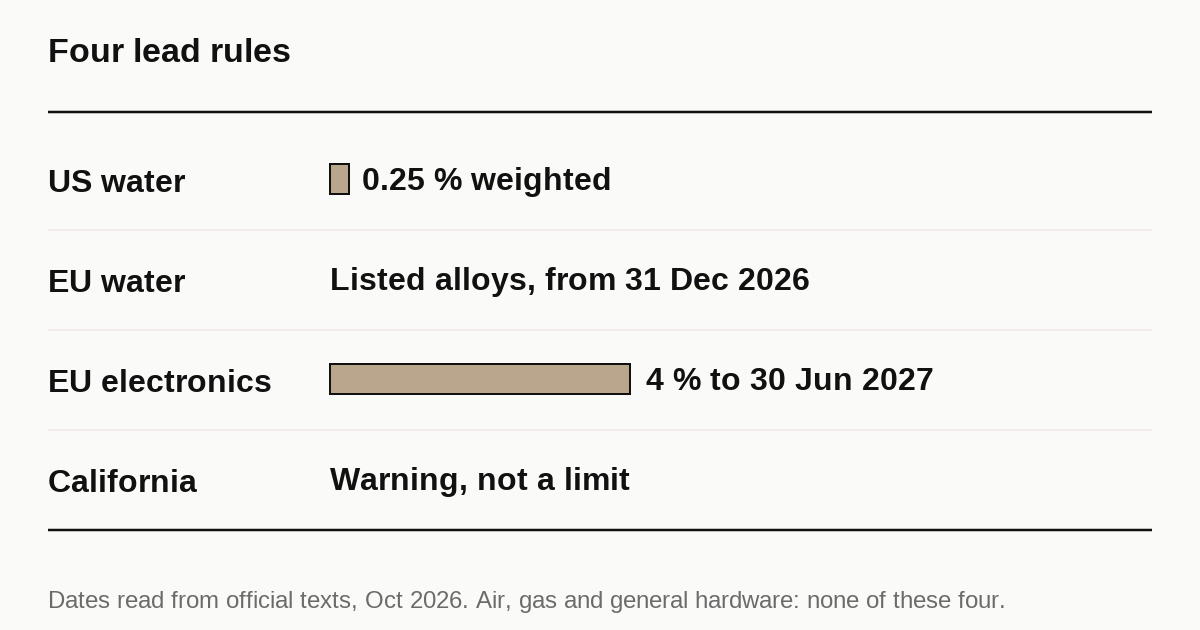
Lead-free brass means different things under different rules: a 0.25 percent weighted average on wetted surfaces for US drinking water, a positive list of named compositions for EU drinking water and no general limit for most other parts. Pick the rule first, then the alloy, write the standard on the drawing and ask for composition proof.
If your brass part touches drinking water in the United States, the 0.25 percent weighted average lead limit decides the alloy before any engineering question. In the EU the test is a named list of compositions. In electronics it is an exemption with a date on it. Outside those cases there may be no limit at all, only a labeling duty. This guide is for buyers and designers who need to choose a lead-free grade, work out which rule applies and write it on the drawing so a shop can quote it.
We name no shop and we do not certify parts or give legal advice. Alloy figures are published typical values and lead percentages are nominal composition, not a lot certificate.
Last reviewed: October 2026. Rules and dates carry the date they were checked; confirm them against the official text or with counsel before you rely on them.
- What lead free means and which rule applies
- US drinking water rules
- EU drinking water rules
- Electronics and RoHS exemption 6(c)
- California Proposition 65
- Garden hose and water meter parts
- Lead-free alloys compared
- Cost per part
- Surface lead, leaching and recycled bar
- Proving the alloy
- Drawing note and checklist
- Send the drawing
What lead free means and which rule applies
There is no single definition of lead-free brass. The free-cutting standard, C360, carries about 2.5 to 3.7 percent lead by weight (CDA lists C36000 at 2.5 to 3.0 percent and C36010 at 3.1 to 3.7, so the range covers both numbers). Lead is there on purpose: it breaks the chip. Each rule below asks a different question of that number, so the first job is to find which rule your part sits under.
| Part and market | Rule | What it limits | What it means for the alloy |
|---|---|---|---|
| Drinking water fitting, US | Safe Drinking Water Act section 1417, NSF/ANSI 372 | 0.25 percent weighted average lead across wetted surfaces | C360 is out. C69300 (under 0.09) and bismuth brass (under 0.25) are in range |
| Drinking water fitting, EU | Directive 2020/2184 article 11, Decision 2024/367 | Only compositions on the European positive list | Named alloys such as CW724R. Check leaded grades one by one |
| Part inside electronics sold in the EU | RoHS Annex III, exemption 6(c) | Copper alloy with up to 4 percent lead is exempt until 30 June 2027 | Leaded brass stays legal to that date, so plan the switch |
| Product sold in California | Proposition 65 | A warning duty when exposure is above set levels | A label or notice, not an alloy change |
| Compressed air, gas, general hardware | None of the four rules above sets a composition limit | Nothing, unless your customer or market adds one | C360 stays the usual grade |
Alloy values are published typical values for the alloy. Sources: EPA, Cornell LII 42 U.S.C. 300g-6, EUR-Lex, OEHHA, all opened October 2026.
Two cautions run through the whole guide. A limit on composition is checked on bar and on the finished part, not on a catalogue name. And the shop supplies alloy and records, while certification of a finished product belongs to the company that places it on the market.
Read more: Leaded vs lead-free brass: which one your part needs
US drinking water rules
The federal definition sits in the Safe Drinking Water Act. In the text on Cornell LII, section 1417 defines lead free for pipes, fittings and fixtures as “not more than a weighted average of 0.25 percent lead” across the wetted surfaces, and for solder and flux as not more than 0.2 percent. Where a material’s lead content is given as a range, the formula takes the maximum. That is why C360 is read at 3.7 percent and why a lead-free alloy is read at its upper limit, not its typical figure.
A short illustration shows why the weighting matters. Take an assembly whose wetted surface is 95 percent C69300 (read at its 0.09 maximum) and 5 percent C360 (read at 3.7): 0.95 times 0.09 plus 0.05 times 3.7 gives about 0.27 percent, which is over the line even though the body is lead-free. This is an illustration of the arithmetic, not a ruling on any product. It is the reason many buyers specify a lead-free grade for every wetted part instead of splitting the assembly.
Two exemptions matter to a buyer. Fittings and fixtures used exclusively for nonpotable service, such as manufacturing, industrial processing, irrigation and outdoor watering, are exempt from the prohibition. So is a list of named products, including toilets, bidets, urinals, fill valves, flushometer valves, tub fillers, shower valves, fire hydrants, service saddles and water mains gate valves of 2 inches or more. If your part is a general-purpose fitting that could end up on a drinking line, do not assume the exemption: ask the product maker.
EPA’s page says the final rule was published on 1 September 2020 and that certification became required for manufacturers and importers from 1 September 2023. The certification is of the finished product and rests on the manufacturer or importer. A turning shop cannot supply it for your product.
NSF’s own pages did not open for me this session. Our NSF post describes NSF/ANSI 372 as the standard for how the weighted average is calculated and NSF/ANSI 61 as the separate leaching standard; the 0.25 percent figure in this guide is attributed to the Act and EPA, not to NSF. For the arithmetic on an assembly, use the lead content calculator.
Read more: NSF/ANSI 61 and 372 for machined brass water fittings
EU drinking water rules
Article 11 of Directive (EU) 2020/2184 requires Member States to ensure that materials in contact with drinking water do not compromise human health, and it tasks the Commission with European positive lists. Commission Implementing Decision (EU) 2024/367 sets those lists. Annex II is the list of metallic compositions. The Decision applies from 31 December 2026 (its article 4), and national systems apply until then.
For a brass part that changes two things. First, the question becomes “is this composition on the list” instead of “is this alloy accepted by the national scheme”. Second, the list is built on the 4MS common approach run by France, Germany, the Netherlands and the UK, and the European list does not carry every composition that the 4MS list and the German list accepted. In the Annex II text I read, the named brasses include the low-lead plain brasses with a “-DW” suffix (for example CW506L-DW and CW510L-DW), two arsenic brasses (CW707R and CW702R) and the silicon brass CW724R. I found no entry named CW511L, CW602N, CW617N, CW614N or CW603N, and no bismuth brass.
That differs from what the 4MS list shows in its 17th revision of January 2023, the only revision I could read (CW511L, CW617N and CW612N were listed there), and from the “not on the list” wording of our standards page. The list a buyer relies on depends on the revision, the product group and the country, so confirm the current entry before you draw an alloy. Separately, Annex I of the Directive sets the lead parametric value at 5 micrograms per liter, to be met at the latest by 12 January 2036, with 10 micrograms per liter until then. The Annex also says the 5 microgram value at the tap applies when the European lists are assessed, which is why the first list holds only compositions assessed against it. The transition runs to 31 December 2032 for products already attested under national rules, and Germany has its own 12 January 2028 cut-off for some leaded alloys, according to the UBA notice effective 13 October 2025.
Read more: 4MS positive list for brass: what applies from 31 December 2026
Electronics and RoHS exemption 6(c)
RoHS covers electrical and electronic equipment, not plumbing. Within that scope, leaded brass for connector shells, terminals and inserts has relied on exemption 6(c), copper alloy containing up to 4 percent lead by weight. Commission Delegated Directive (EU) 2025/2364 of 8 September 2025, published in the Official Journal on 21 November 2025, renews 6(c) with the text “Expires on 30 June 2027”. A footnote removes the exemption for equipment supplied to the general public where a child may put a part in the mouth, unless both of two things can be shown: that lead release does not exceed 0.05 micrograms per square centimetre per hour, and, for a coated part, that the coating holds that rate for at least two years of normal use. The footnote treats equipment or an accessible part as mouthable by a child if it is smaller than 5 cm in one dimension or has a detachable or protruding part of that size.
The recitals of the same text say the Commission could not identify application areas that no longer need the exemption. The recital adds that there were indications lead could be substituted in certain applications, but that the substitutes were not sufficiently reliable, and it sets one expiry date for all equipment categories. That is a reason for the renewal, not a promise of the next one. Member States apply the national rules from 1 July 2026. Our RoHS post covers whether a further renewal request is pending; the official text itself states only the date.
A shop cannot tell you whether 6(c) applies to your part. Only you know which equipment it goes into. If you have parts under the exemption, ask suppliers now whether they have shipped lead-free grades in production.
Read more: RoHS exemption 6(c): leaded brass and the 2027 date
California Proposition 65
Proposition 65 is a warning law, not a material limit. In the OEHHA regulations, lead is listed as a reproductive toxicant (listed 27 February 1987) and, as lead and lead compounds, as a carcinogen (1 October 1992). The regulations set a level for reproductive toxicity of 0.5 micrograms per day for lead (27 CCR 25805) and a no significant risk level of 15 micrograms per day, oral (25705). The regulations treat exposure at or below the first level as having no observable effect and at or below the second as posing no significant risk. Above them, a product sold in California may need a warning.
The warning has a defined content: a symbol, the word WARNING, the name of the chemical and the harm, plus a web address. The wording differs for cancer, for reproductive harm and for both, and section 25602 allows a short-form label warning in type not smaller than 6 point. The regulations let the manufacturer, importer or distributor give the warning on a label or pass a written notice to the seller, and section 25600.2 says that notice must be renewed every year while the product is sold in California. Article 6 itself says it does not decide whether a warning is required; it governs only content and method. Whether a given brass part needs a warning depends on how a consumer is exposed and in what dose, which is a question for counsel and not for the shop.
Read more: Prop 65 and brass products sold in California
Garden hose and water meter parts
Two common brass products show how the rules split. A hose barb or garden fitting used only for outdoor watering sits under the nonpotable exemption in the federal text, so a leaded alloy is common there. The hose is not meant for drinking, but a fitting that could be used on a drinking supply, such as an RV fill, is a different case, and Proposition 65 labeling can still apply in California. The federal text words the exemption as fittings used exclusively for nonpotable services, so the test is the use you can show, not the product name. EPA’s page lists the same nonpotable and named-product exemptions. Our hose barb post sets out the use-by-use table.
A water meter body is the opposite case. It sits on a drinking supply, so the body, tailpieces and plugs are wetted parts under the US rule and need a lead-free grade, and in the EU they need a listed composition. The body is usually hot forged and then machined, and the largest wetted area decides the weighted average. In the 4MS product groups, meter bodies for building installations are the example given for group B, with an assumed contact surface of 10 percent, which is one reason the same alloy question comes up for the body and for the small parts inside the meter.
Read more: Brass hose barbs and garden fittings: lead limits by market
Read more: Brass water meter bodies: lead rules and drawing specs
Need a quote for this part? Get a quote for your brass parts
Lead-free alloys compared
| Grade | Spec | Lead, nominal % | Machinability (C360 = 100) | Where it fits |
|---|---|---|---|---|
| C69300 silicon brass | UNS C69300, near CW724R | under 0.09 | 80 | US potable water, hot water, stronger parts |
| Bismuth brass | UNS C49300 family | under 0.25 | 80 | Quick conversion of a turned part, US use |
| CW511L | CuZn38As | under 0.2 | 40 | Listed in 4MSI rev 17 (January 2023). Not in Decision 2024/367 Annex II as read, so check before you draw it |
| C360 free-cutting (reference) | UNS C36000 and C36010 | 2.5 to 3.7 | 100 | Not for US drinking water wetted parts |
Published typical values for the alloy, as used on this site’s datasheets. They describe the material, not a promise from any shop. Another producer’s lead-free sheet rates C69300 at 85, without stating the scale on the sheet, so treat ratings as ordering, not as cycle time.
C69300 and CW724R are close but not identical. The datasheet range for C69300 copper is 73.0 to 77.0 percent; the Annex II entry for CW724R is 75.0 to 77.0. A bar sold as C69300 is not automatically a CW724R bar, so an EU drawing should name the EU notation and ask for a certificate that shows the composition inside its limits.
Bismuth brass can carry a stress corrosion risk on cold-worked parts, according to our RoHS post, and it is not named in the EU lists I read. Silicon brass cuts tougher and, from its copper content, probably costs more in bar. The deeper comparisons are in the cluster posts.
On the lathe the difference is less about speed than about chip and tool behavior. Silicon brass work hardens, so it wants sharp tooling and a feed that keeps cutting, and threads behave differently. Bismuth brass is closest to the C360 habit. CW511L is a long chipping grade. A shop that has run the grade will quote it without a guess margin, which is why the useful question is whether it has shipped the grade, not whether it can run it.
Read more: C360 vs C69300 brass
Read more: Bismuth brass vs silicon brass: two lead-free routes
Cost per part
Lead-free brass costs more in two places: the bar and the cycle. Bar probably costs more because the silicon route carries more copper (73 to 77 percent for C69300 against 60 to 63 for C36000), which is my inference from the composition ranges and not a sourced price, and because our comparison posts note that lead-free bar is not held as widely as C360. The cycle is longer because the grade cuts slower. I found no published bar price list for lead-free grades that I could verify, and no tool-life figure from a source I could open, so this guide gives no percentage for the bar.
What it does give is a method. In the worked example in our cost post, a heavy part with a 60 second cycle on C360 costs about 2.20 currency units. On a lead-free grade rated 80, with the cutting time scaled to match, it comes to about 2.51 with a 10 percent bar premium and 2.69 with 25 percent. Those assumptions are stated there and they are an example, not a quote. In that example the cycle delta and the bar delta are about equal at a premium near 16 percent: below it the cycle is the bigger line, above it the bar is. A light part with a 10 second cycle gives +14 and +21 percent on the same assumptions. Ask a shop to show the bar and the cycle as separate lines so you can see which one moves your quote.
Read more: Lead-free brass cost per part: bar, cycle time and tools
Surface lead, leaching and recycled bar
According to our leaching post, a leaching treatment is an acid etch that dissolves exposed lead from the surface, and it lowers the lead that comes off a part in the first days of use. It does not change the alloy. The US limit is on the lead content of the wetted material, so a C360 part with a treated surface still holds about 3 percent lead in the bulk and does not meet a 0.25 percent weighted average. Use the treatment where a market asks for lower lead release from a leaded part that is lawful to make, or as an extra on a lead-free part. Do not use it to bridge the gap to a composition limit. Ask the shop what the bath removes, how the result is checked and which test method applies.
Read more: Brass lead leaching treatment
The bar is the other place lead enters. According to our recycled rod post, much brass rod is made from recycled scrap. In a leaded grade, lead in the scrap is normal feedstock. In a lead-free grade, leaded scrap melted into the charge puts lead into the bar, and melting does not remove it, so, as that post adds, mills making lead-free grades use dedicated scrap streams and a controlled cleanout between leaded and lead-free runs. The questions for a lead-free bar are therefore about the mill: how it separates leaded and lead-free scrap, whether the furnace is dedicated and how a lot is checked. This is why a lead-free claim rests on bar traceability and not on the alloy name.
Read more: Recycled brass rod and lead impurities
Proving the alloy
| Evidence | What it shows | What it does not show | Who issues it |
|---|---|---|---|
| Mill certificate, EN 10204 type 3.1 | Composition and tests on the bar lot, signed by the mill’s inspection representative | The finished part, or mix-ups after delivery | The mill |
| Handheld XRF reading | A screening reading of the surface, quick sorting of leaded against lead-free bar | A figure for a dispute or a compliance claim | The shop or the buyer |
| Laboratory analysis | A tighter composition figure, the one that settles a disagreement | Traceability of other lots | An independent lab |
| Lot traceability record | Which bar lot each part lot was cut from | The alloy itself | The shop |
| Product certification | That the finished product was assessed under the market’s scheme | Anything about a different product | The product maker or importer in the US. A notified conformity assessment body in the EU |
Sources: EPA (manufacturers and importers certify their products, from 1 September 2023), UBA notice (EU conformity assessment and marking from 31 December 2026), a vendor summary of EN 10204 (the standard text was not read; directional only).
The point of the table is the last column. A shop can show its bar and its records. It cannot supply the product certification, in the US or in the EU. Lot traceability is the record that connects the other rows. It is what lets you answer a later question, such as which bar a failed part came from, without opening every lot in stock, and it is the part of the paperwork most often priced separately. On the EU side the UBA notice describes certificates by notified conformity assessment bodies from 31 December 2026 and a common marking, with the transition to 31 December 2032 for products already attested.
Read more: XRF checks on brass bar
Drawing note and checklist
Write the rule, not only the alloy. A bare alloy name tells the shop one bar it can buy. A rule tells it what has to be true and leaves it free to offer any grade that meets it. Three phrases to avoid on a custom part: “lead free” alone, because it has a different test in each market; “RoHS compliant” alone, because it depends on where the part ends up; and “NSF certified”, because certification belongs to a product and its maker, not to a drawing.
US drinking water, wetted part.
Wetted surfaces to NSF/ANSI 372, 0.25 percent weighted
average lead. Suggested alloy: C69300 or equivalent
lead-free brass. Mill certificate EN 10204 3.1 per lot.
EU drinking water, wetted part.
Composition listed in the European positive list,
Implementing Decision (EU) 2024/367, Annex II.
Alloy: CW724R (EUPL 1658) or buyer-approved equivalent.
Mill certificate EN 10204 3.1 per lot.
- Name the market and the rule before you pick the alloy.
- Decide who owns product certification, and say so on the order.
- Write the standard or list on the drawing, with the alloy as a suggestion.
- State the certificate type and whether you need it per lot or with the first article.
- Ask which bar the shop will buy and what lead value its certificate shows.
- Ask how lead-free bar is kept apart from leaded bar from the rack to the packing bench.
- Ask what check the shop runs on incoming bar and whether it retains a sample.
- Check the EU entry, product group and expiry date on the current list before release.
Read more: Lead-free brass compliance documents: what to ask a shop for
Send the drawing
Have a lead-free part to quote? Send the drawing and set the compliance field to the rule you work to. We quote the finished parts within 24 business hours and place the work with one of the partner shops that turn brass.
Frequently asked questions
What counts as lead free brass?
It depends on the rule. For US drinking water parts the Safe Drinking Water Act defines lead free as a weighted average of not more than 0.25 percent lead across wetted surfaces. For EU drinking water parts the test is whether the composition is on the European positive list. Other markets and products have other tests, or none.
Is C69300 or bismuth brass the better lead-free choice?
Neither wins everywhere. C69300 silicon brass is stronger, resists dezincification and suits hot water, but it cuts tougher. Bismuth brass behaves closest to C360 on a lathe and suits a quick conversion of a turned part. Pick by the part, the market rule and which bar the shop can buy.
Can I use bismuth brass in the EU?
I found no bismuth brass named in the Annex II composition list of Decision (EU) 2024/367, or in the 17th revision (January 2023) of the 4MS list I read. For an EU drinking water part, check the current European positive list before you draw bismuth brass. Parts for other uses are a separate question.
Does a mill certificate prove my part is lead free?
It documents the composition of the bar the part was cut from. It does not show that the finished part meets a product standard, and it says nothing about mix-ups between bars after delivery. Ask for lot traceability from bar to part as well, and keep product certification with the maker of the finished product.
Does RoHS ban leaded brass in 2027?
Not by itself. Exemption 6(c) allows copper alloy with up to 4 percent lead in electrical and electronic equipment, and the 2025 Commission text sets its expiry at 30 June 2027. After that date, an exemption that is not renewed means those parts need a lead-free grade. RoHS does not cover plumbing parts.
How much more does lead-free brass cost per part?
I found no published price list for lead-free bar that I could verify. In the worked example in our cost post, lead-free grades rated 80 on the machinability scale add roughly 14 to 22 percent per part, depending on the bar premium. That is an example with stated assumptions, not a quote.
Alloys in this guide
| Alloy | Lead % | Mach. | DZR |
|---|---|---|---|
| C69300 silicon brassC69300 · CuZn21Si3P / CW724R | under 0.09 | 80 | High |
| Bismuth brassC49300 / C49350 · No single EN equivalent, see supplier spec | under 0.25 | 80 | Moderate |
| CW511L lead-free brassC27450 (nearest, without arsenic) · CuZn38As / CW511L | under 0.2 | 40 | High |
| C360 free-cutting brassC36000 · CuZn36Pb3 / CW603N | 2.5 to 3.7 | 100 | Poor |
Published typical values for the alloy. Machinability against C360 at 100. Not a promise from a shop.
Sources
- US EPA, Use of lead free pipes, fittings, fixtures, solder and flux for drinking water epa.gov
- Cornell LII, 42 U.S.C. 300g-6, prohibition on use of lead pipes, solder and flux law.cornell.edu
- EUR-Lex, Commission Implementing Decision (EU) 2024/367, European positive lists for materials in contact with drinking water eur-lex.europa.eu
- EUR-Lex, Directive (EU) 2020/2184 on the quality of water intended for human consumption eur-lex.europa.eu
- UBA, Hygienic requirements of materials in contact with drinking water, transitional regulations (REV02, effective 13 October 2025) umweltbundesamt.de
- EUR-Lex, Commission Delegated Directive (EU) 2025/2364, RoHS Annex III exemption 6(c) eur-lex.europa.eu
- OEHHA, Regulations on Proposition 65, Title 27 Division 4 (unofficial copy, February 2025) oehha.ca.gov
- 4MSI Common Approach, Part B, positive list of compositions for metallic materials (17th revision, January 2023) caleffi.com
- Smiths Metal Centres, C36000 free-machining brass datasheet smithmetal.com
- MakeItFrom, UNS C69300 silicon brass properties makeitfrom.com
- Wieland Concast, lead-free hardness and machinability ratings concast.com
- Projectmaterials, EN 10204 certificate types (vendor summary, standard text not read) blog.projectmaterials.com
Need a quote for this part?
Send the drawing. We read it, send one itemised quote for the finished parts within 24 business hours and place the work with a partner shop that turns brass. Brass only.
Get a quote for your brass parts