Guides / Compliance
Lead Leaching Treatment for Brass Parts: What It Removes and What It Does Not
Published November 6, 2026. Reviewed for the facts in the corrections log.
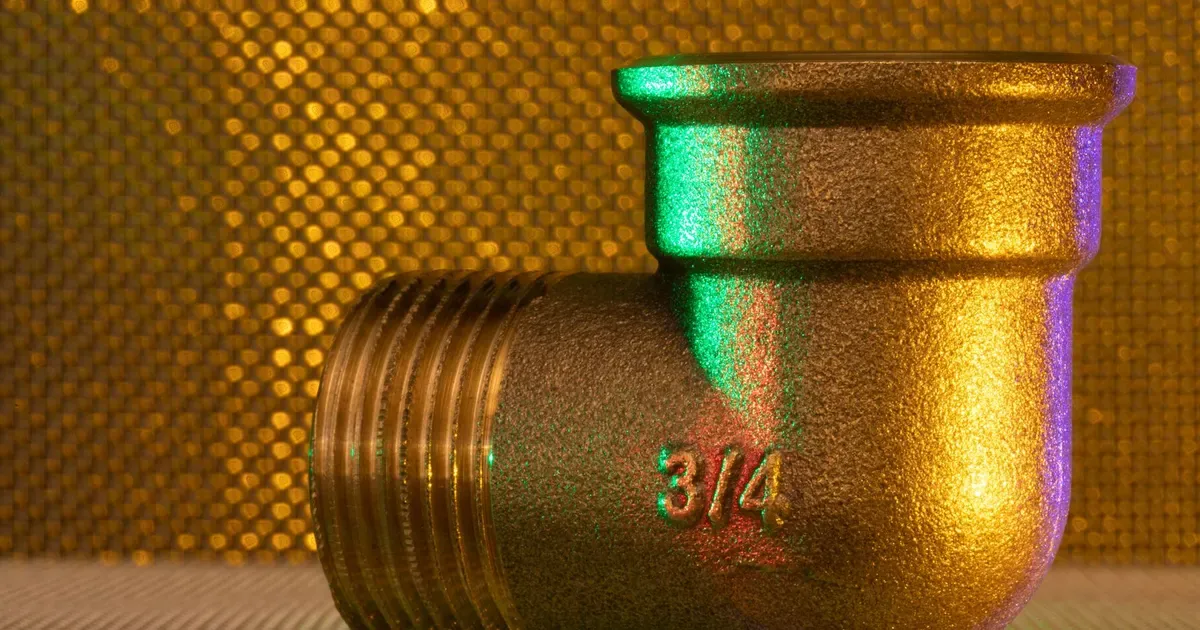
A lead leaching treatment is a controlled acid etch that dissolves the lead particles exposed at a brass surface, so less lead washes out when water first touches the part. It does not change the lead inside the alloy, so it cannot make a leaded brass meet a composition limit such as the 0.25 percent weighted average.
Machined brass has a lead problem that is only partly about lead content. Free-cutting brass holds its lead in tiny globules spread through the alloy. A cutting tool slices through those globules and smears lead across the surface, and a freshly cut part carries a skin of loose lead that washes off when water touches it. That loose film is what a lead leaching treatment goes after.
This post explains how the treatment works, where it helps, and where it stops. The last point matters most, because buyers sometimes read “lead leaching treatment” on a quote and take it to mean a leaded part now meets a lead-free rule. It does not.
Where the surface lead comes from
In C360 free-cutting brass, lead sits at the grain boundaries as separate particles because it does not dissolve in solid brass. This is what makes the alloy machine so well. The particles break the chip, lubricate the tool and keep the cut cool. It also puts lead at every cut surface.
A turned or drilled surface therefore shows exposed lead particles and a smeared layer where the tool dragged lead over the copper-zinc matrix. When potable water first contacts a new part, some of that lead dissolves or washes away. The amount is highest in the first flush and falls with time as the surface equilibrates.
What the treatment does
A leaching treatment, also called a lead reduction or lead removal etch, is a controlled chemical bath. It dissolves the exposed lead and a thin layer of the surrounding metal, so the lead-rich smear and the outer particles are carried away. Common baths use an acid with a complexing agent that holds the dissolved lead in solution. Makers tune the chemistry, the temperature and the time to take off a thin layer, typically a matter of micrometres, without attacking the part’s dimensions.
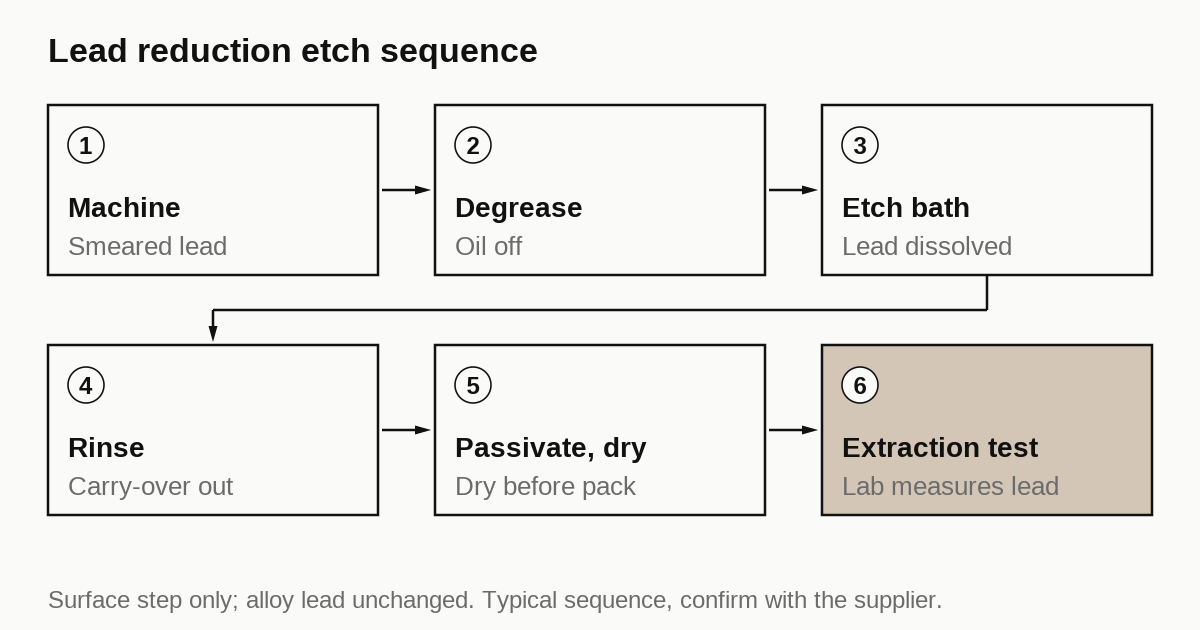
A typical sequence has these steps:
- Machine and degrease, to remove cutting oil that would block the bath.
- Etch in the lead removal bath for a set time.
- Rinse, usually in several stages.
- Neutralize or passivate the surface so it does not tarnish.
- Dry.
- Test a sample, usually by an extraction test with a defined water.
The result is a surface with far less loose lead and a smaller number of exposed particles. The first-flush lead release falls, and it falls faster in the days after installation.
What it cannot do
The treatment changes the surface, not the alloy. The bulk of the part still holds the lead it was cast with. A composition test, such as XRF or optical emission spectroscopy, measures the bulk, and the figure does not change.
This matters for the rule most buyers care about. NSF/ANSI 372 and the US Safe Drinking Water Act set a 0.25 percent weighted average lead limit on wetted surfaces. That is a composition limit, measured on the part’s own material. A C360 part that still holds about 3 percent lead is far above it with or without an etch. The EPA page on lead free pipes, fittings and fixtures describes the US definition. The NSF 61 and 372 guide on this site explains how the two standards differ. This is not legal advice, and a product’s status depends on the standard and the market.
The weighted average is also easy to check in advance with the lead content calculator.
| Question | Does the etch change it? |
|---|---|
| Bulk lead percentage in the alloy | No |
| Weighted average lead on wetted surfaces | No |
| Loose lead smear from machining | Yes, mostly removed |
| First-flush lead release in water | Yes, usually lower |
| Part dimensions | Slightly, by micrometres |
| Surface color | Often, paler or pinker |
Typical effects of the process. A shop’s own test data and the standard in force take precedence.
Where shops use it
There are three common uses.
Alongside a lead-free alloy. Lead-free brasses such as C69300 silicon brass and bismuth brass hold no significant lead, but machining can still deposit traces from tooling or from earlier jobs on the same machine. Some makers etch or wash these parts to bring first-flush levels lower still. Leaded vs lead-free brass covers the alloys.
On low-lead alloys. Brasses with lead between about 0.25 and 0.7 percent may be etched to cut surface release further.
On hardware that is handled. Keys, taps and decorative fittings touch skin and sometimes food. Reducing surface lead lowers what rubs off. Rules for these products vary by market and by product class, so a buyer should name the rule that applies.
Need a quote for this part? Get a quote for your brass parts
Side effects
Three side effects are worth planning for.
Dezincification at the surface. The bath often removes zinc faster than copper, leaving a copper-rich surface layer. That changes the color and can matter on parts that will be plated or lacquered. It is a shallow effect, but it is real. Dezincification of the whole wall is a separate problem, covered in dezincification-resistant brass.
Dimension change. A few micrometres off every surface can matter on tight sealing faces, gauged threads and press fits. A shop should etch before final inspection, not after. The thread effects are in thread gauging brass fittings.
Waste. The bath ends up holding dissolved lead and copper. It is hazardous waste and needs treatment by a licensed handler. Ask a shop how it manages this. A shop that cannot answer should not be running the process.
How the result is checked
A treated part is judged by extraction testing, not by looks. A sample is filled or immersed in a defined test water for a set time, and the water is analyzed for lead. NSF/ANSI 61 has its own extraction procedure and limits, set out in the standard. A shop that claims a result should name the test and the lab. A drawing or purchase order that says “lead leached” with no test, limit or method is not a specification.
Other ways to cut surface lead
Etching is not the only route. Careful washing after machining removes much of the loose smear, and an ultrasonic wash with a mild detergent is often enough for parts that only need to be clean. Tumbling with an abrasive media wears the smeared layer off, though it can embed media and does not reach inside blind bores. Coatings such as nickel plating seal the surface under a barrier layer, but a coating can wear through at threads and sealing faces, so it does not replace a composition limit either. The surest route to low lead is still a lead-free alloy, with a clean machining process behind it. See cleaning brass parts before plating for the washing steps that also apply here.
Questions to ask a shop
A shop that offers the treatment should be able to answer these without delay: which chemistry is used and how often the bath is checked, how long parts stay in the bath, how the shop confirms the result, which lab runs the extraction tests, whether the process is done in house or by a subcontractor, and how the waste is handled. A short, specific answer is a good sign. A vague one is a reason to ask for a sample report before the order.
What to write on an RFQ
Material: lead-free brass per [standard / grade]. Composition to meet 0.25 percent weighted average lead.
Surface treatment: lead reduction etch after final machining, before plating if any.
Verification: extraction test per [named standard], report with the lot.
Pick the lines that apply. Write the composition limit and the extraction test as two separate lines, so each is checked on its own.
Checklist
- Composition requirement and extraction requirement written separately.
- Treatment named and placed in the process order, after machining, before plating.
- Test standard and lab named for extraction results.
- Dimension and color effects discussed with the shop.
- Waste handling confirmed.
- Alloy chosen first. Treatment does not rescue a leaded alloy from a composition limit.
Where a surface treatment sits against the composition rules is explained in the guide to lead free brass.
Have a brass part for a drinking water or hardware market? Send the drawing with the lead requirement marked. We quote the finished parts within 24 business hours and place the work with one of the partner shops that turn brass.
See also: how lead leaching is tested on brass.
Frequently asked questions
Does a lead leaching treatment make leaded brass lead free?
No. The treatment changes the surface only. The alloy still contains its original lead, for example 2.5 to 3.7 percent in C360, and a composition test measures that bulk figure. NSF/ANSI 372 sets a 0.25 percent weighted average limit on wetted surfaces, and a treated leaded part is still above it.
What is the treatment for, then?
It lowers the amount of lead that leaches into water in the first hours of contact, and it removes loose lead-rich smear left by machining. Makers use it on parts that already meet the composition rule, on low-lead alloys and on hardware that is handled, to reduce surface lead further.
Does the treatment change how the part looks or fits?
It can. The etch removes a thin layer of metal, so very tight threads and sealing faces may shift by a few micrometres, and the surface often turns a paler or pinker shade because zinc dissolves faster than copper. Parts that need a set color usually get a finish applied afterward.
Alloys in this guide
| Alloy | Lead % | Mach. | DZR |
|---|---|---|---|
| C360 free-cutting brassC36000 · CuZn36Pb3 / CW603N | 2.5 to 3.7 | 100 | Poor |
| C69300 silicon brassC69300 · CuZn21Si3P / CW724R | under 0.09 | 80 | High |
| Bismuth brassC49300 / C49350 · No single EN equivalent, see supplier spec | under 0.25 | 80 | Moderate |
Published typical values for the alloy. Machinability against C360 at 100. Not a promise from a shop.
Sources
Need a quote for this part?
Send the drawing. We read it, send one itemised quote for the finished parts within 24 business hours and place the work with a partner shop that turns brass. Brass only.
Get a quote for your brass parts