Guides / Process
How to Clean Machined Brass Parts Before Plating So the Coating Sticks
Published November 16, 2026. Reviewed for the facts in the corrections log.
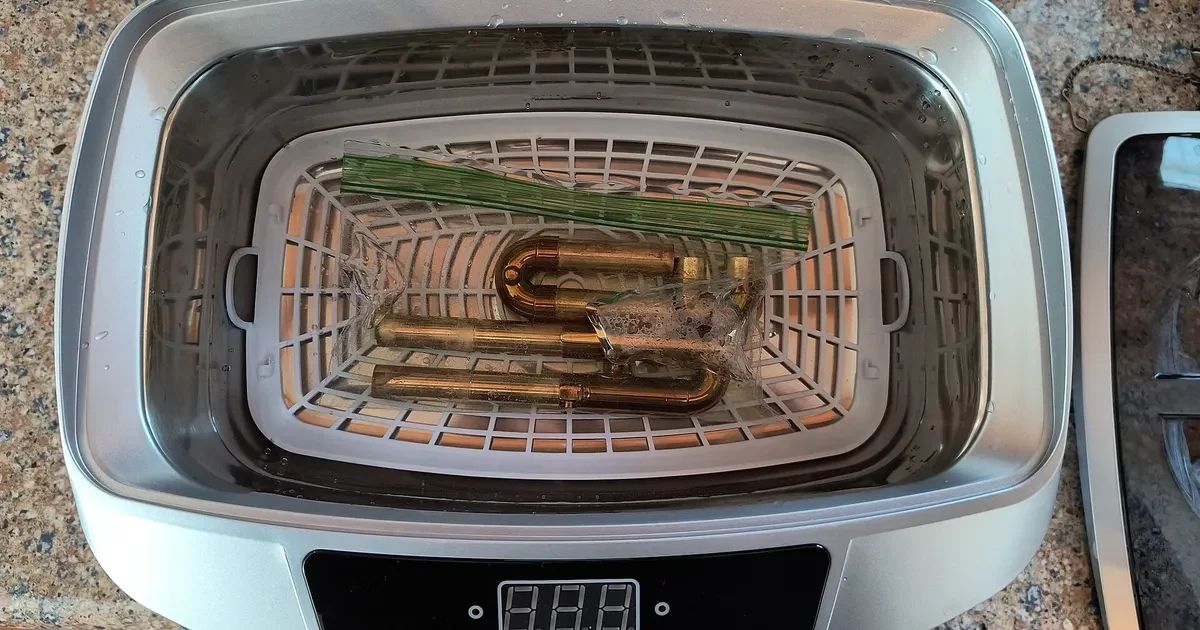
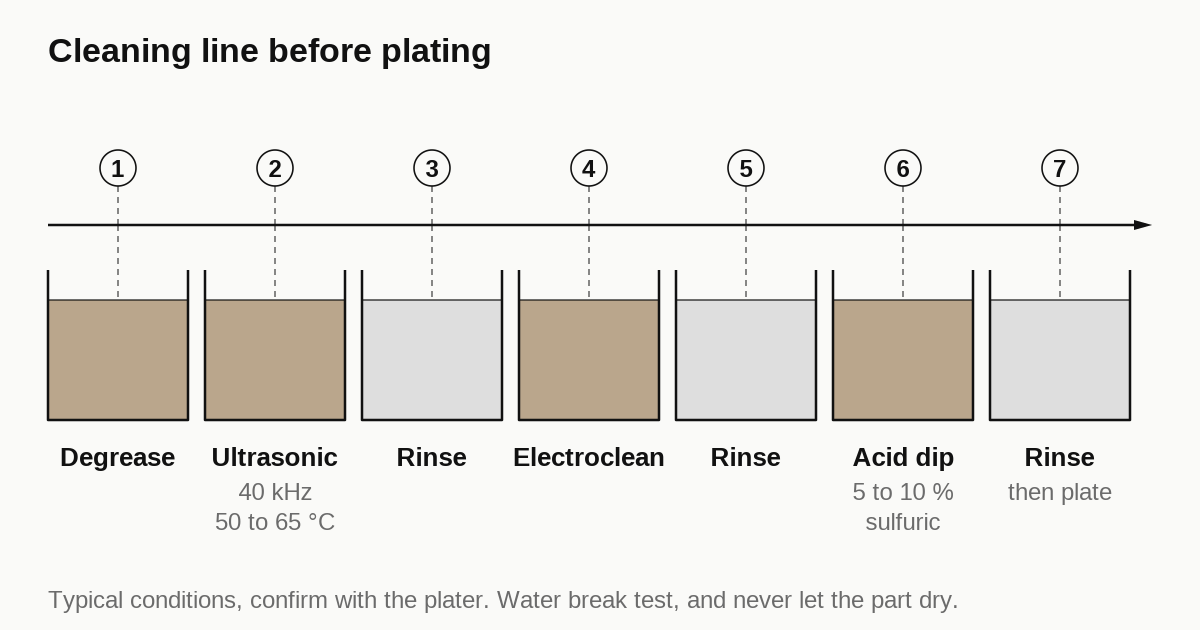
Brass parts are cleaned before plating in stages: remove oil and chips, soak in a warm alkaline cleaner with ultrasonics, rinse, electroclean, rinse, then a short acid dip to activate the metal. Each stage removes a different contaminant. A water break test shows whether the surface is clean enough to plate.
Plating failures on brass rarely start in the plating tank. They start in the cleaning line, because a coating can only bond to metal it can touch. A film of oil a few molecules thick, a smear of lead from machining or a trace of tarnish is enough to leave a blister or a flaking edge that shows up weeks later in the customer’s hands.
This post describes the cleaning sequence a good plating line runs on machined brass, what each stage removes and what a buyer can ask for on the drawing and the purchase order.
What is on a machined brass part
A part straight off the lathe carries several kinds of dirt, and no single cleaner removes them all.
Cutting oil or coolant. Mineral oil, straight cutting oil or a water-soluble emulsion coats the part and fills threads and blind holes.
Chips and fines. Small brass chips lodge in threads, cross holes and behind knurls. Brass fines also embed in the surface.
Smeared lead. On leaded grades such as C360 free-cutting brass and C385 architectural bronze, the tool leaves a lead-rich smear on the surface. It blocks plating adhesion, and it is the reason plating lines treat leaded brass differently.
Polishing and buffing compound. Parts that were polished carry a wax and abrasive residue.
Oxide and tarnish. Brass dulls in air. A thin oxide or sulfide film forms within hours in a humid shop.
Handling soils. Fingerprints carry salt and oils that will etch a mark into a bright surface.
The sequence
A typical line for brass, in order:
| Stage | What it removes | Typical conditions |
|---|---|---|
| Solvent or aqueous degrease | Bulk oil, coolant, chips | Warm aqueous cleaner or vapor degrease, 2 to 10 minutes |
| Ultrasonic alkaline soak | Fine oil, buffing compound, fines in holes | 40 kHz, 50 to 65 C, 3 to 10 minutes |
| Rinse | Cleaner carry-over | Clean running water, 1 minute |
| Electroclean | Last film of soil, light oxide | Anodic or cathodic, a few minutes |
| Rinse | Cleaner carry-over | Clean running water |
| Acid dip | Oxide, tarnish, lead smear | Dilute sulfuric acid, about 5 to 10 percent, 10 to 30 seconds |
| Rinse | Acid carry-over | Clean running water, then straight into the plating bath |
Typical conditions as published for brass cleaning. The plater’s own process sheet and bath supplier data take precedence.
Each stage is short. What matters is that none is skipped and that the part never dries between the last rinse and the bath, because a dry surface oxidizes in seconds.
Why ultrasonics help
In an ultrasonic bath, sound waves create tiny bubbles that collapse against the part surface. The collapse scrubs oil and fines off areas a spray cannot reach: inside threads, blind holes, cross holes and behind knurls. Ultrasonic cleaning is the standard way to clear fine soil from complex shapes.
For brass, 40 kHz is the common frequency. Lower frequencies, around 25 kHz, scrub harder and suit heavy soil but can pit soft metals. Higher ones, 60 kHz and above, are gentler and reach finer detail. Time and temperature matter. A few minutes in a warm alkaline solution cleans well, and a very long soak can erode a polished surface or edges. Parts should not touch each other in the basket, as that leaves contact marks.
Chemistry for brass
Brass reacts to strong chemicals, so a cleaner that suits steel can harm it. Two points stand out.
Alkalinity. Strongly caustic cleaners can stain brass and attack zinc. A brass-safe cleaner is moderately alkaline and has inhibitors. Most platers hold a separate line for copper alloys.
Acid strength and time. A dilute sulfuric dip removes oxide and brightens the surface. A strong or long dip removes zinc faster than copper and leaves a pink, copper-rich surface layer, a mild form of dezincification. See dezincification-resistant brass for the same mechanism acting on a whole wall. Dips for leaded brass often use a mix designed to dissolve the lead smear, and the same idea drives a lead leaching treatment.
Blind holes and the bleed-out problem
The worst stain on a plated brass part is bleed-out. Fluid trapped in a blind hole, a thread or an overlap seeps out after plating and leaves a brown streak. The fix is a combination of design and process: avoid pockets that hold liquid when a through hole will do, add a vent hole where a blind bore must be deep, and rinse long enough for the liquid to exchange. Ultrasonic rinsing helps. See brass deburring of cross holes for related geometry.
Need a quote for this part? Get a quote for your brass parts
Checking the surface
The usual check is the water break test, described in ASTM F22. After the final rinse, a clean surface holds an unbroken sheet of water for about 30 seconds. If the water beads or retreats, a film is left and the part goes back to the start. The test is quick enough to run on a sample part at the start of every batch.
Other checks come after plating: a bend test, a tape test or a heat test, each described in the plating standard named on the drawing. A heat test is worth knowing. Plated parts held at an elevated temperature for a set time blister if adhesion is poor. See brass surface finishes and plating for the finishes and their callouts.
What the machine shop can do
The cleaning line is the plater’s job, but the machine shop controls what arrives. Three habits help. Use a cutting fluid the plater approves, since some synthetic fluids leave films that are hard to shift. Wash parts after machining and before storage, so oil does not bake in. Pack parts so that they do not rub, and do not touch them bare-handed before plating. Tumbling brass parts also removes many fines before the plating line, at the cost of surface change.
Racking and contact marks
Parts are plated on racks or in barrels, and the cleaning line feeds both. Rack plating suits parts that must not touch, such as polished knobs and sealing faces. The rack contact leaves a small bare spot, so the drawing should say where that spot may sit. Barrel plating suits small parts like inserts and ferrules in bulk, but parts tumble against each other and nick edges, and a thread can fill with a nest of other parts. Name the method if the surface matters, and say which faces must stay unmarked.
When a part fails and needs stripping
A lot that fails adhesion can be stripped and replated, but stripping attacks brass. Chemical strippers for nickel can dissolve zinc from the base and leave a rough surface, and a replated part may show the damage. Many drawings allow one replating cycle at most. If a part is a critical sealing component, ask the shop to scrap and remake it, not to strip it. A short note on the purchase order about rework limits avoids an argument later.
What to write on the drawing
Plating: nickel 8 to 12 microns on all surfaces except threads (masked).
Clean per plater's brass process before plating. Water break free surface before plating.
Adhesion: tape or bend test per plating standard on a sample from each lot.
No fingerprints, oil or chips on parts supplied to the plater.
Checklist
- Plating, thickness and masked areas written on the drawing.
- Water break test or equivalent asked for before plating.
- Adhesion test and sample size stated.
- Blind holes and pockets reviewed for bleed-out risk.
- Cutting fluid agreed with the plater.
- Parts packed so the surfaces do not rub before plating.
Want a plated brass part quoted? Send the drawing with the finish marked. We quote the finished parts within 24 business hours and place the work with one of the partner shops that turn brass.
Frequently asked questions
Why does plating peel from machined brass?
Almost always because the surface was not clean at the moment it entered the bath. A film of cutting oil, a fingerprint, a smear of lead from machining or a layer of tarnish stops the first atoms of plating from bonding. The blister or flake that results can look like a plating fault, but the cause is upstream.
Is ultrasonic cleaning safe for brass?
Yes, for normal cycle times. Brass is soft, so a very long ultrasonic soak can pit the surface, and thin or polished parts are more at risk. Typical cycles run a few minutes at 40 kHz in a warm alkaline cleaner. A shop should watch time and temperature and keep parts from touching in the basket.
What is a water break test?
A clean metal surface holds a continuous sheet of water. If the water pulls into beads or breaks apart in a few seconds, oil or another film is still present. ASTM F22 describes the test. Shops use it as a quick check on a sample part between the final rinse and the plating bath.
Alloys in this guide
| Alloy | Lead % | Mach. | DZR |
|---|---|---|---|
| C360 free-cutting brassC36000 · CuZn36Pb3 / CW603N | 2.5 to 3.7 | 100 | Poor |
| C385 architectural bronzeC38500 · CuZn39Pb3 / CW614N | 2.5 to 3.5 | 90 | Poor |
Published typical values for the alloy. Machinability against C360 at 100. Not a promise from a shop.
Sources
- Wikipedia, Electroplating en.wikipedia.org
- Wikipedia, Ultrasonic cleaning en.wikipedia.org
Need a quote for this part?
Send the drawing. We read it, send one itemised quote for the finished parts within 24 business hours and place the work with a partner shop that turns brass. Brass only.
Get a quote for your brass parts