Guides / Process
Machined Brass Pneumatic Fittings: Push-In Bodies, Threads, Seals and Plating
Published November 21, 2026. Reviewed for the facts in the corrections log.
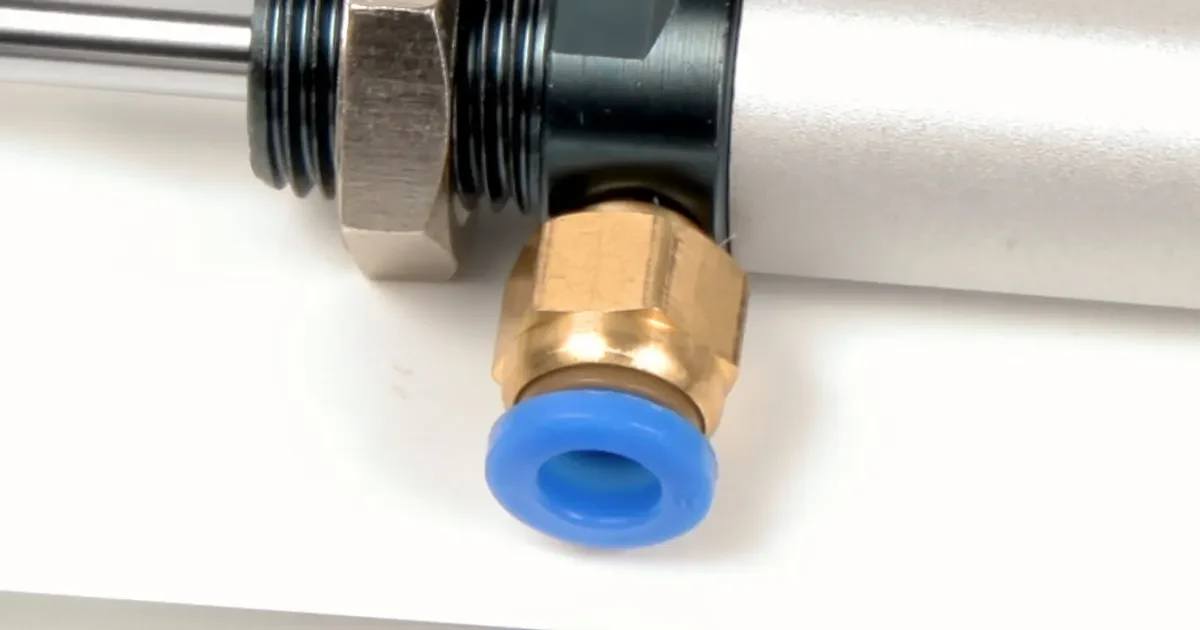
Brass pneumatic fittings are push-in connectors, threaded adapters and quick couplings for compressed air, usually turned from leaded brass and nickel plated. The thread type decides how the joint seals: G parallel threads seal with a washer or O-ring, R and NPT tapered threads seal on the thread. Burr-free bores protect the tube and the seals.
Walk along any packaging line, robot cell or machine tool and you will see compressed air running through plastic tube into small metal fittings. Most of those fittings are nickel plated brass. They screw into valves, cylinders and manifolds on one end and grip a tube on the other.
A pneumatic fitting looks simple, but it seals air at working pressure through thousands of cycles and tube movements. The thread, the seal, the bore and the plating all have to be right. This post covers the parts, the threads, sealing, plating, the features a shop must hold and how the parts are tested.
The parts
Pneumatics uses a handful of fitting families, and brass appears in most of them.
| Part | Typical grade and route | Critical feature | Typical check |
|---|---|---|---|
| Push-in fitting body | C360 or CW614N turned, nickel plated | Tube bore, O-ring seat, thread | Pin gauge, thread gauge |
| Collet | Brass or plastic with stainless steel teeth | Grip on tube, release travel | Pull test on assembly |
| Release sleeve | Brass or plastic | Slide fit in body | Visual, function |
| Male adapter, nipple, reducer | C360 or CW614N turned, nickel plated | Thread, sealing face | Thread gauge |
| Banjo and swivel elbow | CW617N forged or C360 turned | Cross holes, sealing faces | Visual, leak test |
| Quick coupling body and plug | C360 or CW617N, nickel plated | Plug profile, valve seat | Profile gauge, leak test |
| Silencer body | C360 turned | Thread, seat for element | Thread gauge |
Typical practice. The fitting maker’s drawing and the product standard take precedence.
Most bodies are turned from C360 free-cutting brass or CW614N on bar-fed lathes and multi-spindle machines, because volumes are high and the parts are small. Elbows and tees with thick sections are often hot stamped from CW617N and machined.
How a push-in fitting works
A push-in fitting holds a plastic tube, usually polyamide or polyurethane, with no tools. The tube passes through a release sleeve and a collet, then through an O-ring, and stops against a shoulder in the body. The collet carries small stainless steel teeth that bite into the tube when it is pulled. Pushing the release sleeve opens the collet and frees the tube.
The brass body is the part a shop machines. It carries the tube bore, the O-ring seat, the bore for the collet, the shoulder the tube stops against and the thread or second tube end. The collet and sleeve may be brass or plastic, and the teeth are stainless steel. This site quotes the brass parts only. The fitting maker assembles the collet and seals.
Push-in connectors for thermoplastic tube are covered by ISO 14743. The ports and stud ends they screw into are covered by ISO 16030. Check the editions and the clauses that apply to your part.
Threads: G, R and NPT
The thread on the stud end decides how the fitting seals.
| Thread | Standard | Form | How it seals |
|---|---|---|---|
| G (BSPP) | ISO 228-1 | Parallel, 55 degree | Face seal: bonded washer, O-ring or sealing edge |
| R (BSPT) | ISO 7-1 | Tapered male, 55 degree | On the thread, with sealant |
| NPT | ASME B1.20.1 | Tapered, 60 degree | On the thread, with sealant |
| Metric M5, M3 | ISO 261 family | Parallel | Face seal with a small O-ring or washer |
Typical practice. The port drawing and the thread standard take precedence.
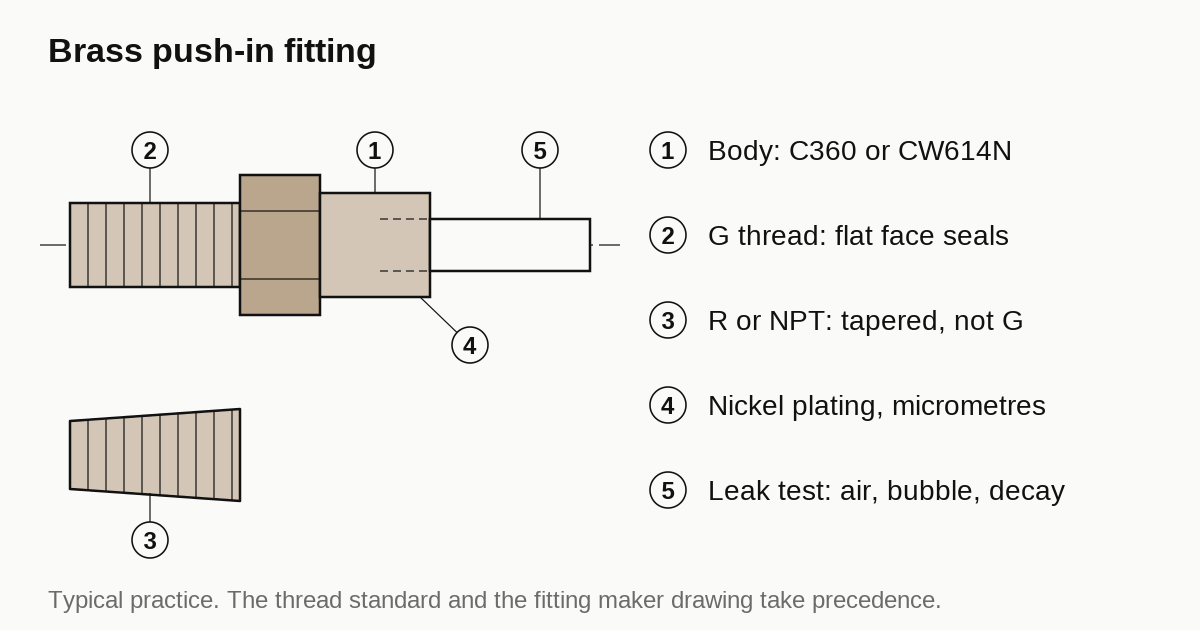
A G thread does not seal on the thread itself. The fitting carries a captive O-ring, a bonded seal or a machined sealing edge that presses on the port face. The face under the hex must be flat and square to the thread. R and NPT threads seal on the taper and need a sealant. Many fittings ship with a thread sealant precoat already on the male thread, which the fitting maker applies after machining. The British and American families are not interchangeable: the thread angle and, in most sizes, the pitch differ. The background is in British Standard Pipe threads, in NPT vs BSP brass fittings and in the brass thread chart.
Sealing options
Bonded seal. A steel or brass washer with a rubber ring bonded to its bore. It sits under the hex on a G thread. The hex face needs a fine finish and no burr at the thread run-out.
Captive O-ring. A groove under the hex holds an O-ring that seals on the port face. Groove size and finish follow the O-ring maker’s table. See O-ring grooves in brass.
Sealing edge. A small machined lip under the hex bites into the port face. It needs a sharp, unbroken edge and suits harder port materials.
Thread precoat. A dry sealant ring on an R or NPT thread. The drawing says where the coat starts and stops, so it does not foul the first thread or the bore.
Internal O-ring. The tube seal inside a push-in body. Its seat sets the squeeze on the tube, so the bore diameter and the seat depth matter as much as the O-ring itself.
Quick couplings
A quick coupling is a socket with a spring-loaded valve and a plug that clicks into it. The socket body, the sleeve and the plug are often brass, nickel plated. Several plug profiles exist, and they do not mix. A plug cut to one profile will not lock or seal in a socket made for another. ISO 6150 covers pneumatic quick-action couplings and their plug dimensions, and other profiles are set by industry practice. The drawing should name the profile, not just the size.
The machined features that matter are the plug nose and groove, which the locking balls grip, and the valve seat inside the socket. A burr on the plug nose cuts the socket seal, and a scratch on the valve seat leaks when the coupling is open.
Need a quote for this part? Get a quote for your brass parts
Why brass, and when not
Brass holds a fine thread, survives being tightened many times and tolerates heat, weld spatter and sunlight better than plastic. It turns fast, so cost per part stays low.
Plastic bodies, often in an engineering polymer, are lighter and cheaper for clean, cool, low-load lines. Stainless steel bodies are used in food plants, washdown areas and corrosive atmospheres. Both are common in pneumatic catalogues. This site quotes brass only, so it does not quote plastic or stainless fittings. If your application needs one of those, ask a supplier of that material.
A note on silencers. The common porous silencer element is sintered bronze, which is not brass. Some silencers combine a turned brass body with a separate element. The brass body can be quoted here. The sintered element cannot.
Plating callouts
Pneumatic fittings are usually nickel plated. Bare brass tarnishes, and loose tarnish can travel into valve spools. Nickel gives a hard, bright surface that resists corrosion and wear on the release sleeve and the hex.
A plating callout should name:
- The type: electroplated nickel or electroless nickel. ASTM B689 covers electrodeposited engineering nickel and ASTM B733 covers electroless nickel.
- The thickness range, commonly a few micrometres.
- Whether thread and bore dimensions apply before or after plating.
- Areas that must stay bare or masked, if any.
Plating builds up on edges and in threads, so a tight bore or a gauge-fit thread needs the allowance written down. See brass surface finishes and plating.
Burr-free bores and edges
A burr inside a push-in body is a leak waiting to happen. The tube slides past the O-ring and a sharp edge scores the tube or nicks the O-ring. The result is a slow leak that appears weeks later.
What the drawing should ask for:
- A lead-in chamfer at the tube entry, with a smooth blend into the bore.
- No burr at the O-ring seat or at any step the tube passes.
- Burr-free cross holes in banjos, swivels and manifold blocks. See deburring cross holes.
- Bore tolerance and finish stated, since tube outside diameter and O-ring squeeze depend on it.
- Parts washed and free of chips, since a chip in a valve seat holds it open.
Testing with air
Pneumatic fittings are tested with air, which is the medium they carry. Common methods are a bubble test under water at a stated pressure and a pressure decay test on an automated station. Push-in fittings are also pull tested on the assembled tube, and rotated or vibrated where the product standard asks for it. Most industrial pneumatic circuits run well under 10 bar, and catalogue ratings for fittings are often higher. The fitting maker sets the rating and the test pressure, and the drawing should state them. A machine shop supplies parts to the drawing and does not certify the finished fitting.
Lead and compliance
Pneumatic bodies are usually leaded free-cutting brass. Machines that contain electrical equipment may fall under EU RoHS, and lead in copper alloys sits under exemption 6(c), which has an expiry of 30 June 2027. See RoHS exemption 6(c) and leaded brass. Some buyers already specify lead-free, such as C69300 silicon brass. This is not legal advice.
What to write on the drawing
Material: CW614N (CuZn39Pb3) or C360, lead-free alternative where required.
Plating: electroless nickel per ASTM B733, 3 to 8 micrometres. Dimensions after plating.
Stud thread G1/4 per ISO 228-1, class A. Sealing face flat within 0.02, Ra 0.8.
Tube bore 8.00 +0.05/-0, lead-in chamfer 15 degrees, no burrs at any step.
Clean and free of chips. Leak test with air per fitting maker's spec.
Checklist
- Fitting family named: push-in, adapter, banjo, coupling or silencer body.
- Stud thread and standard named, with the sealing method.
- Plating type, thickness, standard and before or after plating stated.
- Tube size, bore tolerance, chamfer and burr limits given.
- Brass parts separated from collets, teeth and seals in the quote.
- Working pressure, test pressure and leak method stated.
- Lead requirement and RoHS position stated.
Need machined brass pneumatic fitting bodies? Send the drawing with the thread and plating callout. We quote the finished parts within 24 business hours and place the work with one of the partner shops that turn brass.
Frequently asked questions
Why are brass pneumatic fittings nickel plated?
Bare brass tarnishes and marks, and the tarnish can flake into valves. A nickel layer of a few micrometres gives a hard, clean surface that resists corrosion and wear on the thread and the release sleeve. State the plating type, thickness and standard on the drawing, and say whether thread dimensions apply after plating.
Can a G thread fitting screw into an R or NPT port?
Sometimes it will start, but it will not seal properly. G threads to ISO 228-1 are parallel and seal with a washer, bonded seal or O-ring on a face. R threads to ISO 7-1 and NPT threads are tapered and seal on the thread with sealant. NPT also has a different thread angle and pitch in most sizes. Match the fitting to the port.
Are silencers on pneumatic valves made of brass?
The common porous silencer element is sintered bronze, which is not brass. Some silencers have a brass threaded body with a separate porous element. This site quotes brass only, so it can quote a machined brass silencer body but not a sintered bronze element.
Alloys in this guide
| Alloy | Lead % | Mach. | DZR |
|---|---|---|---|
| C360 free-cutting brassC36000 · CuZn36Pb3 / CW603N | 2.5 to 3.7 | 100 | Poor |
| C385 architectural bronzeC38500 · CuZn39Pb3 / CW614N | 2.5 to 3.5 | 90 | Poor |
| CW617N CuZn40Pb2C37700 (nearest) · CuZn40Pb2 / CW617N | 1.6 to 2.5 | 80 | Poor |
| C69300 silicon brassC69300 · CuZn21Si3P / CW724R | under 0.09 | 80 | High |
Published typical values for the alloy. Machinability against C360 at 100. Not a promise from a shop.
Sources
- Wikipedia, Pneumatics en.wikipedia.org
- Wikipedia, British Standard Pipe en.wikipedia.org
Need a quote for this part?
Send the drawing. We read it, send one itemised quote for the finished parts within 24 business hours and place the work with a partner shop that turns brass. Brass only.
Get a quote for your brass parts