Guides / Process
When a Brass Part Belongs on a Multi-Spindle Screw Machine
Published November 21, 2026. Reviewed for the facts in the corrections log.
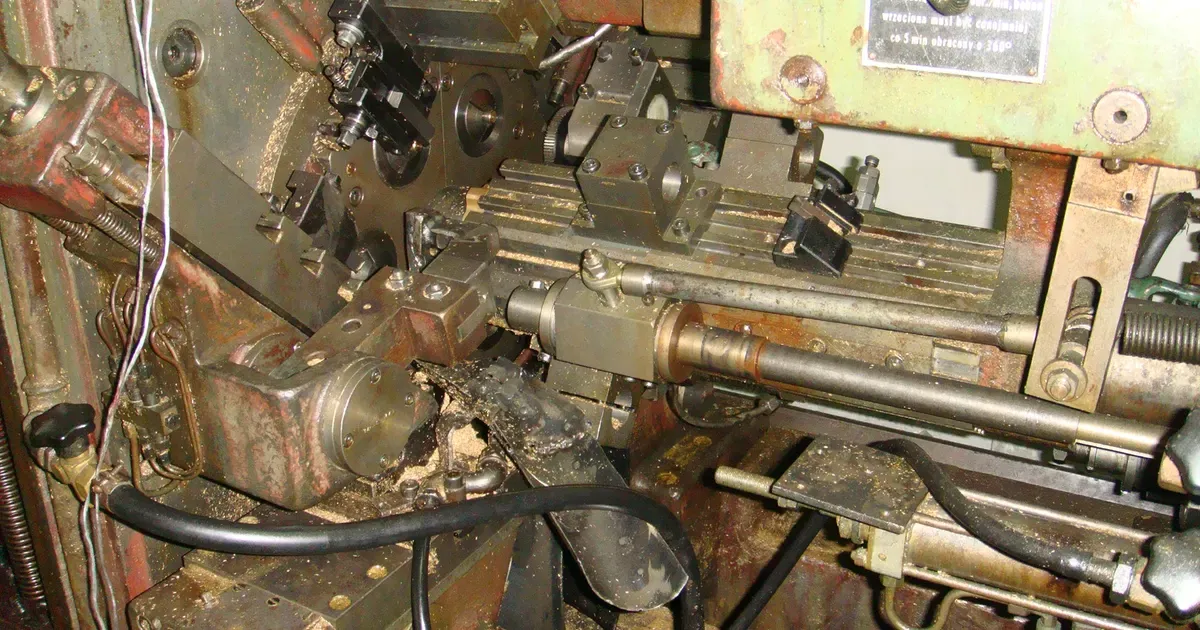
A multi-spindle screw machine cuts every operation of a brass part at the same time, one per spindle, so the cycle time equals the slowest station. It pays when lots run into tens of thousands and the part is round, bar fed and simple. Below that, setup time eats the saving.
Walk into a shop that makes brass plumbing fittings by the million and you will not see a row of CNC lathes. You will see a drum lathe with six spindles, bar stock feeding through the back and a finished part dropping into a bin every few seconds. That machine is the multi-spindle automatic screw machine, and it is still the cheapest way to make a simple brass part in large numbers.
The catch is that it only wins under certain conditions. This post sets out what the machine does, where it stops paying and how to tell on your own drawing.
How the machine works
A multi-spindle automatic holds several bars at once in a drum. Each bar sits in its own spindle, and the drum turns by one position, called an index, after every cut cycle. At each station a different tool works on the bar: one drills, one turns the outside diameter, one forms, one threads, the last cuts the finished part off. After six indexes every bar has passed through every station.
Because all the stations cut at the same time, one finished part leaves the machine at every index. The cycle time of the whole part is the time of the slowest station plus the index time. A part that would take 40 seconds on a single-spindle lathe, where the same tool post does everything in turn, can come off a six-spindle machine in 6 to 10 seconds.
Two kinds of machine exist. The older cam-driven type, from makers such as National Acme and Davenport, runs on cams that a setter cuts or files to the part. The newer CNC type, from builders such as Tornos, Index and Schütte, uses servo axes on each spindle or on each tool slide. The Wikipedia article on screw machines gives the history.
Why brass suits it so well
Free-cutting brass breaks into short chips, cuts with low force and leaves a good finish straight off the tool. C360 free-cutting brass is rated 100 for machinability, the reference every other alloy is compared with. That means a drum machine can feed brass at rates that would break tools on steel, and the chips clear without tangling. A tangled chip in a six-spindle drum stops all six stations, so chip behaviour matters more here than on a single-spindle machine. See brass speeds and feeds for how feed controls chip length.
C385 architectural bronze, a leaded brass rated 90, works in the same way and is common in hardware. Lead-free grades cut slower and form longer chips, so a drum machine running them needs a lower feed and often a chip breaker on the tool.
The setup cost
Setup is where the economics turn. A cam-driven machine needs a cam for each slide, a set of tools for each station, collets and feed fingers for the bar size, and a setter who may spend a day or two bringing the first good part. A CNC multi-spindle machine saves the cams and cuts the time to perhaps one shift, but the tool holders still need to be built up and the spindles aligned.
That time is paid back only if the lot is large. A single-spindle CNC lathe or a swiss machine may be ready in two or three hours and spend 25 to 40 seconds on each part. The drum machine takes much longer to prepare and then runs far faster.
A worked example
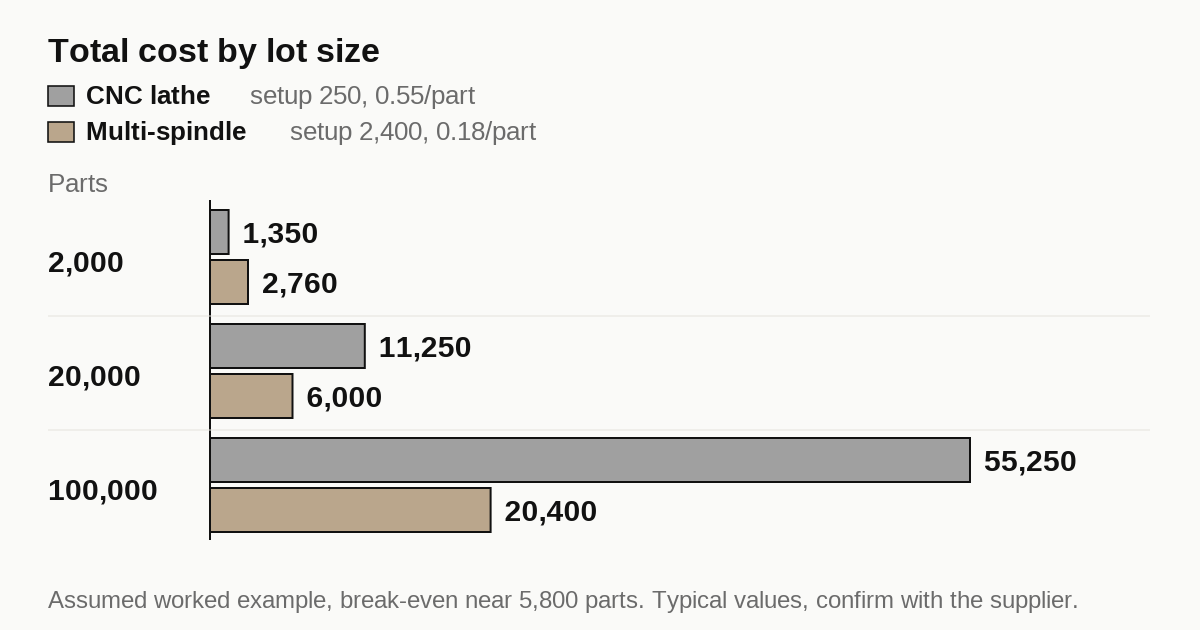
The figures below are assumed, not quoted, to show how the arithmetic works. Take a simple brass fitting body turned from 20 mm hex bar.
| Item | CNC lathe | Multi-spindle |
|---|---|---|
| Setup cost | 250 | 2,400 |
| Cycle time | 30 seconds | 6 seconds |
| Run cost per part | 0.55 | 0.18 |
| Cost for 2,000 parts | 1,350 | 2,760 |
| Cost for 20,000 parts | 11,250 | 6,000 |
The break-even point here is about 5,800 parts, which is the setup difference of 2,150 divided by the 0.37 saved on each part. Below it the CNC lathe is cheaper. Above it the drum machine pulls away, and at 100,000 parts the gap is over 30,000. The numbers will differ between shops, but the shape of the curve does not.
Need a quote for this part? Get a quote for your brass parts
Which parts qualify
Four traits make a part a good fit.
Round or hex, bar fed. The machine works from bar through the spindle. Square, flat or irregular parts need milling that the drum cannot do.
Operations that split across stations. A fitting with a bore, an external form, a thread and a groove spreads naturally over six stations. A part that needs one long cut cannot be shared, and that cut sets the cycle for the whole drum.
Simple cross features. Cross drilling and slotting are possible on attachments, and shops add them to common parts. A part that needs five cross holes at awkward angles is a poor fit.
Moderate tolerances. Typical turned tolerances on a drum machine are in the range of 0.05 mm on diameters and a little looser on length from the cut-off. Each spindle has its own offset, so the parts from spindle one and spindle four are not identical. A shop checks all six.
| Part trait | Good for drum lathe | Better elsewhere |
|---|---|---|
| Lot size | Over several thousand | Under a few hundred |
| Shape | Round, hex, bar fed | Flat, prismatic, forged blanks |
| Repeat orders | Same part every year | One-off or changing revisions |
| Tolerance | General turned limits | Tight limits on several features |
| Diameter | Common bar sizes | Very small or very large |
Published typical values for the process. Real capability is set by the machine and the setter, and a shop’s own data takes precedence.
Changeover and the repeat order
A drum machine rewards the part that comes back. Once a cam set or a CNC program and its tooling are proven, the next run needs only a reset, and the shop keeps the tooling on a shelf for the next order. That makes repeat orders cheaper than the first, and it is a fair question to ask a quoting shop: is the setup cost one time, or charged again with every run?
A part that changes revision often is a bad candidate. Each change may mean a new cam or a re-cut form tool. A fitting that has not changed in ten years is the ideal.
How to ask for a quote
You do not need to tell a shop which machine to use. Say what the part is and how many you need, then let the shop choose the route. What helps is to give the annual volume and the lot size separately. A buyer who needs 120,000 a year in 10,000 lots gets a different price than one who needs 120,000 in a single order, because the shop can tie up bar stock and tooling differently.
Also say whether secondary operations are allowed. Deburring, plating, pressure testing and a second-operation thread may sit outside the drum, and the quote should show them as separate lines. Brass parts cost drivers explains how those lines add up, and prototype runs and minimum order quantity covers what happens when a part is not ready for volume.
Chips and scrap
Drum machines make a lot of chip. A six-spindle machine on free-cutting brass fills a bin quickly, and chip value is a real part of the shop’s economics. Clean, segregated chips of leaded brass sell better than mixed ones. Brass chips and scrap value covers this for shops.
Checklist before you ask for a drum machine quote
- Annual volume and lot size, written separately.
- Bar size and shape, round or hex, and the grade, for example C360.
- Number of features, and which ones carry tight tolerances.
- Secondary operations: deburr, plating, testing, packing.
- Whether the part will stay unchanged for several years.
- Samples or first-article rules, since the first part costs the most.
If most answers point to high volume and a simple turned part, a multi-spindle shop will quote lowest. If not, a CNC lathe or swiss shop will. When you are ready, send the drawing. We quote the finished parts within 24 business hours and place the work with one of the partner shops that turn brass.
Frequently asked questions
How many spindles does a brass screw machine have?
Most multi-spindle automatics carry 4, 5, 6 or 8 spindles in a rotating drum. Six is the common size for brass fittings. The spindle count sets how many operations run at once, and the machine finishes one part at every index of the drum.
Can a multi-spindle machine hold tight tolerances on brass?
It holds consistent tolerances once it is set, but each spindle has its own small offset, so a shop checks parts from every spindle. Typical turned tolerances are looser than a swiss or CNC lathe can hold. Features with tight limits are often finished on a second operation.
What is the minimum lot size for a drum lathe?
There is no fixed number, because it depends on part cost and the setup of the machine. Shops usually look at lots above several thousand pieces, and the cam-driven machines make most sense when the same part comes back every year.
Alloys in this guide
| Alloy | Lead % | Mach. | DZR |
|---|---|---|---|
| C360 free-cutting brassC36000 · CuZn36Pb3 / CW603N | 2.5 to 3.7 | 100 | Poor |
| C385 architectural bronzeC38500 · CuZn39Pb3 / CW614N | 2.5 to 3.5 | 90 | Poor |
Published typical values for the alloy. Machinability against C360 at 100. Not a promise from a shop.
Sources
- Wikipedia, Screw machine en.wikipedia.org
- Copper Development Association, Copper alloy machining copper.org
Need a quote for this part?
Send the drawing. We read it, send one itemised quote for the finished parts within 24 business hours and place the work with a partner shop that turns brass. Brass only.
Get a quote for your brass parts