Guides / Compliance
Machined Brass Parts for Fire Sprinklers, Hose Valves and Couplings
Published November 21, 2026. Reviewed for the facts in the corrections log.
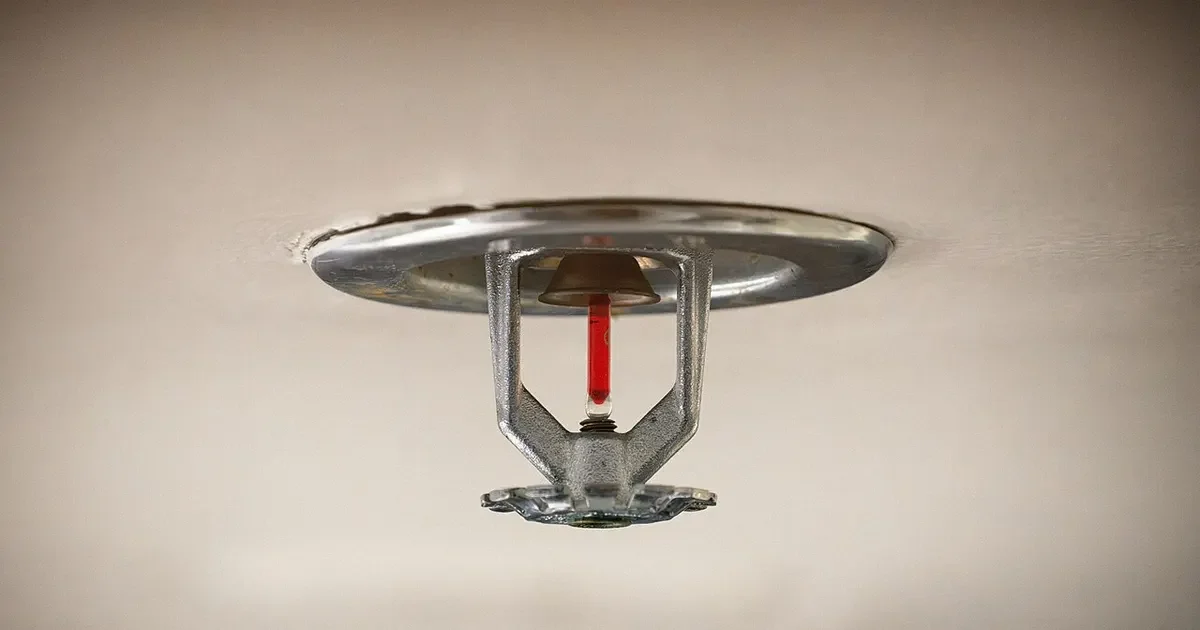
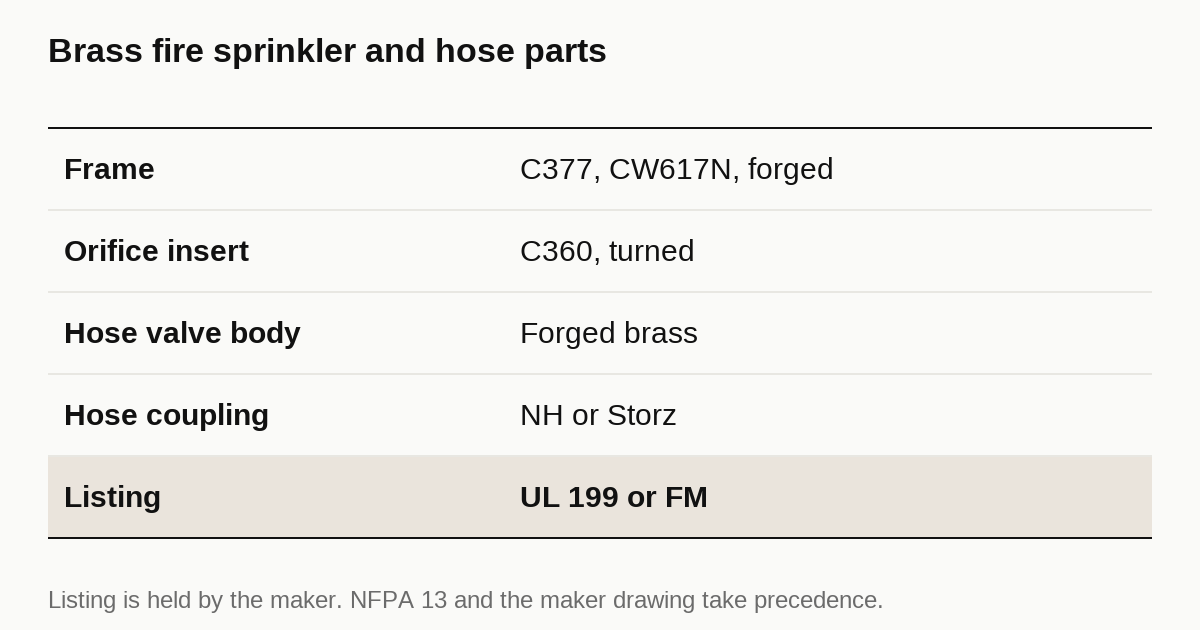
Brass is common in sprinkler frames, orifice inserts, hose valves and couplings because it forges, machines and resists corrosion. The UL 199 listing or FM approval belongs to the finished product and its maker, never to the shop that turns the parts. Specify stress relief where ammonia is present, name the thread standard and state the pressure test.
Fire protection uses a lot of brass. The frame of a sprinkler, the orifice it sprays through, the hose valve on a standpipe and the coupling on the end of a hose are often brass. It forges well, machines to a clean thread and resists corrosion in water that sits still for years.
Fire protection products are also among the most tightly listed products in a building. A sprinkler or a hose valve is approved as a complete product, made by a named maker to a controlled design. The shop that turns a part works to that maker’s drawing. This post covers the parts, the standards, the cracking risk, the threads and the tests, and draws a clear line between the listing and the part.
The parts
A fire sprinkler has a frame with a threaded inlet and an orifice, two arms that hold a deflector, a heat element such as a glass bulb or a fusible link, and a seal that holds the water back. When the element breaks, the seal drops and water hits the deflector.
| Part | Typical brass route | Critical feature | Typical check |
|---|---|---|---|
| Sprinkler frame | Cast or hot forged, then machined | Inlet thread, orifice bore, arm alignment | Thread gauge, bore gauge, pressure test by the maker |
| Orifice insert | Turned from C360 | Bore size and edge, concentricity | Pin gauge, visual |
| Deflector | Usually stamped from sheet | Form and position | Fixture |
| Load screw | Turned from C360 | Thread, tip form | Gauge |
| Hose valve or landing valve body | Forged or cast, then machined | Seat, threads, wall | Pressure test |
| Valve stem and bonnet | Turned | Thread, seal groove | Gauge |
| Hose coupling and nozzle | Forged or turned | Hose thread or Storz lugs, bore | Thread gauge, fit check |
| Hydrant trim parts | Turned or cast | Thread, seat | Gauge |
Typical practice. The product maker’s drawing and the listing take precedence.
Frames are cast or hot stamped from forging brass such as C377 or CW617N, then machined on the inlet thread and the orifice. Turned parts use C360 free-cutting brass. The choice between a forging and a part turned from bar is covered in brass hot forging vs machining.
Some fire products use other metals. Hydrant bodies are usually iron. Many hose couplings are hard anodised aluminium. Some valve bodies and seat rings are cast bronze. If the drawing calls for bronze, iron, aluminium or stainless, this site does not quote it. Send the brass parts only.
Standards and listings
Three names come up on almost every fire protection drawing.
NFPA 13 is the US standard for the installation of sprinkler systems. It tells the system designer which sprinklers to use where, how to space them and how to test the system. It does not tell a shop how to make a frame.
UL 199 is the UL standard for automatic sprinklers for fire protection service. A sprinkler that carries a UL listing has been tested as a complete product, and UL follows up on the maker’s production.
FM Approvals runs a separate approval scheme for sprinklers and fire protection equipment, used widely by insurers.
Other products have their own standards. Standpipe and hose systems are covered by NFPA 14. Fire hose connections and their threads are covered by NFPA standards for fire hose connections, which have been reorganised in recent editions, so check the current one.
The important point for a buyer is who holds what. The listing or the approval belongs to the finished product and to the maker named on it. It covers the design, the materials, the production controls and the tests. A shop that machines a frame or an insert supplies a part to a drawing. It does not hold the listing, and it should never mark a part or a document as if it did. A maker that changes a part source usually has to tell its listing body. Keep that in the plan before you move a part. This is a general description, not legal or listing advice.
Stress corrosion cracking
Brass sprinklers have a known failure in the presence of ammonia. Ammonia comes from animal housing, from fertiliser stores and from leaks in ammonia refrigeration in cold stores and food plants. Brass that holds tensile stress and meets ammonia can crack. A sprinkler frame is always under stress, because the seal and the heat element load the arms. A cracked frame can leak or fail to work.
Three things reduce the risk:
- Stress relief. A low temperature anneal, typically 330 to 350 C, reduces residual stress from forging and machining without softening the part much. The drawing or the maker’s process states the time and the check.
- Coatings. Sprinkler makers offer corrosion resistant versions with wax, polymer or other coatings for these spaces. The coating is part of the listed product, applied by the maker.
- Avoid ammonia in testing. Some leak-test liquids and cleaners contain ammonia. Use non-ammoniated products on brass.
See brass stress corrosion cracking for the mechanism and the tests used to check residual stress on samples, such as the ISO 6957 ammonia vapour test and the ASTM B154 mercurous nitrate test. The choice of sprinkler type for a corrosive space is the system designer’s job under NFPA 13.
Need a quote for this part? Get a quote for your brass parts
Threads
Fire protection uses several thread families, and they do not mix.
Pipe threads on sprinkler inlets and valves. In the US, sprinkler inlets are tapered NPT, commonly 1/2 inch or 3/4 inch depending on the orifice size. Outside the US, ISO 7 tapered threads are common. See NPT vs BSP brass fittings.
Fire hose threads. In the US the common fire hose thread is NH, also called National Standard Thread or NST. Its form and pitch are not the same as NPT, so an NPT gauge does not check an NH thread. Some cities and older systems use local hose threads. The fire service or the system specification names the one required.
Storz couplings. A Storz coupling is symmetrical and has no thread. Two identical halves lock with lugs and a quarter turn. It is standard in much of Europe and is used on large diameter hose elsewhere. The lug form and the seal groove are the critical features.
Every thread on a fire part should be gauged with the right gauge. See thread gauging for brass fittings.
Pressure testing
Pressure tests run at two levels. The maker tests the product, as its listing requires, often on every unit for leak and on samples for strength. The installer tests the system: NFPA 13 sets a hydrostatic test for new systems, held for a set time at a set pressure. Check the current edition for the figures.
The machined part feeds into the maker’s test. A drawing for a frame, a valve body or a coupling can call for a hydrostatic or air test on each part or on a sample, with the pressure, the hold time and the pass limit. See leak and pressure testing brass valve bodies for the methods.
Traceability and first articles
Fire products are traced by lot, and the parts in them should be too. Expect a mill certificate for the bar or forging stock, a lot number carried through machining and an inspection record for each lot. If a batch of sprinklers fails in the field, the maker uses the lot number to find every frame from the same stock and the same run.
A new part source usually starts with a first article: a small batch measured in full against the drawing, with a sectioned sample where internal features matter. The maker may also run its own product tests on assemblies built from the new parts before it accepts them. Plan for that time in the schedule.
Plating and finish
Sprinklers come in natural brass, chrome plated, white painted and coated finishes. Hose valves and couplings are often natural or chrome plated brass. NFPA 13 does not allow sprinklers to be painted or coated in the field, so the finish is applied by the maker and forms part of the listed product.
For machined parts, plating adds thickness on threads and bores. The drawing must say whether a thread or an orifice dimension applies before or after plating, and which areas are masked. The orifice bore and the seal seat are usually controlled closely or left unplated. See brass surface finishes and plating.
What to write on the drawing
Material: CW617N (CuZn40Pb2), hot stamped, mill certificate EN 10204 3.1.
Inlet thread 1/2-14 NPT, gauged L1. Orifice bore per maker's table, edge burr-free.
Stress relieve 330 to 350 C after machining, method and check per maker's process.
No ammonia-based cleaners or leak test fluids. Hydrostatic test per maker's specification.
Checklist
- Product maker’s drawing and revision on the RFQ.
- Listing or approval held by the maker, not claimed by the part source.
- Grade named, forged or turned stated.
- Thread standard named for every thread: NPT, ISO 7, NH or other.
- Storz lug and seal features toleranced, if used.
- Stress relief and ammonia limits stated for frames and stressed parts.
- Pressure test, hold time and pass limit stated.
- Finish, masking and before or after plating stated.
Need machined brass fire sprinkler or hose parts? Send the drawing with the thread standard and test marked. We quote the finished parts within 24 business hours and place the work with one of the partner shops that turn brass.
See also: what UL Listed or FM Approved means for a brass fire protection part.
Frequently asked questions
Can a machine shop supply UL listed sprinkler parts?
A shop can supply brass frames, inserts and fittings made to the sprinkler maker's drawing. The UL 199 listing or FM approval covers the complete sprinkler and belongs to the maker, who controls the design, the materials and the production checks. Parts from a new source usually need the maker to update its listing file. The shop itself does not list or approve anything.
Why do brass sprinklers crack in barns and cold stores?
Ammonia from animal waste or from refrigeration leaks causes stress corrosion cracking in brass that holds residual stress. Sprinkler frames are loaded by the seal and the bulb or link, so the stress is always there. Corrosion resistant coated sprinklers and stress relieved parts are the usual answers. The system designer picks the sprinkler type for the space.
Do fire sprinkler parts need lead-free brass?
A fire sprinkler system that only carries fire water is generally outside drinking water lead rules, and US law exempts fire hydrants from the lead-free requirement. A residential system tied into the drinking water supply is a different case. Check the rule that applies with the system designer and state the requirement on the drawing.
Alloys in this guide
| Alloy | Lead % | Mach. | DZR |
|---|---|---|---|
| C377 forging brassC37700 · CuZn39Pb2 / CW612N | 1.5 to 2.5 | 80 | Poor |
| CW617N CuZn40Pb2C37700 (nearest) · CuZn40Pb2 / CW617N | 1.6 to 2.5 | 80 | Poor |
| C360 free-cutting brassC36000 · CuZn36Pb3 / CW603N | 2.5 to 3.7 | 100 | Poor |
Published typical values for the alloy. Machinability against C360 at 100. Not a promise from a shop.
Sources
- Wikipedia, Fire sprinkler en.wikipedia.org
- Wikipedia, Storz en.wikipedia.org
Need a quote for this part?
Send the drawing. We read it, send one itemised quote for the finished parts within 24 business hours and place the work with a partner shop that turns brass. Brass only.
Get a quote for your brass parts