Guides / Compliance
Machined Brass Water Meter Bodies and Parts: Lead Limits, Grades and Drawing Specs
Published November 21, 2026. Reviewed for the facts in the corrections log.
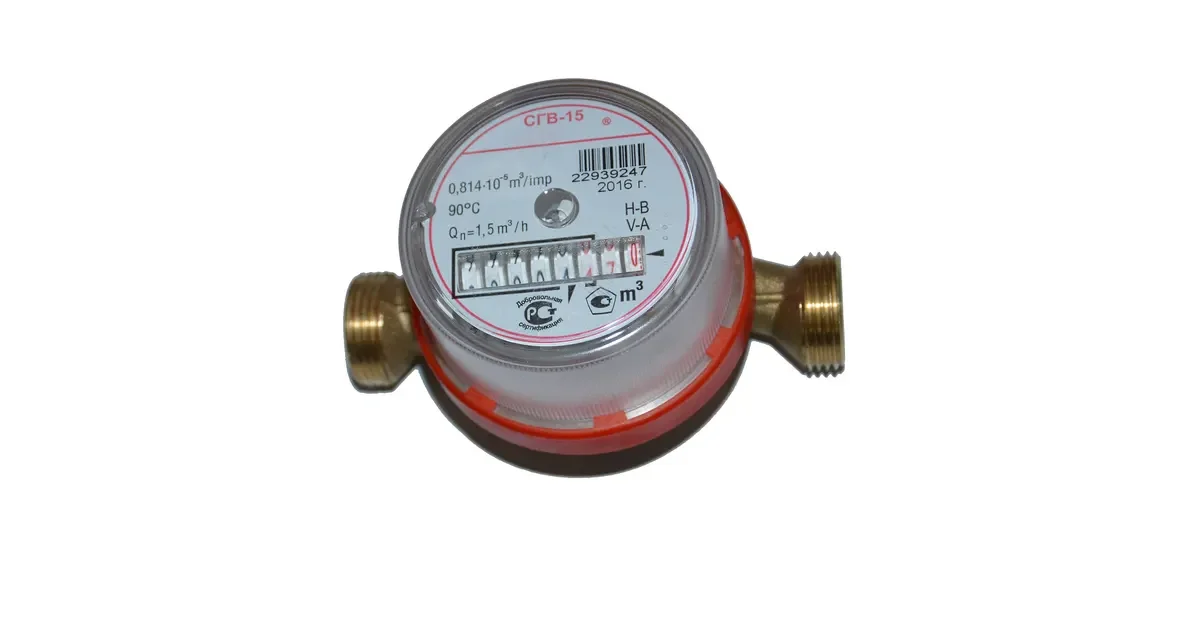
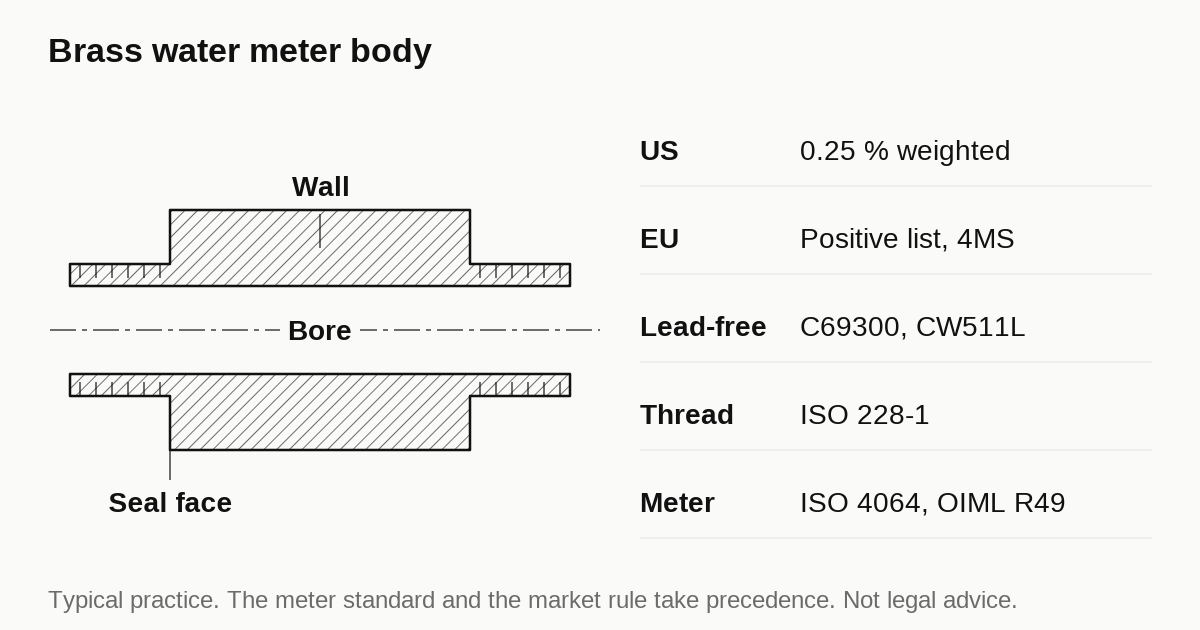
A brass water meter body is usually hot forged, then machined on its threads, sealing faces and bores. It is wetted by drinking water, so the grade must meet the market's lead rule: a 0.25 percent weighted average under NSF/ANSI 372 in the US, a positive list alloy in the EU. C69300, bismuth brass and CW511L are usual lead-free choices.
A water meter sits at the boundary between the utility and the customer. Its body carries mains pressure for decades, holds the measuring element in place and must not add lead to the water it measures. Most small meter bodies are brass, hot forged and then machined. Their couplings, nuts and register rings are often brass too.
That puts meter parts under two sets of rules at once. One set covers how the meter measures. The other covers what the wetted metal may contain. This post covers both, the grades that meet the lead rules, the machined features that decide sealing and what a drawing should say.
The parts
| Part | Typical make | Wetted | Critical feature |
|---|---|---|---|
| Meter body | Hot forged, then machined | Yes | Threads, sealing faces, bore for the measuring unit |
| Coupling nut | Turned or forged | No, but touches the gasket | Thread, face, seal wire hole |
| Tailpiece | Turned from bar | Yes | Thread, sealing face, bore |
| Register ring or cap | Turned or forged | Depends on design | Bayonet or thread, seal wire hole |
| Strainer seat and plugs | Turned from bar | Yes | Thread, face |
Typical practice. The meter design and the drawing take precedence.
The body is the largest wetted part and decides the lead calculation. Tailpieces and plugs are small, but they are wetted too and need the same lead-free grade.
Metrology standards
Water meters for drinking water are designed to ISO 4064 and to OIML R49, which carry the same technical content. They set the flow rates, the accuracy classes, the maximum admissible pressure, the type tests and the markings. In the EU, meters placed on the market for legal use fall under the Measuring Instruments Directive 2014/32/EU. In North America, utilities buy to the AWWA C700 series of meter standards.
These standards apply to the meter, and the meter maker holds the type approval. A machine shop makes parts to a drawing. It does not certify a meter, and nothing on a part drawing should suggest it does. The drawing should carry what the meter design needs from the part: the alloy, the dimensions, the test and the marking.
Lead rules by market
United States. The Safe Drinking Water Act and NSF/ANSI 372 limit wetted surfaces of products for drinking water to a 0.25 percent weighted average lead content. NSF/ANSI 61 covers what leaches from the product into the water. Utility meters are wetted drinking water products, so the body, tailpieces and plugs all count. See NSF 61 and 372 for brass fittings and the EPA lead free guidance.
The weighted average is calculated across all wetted parts by wetted area. A meter body has a large wetted area, so its alloy drives the result. A small leaded part can still push the average over the limit, so many buyers ask for every wetted part in a lead-free grade. Run the numbers with the lead content calculator.
European Union. Directive (EU) 2020/2184 sets hygiene requirements for materials in contact with drinking water and introduces European positive lists of permitted materials. Until those lists apply, makers work to national schemes built on the 4MS common approach composition list, such as the German UBA list. CW511L and CW724R are on it for wetted parts. CW617N and CW614N are not. The dates and lists are on the standards page. This is not legal advice.
Grades for meter bodies
| Grade | Lead, nominal | Machinability | Fit for meter bodies |
|---|---|---|---|
| C69300 silicon brass | under 0.09 % | 80 | Lead-free, strong, dezincification resistant |
| Bismuth brass C49300 | under 0.25 % | 80 | Lead-free, closest to C360 in the cut |
| CW511L | under 0.2 % | 40 | EU lead-free, dezincification resistant, slow to cut |
| CW602N DZR | 1.7 to 2.8 % | 80 | Dezincification resistant, leaded, not US potable |
| CW617N | 1.6 to 2.5 % | 80 | Leaded, not for wetted parts under current lead rules |
Published typical values, machinability against C360 at 100. Lead is nominal composition, not a lot certificate. The drawing and the market rule take precedence.
C69300 silicon brass is a common lead-free answer for US potable water parts. It is stronger than leaded brass, which allows thinner walls, and it resists dezincification. CW511L is the European lead-free choice with arsenic for dezincification resistance, at a machinability near 40. Bismuth brass machines closest to C360, but it carries a higher stress corrosion risk on cold-worked parts. CW602N solved dezincification for leaded fittings, and it does not meet a lead-free rule.
Hot forged, then machined
Most small meter bodies are hot forged close to shape and machined on the features that matter. Forging gives dense metal without the porosity of a casting, which helps the pressure test. Lead-free alloys do not all forge like CW617N. Silicon brass forges well, while bismuth brass needs more care in hot working, so ask the shop before assuming a grade forges. See brass hot forging vs machining.
Wall thickness. The meter design sets a minimum wall at the thinnest point, usually around the bore and the thread roots. Forging shift moves the bore off center against the outside. The drawing should state the minimum wall and how it is checked, by section on the first article or by ultrasonic gauge.
Bore for the measuring unit. The measuring chamber or turbine insert seats in a machined bore. Diameter, depth, the seat face and its squareness to the axis decide whether the meter reads true. Burrs here can damage the insert’s seal.
Need a quote for this part? Get a quote for your brass parts
Threads and sealing faces
Meter connections in Europe and much of Asia use ISO 228-1 parallel threads with a flat sealing face and a gasket. The meter standard lists the connection thread for each nominal size. The face does the sealing, not the thread. In North America, meter spuds and couplings follow the AWWA meter standard, and the connecting pipe threads are often NPT. Check the spud thread in the standard rather than assuming it. See the brass thread chart.
A sealing face needs flatness, a turned finish without radial scratches and a clean edge where it meets the thread. A typical callout is Ra 1.6 micrometre or finer, with no chatter marks. Radial scratches give water a path past the gasket.
Pressure test
Every body is pressure tested before assembly or as part of the meter test. ISO 4064 sets static pressure tests above the maximum admissible pressure of the meter. Check the current edition for the factors and the hold times. A body drawing usually carries a test pressure, a hold time and a leak limit, or refers to the meter standard. See leak and pressure testing brass valve bodies, as the same methods apply.
Seal wire holes, marking and stress
Meters are sealed against tampering with a wire threaded through cross holes in the body, nut and register ring. These holes are small, cross other features and must be burr-free so the wire does not cut.
ISO 4064 lists the markings a meter must carry, among them a flow direction arrow. The arrow is often forged into the body. Lot numbers and other marks may be stamped or laser marked. See laser marking brass parts.
Forged bodies tightened into a line hold residual stress. Ammonia in the environment can crack them. A stress relief at 330 to 350 C lowers the risk on parts with heavy cold work.
Surface lead
Machining smears lead to the surface of a leaded part. A lead leaching treatment removes some of it and cuts what leaches in the first hours of service. It does not change the alloy, so it cannot bring a leaded body under a composition limit.
What to write on the drawing
Material: C69300 silicon brass, lead 0.09 % max, mill certificate EN 10204 3.1.
Wetted part. Lead requirement: NSF/ANSI 372, 0.25 % weighted average, for the meter.
Hot forged, then machined. Minimum wall 2.5 at section A-A, checked on first article.
Connection thread G 3/4 B to ISO 228-1. Sealing face flat, Ra 1.6, no radial scratches.
Pressure test per meter design. Seal wire holes burr-free. Flow arrow forged in.
Checklist
- Market named: US, EU or both, and the lead rule for each.
- Body and every wetted small part in a lead-free grade where required.
- Weighted average checked with all wetted parts.
- Meter standard named for the design, with no compliance claim on the part.
- Minimum wall stated with the check method.
- Threads, sealing faces and finish given.
- Test pressure, hold time and leak limit stated or referenced.
- Seal wire holes and marking specified.
For the lead rules across all wetted brass parts, read the guide to lead free brass.
Need machined brass water meter bodies or parts? Send the drawing with the market and the lead rule marked. We quote the finished parts within 24 business hours and place the work with one of the partner shops that turn brass.
Frequently asked questions
Does ISO 4064 say which brass to use for a meter body?
No. ISO 4064 and OIML R49 cover the metrology of the meter: flow rates, accuracy classes, pressure ratings, tests and markings. The body material is set by the drinking water rules of the market and by the meter maker's design. The drawing should name both: the meter standard for the design and the alloy for the lead rule.
Can a meter body be made in CW617N or C360?
Not for a wetted drinking water part in the US. Both carry far more than the 0.25 percent weighted average lead that NSF/ANSI 372 allows on wetted surfaces. In the EU, the 4MS composition list and the coming European positive lists set the accepted alloys, and CW617N is not on the list for wetted parts. Check the current list before keeping a leaded grade.
Does a lead leaching treatment make a leaded meter body compliant?
No. The treatment removes lead at the surface and cuts what leaches in the first hours. It does not change the lead in the alloy, and the composition limit applies to the alloy. Use a lead-free grade for the body, and treat the leaching step as an extra, not a fix. This is not legal advice.
Alloys in this guide
| Alloy | Lead % | Mach. | DZR |
|---|---|---|---|
| C69300 silicon brassC69300 · CuZn21Si3P / CW724R | under 0.09 | 80 | High |
| Bismuth brassC49300 / C49350 · No single EN equivalent, see supplier spec | under 0.25 | 80 | Moderate |
| CW511L lead-free brassC27450 (nearest, without arsenic) · CuZn38As / CW511L | under 0.2 | 40 | High |
| CW602N DZR brassNo direct UNS equivalent · CuZn36Pb2As / CW602N | 1.7 to 2.8 | 80 | High |
| CW617N CuZn40Pb2C37700 (nearest) · CuZn40Pb2 / CW617N | 1.6 to 2.5 | 80 | Poor |
Published typical values for the alloy. Machinability against C360 at 100. Not a promise from a shop.
Sources
- Wikipedia, Water metering en.wikipedia.org
- US EPA, Use of lead free pipes, fittings and fixtures epa.gov
- EUR-Lex, Directive (EU) 2020/2184 on the quality of water intended for human consumption eur-lex.europa.eu
Need a quote for this part?
Send the drawing. We read it, send one itemised quote for the finished parts within 24 business hours and place the work with a partner shop that turns brass. Brass only.
Get a quote for your brass parts