Guides / Compliance
Brass Parts Rules in 2027 and 2028: Lead, Drinking Water and Origin Dates for Importers
Published November 21, 2026. Reviewed for the facts in the corrections log.
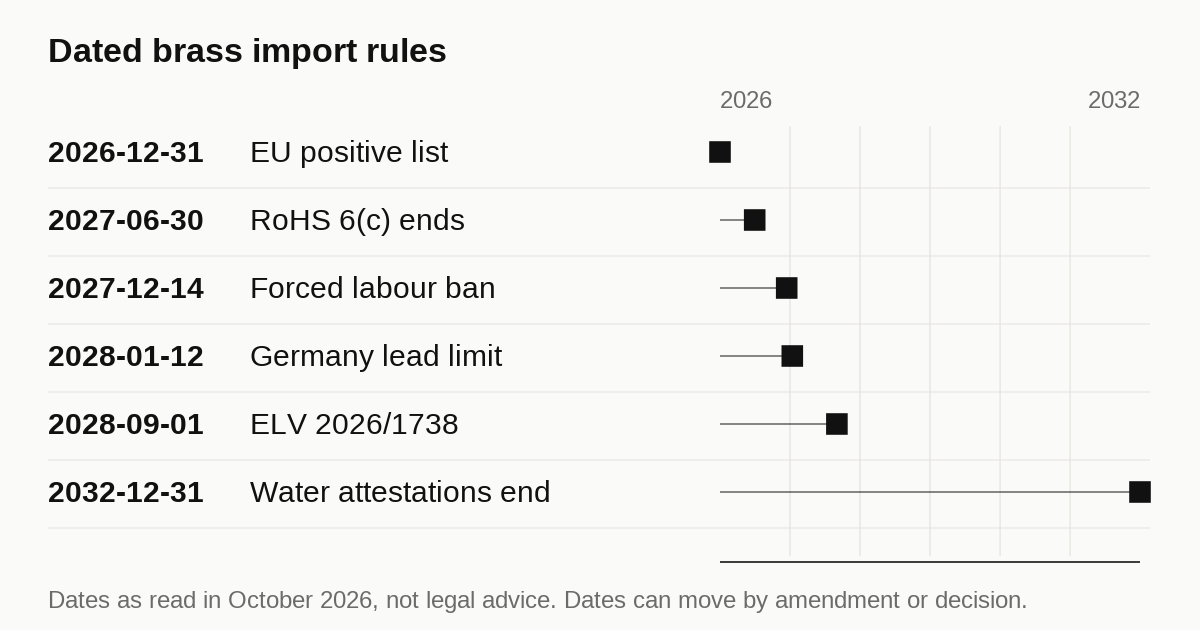
Six dated rules reach importers of machined brass parts between 31 December 2026 and 2032: the EU positive list, RoHS exemption 6(c), the EU forced labour ban, Germany's 5 microgram lead limit, the new ELV Regulation and the end of national water attestations. Each one changes a document you ask the supplier for. Not legal advice.
Six dated rules reach an importer of machined brass parts between the last day of 2026 and 2032, and five of them fall in the next 26 months. None bans brass. They change which alloy a drinking water part may use, which customers may still claim an electronics exemption and which records you hold on origin. This post puts the dates in one table and says what changes on paper for each.
We hold no certificate and we do not give legal advice. Every date below was read in October 2026 from the Commission, the German Environment Agency (UBA) or a named law-firm or industry note. The EUR-Lex pages did not open from my automated access, so where I could not read the Official Journal text myself the table says which note carries the date. Confirm each date against the Official Journal before you rely on it.
Checked 25 October 2026.
The calendar in one table
| Applies from | Rule | Who it hits | What changes on paper | Source read |
|---|---|---|---|---|
| 1 July 2026 (already running) | RoHS Annex III, Delegated Directive (EU) 2025/2364 | Brass parts inside electrical and electronic equipment sold in the EU | The provisions apply from this date and exemption 6(c) now ends on 30 June 2027 | CIRS; Jacob GmbH |
| 31 December 2026 | European positive list, Implementing Decision (EU) 2024/367 | Brass in contact with drinking water in the EU | New products need the European certificate and marking, and the alloy must be on the European list | Article 4 text; UBA notice |
| 30 June 2027 | RoHS exemption 6(c) ends (renewal request pending) | Leaded brass in electrical equipment | Declarations that rely on 4 percent lead need a plan B or a decision from the Commission | Jacob GmbH; CIRS |
| 14 December 2027 | EU Forced Labour Regulation (EU) 2024/3015 | Any product placed on the EU market, whatever the part | Origin, lot and volume records from supplier and rod mill | Clifford Chance |
| 12 January 2028 | German 5 microgram per litre lead value | Drinking water installations in Germany | Listed leaded brasses may no longer be built in; national attestations end 11 January 2028 | UBA notice, sections 4.3 and 5.2 |
| 1 September 2028 | Regulation (EU) 2026/1738 on end-of-life vehicles | Brass parts in road vehicles | The Directive 2000/53/EC is replaced; substance bans move into the Regulation | Noerr |
| 31 December 2032 | End of the national transition | EU drinking water products | Products must meet European rules and carry the label | UBA notice, sections 4.3 and 5.2 |
The rest of this post takes the rows in order of the date a buyer feels them.
31 December 2026: the EU positive list
Article 4 of Implementing Decision (EU) 2024/367 fixes 31 December 2026 as the date it applies. It sets the European positive lists of materials in contact with drinking water, and Annex II is the list of metallic compositions. The UBA notice explains the practical effect: products placed on the market for the first time from 31 December 2026 have to be certified and labelled under the European procedure and may then be used in all Member States. Products with a correct national attestation on 31 December 2026 may keep it until 31 December 2032.
For a buyer the paper change is the drawing and the certificate. The alloy named on the drawing has to be an entry on the European list, and a US grade name is not an entry. Our post on the 4MS positive list for brass shows which brass entries I could find and which I could not. The UBA also says its national list still holds low-lead materials that are not yet in the European list, and until a material is added no EU certificate can be issued for components made from it. If your part uses one of those, ask the product maker now which route it plans.
30 June 2027: RoHS exemption 6(c)
Delegated Directive (EU) 2025/2364 was published on 21 November 2025. CIRS reports that Member States had to transpose it by 30 June 2026 and that it applies from 1 July 2026. It leaves exemption 6(c), copper alloy with up to 4 percent lead, running to 30 June 2027.
Jacob GmbH adds the part that matters for planning: a request for a further extension was filed in December 2025, no decision had been made when it wrote, and so exemption 6(c) remains in effect for the time being. That is a status, not a promise. Plan for the date and treat a later decision as a bonus. The details, including the footnote on products children may put in the mouth, are in our post on RoHS exemption 6(c) and leaded brass.
What changes on paper: any part that sits inside EU electrical equipment and relies on leaded brass needs a line in the compliance file that says which alloy replaces it if the exemption lapses. Silicon brass and bismuth brass are the usual candidates, and the machinability gap between them and C360 is covered in leaded versus lead-free brass.
14 December 2027: the forced labour ban
Regulation (EU) 2024/3015 entered into force on 13 December 2024 and applies from 14 December 2027 (Clifford Chance). It bans placing products on the EU market, making them available and exporting them when forced labour was used at any stage. It does not name a certificate and it does not list brass. The paper change is a record set: rod mill, lot, volume in and volume out, and the plating or finishing subcontractor. Our guide to the Regulation and machined brass parts lists the questions to put to a turning shop.
Need a quote for this part? Get a quote for your brass parts
12 January 2028: the German lead value
The UBA notice states that in Germany the lowered threshold value for lead of 5.0 micrograms per litre applies from 12 January 2028. Products made of certain lead-containing alloys on its metals list can no longer be used for building or maintaining water supply systems from that date, and attestations for them are limited to 11 January 2028. The notice also says compositions on the first European positive list were assessed against the 5.0 microgram value, so they can still be used after that date.
If you sell valves or fittings into German water systems, this date is closer than the 2032 end of the transition. A part drawn in CW617N on a national attestation has a shorter life than the general rule suggests. See brass for German drinking water for the alloy lists.
1 September 2028 and after: vehicles
Noerr reports that Regulation (EU) 2026/1738 generally applies from 1 September 2028 and replaces the End-of-Life Vehicles Directive 2000/53/EC. Its Article 5 carries the ban on critical substances such as lead, which the firm describes as largely already in place. I could not open the Regulation text, so I cannot confirm from it how the exemption for copper alloys with up to 4 percent lead is carried over. Our page on the ELV lead exemption for brass vehicle parts reads the Annex and the review date; check it against the Official Journal. A vehicle part and an electronics part are different cases, and a part used in both needs a separate answer for each.
Rules with no new date
Three things importers ask about do not appear in the table because I found no date to put there.
- US drinking water. EPA says the Reduction of Lead in Drinking Water Act lowered the weighted average lead content of wetted surfaces to 0.25 percent. It is already in force. See NSF/ANSI 61 and 372 for brass fittings.
- California warnings. Proposition 65 is a warning law, not a composition limit. Our post on Prop 65 and brass covers it.
- EU gas appliances. The Commission says Regulation (EU) 2016/426 became fully applicable on 21 April 2018 and covers fittings, meaning safety, controlling and regulating devices and their sub-assemblies. I found no 2027 date for it.
Duties are also outside the table. US copper duties have been changed by proclamation more than once, and I could not open an official page that states the current rate for brass rod. Ask your customs broker for the rate on your heading, and read HS codes for machined brass parts first.
What to do with the table
- Mark each part in your range with the market it ships to and the use it has: drinking water, electronics, vehicle or other.
- Put the dates that apply to that row into the part file, with the alloy named on the drawing.
- Ask each supplier in writing which of its parts use leaded alloy and which rod mill supplies each alloy.
- Add the document you need to your lead-free compliance documents list and to the quality agreement.
- Re-check the table every quarter. A pending RoHS decision or an amendment to the positive list can move a row.
Where to go next
Pick the single-rule post for each row that applies to you, then settle the alloy before the drawing is released. Have a drawing and a destination market? Send the drawing with the market and the end use named. We quote the finished parts within 24 business hours and place the work with one of the partner shops that turn brass.
Frequently asked questions
Which brass rule has the nearest date?
The EU positive list for metallic materials in contact with drinking water applies from 31 December 2026, according to Article 4 of Implementing Decision (EU) 2024/367. Products placed on the market for the first time from that date need the European certificate and marking. Products with a national attestation on that day have until 31 December 2032.
Does RoHS exemption 6(c) end on 30 June 2027?
Delegated Directive (EU) 2025/2364, published on 21 November 2025, sets 30 June 2027 as the end date for copper alloys with up to 4 percent lead. A renewal request was filed in December 2025. Jacob GmbH reports that no decision had been made, so the exemption stays in force for now. Plan for the date.
Does the EU forced labour ban need a certificate from my brass supplier?
No certificate is named. Regulation (EU) 2024/3015 applies from 14 December 2027 and bans products made with forced labour from the EU market. It sets a result, not a paperwork duty, so keep purchase, lot and volume records that show where the bar and the part came from.
Do these dates apply to brass parts bought for the US market?
No. The dates above are EU and German rules. For US drinking water parts the federal weighted average limit of 0.25 percent lead on wetted surfaces already applies and has no new date in this table. State rules and the California warning law sit outside it. Ask your compliance team.
Alloys in this guide
| Alloy | Lead % | Mach. | DZR |
|---|---|---|---|
| C360 free-cutting brassC36000 · CuZn36Pb3 / CW603N | 2.5 to 3.7 | 100 | Poor |
| C69300 silicon brassC69300 · CuZn21Si3P / CW724R | under 0.09 | 80 | High |
| CW617N CuZn40Pb2C37700 (nearest) · CuZn40Pb2 / CW617N | 1.6 to 2.5 | 80 | Poor |
| CW511L lead-free brassC27450 (nearest, without arsenic) · CuZn38As / CW511L | under 0.2 | 40 | High |
Published typical values for the alloy. Machinability against C360 at 100. Not a promise from a shop.
Sources
- EUR-Lex copy (LawPlayer), Commission Implementing Decision (EU) 2024/367, Article 4: applies from 31 December 2026 lawplayer.com
- UBA, Hygienic requirements of materials in contact with drinking water, transitional regulations (REV02, effective 13 October 2025), sections 4.3, 5.1 and 5.2 umweltbundesamt.de
- Jacob GmbH, RoHS Directive and lead in brass (Delegated Directive (EU) 2025/2364, exemption 6(c)) jacob-gmbh.de
- CIRS, EU updates RoHS Directive with revised lead exemption clauses cirs-group.com
- Clifford Chance, EU ban on products made with forced labour makes its way into law (February 2025) cliffordchance.com
- Noerr, New EU End-of-Life Vehicles Regulation: a challenge for the automotive industry noerr.com
- European Commission, Gas Appliances Regulation single-market-economy.ec.europa.eu
- US EPA, Use of lead free pipes, fittings, fixtures, solder and flux for drinking water epa.gov
Need a quote for this part?
Send the drawing. We read it, send one itemised quote for the finished parts within 24 business hours and place the work with a partner shop that turns brass. Brass only.
Get a quote for your brass parts