Guides / Compliance
Prop 65 and Brass Products Sold in California: Lead Levels, Warnings and Who Gives Them
Published November 21, 2026. Reviewed for the facts in the corrections log.
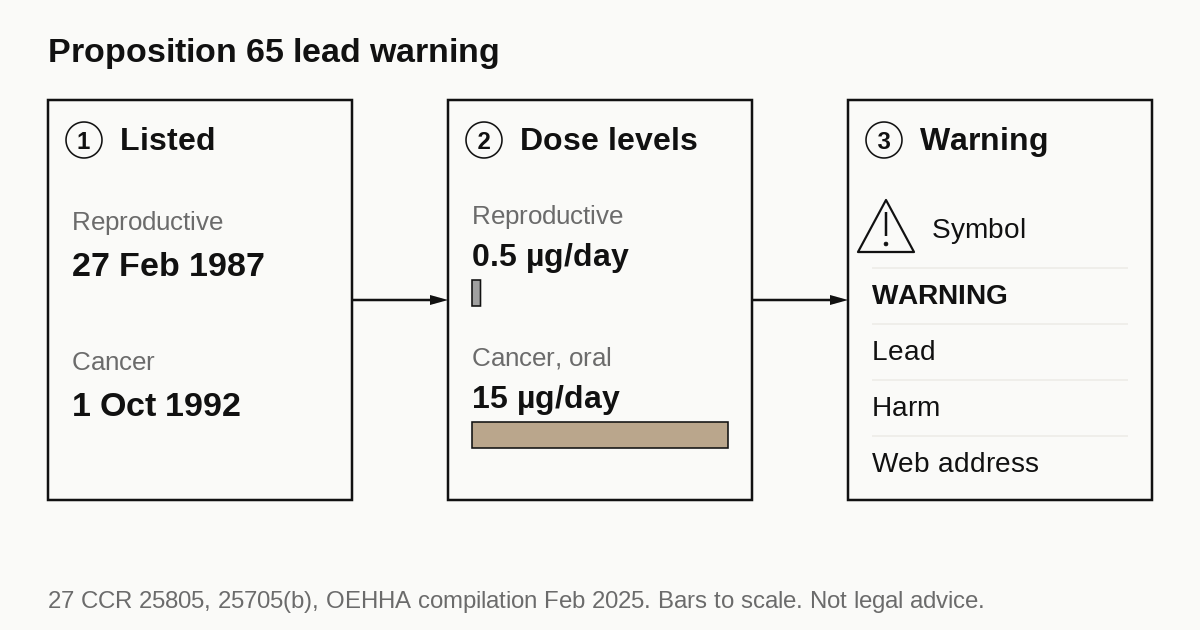
Proposition 65 is a California warning law, not a limit on what brass may contain. Lead is a listed chemical, with levels of 0.5 micrograms per day for reproductive harm and 15 for cancer. A product sold in California that exposes users above them may need a warning. It differs from the federal drinking water composition rule.
Buyers sometimes read Proposition 65 as a lead limit for brass. It is not. It is a California warning law, and brass comes into it only because lead is a listed chemical and some brass parts end up in products that people handle. This post is part of our guide to lead free brass. It covers what the regulations say, what the levels mean and how to write the question into a drawing package.
We do not give legal advice. This is not legal advice. The texts below were opened in October 2026, and the regulation file is an unofficial compilation that OEHHA says may be out of date, so check the current official text.
Checked October 2026.
What Proposition 65 is and who runs it
Proposition 65 is the Safe Drinking Water and Toxic Enforcement Act of 1986. The lead agency is the Office of Environmental Health Hazard Assessment, OEHHA, and the regulations sit in Title 27 of the California Code of Regulations. Article 6 covers clear and reasonable warnings. Its first section says that nothing in Article 6 decides whether a warning is required for a given exposure. It covers only what a warning must contain and how it is given.
The duty is aimed at people in the course of doing business. OEHHA’s definition of employee, in the same regulations, says the prohibitions on exposures apply to a person who has ten or more full-time or part-time employees on the date in question.
Lead on the list
| Listing | Endpoint | Listed | Level | Section |
|---|---|---|---|---|
| Lead | Developmental, female and male reproductive toxicity | 27 February 1987 | 0.5 micrograms per day | 27 CCR 25805 |
| Lead and lead compounds | Cancer | 1 October 1992 | 15 micrograms per day, oral | 27 CCR 25705(b) |
Source: OEHHA unofficial compilation of Title 27 (February 2025), and Cornell LII for sections 25805 and 25705, opened October 2026. Brass is not named in these entries: the listing is for lead.
What the levels mean
The two figures are daily doses, not limits on product composition. The reproductive level is a dose at which, according to the regulation text, exposure has no observable effect even at 1,000 times that level. The cancer figure is a level that poses no significant risk. A product raises the question when a person’s exposure from it, in a day, is above those doses.
That means no percentage of lead in brass can be read off these sections. Whether a given brass product exposes someone above the levels depends on how the person contacts it, how often and how much lead transfers. I found no brass-specific figure in the texts I opened, and a figure that someone quotes as a “Prop 65 limit for brass” needs its source checked. An exposure assessment is the way to answer it, and a shop’s mill certificate gives the lead value that goes into one.
What a warning must say
The content rules are in section 25603. A full warning has four elements: a warning triangle symbol, the word WARNING (or CA WARNING, or CALIFORNIA WARNING), a sentence naming at least one listed chemical and the harm it is known to cause plus a web address for more information. The sentence differs for cancer, for reproductive harm and for both. A short-form version is allowed on a label under section 25602, in type not smaller than 6 point.
The methods are on the product label, on a sign or shelf tag at the point of display, by an electronic device that gives the warning before purchase, or, for internet sales, on the product page or through a clearly marked link. Where a label carries consumer information in another language, the warning must also appear in that language.
The regulation text implies that these content rules took their current form on 30 August 2018, and it deems earlier warnings clear and reasonable under conditions it sets out.
Who gives the warning
Section 25600.2 spreads the duty along the supply chain. The manufacturer, producer, packager, importer, supplier or distributor of a product may comply either by warning on the product label or by giving a written notice to the seller’s authorized agent, renewed every year while the product is sold in California. The retail seller then places and maintains the warning materials it received. A retail seller is responsible for the warning itself only in listed cases, such as selling under its own brand or knowingly introducing the chemical.
A turning shop that supplies a brass component to a product maker is not the label-giver for the finished consumer product in the ordinary case. The facts decide, and a buyer who sells into California should ask counsel. This post does not tell any shop or buyer that a warning is or is not required.
Need a quote for this part? Get a quote for your brass parts
Prop 65 and the drinking water rules compared
| Safe Drinking Water Act section 1417 | Proposition 65 | |
|---|---|---|
| What it is | A composition rule for pipes, fittings and fixtures | A warning rule for exposure to listed chemicals |
| Figure | 0.25 percent weighted average lead across wetted surfaces | 0.5 and 15 micrograms per day for lead |
| Who sets it | Congress, with EPA guidance | California, with OEHHA regulations |
| Scope | Drinking water products, with exemptions | Products and exposures in California |
| Result | A product that fails the definition cannot be used in drinking water plumbing | A warning, or reformulation, if exposure is above the level |
Sources: EPA page and Cornell LII on section 1417, opened October 2026; OEHHA regulations.
Meeting one does not settle the other. A part can meet the composition rule and still raise a Proposition 65 question, or the reverse. A hose fitting used only for outdoor watering sits outside the federal drinking water definition and can still be a California labeling question.
What to write in your spec
- State whether the part ends up in a consumer product sold in California.
- State who owns the warning decision: the buyer or the product maker.
- Ask the shop for the alloy and the lead value on the mill certificate. An exposure assessment needs it.
- If the rule you work to is a lead-free composition rule, write that rule, not a Proposition 65 word.
- If a warning must appear on packaging, supply the exact wording and placement. The shop should not draft legal text.
A sentence for the RFQ:
Brass component for a consumer product that may be sold
in California. Warning decision rests with the buyer.
Please state the alloy and the lead value on the
mill certificate for each lot.
Common misreadings
- “Prop 65 bans lead in brass.” It is a warning law.
- “The limit is 0.5 percent.” The level is 0.5 micrograms per day of exposure, a dose.
- “Lead-free means no warning.” The tests differ, and no source I opened settles it for brass.
- “The shop prints the warning.” The warning belongs to the product, and its wording is set by the regulation.
- “A 0.25 percent figure from drinking water law is the Prop 65 trigger.” It is a different rule with a different purpose.
Next steps
The Prop 65 section of our guide to lead free brass places this law next to the US, EU and RoHS rules. For the drinking water side, see NSF/ANSI 61 and 372 for brass fittings and the standards index. To get a part quoted, send the drawing. We quote the finished parts within 24 business hours and place the work with one of the partner shops that turn brass.
See also: how Proposition 65 works for buyers of metal parts, which covers notices, penalties and the 10 employee rule.
Frequently asked questions
Does Proposition 65 ban leaded brass?
No. Proposition 65 does not set a limit on what a product may contain. It requires a clear and reasonable warning when a listed chemical exposes a person above the set levels. The ban on non-lead-free fittings for drinking water comes from a different law, the federal Safe Drinking Water Act.
What are the Prop 65 levels for lead?
Two figures appear in the regulations. For reproductive toxicity the level for lead is 0.5 micrograms per day (27 CCR 25805). For cancer, the no significant risk level for lead is 15 micrograms per day, oral (27 CCR 25705). Both are doses a person receives per day, not a percentage of lead in the product.
Does lead-free brass mean no warning is needed?
Not automatically. A warning depends on exposure to a listed chemical from the product, in a stated dose. Meeting the drinking water composition rule and the Proposition 65 test are separate questions. I found no source that settles the point for brass, so ask counsel how your product is treated.
Who has to give the warning on a brass product?
The regulations allow the manufacturer, producer, packager, importer, supplier or distributor to warn on the product label, or to give a written notice to the seller. A retail seller is responsible only in listed cases. Who carries the duty for your product is a question for counsel, not for the machine shop.
Alloys in this guide
| Alloy | Lead % | Mach. | DZR |
|---|---|---|---|
| C360 free-cutting brassC36000 · CuZn36Pb3 / CW603N | 2.5 to 3.7 | 100 | Poor |
| C69300 silicon brassC69300 · CuZn21Si3P / CW724R | under 0.09 | 80 | High |
Published typical values for the alloy. Machinability against C360 at 100. Not a promise from a shop.
Sources
- OEHHA, Regulations on Proposition 65, Title 27 Division 4 (unofficial copy, February 2025) oehha.ca.gov
- Cornell LII, 27 CCR 25805, specific regulatory levels for chemicals causing reproductive toxicity law.cornell.edu
- Cornell LII, 27 CCR 25705, specific regulatory levels posing no significant risk law.cornell.edu
- US EPA, Use of lead free pipes, fittings, fixtures, solder and flux for drinking water epa.gov
Need a quote for this part?
Send the drawing. We read it, send one itemised quote for the finished parts within 24 business hours and place the work with a partner shop that turns brass. Brass only.
Get a quote for your brass parts