Guides / Compliance
Lead-Free Brass Compliance Documents: A Four-Stage Checklist for Buyers
Published November 21, 2026. Reviewed for the facts in the corrections log.
Ask a shop for four things in order: a drawing note that names the rule, a mill certificate type 3.1 for each bar lot showing the lead value, a traceability answer that links bar lot to part lot and a receipt check on the bar. Product certification belongs to the maker of the finished product, not to the turning shop.
Most disputes on lead-free brass jobs are about paper, not metal. Nobody asked for the certificate type. Nobody wrote the rule on the drawing. Or the bar and the part could not be linked. This checklist puts the requests in the order a buyer meets them. It is part of our guide to lead free brass.
We name no shop and we do not certify parts or give legal advice. The checklist asks for documents a turning shop can actually supply.
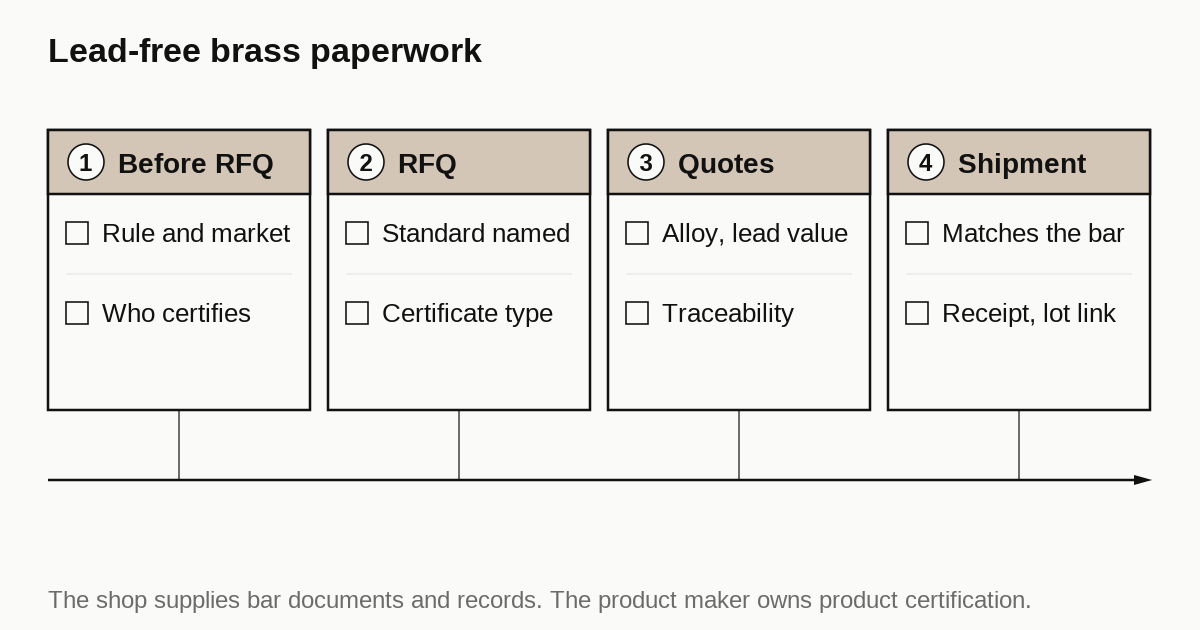
Stage 1: before the RFQ
| Item | What to ask or send | Why | What good looks like |
|---|---|---|---|
| 1. The rule | Name the market and the rule: US drinking water, EU drinking water, electronics, California | Each has a different test, so “lead free” alone means nothing | One sentence naming the rule and market |
| 2. Product certification | Decide who certifies the finished product | EPA says certification became required for manufacturers and importers from 1 September 2023. EU certificates come from notified bodies from 31 December 2026 at the earliest | A line on the order: product certification is held by the buyer or product maker |
| 3. The assembly maths | If the part sits in an assembly, run the weighted average | A small leaded part can lift the average over the line | A calculation attached to the drawing package |
Sources: EPA page and UBA notice, both read October 2026; confirm the dates against the current text. The calculator is on this site at /tools/lead-content-calculator/.
Stage 2: the RFQ
| Item | What to ask or send | Why | What good looks like |
|---|---|---|---|
| 4. Drawing note | Write the standard or list, with the alloy as a suggestion | A bare alloy name closes off equivalents and hides the requirement | Wording as in the pillar guide, for example “wetted surfaces to NSF/ANSI 372” |
| 5. Certificate type | Ask for EN 10204 type 3.1 per lot, or with the first article only | It sets the segregation cost and the paper trail | The frequency stated and priced as its own line |
| 6. Compliance field | Use the RFQ form’s compliance field: potable water standards, RoHS or REACH declaration, material certificate 3.1, other | The shop sees the requirement before it quotes | The field matches the drawing note |
| 7. Grade open | Choose “Lead-free, grade open” where the rule allows | A shop can offer the compliant bar it can buy that week | Alloy listed as a suggestion, not a lock |
The 3.1 definition comes from a vendor summary of EN 10204, not the standard text, and is directional.
Stage 3: reviewing quotes
| Item | What to ask or send | Why | What good looks like |
|---|---|---|---|
| 8. Alloy and lead value | Which alloy, and what lead value the certificate shows | Typical values describe an alloy, not your lot | A number on the certificate, not only “lead free” |
| 9. Segregation | How lead-free bar is kept apart from leaded bar | Lead from mixed bar cannot be melted out of a lead-free part | A described process: separate racks, lot tags, a changeover check |
| 10. Experience | Has the shop shipped lead-free parts of this class in production | “Can run it” and “has shipped it” are different answers | A specific answer about the grade and the part family |
| 11. Test report scope | If any test report is offered, what it covers: alloy or part, lab, date | A report for one product says nothing about another | Scope stated in the report |
Do not accept “certified to NSF 61” from a turning shop for a custom part. Certification belongs to a product and its maker.
Stage 4: before shipment
| Item | What to ask or send | Why | What good looks like |
|---|---|---|---|
| 12. Certificate matches bar | Heat or lot numbers on the certificate match the bar markings and the alloy ordered | A certificate for another lot proves nothing about yours | Numbers match, lead value inside the stated limits |
| 13. EU entry | For an EU drawing, the composition sits within the limits of the named entry in the positive list | A bar sold under a US grade name may differ from the EU notation | Certificate shows the composition against the entry, for example CW724R |
| 14. Receipt check | A screening reading on incoming bar and a retained sample | It catches mix-ups after delivery. See XRF checks on brass bar | A reading logged against the lot, sample kept |
| 15. Lot link | Part lot linked to bar lot on shipping papers | It answers a later question without opening every lot | Bar lot number printed on the packing document |
Declarations your customer asks for, such as a RoHS or REACH declaration, come from you as the product maker. The shop supplies the composition behind them.
Need a quote for this part? Get a quote for your brass parts
Reading a mill certificate
A certificate is only useful if you read it against the bar. Five checks take a minute.
- Alloy designation. It should match the grade you ordered, in the same notation as the drawing. A US grade name on a certificate does not show an EU entry.
- Heat or lot number. It must match the number marked on the bar or its tag. A certificate for another lot proves nothing about yours.
- Composition table. Look for a lead figure as a number, and for the other elements of the grade: silicon for silicon brass, bismuth for bismuth brass, arsenic for CW511L. A line that says only “lead free” is a claim, not a measurement.
- Limits. Compare each figure with the limits of the grade or, for the EU, with the entry on the positive list. Do not compare it with the typical values on a datasheet, which describe the alloy and not your lot.
- Type and signature. The vendor summary I read describes type 3.1 as test results for the lot supplied, validated by the manufacturer’s authorized representative. If the document is a declaration with no test results, it is a different type.
In a dispute, the certificate, the receipt reading and the lot link are the three records that matter. A lab result settles a disagreement about a reading, so keep a retained sample from each lot.
Red flags
- The shop offers “NSF certified parts” for a custom drawing.
- A certificate shows no lead value, or no heat or lot number.
- No answer to how lead-free bar is kept apart from leaded bar.
- The alloy is named only as “lead free”, with no grade.
- A test report for one product is offered as proof for yours.
- A 3.1 certificate is described as a shop-issued document, when it is a mill document passed through. The shop adds its own link between certificate and lot.
The RFQ fields
The RFQ form on this site asks for: part description, brass grade, quantity, compliance, tolerance, finish, threads, needed-by date, supplier region, drawing files and an NDA request. For a lead-free part, fill the grade as “Lead-free, grade open” or the alloy you suggest, and pick the compliance option that matches your drawing note. Write the rule in the part description as well, since the compliance field has five fixed options.
Next steps
If your part sits under the US rule, read NSF/ANSI 61 and 372 for brass fittings. For what a certificate does and does not prove, see material certificates for brass parts. The rules and wording are in our guide to lead free brass. To get a part quoted, send the drawing. We quote the finished parts within 24 business hours and place the work with one of the partner shops that turn brass.
See also: how to verify an NSF/ANSI 61 or 372 listing and REACH and lead in brass.
Frequently asked questions
Which certificate should I ask for with lead-free brass bar?
An EN 10204 type 3.1 certificate for each bar lot is the usual ask. It reports test results for the lot supplied, signed by the mill's authorized inspection representative. I read a vendor summary of the standard, not the standard text. The certificate should show the lead value for the lot, with heat or lot numbers that match the bar markings.
Can a machine shop give me an NSF or EU certificate for my part?
No. Product certification belongs to the maker of the finished product. In the US, EPA says manufacturers and importers certify products from 1 September 2023. In the EU, certificates are issued by notified conformity assessment bodies from 31 December 2026 at the earliest. A shop supplies alloy, certificates for bar and traceability.
What does lot traceability mean on a lead-free job?
It means the shop can show which bar lot each part lot was cut from, and that lead-free bar was kept apart from leaded bar from the rack to the packing bench. Without that record, a mill certificate proves only what the bar was when it left the mill.
Do I need a certificate per lot or only with the first article?
A certificate per lot costs more because the shop must segregate every bar lot and keep the trail through machining and packing. If the part is low risk and repeats, the first article may be enough. If the alloy is doing compliance work, ask for each lot and say so in the RFQ.
Alloys in this guide
| Alloy | Lead % | Mach. | DZR |
|---|---|---|---|
| C69300 silicon brassC69300 · CuZn21Si3P / CW724R | under 0.09 | 80 | High |
| Bismuth brassC49300 / C49350 · No single EN equivalent, see supplier spec | under 0.25 | 80 | Moderate |
| CW511L lead-free brassC27450 (nearest, without arsenic) · CuZn38As / CW511L | under 0.2 | 40 | High |
Published typical values for the alloy. Machinability against C360 at 100. Not a promise from a shop.
Sources
- US EPA, Use of lead free pipes, fittings, fixtures, solder and flux for drinking water epa.gov
- UBA, Hygienic requirements of materials in contact with drinking water, transitional regulations (REV02, effective 13 October 2025) umweltbundesamt.de
- EUR-Lex, Commission Implementing Decision (EU) 2024/367, Annex II metallic compositions eur-lex.europa.eu
- Projectmaterials, EN 10204 certificate types 2.1, 2.2, 3.1 and 3.2 (vendor summary, standard text not read) blog.projectmaterials.com
Need a quote for this part?
Send the drawing. We read it, send one itemised quote for the finished parts within 24 business hours and place the work with a partner shop that turns brass. Brass only.
Get a quote for your brass parts