Guides / Choosing a Supplier
Using a Handheld XRF to Check Lead in Brass Bar Before You Cut It
Published November 21, 2026. Reviewed for the facts in the corrections log.
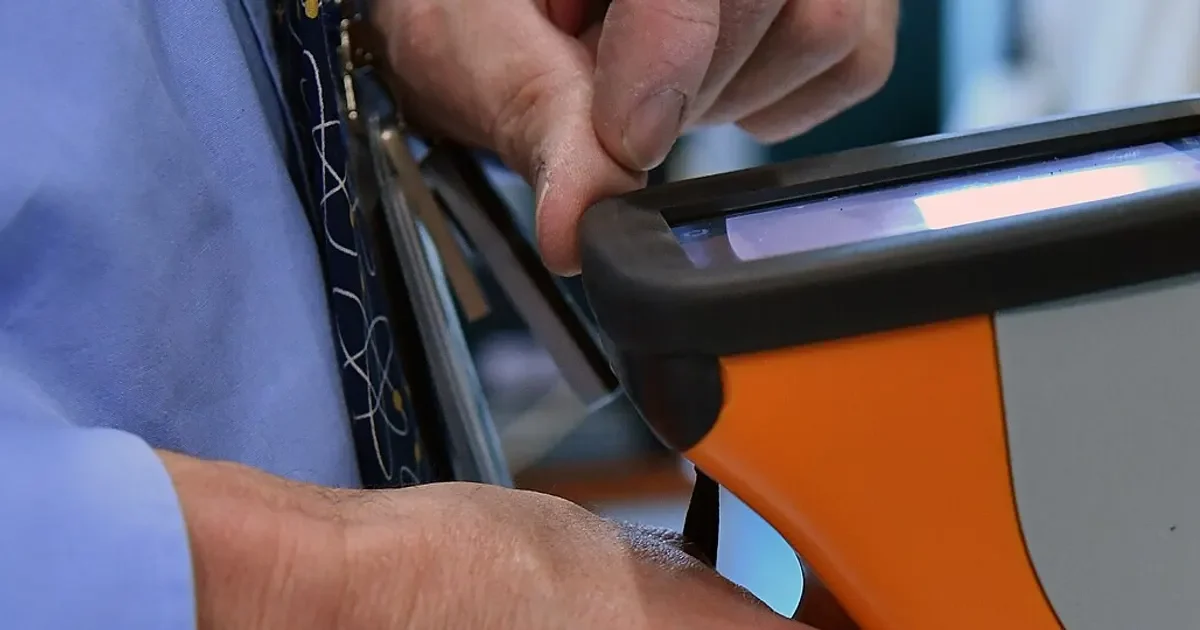
A handheld XRF analyzer reads the lead, zinc, copper and other elements of a brass bar in seconds, so a shop can catch mixed or mislabeled bar before cutting. It is a screening tool. Near a limit such as 0.25 percent lead the reading carries an uncertainty, so a borderline result goes to a laboratory.
Mixed brass bar is a quiet, expensive problem. A leaded bar slides into a rack of lead-free stock, or a bundle arrives with the wrong tag, and the shop cuts a few thousand parts before anyone finds out. Parts for drinking water, food contact or electronics then fail a limit they were never made to meet.
A handheld X-ray fluorescence analyzer, XRF for short, catches most of these mistakes in a few seconds, before the first cut. This post covers how it works on brass, what it can and cannot read, and how to use it without overtrusting it.
How handheld XRF works
The analyzer fires a beam of X-rays at the metal. Each element in the surface absorbs the beam and re-emits X-rays at its own characteristic energy. The detector counts those energies and software converts the counts into percentages. The X-ray fluorescence article describes the physics. A reading takes 5 to 30 seconds.
On brass the instrument reports copper, zinc and lead as the main elements, plus tin, iron, nickel, manganese, aluminum and bismuth when present. Silicon, the key element in C69300 silicon brass, is a light element that older analyzers read poorly. Newer models with silicon drift detectors read it, but a shop should confirm the instrument can do so before relying on it.
What XRF is good for
Sorting mixed bar. The most useful job is separating leaded from lead-free bar, and one grade from another. C360 free-cutting brass reads around 2.5 to 3.7 percent lead and about 35 to 36 percent zinc. A lead-free bar reads near zero lead, and bismuth brass shows bismuth that leaded brass does not. The whole check takes about 20 seconds.
Matching to the certificate. The reading should agree with the mill certificate to within the instrument’s uncertainty. A bar tagged C360 that reads 0.1 percent lead is not C360.
Screening for RoHS. XRF is the standard screening method for lead in electronics materials under IEC 62321-3-1. It is how a supplier gets a quick answer before a lab test.
Positive material identification. Industries that fear wrong-material mix-ups use XRF as a routine check. See positive material identification.
Where it falls short
XRF is a screening tool, and four limits matter.
Surface depth. The beam reads only the outer tens of micrometres. Drawn bar can carry a surface layer that is richer or poorer in lead than the core, and oil, oxide, paint or plating change the reading. A fresh cut face, wiped clean, gives a truer result than the bar skin.
Uncertainty near a limit. A good instrument reads lead in brass to a few hundredths of a percent at low levels, and to a tenth or more at high levels. If the limit is 0.25 percent and the reading is 0.22, the true value could be on either side. A figure that close needs a laboratory.
Segregation. Lead sits in particles, not evenly. Two readings an inch apart can differ. Take several and average them.
Light elements. Silicon, aluminum and sometimes bismuth can be read poorly on some analyzers, and the manufacturer’s data sheet lists the limits. If a lot depends on those elements, confirm in a lab.
A practical screening routine
A shop can follow a short procedure on every lot:
- Check the analyzer against a certified reference piece at the start of each shift. Log the reading.
- Cut or file a clean, flat face on the end of one bar from each bundle. Wipe it with solvent.
- Hold the nozzle flat against the face. Take three readings of 15 to 30 seconds.
- Average the lead, zinc and copper. Compare to the certificate.
- Record the heat number, the readings and the date.
- Tag and segregate any bar that does not match.
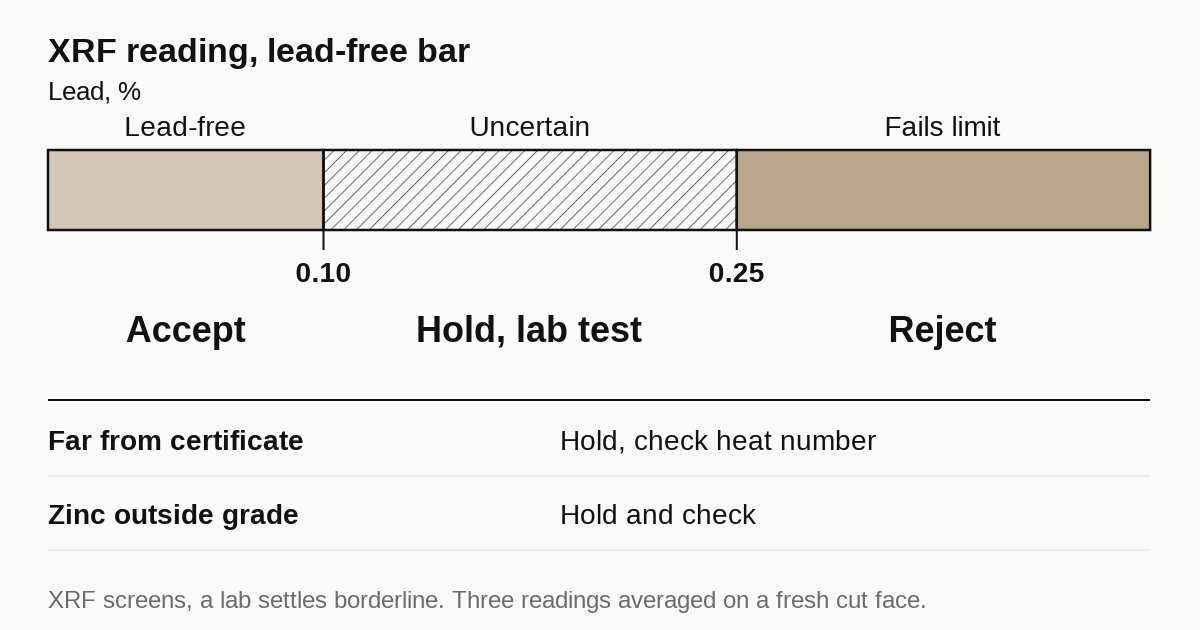
The table below shows a typical decision rule for a lot ordered as lead-free to a 0.25 percent limit. It is an example. A shop sets its own thresholds from the instrument’s performance.
| Average lead reading | What it suggests | Action |
|---|---|---|
| Under 0.10 percent | Consistent with a lead-free bar | Accept, file the reading with the certificate |
| 0.10 to 0.25 percent | Uncertain, near the limit | Hold the lot, send a sample to a lab |
| Over 0.25 percent | Does not meet the limit | Reject the lot, tell the supplier |
| Reading differs from the certificate by a wide margin | Mixed or wrong material | Hold, check the heat number, quarantine |
| Zinc far from the grade range | Wrong alloy even if lead looks right | Hold and check |
An example screening rule, not a standard. The standard being worked to and the laboratory result take precedence.
Need a quote for this part? Get a quote for your brass parts
When to go to a laboratory
A laboratory reading is the one that settles an argument. Spark optical emission spectroscopy, described in EN 15079, reads copper alloys to a much tighter uncertainty than a handheld. Wet chemistry to ASTM E478 is slower and more exact still. Use a lab when the XRF result is near a limit, when the lot decides a compliance claim, when two parties dispute a reading, and when the certificate and the reading disagree. Keep a retained sample from each lot so a later question can be answered.
A mill certificate remains the main record. EN 10204 3.1 certificates explains what the paper does and does not prove, and XRF checks that the paper matches the bar in the rack.
What a buyer can ask a shop
For lead-free parts, ask three questions. Does the shop check incoming bar with XRF or a lab? Is the check logged by heat number? Is lead-free bar stored apart from leaded, with end marking? A shop with a good answer to each is far less likely to ship mixed material. Lead-free brass shop capability lists what else to look for, and leaded vs lead-free brass sets out why the line is drawn at 0.25 percent.
Calibration and operator habits
An analyzer is only as good as its last check. Most handheld units carry a factory calibration for copper alloys, and the shop adds a daily check against a certified reference piece of known brass. If the reference reads outside the stated tolerance, the unit stops being used until it is serviced. Two habits make readings more repeatable. Hold the nozzle flat and still against the face for the whole reading, because a gap or a tilt cuts the signal. Do not read through a lacquer, a coating or a film of oil, and do not read on a curved surface when a flat one can be made. Round bar can be read on the end face or on a short flat filed on the side. Readings on a convex surface tend to come out low.
Operators should know the alloy modes of the instrument. A unit set to a stainless steel mode will return nonsense on brass. The shop should record the mode, the reading time and the operator with each result.
Radiation safety
A handheld XRF emits X-rays, at low power but not none. The usual rules are simple: never point the unit at a person, keep a hand away from the nozzle during a reading, store the instrument locked when not in use and train every operator. Some countries and states require a registration or a trained user, so a shop should know the local rule. This is a point to check with the shop, not a risk to a buyer who simply receives parts.
What to write on an RFQ
Material: lead-free brass, lead under 0.25 percent weighted average. Mill certificate EN 10204 3.1 with each lot.
Incoming bar verified by XRF or laboratory analysis, record kept by heat number.
Lead-free and leaded bar stored separately and marked.
Checklist
- Analyzer checked against a reference piece each shift.
- Fresh, clean cut face used, not the bar skin.
- Three readings averaged and logged with the heat number.
- Borderline results sent to a laboratory.
- Certificate and reading compared on every lot.
- Lead-free and leaded bar stored apart and marked.
For the other proof a lead-free claim needs, see the guide to lead free brass.
Need lead-free brass parts with material checks written in? Send the drawing. We quote the finished parts within 24 business hours and place the work with one of the partner shops that turn brass.
Frequently asked questions
Can XRF prove a brass bar is lead free?
It can show that a bar reads well below the limit, which is a strong screen. It cannot replace a mill certificate or a laboratory analysis, because a handheld reading has an uncertainty of a few hundredths of a percent and reads only the surface layer. For a result that decides compliance, use spark optical emission analysis from a lab.
Why does a bar read differently at the surface and in the middle?
Handheld XRF reads only the outer tens of micrometres. Machining and drawing smear lead toward the surface, and oil, oxide or a coating change the reading. Cut or file a fresh face, clean it and read there. Readings taken on a skin of drawn bar can be off by a wide margin.
How often should a shop check incoming brass bar?
Check every new heat or lot on arrival, and any bar that is out of its rack or unmarked. When lead-free and leaded bar share a machine, check the first part of each changeover as well. A short written record with the reading, the heat number and the date is what an auditor will ask to see.
Alloys in this guide
| Alloy | Lead % | Mach. | DZR |
|---|---|---|---|
| C360 free-cutting brassC36000 · CuZn36Pb3 / CW603N | 2.5 to 3.7 | 100 | Poor |
| C69300 silicon brassC69300 · CuZn21Si3P / CW724R | under 0.09 | 80 | High |
| Bismuth brassC49300 / C49350 · No single EN equivalent, see supplier spec | under 0.25 | 80 | Moderate |
Published typical values for the alloy. Machinability against C360 at 100. Not a promise from a shop.
Sources
- Wikipedia, X-ray fluorescence en.wikipedia.org
- Wikipedia, Positive material identification en.wikipedia.org
Need a quote for this part?
Send the drawing. We read it, send one itemised quote for the finished parts within 24 business hours and place the work with a partner shop that turns brass. Brass only.
Get a quote for your brass parts