Guides / Choosing a Supplier
Sourcing Machined Brass Parts: A Guide for Procurement Managers, From Drawing to Quarterly Review
Published November 21, 2026. Reviewed for the facts in the corrections log.
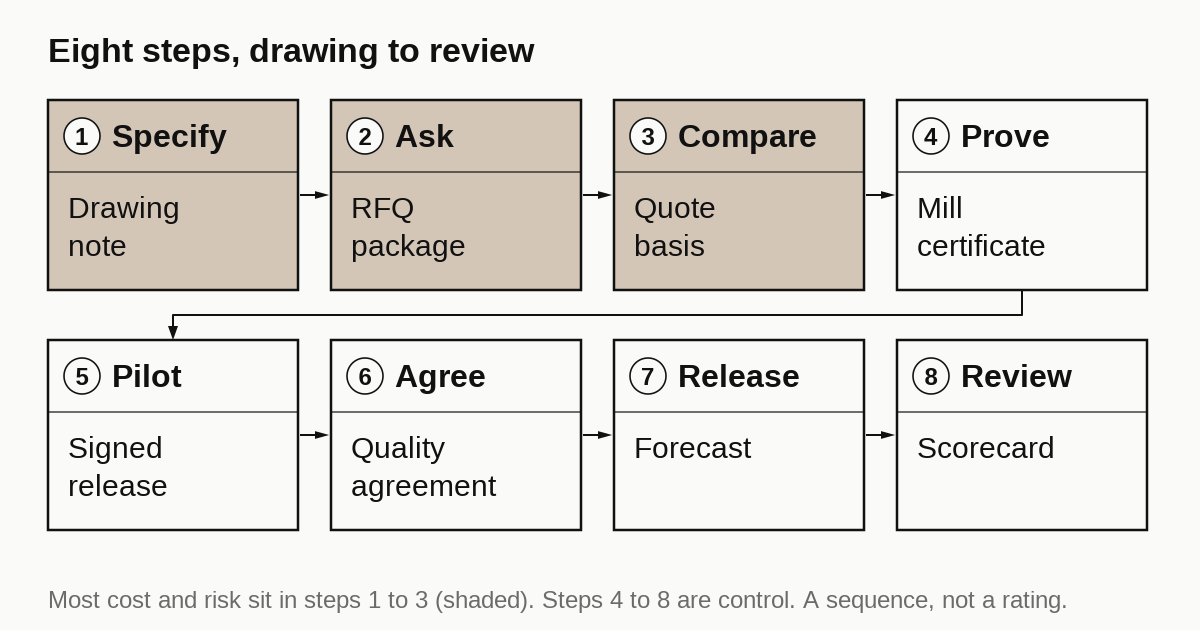
A procurement manager sources machined brass parts in eight steps: specify the alloy and the rule, send a complete RFQ, compare quotes on one basis, check compliance documents, approve a pilot lot, sign a quality agreement, release against a forecast and score the supplier each quarter. Each step has one decision, one document and one guide on this site.
A procurement manager buying machined brass parts has eight decisions to make, and most of the cost and risk sit in the first three. Specify the alloy and the rule behind it, send a complete RFQ and compare quotes on one basis. The rest of the route is control: documents, a pilot lot, an agreement, a forecast and a review. This guide walks the route and points to the post that covers each step in depth.
We do not certify any part or shop. The steps below come from our own guides on this site; the three outside sources are listed at the end.
The route in one table
| Step | The decision | The document you hold | Read this |
|---|---|---|---|
| 1 | Alloy and the rule that drives it | Drawing note naming the rule | Brass grades selection guide |
| 2 | What the RFQ must say | Complete RFQ package | The brass RFQ checklist |
| 3 | How to compare quotes | One comparison sheet | Quoting a brass fittings family |
| 4 | Whether the supplier can prove the alloy | Mill certificate per lot | Lead-free compliance documents |
| 5 | Whether the first parts are right | Signed pilot lot release | Pilot lot approval |
| 6 | What the shop must tell you | Quality agreement | Quality agreement clauses |
| 7 | How you secure capacity | Rolling forecast and releases | Capacity planning |
| 8 | Whether to keep the supplier | Quarterly scorecard | Supplier scorecard |
Step 1: fix the alloy and the rule
Brass is a family, and the rule decides the member. A part in contact with US drinking water sits under the federal weighted average limit of 0.25 percent lead on wetted surfaces, which EPA states in its page on lead free plumbing. That rules out free-cutting C360 for that use and points to a lead-free grade such as silicon brass or bismuth brass. A part in a dry mechanical assembly can stay on C360 and cut faster.
Do not leave the choice to the shop by default. Name the alloy, or the standard it must meet, on the drawing. If the shop proposes an equivalent, treat it as a change request: our post on grade substitution rules lists what to compare before you say yes. Our leaded versus lead-free comparison covers the machinability gap that follows from the choice.
Step 2: send an RFQ that can be compared
Each missing item in an RFQ is assumed conservatively by the shop, and the quote comes back padded. The package that gets a usable answer holds a STEP file, a PDF drawing, the alloy, the service environment, every thread in full, the internal burr condition, tolerances, finish, plating, the real quantity and repeat interval, a date and the certificate type. Our RFQ checklist has the full list, and there is a printable version.
If you inherited a foreign drawing, read it before you send it. Reading a US or EU brass fitting drawing shows the order: units and projection, then threads, then notes.
Step 3: compare quotes on one basis
Three quotes that differ by 30 percent usually differ in scope, not in price. Build a sheet with the same rows for each shop:
- alloy and standard quoted
- price at each quantity break, with metal as its own line
- setup, fixture and gauge charges, listed item by item (see fixture and gauge charges)
- certificate type, finish, plating and packing included
- quote validity and the rule for metal movement
- lead time and what it counts from
Metal deserves its own line because it moves. Copper averaged 9,947 US dollars a tonne in 2025 and 13,431 across January to September 2026 on the LME monthly series in the World Bank Pink Sheet. A quote with no metal clause carries that risk inside the price, or it expires quickly. Our 2026 market review puts the numbers and the forecasts in one place, and why brass prices move explains the quote mechanics. For a first small order, read minimum order quantity before you judge the unit price.
Step 4: ask for proof, not claims
A supplier saying “lead free” has made a claim. The proof is a mill certificate per bar lot with the lead value, a traceability answer linking bar lot to part lot and a receipt check on the bar. Hold them in the supplier file.
- Type 3.1 certificates and what they prove: EN 10204 for brass.
- The four documents to ask for in order: lead-free compliance documents.
- Verifying a claim from a supplier you have not met: lead-free supplier verification.
- Screening bar on arrival: XRF checks on brass bar.
Keep one boundary clear. The maker of the finished product owns product certification. The shop supplies the alloy, the certificate and traceability.
Need a quote for this part? Get a quote for your brass parts
Step 5: approve a pilot lot before volume
A sample proves a part can be made once. A pilot lot is made with production tools, bar and process and checked against the whole drawing. Gate the release in writing and order volume in tranches. The six gates are in pilot lot approval. Pair it with the checks you will run at receiving: thread gauging, the five quality checks and the causes in why fittings fail incoming inspection.
Step 6: put the rest in a quality agreement
A purchase order cannot carry everything. A short quality agreement fixes the alloy and lead limit, the certificate per heat, the leak and thread tests, the changes the supplier must tell you about first and what happens to a nonconforming lot. Write one line on origin records too if the part goes to the EU after 14 December 2027; the dates are in our regulation calendar.
Step 7: release against a forecast
A quote does not reserve machine time. Send a rolling forecast, split into firm and planned releases, and agree who holds safety stock before the first order. The shop can then buy bar, book plating and book the leak test. Details are in capacity planning for turned parts.
Step 8: score the supplier every quarter
Four numbers are enough: on-time delivery by order line, rejects in parts per million at incoming inspection, the share of lots with a mill certificate showing a lead value and the days to a written answer on a problem. Review quarterly while the relationship is young. The formulas are in the supplier scorecard.
Dates to put in your plan
If you ship to Germany, the UBA notice says the lowered lead value of 5.0 micrograms per litre applies there from 12 January 2028, and that products made of certain leaded alloys on its list can no longer be installed from that date. If you ship electronics into the EU, RoHS exemption 6(c) is set to end on 30 June 2027 unless a pending renewal is granted. Both are covered in the regulation calendar above. Neither moves with the metal price, and both change a drawing.
Who owns what
Procurement problems on brass often come from an unclear owner. This split keeps the file clean:
| Item | Buyer or product maker | Turning shop |
|---|---|---|
| Alloy and rule on the drawing | Decides and writes it | Quotes to it and flags a conflict |
| Product certification | Owns it | Does not certify the product |
| Mill certificate per lot | Asks for it and files it | Supplies it with the lot |
| Bar lot to part lot traceability | Writes it into the agreement | Keeps the record |
| Change of bar source, tool or plater | Approves or refuses | Tells you first |
| Approval of an equivalent grade | Signs it | Proposes it |
If a row has no name against it in your file, add one before the first order.
Common mistakes
- Comparing unit prices before scope. Check the rows in step 3 first.
- Treating the sample as the approval. Approve the pilot lot.
- Accepting an equivalent by email. Approve it in writing against the certificate chemistry.
- Leaving metal inside the price. Split it out and index it.
- Scoring from memory. Use the four counts.
Where to go next
Start with steps 1 and 2: they decide whether the other six are easy. Have a drawing, a quantity and a destination market? Send the drawing with the certificate type you need. We quote the finished parts within 24 business hours and place the work with one of the partner shops that turn brass.
Frequently asked questions
What should a procurement manager fix before asking for brass quotes?
Three things: the alloy or the rule behind it, the real quantity with the repeat interval, and the certificate type. Without them each shop assumes the worst case and the quotes come back padded and not comparable. A complete RFQ also names every thread in full, the burr condition inside bores and the finish.
How do I compare brass quotes fairly?
Put them on one basis: same alloy, same quantity breaks, same certificate, same finish and packing, and metal shown as its own line. Then look at the conversion price, setup and tooling charges separately. A quote that is low only because it leaves out gauging, deburring or certificates is not low.
Who owns compliance for a brass fitting, the buyer or the shop?
The maker of the finished product owns product certification. The turning shop supplies the alloy, the mill certificate per lot and traceability from bar to part. A procurement manager's job is to ask for those documents and to write them into the agreement, not to expect the shop to certify the product.
How often should I review a brass supplier?
Quarterly while volumes are small and the relationship is new, then at least once a year. Track on-time delivery by order line, rejects in parts per million, the share of lots with a mill certificate showing a lead value and the days a supplier takes to answer a problem in writing.
Alloys in this guide
| Alloy | Lead % | Mach. | DZR |
|---|---|---|---|
| C360 free-cutting brassC36000 · CuZn36Pb3 / CW603N | 2.5 to 3.7 | 100 | Poor |
| C69300 silicon brassC69300 · CuZn21Si3P / CW724R | under 0.09 | 80 | High |
| CW511L lead-free brassC27450 (nearest, without arsenic) · CuZn38As / CW511L | under 0.2 | 40 | High |
Published typical values for the alloy. Machinability against C360 at 100. Not a promise from a shop.
Sources
- US EPA, Use of lead free pipes, fittings, fixtures, solder and flux for drinking water epa.gov
- World Bank, Commodity Price Data (The Pink Sheet), monthly prices, updated 2 October 2026 thedocs.worldbank.org
- UBA, Hygienic requirements of materials in contact with drinking water, transitional regulations (REV02, effective 13 October 2025) umweltbundesamt.de
Need a quote for this part?
Send the drawing. We read it, send one itemised quote for the finished parts within 24 business hours and place the work with a partner shop that turns brass. Brass only.
Get a quote for your brass parts