Guides / Cost
The Brass Raw Material Market in 2026 and What Buyers Should Plan for 2027
Published November 21, 2026. Reviewed for the facts in the corrections log.
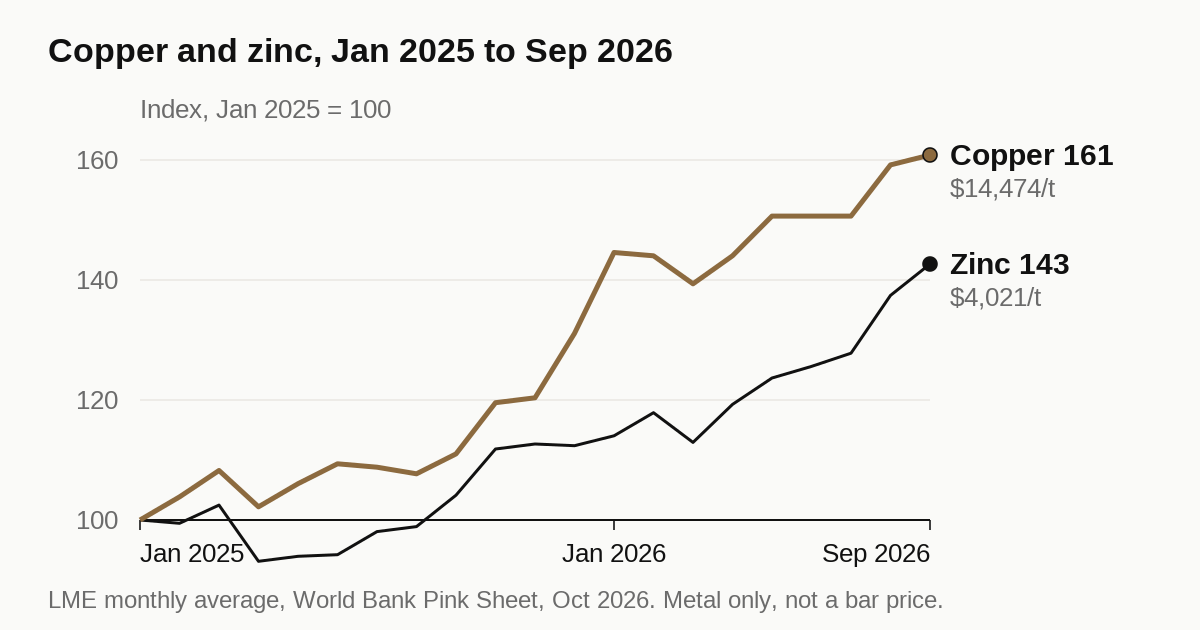
Copper and zinc, the two metals in brass, rose about 61 and 43 percent on the LME from January 2025 to September 2026. ICSG expects a refined copper surplus of 368,000 tonnes in 2027 and ILZSG a small zinc surplus of 25,000 tonnes. Forecasts have missed before, so plan with a metal-price clause, not a prediction.
The two metals in brass are at or near record prices, and the agencies that publish forecasts expect more supply in 2027, not less. From January 2025 to September 2026 the London Metal Exchange monthly average for copper rose from 8,991 to 14,474 US dollars a tonne, about 61 percent. Zinc rose from 2,819 to 4,021, about 43 percent. This review sets out what happened, what the October 2026 forecasts say and what a buyer of machined brass parts can do about it.
We do not give investment advice. The figures come from the World Bank, ICSG, ILZSG and USGS documents listed under Sources, all opened in October 2026. Forecasts are labelled with the group that made them.
Checked 25 October 2026.
What happened to copper and zinc
The World Bank Pink Sheet publishes monthly LME prices in nominal US dollars. These are the averages I read from its October 2026 release:
| Year | Copper, US$ per tonne | Zinc, US$ per tonne |
|---|---|---|
| 2023 (average) | 8,490 | 2,653 |
| 2024 (average) | 9,142 | 2,776 |
| 2025 (average) | 9,947 | 2,868 |
| 2026, January to September (average) | 13,431 | 3,511 |
| September 2026 (month) | 14,474 | 4,021 |
The 2023 to 2026 averages are my arithmetic on the monthly series. The 2024 and 2025 copper and zinc figures match the annual averages in the World Bank’s April 2026 outlook. Copper has not fallen below 12,500 in any month of 2026, and zinc has risen every month since March.
The World Bank April 2026 outlook gives the reasons it saw for copper: strong demand, supply concerns after setbacks at key mines, disruptions to Middle East exports of sulfur that is used in copper ore leaching and continued uncertainty about US tariffs on refined copper imports. For zinc it names disruptions to concentrate supplies linked to the Middle East conflict, which hindered Chinese smelting output.
The US side of the story
USGS adds a US view. It reports a record COMEX copper average of 4.80 US dollars a pound for 2025, against 4.22 in 2024, and says analysts put the rise mainly down to uncertainty over tariffs on copper imports. Its estimate of US refined copper imports for 2025 is 1.7 million tonnes against 903,000 in 2024, and year-end stocks of 450,000 tonnes against 123,000. That fits metal being brought in ahead of tariff decisions, though USGS does not state the reason for the stock build. For a buyer ordering brass parts, the point is that a US price and a London price can differ, and the contract should name which one it uses.
What it did to the metal in a brass bar
C360 free-cutting brass is 60.0 to 63.0 percent copper with 2.5 to 3.7 percent lead and zinc as the remainder, according to the composition on our C360 datasheet. That is roughly 0.6 kg of copper and 0.35 kg of zinc in every kilogram of bar. Using 61.5 percent copper and 35 percent zinc, the raw metal in a kilogram of bar was worth about this at the monthly LME averages:
| Month or year | Copper and zinc in 1 kg of C360, US$ (my calculation) |
|---|---|
| 2024 average | 6.59 |
| 2025 average | 7.12 |
| January 2026 | 9.13 |
| September 2026 | 10.31 |
This is not a bar price. It leaves out lead, the mill’s conversion premium, freight and any local premium, and no public index states a brass rod price. It shows the direction and scale: between the 2025 average and September 2026 the metal alone moved up by about 45 percent. For a heavy turned part, where our post on why brass prices move explains that metal can be more than half the quote, that reaches the part price directly.
Need a quote for this part? Get a quote for your brass parts
What the groups forecast for 2027
Three forecasts matter, and they come from three different bodies with different methods.
| Body and date | Metal | 2026 | 2027 |
|---|---|---|---|
| ICSG, 14 October 2026 | Refined copper balance | Surplus about 104,000 t | Surplus about 368,000 t |
| ICSG, 14 October 2026 | Refined copper output / usage growth | +0.4% / +1.5% | +3.4% / +2.5% |
| ILZSG, 19 October 2026 | Refined zinc balance | Deficit 88,000 t | Surplus 25,000 t |
| ILZSG, 19 October 2026 | Zinc usage / refined output growth | +1.4% / +0.9% | +1.2% / +2% |
| World Bank, April 2026 | Copper price forecast | 12,000 US$/t | 11,000 US$/t (8 percent lower) |
| World Bank, April 2026 | Zinc price forecast | 3,000 US$/t | 2,750 US$/t |
Three notes on how to read this table:
- The ICSG expects secondary refined production from scrap to grow by about 4.7 percent in 2027, faster than the 3 percent for primary production. That matters to brass because rod mills are scrap-heavy users. USGS says brass and wire-rod mills accounted for about 80 percent of the copper recovered from scrap in the US.
- The World Bank figures date from April. January to September 2026 copper already averaged 13,431, above its 12,000 forecast for the year. The World Bank page said the next outlook was due in October 2026; I did not find it, so check for a revision.
- The ICSG warns in its own release that market balances can vary from those projected, citing the Middle East conflict, and that actual outcomes have on recent occasions deviated from its forecasts. A surplus forecast is not a price forecast.
What this means for a machined brass buyer in 2027
Expect the metal to stay a large share of quotes. Even if the World Bank is right and copper eases in 2027, it would still sit far above the 2024 average of 9,142.
Do not wait for a price fall. A forecast surplus can be absorbed by stock building or a supply setback. Nothing in the three releases promises a lower bar price on a date.
Put the metal on an index. Agree a split between a fixed conversion price and a metal component linked to a named index. Name the exchange, the averaging period and the weight of metal per part. See brass parts cost drivers for how the split works.
Watch the lead-free premium. Silicon brass such as C69300 carries more copper than C360, so a copper rise hits it harder per kilogram. The comparison is in lead-free brass cost per part.
Use release schedules where the volume is real. A yearly quantity with monthly call-offs lets a shop buy bar once and quote a stable price. Our guide to capacity forecasts and releases shows what to share.
Check what your shop does with its chips. Swarf credit follows copper too, which is why a segregated bin matters. See brass chip scrap value.
What to ask your supplier before the next order
- Which index and which averaging period do you use for the metal part of the quote?
- How many kilograms of bar does one finished part consume, with the scrap share stated?
- How long is the quote valid, and what happens to an order that ships after that date?
- Do you hold bar stock for my part, or buy per order?
Where to go next
Start with the metal clause, then the bar diameter and the alloy. Have a drawing and a quantity? Send the drawing with the quantity and the target delivery window. We quote the finished parts within 24 business hours and place the work with one of the partner shops that turn brass.
Frequently asked questions
How much did copper and zinc rise between 2025 and 2026?
On the LME monthly average in the World Bank Pink Sheet, copper went from 8,991 US dollars a tonne in January 2025 to 14,474 in September 2026, and zinc from 2,819 to 4,021. That is about 61 and 43 percent. These are metal prices, not brass bar prices, which add a premium and the lead content.
Will brass prices fall in 2027?
Nobody can say. The International Copper Study Group expects a refined copper surplus of about 368,000 tonnes in 2027, and the World Bank April 2026 outlook projected copper 8 percent lower in 2027. The ICSG itself warns that outcomes have deviated from its forecasts. Plan with a metal-price clause instead of a guess.
Is zinc a big part of the price of brass bar?
It is the second metal. C360 is about 61.5 percent copper and about 35 percent zinc, so a dollar move in zinc reaches the bar at a little over half the weight of the same move in copper. Zinc rose 43 percent from January 2025 to September 2026, to 4,021 dollars a tonne.
What clause protects me from copper moves on a repeat order?
A metal-price basis. The quote splits into a fixed conversion price and a metal component that is recalculated against a named index at agreed intervals. Name the index, the averaging period and the weight of metal per part, and the repeat order stops being re-negotiated each time.
Alloys in this guide
| Alloy | Lead % | Mach. | DZR |
|---|---|---|---|
| C360 free-cutting brassC36000 · CuZn36Pb3 / CW603N | 2.5 to 3.7 | 100 | Poor |
| C69300 silicon brassC69300 · CuZn21Si3P / CW724R | under 0.09 | 80 | High |
| CW617N CuZn40Pb2C37700 (nearest) · CuZn40Pb2 / CW617N | 1.6 to 2.5 | 80 | Poor |
Published typical values for the alloy. Machinability against C360 at 100. Not a promise from a shop.
Sources
- World Bank, Commodity Price Data (The Pink Sheet), monthly prices, updated 2 October 2026 thedocs.worldbank.org
- World Bank, Commodity Markets Outlook, April 2026 openknowledge.worldbank.org
- ICSG, press release 14 October 2026, Copper Market Forecast 2026/2027 icsg.org
- ILZSG, press release 19 October 2026, Session/Forecasts ilzsg.org
- USGS, Mineral Commodity Summaries 2026, copper pubs.usgs.gov
- USGS, Mineral Commodity Summaries 2026, zinc pubs.usgs.gov
Need a quote for this part?
Send the drawing. We read it, send one itemised quote for the finished parts within 24 business hours and place the work with a partner shop that turns brass. Brass only.
Get a quote for your brass parts