Guides / Cost
What Lead-Free Brass Adds to the Cost of a Machined Part and How to Read the Quote
Published November 21, 2026. Reviewed for the facts in the corrections log.
Lead-free brass adds cost in the bar, the cycle and the paperwork. The bar usually costs more per kilogram and the grade cuts slower than C360. Lot certificates and segregation add lines. In our worked example a lead-free grade rated 80 adds roughly 14 to 22 percent per part. That is an example with stated assumptions, not a price.
If you move a part from C360 to a lead-free grade, the quote goes up in three places: the bar, the cycle and the paperwork. How much depends on the grade, the part and the quantity. This post splits the extra into lines you can ask a shop to show, and works one example through so you can see how they add up. It is part of our guide to lead free brass.
This is not a quote. Every figure below is either a published value with its source or an assumption labelled as one.
The cost drivers at a glance
| Driver | Direction | Magnitude | Who controls it |
|---|---|---|---|
| Bar price per kilogram | Up | We found no verifiable price list. Ask the shop for its bar price basis | Mill, distributor, shop |
| Cutting time | Up | Rated 80 against C360 at 100 for C69300 and bismuth brass on this site’s datasheets. Another producer’s sheet gives 85 for C69300 | Alloy, shop’s tooling |
| Tool life and tooling | Up or flat | No public figure found that I could open | Shop |
| Setup and first article | Up once | Fixed cost, spread over the run | Shop |
| Certificate per lot | Up | Priced as a separate line by many shops | Buyer’s choice |
| Material segregation | Up | Operating cost, rarely shown as a line | Shop |
| Quantity | Down per part | Setup spreads over more parts | Buyer |
Direction and who controls it are general. Magnitudes are stated only where a source gives one. Sources: datasheets listed below.
Bar price: where the premium may come from
C36000, the usual leaded free-cutting brass, is 60.0 to 63.0 percent copper with 2.5 to 3.0 percent lead (the neighbour C36010 is 3.1 to 3.7; this site shows C360 as 2.5 to 3.7 for both), and one distributor datasheet calls it the least expensive of the brass alloys. C69300 silicon brass is 73 to 77 percent copper according to a properties page, with 2.7 to 3.4 percent silicon and no more than 0.09 percent lead. More of the dearer metal in the bar points to a higher bar price, but that is my reading of the composition ranges, not a quoted price.
Bismuth brass is a separate cost story. I found no price list for either lead-free grade that I could verify, so the example below varies the bar premium instead of picking one. Our comparison posts also note that lead-free bar is held in fewer diameters than C360, which can lengthen lead time on an unusual size.
Cycle time: what a rating of 80 means
Machinability ratings are relative. The best known scale sets B1112 steel at 100 and builds each rating from cutting speed, surface finish and tool life. This site rates brass against free-cutting brass C360 at 100. Mixing the two scales gives nonsense, and a number on a datasheet with no stated baseline cannot be compared at all.
The ratings used here are published typical values for the alloy:
| Grade | Machinability, C360 = 100 | Note |
|---|---|---|
| C360 | 100 | Reference |
| C69300 silicon brass | 80 | A lead-free bar producer’s sheet lists 85, scale not stated on the sheet |
| Bismuth brass C49300 | 80 | Closest to C360 on the lathe |
| CW511L | 40 | A long chipping grade, a stress case |
Typical values from this site’s datasheets and one producer’s sheet. They rank alloys. They are not cycle times.
Only the cutting part of a cycle scales with the rating. Loading, indexing, cut-off and tool changes do not. A shop will see a smaller increase than “100 over 80” suggests on a part with a short cutting share and a larger one where nearly the whole cycle is cutting.
Tools, setup and first article
I found no public tool-life figure for the lead-free brasses from a source I could open, so the post makes no claim about it. The practical points are these. Silicon brass work hardens, so it wants sharp tooling and a feed that keeps cutting, and threads behave differently. A shop that has run the grade will quote without a guess margin. A shop that has not either declines or pads the price. Ask whether it has shipped the grade, not whether it can run it.
Setup and first-article inspection are fixed costs. A first run of a new alloy often needs a program change and a short proving run. On a repeat order the fixed cost spreads over more parts.
Need a quote for this part? Get a quote for your brass parts
Worked example: 1,000 parts, heavy part
This is an example with assumptions stated, not a quote and not a network price. Assume a turned part with a 60 second cycle on C360, of which 45 seconds is cutting. Assume 150 grams of bar per part including the chip, machine and operator at 60 currency units per hour and C360 bar at 8.00 per kilogram. Assume no scrap credit for chips. For lead-free grades, scale only the cutting time by 100 over the rating.
| Scenario | Cycle | Cycle cost | Bar cost | Total per part | Change |
|---|---|---|---|---|---|
| C360 baseline | 60.0 s | 1.00 | 1.20 | 2.20 | none |
| Lead-free, rated 80, bar +10 percent | 71.3 s | 1.19 | 1.32 | 2.51 | +14 percent |
| Lead-free, rated 80, bar +25 percent | 71.3 s | 1.19 | 1.50 | 2.69 | +22 percent |
| Stress case, rated 40, bar +25 percent | 127.5 s | 2.13 | 1.50 | 3.63 | +65 percent |
Currency units per part, rounded. For 1,000 parts, read the totals times 1,000.
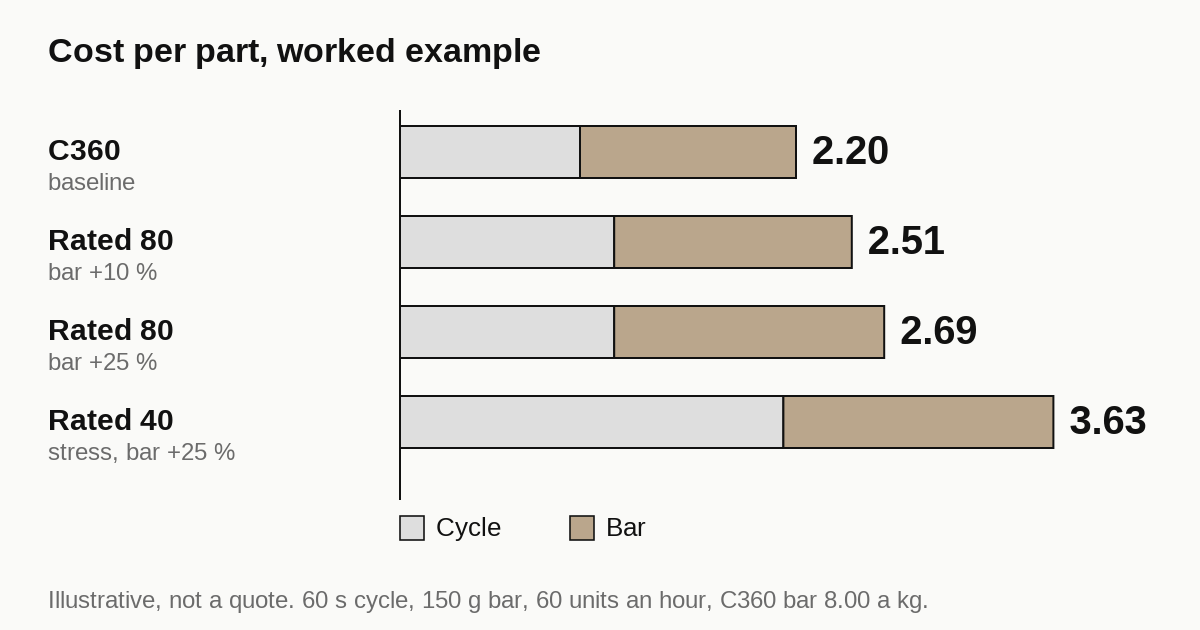
Three things show in the example. The cycle delta is 0.19 on a base cycle cost of 1.00. The bar delta is 0.12 at +10 percent and 0.30 at +25 percent, so the two are equal at a premium of about 16 percent. And a slow grade such as the stress case dominates both. A light part (20 grams of bar, a 10 second cycle with 7 seconds cutting) gives +14 and +21 percent with the same assumptions, so the shape holds across part sizes. Our general cost post says the bar price is usually the bigger line; the example shows that this depends on the premium and not on a rule.
Use the bar weight calculator for your own bar mass.
Paperwork lines
Two lines move the price without touching the machine. A material certificate per lot forces the shop to keep each bar lot apart through machining, finishing and packing and to record which parts came from which bar. A certificate with the first article only does not. Say which you need. Our brass parts cost drivers post covers the other lines in a brass quote.
Compliance testing of the finished product belongs to the product maker and is not a shop line. If a shop adds one, ask what test, by which lab, covering which parts.
The lines to ask for in the quote
- Alloy offered, with the lead value on its mill certificate.
- Bar price basis: fixed or metal surcharge, and its date.
- Cycle time basis, or at least the cutting share of the cycle.
- Setup and first-article charge, separate from the piece price.
- Tooling or fixture charge, if any.
- Certificate cost, per lot or per first article.
- Segregation and traceability: how lead-free bar is kept apart.
- Scrap or chip credit, stated or excluded.
- Quantity breaks, and the lead time on the bar.
Where the premium can shrink
Leave the alloy open on the drawing so the shop can offer whichever compliant bar it can buy that week. Check whether the stronger lead-free grade lets you thin a wall, which sometimes pays back part of the premium. Quote at the quantity you will really order, because setup spreads. Do not split an assembly between leaded and lead-free parts unless a weighted average calculation supports it for your market.
Next step
The rules that decide whether you need lead-free at all are in our guide to lead free brass. For the grades side by side, see C360 vs C69300 brass. To get a part quoted, send the drawing. We quote the finished parts within 24 business hours and place the work with one of the partner shops that turn brass.
Frequently asked questions
How much more does lead-free brass cost than C360?
I found no published price list for lead-free brass bar that I could verify, so I cannot give a bar percentage. The worked example in this post shows how the bar premium and the cycle combine: with a lead-free grade rated 80 and a 10 to 25 percent bar premium, the part cost rises roughly 14 to 22 percent in the example.
Is the extra cost in the bar or in machining time?
It depends on the numbers. In the example the cycle increase and the bar increase are about equal at a bar premium near 16 percent for a heavy part. Below that the cycle is the bigger line, above it the bar is. Ask a shop to show both lines separately so you can see which one drives your quote.
Does a machinability rating of 80 mean 25 percent more cycle time?
No. A rating combines cutting speed, surface finish and tool life, and only the cutting part of a cycle scales with it. Loading, indexing, cut-off and tool changes do not. The example scales cutting time by 100 over the rating as a simplification. Use it to compare options, not to predict a shop's cycle.
Why does a certificate per lot cost more?
A certificate per lot forces the shop to keep each bar lot apart through machining, finishing and packing and to record which parts came from which bar. That is a real operating cost. If you only need the certificate with the first article, say so and do not pay for the rest.
Alloys in this guide
| Alloy | Lead % | Mach. | DZR |
|---|---|---|---|
| C360 free-cutting brassC36000 · CuZn36Pb3 / CW603N | 2.5 to 3.7 | 100 | Poor |
| C69300 silicon brassC69300 · CuZn21Si3P / CW724R | under 0.09 | 80 | High |
| Bismuth brassC49300 / C49350 · No single EN equivalent, see supplier spec | under 0.25 | 80 | Moderate |
| CW511L lead-free brassC27450 (nearest, without arsenic) · CuZn38As / CW511L | under 0.2 | 40 | High |
Published typical values for the alloy. Machinability against C360 at 100. Not a promise from a shop.
Sources
- Smiths Metal Centres, C36000 free-machining brass datasheet smithmetal.com
- MakeItFrom, UNS C69300 silicon brass properties makeitfrom.com
- Wieland Concast, lead-free hardness and machinability ratings concast.com
- Wikipedia, Machinability en.wikipedia.org
Need a quote for this part?
Send the drawing. We read it, send one itemised quote for the finished parts within 24 business hours and place the work with a partner shop that turns brass. Brass only.
Get a quote for your brass parts