Guides / Choosing a Supplier
Quality Agreement for Brass Fittings: Lead, Leak Test and Change Notice Clauses
Published November 21, 2026. Reviewed for the facts in the corrections log.
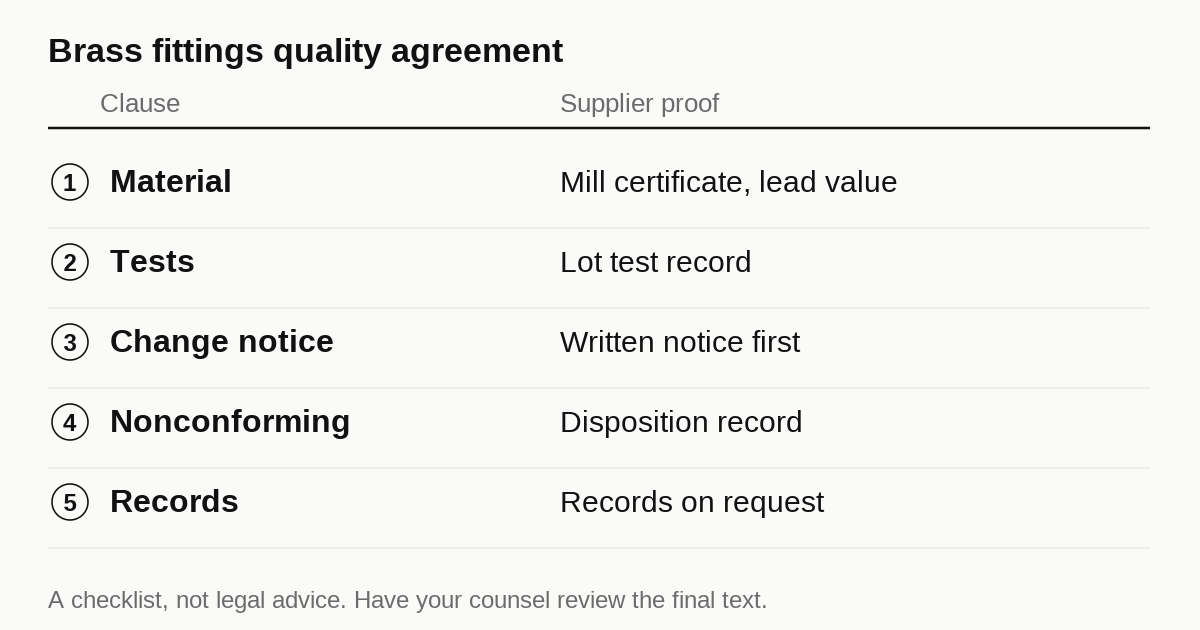
A quality agreement is a short document, signed before volume, that fixes what a purchase order cannot: the alloy and lead limit, the certificate per heat, the leak and thread tests, the changes the supplier must tell you about first, and what happens to a nonconforming lot. Use a clause table with the evidence the supplier gives for each line.
A purchase order says what you want today. It does not say what the supplier must do when the bar mill changes, when a plating line moves or when a lot fails a leak test. Those events decide whether a fitting in the field is still the fitting you approved, and they are the reason buyers of water, gas and HVAC brass fittings write a quality agreement before volume.
This guide lists the clauses to include and what evidence the supplier gives for each. It is a buyer’s checklist, not legal advice. Have your counsel review the final text before you sign it.
Quality agreement versus PO terms
Keep the two documents apart.
| Purchase order | Quality agreement | |
|---|---|---|
| Covers | One order: part, quantity, price, date | Every order for the part family |
| Changes | Each order | Rarely; revised by both sides in writing |
| Holds | Commercial terms | Material, tests, records, change control, nonconformance |
| Who reads it | Purchasing | Purchasing and quality on both sides |
ISO 9001 describes the buyer’s side. A company must communicate its requirements to its external providers: what is to be provided, how methods and equipment are approved, what competence is needed and what checks the buyer intends to run (Advisera, on clause 8.4; the information clause is 8.4.3 in the 2015 edition). A quality agreement is one way to put that information in writing for a supplier of turned brass.
Material clauses: alloy, lead limit, certificates per heat
Name the alloy by designation, not only by “brass”. Free-cutting brass C360 (UNS C36000) carries about 2.5 to 3.7 percent nominal lead. Silicon brass C69300 is a lead-free alloy at under 0.09 percent. The two machine differently and carry different compliance paths, so a drawing that says “brass” leaves the choice to the shop. See leaded and lead-free brass compared for the numbers.
Then name the rule. In the United States, the statute defines a lead free plumbing fitting by the lead content of its wetted surfaces: a weighted average of 0.25 percent or less, calculated from each wetted component’s lead percentage and its share of the wetted surface area, using the highest value if a material’s lead is given as a range (Cornell Law School). The EPA page on the rule describes the change from the earlier 8 percent figure to the 0.25 percent weighted average (EPA). NSF/ANSI 372 is the standard certifiers use to evaluate that lead content; see NSF/ANSI 61 and 372 for brass fittings. Other markets set other limits, so state the one that applies where you sell.
Ask for a mill certificate for each heat, with a measured lead value, and a lot record that ties your parts to the heat. For what a 3.1 certificate does and does not prove, see material certificates for brass.
Test clauses: leak test, thread gauging, sampling
State the test, not the intention. “Parts shall be leak tested” is not testable. Write the medium, the pressure, the hold time, the acceptance rule and the share of parts tested. For background on methods, hydrostatic testing fills a part with a nearly incompressible liquid, usually water, and checks tightness by watching for pressure loss, while a pneumatic test is an alternative where hydrostatic is not practicable and carries an explosion risk if a part fails (Wikipedia). If the supplier tests with air under water or by pressure decay, say which and what pressure. See leak and pressure testing of brass valve bodies.
Threads need the same precision. A tapered NPT thread and a parallel BSPP (G) thread need different gauges, and a gauge for one is not evidence for the other. Name the thread standard and the gauge type on the agreement. Thread gauging for brass fittings covers go and no-go use.
Sampling is where agreements go vague. Pick a sampling plan with a stated acceptance rule or require 100 percent testing for the characteristic that matters most. State who keeps the records.
Change notice: bar source, plating line, machine moves
Most brass fitting failures that surprise buyers follow a change nobody mentioned. The agreement should list the changes the supplier must tell you about before they take effect.
The production part approval process in the automotive industry is a useful model. It asks the supplier to obtain approval when a new or modified component is introduced or when the manufacturing process is changed, and it extends to sub-suppliers (Wikipedia). You do not need PPAP for fittings, but the idea carries over. ISO 9001 puts the same discipline on the supplier’s side: changes to production are reviewed and controlled to keep conformity (Advisera); that clause is 8.5.6, Control of changes, and Advisera’s 2026 comparison reports it unchanged (Advisera).
Write the notice period in working days and say what the supplier does until you reply: usually continue to ship the old configuration or hold the lot.
Need a quote for this part? Get a quote for your brass parts
Nonconforming product and containment
When a lot fails, the order of events matters more than the cause. ISO 9001 clause 8.7 describes controlling nonconforming outputs so they are not used or delivered by mistake, with actions such as segregation, containment, informing the customer and obtaining authorization for acceptance under concession (Advisera). Convert that into three lines.
- The supplier tells you in writing within a set number of working days of finding a nonconformance that may affect shipped parts.
- Suspect stock at the supplier is held and marked, and anything already shipped is traced by lot.
- No concession is accepted without your written approval for that lot.
Add the corrective action reply: cause, fix and prevention in writing, with a date.
Records and how long they are kept
Say which records the supplier keeps and for how long: mill certificates, lot and heat traceability, inspection and leak test results, gauge calibration and change records. Pick a retention period that matches the product’s life and your market’s liability rules, and have counsel confirm it. A record that no longer exists cannot help in a claim.
A clause checklist you can copy
| Clause | What to write | Evidence the supplier gives |
|---|---|---|
| Alloy | Designation and standard, for example C360 (UNS C36000) or C69300 | Mill certificate naming the alloy |
| Lead limit | The rule that applies in your market and how it is measured | Measured lead value on the certificate; listing or test report where the product needs one |
| Heat traceability | Each lot linked to a heat number | Lot record with heat number on every shipment |
| Segregation | Leaded and lead-free bar and parts kept apart | Written procedure; first piece XRF check on lead-free jobs |
| Threads | Thread standard, class and gauge type, for example NPT or BSPP | Gauge record for the lot; gauge calibration status |
| Leak or pressure test | Medium, pressure, hold time, share tested, acceptance rule | Test record per lot |
| Sampling | Plan and acceptance rule, or 100 percent test | Inspection report |
| Plating or finish | Process, thickness if it matters, plating house named | Plating certificate per lot |
| Change notice | List of changes needing approval and notice in working days | Written notice before the first shipment after the change |
| Nonconforming product | Hold, inform within set days, concession only with written approval | Written notification and disposition record |
| Corrective action | Cause, fix and prevention in writing | Corrective action reply |
| Records | What is kept and for how long | Records on request |
| Audit access | Right to review records, with notice | Records or visit on agreed terms |
| Governing document | Which wins if the drawing, PO and agreement differ | Order of precedence stated |
Using the agreement
Send it with the RFQ so the supplier prices the controls instead of discovering them later. Expect the supplier to push back on some lines, and expect honest pushback to be useful: a shop that says it cannot run 100 percent leak testing at your price has told you where the risk sits. Settle each point in writing and keep a signed copy with the drawing.
A first lot approved against these clauses is easier to repeat. For the step before volume, see pilot lot approval for brass fittings.
To get brass fittings quoted against a written quality agreement, send the drawing with the clauses you need. We quote the finished parts within 24 business hours and place the work with one of the partner shops that turn brass.
A note on this site. Brass CNC Parts writes no contracts for buyers and does not certify any shop or part. The table is a starting checklist. Have your counsel review any agreement before you sign it.
Frequently asked questions
What is a quality agreement for brass fittings?
It is a written agreement between a buyer and a supplier that sets the quality terms for a part family. It covers material, tests, records, changes and how problems are handled. A purchase order sets quantity, price and date for one order. The quality agreement applies to every order under it, so you write the terms once.
Do I need a quality agreement if I already have drawings and a PO?
A drawing fixes the part. It rarely says what the supplier must tell you when the bar source, plating house or machine changes, or what happens to a failed lot. If the fittings carry water, gas or a pressure rating, a one or two page agreement is cheap protection compared with finding a change after a field failure.
What lead limit should the agreement state for potable water fittings?
Name the rule the part must meet, not just the word lead free. In the United States the statute defines lead free for wetted surfaces as a weighted average of 0.25 percent lead or less. NSF/ANSI 372 is the standard certifiers use for that figure. Other markets use other limits, so write the one that applies where the fitting is sold.
Can a quality agreement replace inspection on arrival?
No. It tells the supplier what you expect and what proof to send. You still check the proof and the parts. Many buyers keep a light incoming check on thread gauging and certificates, and a periodic XRF reading on bar or parts. The agreement states what is checked at the supplier and what is checked by you.
Alloys in this guide
| Alloy | Lead % | Mach. | DZR |
|---|---|---|---|
| C360 free-cutting brassC36000 · CuZn36Pb3 / CW603N | 2.5 to 3.7 | 100 | Poor |
| C69300 silicon brassC69300 · CuZn21Si3P / CW724R | under 0.09 | 80 | High |
Published typical values for the alloy. Machinability against C360 at 100. Not a promise from a shop.
Sources
- Cornell Law School, 42 U.S.C. 300g-6, prohibition on use of lead pipes, solder and flux law.cornell.edu
- US EPA, use of lead free pipes, fittings, fixtures, solder and flux for drinking water epa.gov
- Advisera, clause-by-clause explanation of ISO 9001:2015 info.advisera.com
- Advisera, ISO 9001:2015 versus ISO 9001:2026, main differences advisera.com
- Wikipedia, Production part approval process en.wikipedia.org
- Wikipedia, Hydrostatic test en.wikipedia.org
Need a quote for this part?
Send the drawing. We read it, send one itemised quote for the finished parts within 24 business hours and place the work with a partner shop that turns brass. Brass only.
Get a quote for your brass parts