Guides / Choosing a Supplier
Pilot Lot Approval for Brass Fittings: Six Gates Before You Release Volume
Published November 21, 2026. Reviewed for the facts in the corrections log.
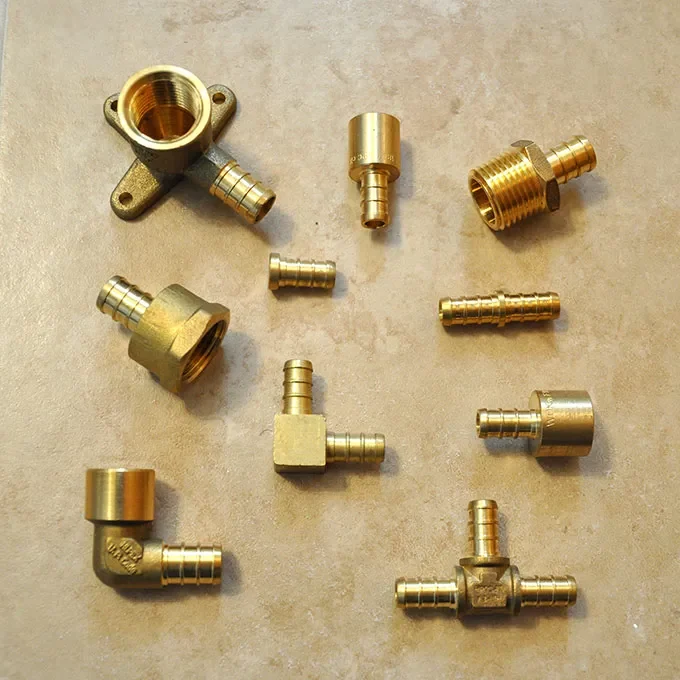
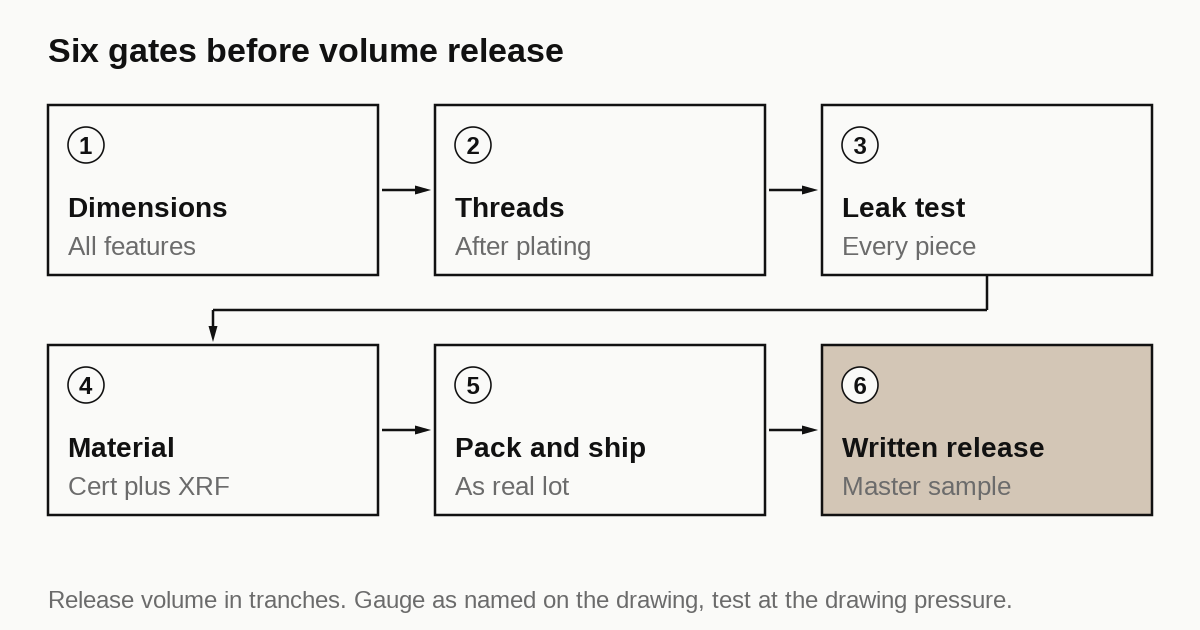
A pilot lot is a small run made with the production tools, bar and process, checked against the whole drawing before volume is released. It differs from a sample, which proves a part can be made once. Run six gates: dimensions, threads, leak test, material, packing and a written release, then order volume in tranches.
A good sample part is not a good supplier. A sample is often made on a careful setup, from bar picked for the job, by the shop’s best operator, in the hours when nobody else is waiting. A pilot lot is how you find out whether the shop can do the same thing again on an ordinary day.
For brass fittings the stakes are concrete. A fitting that fails after volume has shipped means leaks in the field, returns and a second round of tooling cost. This guide sets out a pilot lot that an importer can run in a few weeks with ordinary inspection tools.
Sample, first article and pilot lot are three steps
The words get mixed up, so fix them in the order.
A sample proves the part can be made. A first article inspection checks one part, or a few, against every requirement of the drawing to confirm the drawings, the process and the tooling agree (Wikipedia). A pilot lot repeats that on a lot made as production will run, and shows whether the result holds from one piece to the next.
Each step answers a different question. The sample asks whether it can be done. The first article asks whether this part meets the drawing. The pilot lot asks whether the process will keep meeting it. The quality checks that every machined brass part should pass are the content of the gates below, and prototype runs and minimum order quantity covers how to get to the first order in the first place.
Borrow the useful parts of PPAP
The production part approval process, PPAP, is a package that automotive buyers use to approve a supplier’s process before series production. It has five submission levels, from a part submission warrant alone to a warrant with samples and complete supporting data (Wikipedia). A fittings buyer rarely needs the full package. Four of its elements fit a pilot lot well:
- Dimensional results. A list of every dimension on a ballooned drawing with the measured result. The same source notes that a minimum of 6 pieces per product and process combination is usual in PPAP reports.
- Records of material tests. The mill certificates and test summaries, matched to what the drawing calls for.
- Checking aids. Pictures and calibration records of the special gauges used, such as thread gauges and test fixtures.
- A signed approval and a master sample. A sample signed off by both parties, kept as the reference for visual judgement.
Ask the supplier which of these it can supply before the quote, not after the pilot lot has run.
The six gates
1. Dimensions
Measure every ballooned feature on the pilot lot pieces you take, not only the critical ones. Compare the spread across pieces with the tolerance. A process capability index (Cpk) summarises that. One academic expert, as summarised on Wikipedia, recommends a minimum of 1.33 for an existing process with a two-sided tolerance and 1.50 for a new process (Wikipedia). Treat those numbers as a starting point for a conversation, not a pass mark. With a small pilot lot the index is only a rough guide, so also look at the plain spread on the key features.
2. Threads
Fittings live and die on the thread. Name the gauges and the standard on the drawing, and gauge after plating, because plating thickens the flank. The method is in thread gauging brass fittings. For a tapered NPT thread the check is how far the gauge enters, since a taper has no fixed pitch diameter (Wikipedia).
3. Leak test
Test every piece of the pilot lot at the drawing pressure with the medium the drawing names. It is cheap here and it separates the causes: porosity in the bar, a burr across a sealing face, a cross hole that breaks through. See leak and pressure testing for brass valve bodies for the methods and deburring cross holes for the usual culprit.
4. Material
Check the mill certificate for the heat that made the pilot lot, and test the bar or parts yourself. A lead-free order needs a measured lead value and a heat number you can trace, and an XRF reading on arrival (how to use XRF on brass). If volume will come from a different heat or bar supplier, say so now, because the pilot lot only proves the material it was made from.
5. Pack and ship
Ship the pilot lot the way the volume lot will ship, with the same packing, labels, lot codes and carrier route, then inspect on arrival. Brass can dull and mark in transit, and thread damage can happen in the box, not on the machine. Brass tarnish, packaging and shipping lists the usual failures. Plating and finish belong here too: see brass surface finishes and plating for what to measure.
6. Written release
End the pilot lot with a signed approval, not an email that says it looks good. Say what was checked, which pieces and what the result was, which deviations were accepted and why. Keep a master sample, and let the supplier keep one with the same serial or marking.
Need a quote for this part? Get a quote for your brass parts
Write the release rule before the lot is made
A release rule is a plain sentence both sides sign before the work starts. Acceptance sampling gives the language for it. A lot is accepted or rejected on the strength of a sample, and every plan carries statistical risks, such as an acceptable quality limit (Wikipedia). The table shows one way to state it.
| Result on the pilot lot | Decision |
|---|---|
| Every gate passes, spread well inside tolerance | Approve, release volume in tranches |
| A gate fails for a cause the shop fixes and shows | Conditional approval, repeat that gate on the first tranche |
| A gate fails and the cause is unknown | Reject, repeat the pilot lot |
| Paperwork is missing or does not match the parts | Hold, nothing ships until the records match |
This is an example of the structure, not a standard. Set your own limits with the supplier for each part.
Release volume in tranches
Approval of a pilot lot proves a process on one day. Release the first volume order in tranches, for example a first shipment that is inspected hard and then later shipments inspected on a lighter plan once the results hold. State in the order what changes the plan back to hard inspection: a new bar heat, a new tool, a drawing revision, a change of plating house or a change of shop. The list of changes matters more than the number of pieces.
What to write on the RFQ
Pilot lot of [quantity] pieces made on production tooling and bar.
Supplier delivers: ballooned drawing with measured results, mill
certificate for the heat used, thread gauge record, leak test record
at [pressure and medium], packing as for production.
Buyer approves in writing before volume is released.
Master sample kept by both parties.
If you are still choosing a shop, the questions to ask first are in how to choose a brass machining shop.
Need brass fittings quoted with a pilot lot written in? Send the drawing. We quote the finished parts within 24 business hours and place the work with one of the partner shops that turn brass.
A note on this site. Brass CNC Parts runs no inspections. A pilot lot is agreed and judged between you and the shop you choose.
Frequently asked questions
What is the difference between a sample and a pilot lot?
A sample shows that a shop can make the part once, often with a setup and bar that will not be used again. A pilot lot is made on the production tools, with the production bar and process, in enough pieces to show the process repeats. Approve volume from the pilot lot, not from the sample.
How big should a pilot lot be?
No standard fixes the size. Choose enough pieces to cover at least one full lot of bar, a normal run of the tooling and the sample size your inspection plan needs, and agree the number in writing before the order. For a low-volume part the pilot lot may be the first small production order.
Should every fitting in a pilot lot be leak tested?
Yes, where the fitting holds pressure. Testing every piece of a pilot lot is cheap compared with finding a leak in volume, and it shows whether leaks come from porosity, burrs or cross holes. Once the process proves stable, sampling can replace full testing if the buyer and supplier agree it in writing.
Do I need a PPAP for brass fittings?
Only if you or your customer require it. PPAP is an automotive-origin package with five submission levels. Many fitting buyers use a lighter set from it: a ballooned drawing with measured results, material certificates, test records, a signed approval and a retained master sample.
Alloys in this guide
| Alloy | Lead % | Mach. | DZR |
|---|---|---|---|
| C360 free-cutting brassC36000 · CuZn36Pb3 / CW603N | 2.5 to 3.7 | 100 | Poor |
| C69300 silicon brassC69300 · CuZn21Si3P / CW724R | under 0.09 | 80 | High |
Published typical values for the alloy. Machinability against C360 at 100. Not a promise from a shop.
Sources
- Wikipedia, Production part approval process en.wikipedia.org
- Wikipedia, First article inspection en.wikipedia.org
- Wikipedia, Acceptance sampling en.wikipedia.org
- Wikipedia, Process capability index en.wikipedia.org
- Wikipedia, National pipe thread en.wikipedia.org
Need a quote for this part?
Send the drawing. We read it, send one itemised quote for the finished parts within 24 business hours and place the work with a partner shop that turns brass. Brass only.
Get a quote for your brass parts