Guides / Choosing a Supplier
A Supplier Scorecard for Machined Brass Parts: On-Time, Rejects and Lead Records
Published November 21, 2026. Reviewed for the facts in the corrections log.
A scorecard for a machined brass supplier needs four counts from your own records: on-time delivery by order line, rejects in parts per million at incoming inspection, the share of lots that arrived with a mill certificate showing a lead value, and the days the supplier takes to answer a problem in writing. Review them every quarter.
Most importers judge a brass supplier by memory. The last shipment was late, so the shop feels slow. The last one was clean, so it feels good. Memory weights the recent and the dramatic, and it gives you nothing to show the shop when you want something to change.
A scorecard replaces the feeling with four counts. This guide gives the four, the formula for each, example bands and a review rhythm. It suits an importer with repeat brass orders from one or more shops.
Why a scorecard at all
Supplier evaluation is a continual process in which a supplier is scored and then approved or not, often onto an approved supplier list, and re-evaluated on a periodic and often annual basis. A study cited there found that every example it reviewed used both quality and delivery as evaluation factors (Wikipedia). That gives two of our measures. Brass adds a third, because the material record is part of the product when the order is lead-free. The fourth covers how a shop behaves when something goes wrong, which is where suppliers differ most.
The same source warns that an appraisal system has a cost in time. Keep the card small. Four numbers you actually update beat twelve you do not.
Measure 1: on-time delivery
Formula: order lines delivered by the agreed date divided by order lines due in the period, as a percentage.
Three rules keep it honest:
- Count order lines, not orders. A ten-line order that ships nine lines on time is not one late order, it is nine good lines and one late line.
- Fix the date. Score against the date the shop confirmed, not the date you hoped for. If you change the date, record the new one and the reason.
- Say what “delivered” means. Lead time can include shipping time, because the buyer needs to know when parts will be available (Wikipedia). Agree whether the date is ex-works ready or arrival at your dock, and use the same one every time. Score a shop on its own part of the delay only if you can separate the carrier’s.
Measure 2: rejects in parts per million
Formula: pieces rejected at incoming inspection divided by pieces received, times 1,000,000.
Use pieces, not lots, because a lot with two bad parts in 5,000 is a different event from a lot rejected whole. Count only rejects that your inspection records show. Keep field returns in a separate column, since they arrive months later and come from a different cause.
Watch the arithmetic on small orders. One reject in 500 pieces is 2,000 parts per million. One reject in 50,000 is 20. The same single bad part moves the number by a factor of 100, so read the figure over a quarter and look at the reject reasons next to it. Quality checks for machined brass parts lists the usual ones, and thread gauging for brass fittings covers the single most common failure on fittings.
Measure 3: lead records
Formula: lots received with a mill certificate showing a measured lead value and a heat number, divided by lots received, as a percentage.
This is the measure that is specific to brass. A mill certificate is issued by the manufacturer and gives the test results for the material supplied (Wikipedia), so it is the record that ties a lot of parts to a bar. Score a lot as complete only when three things are present:
- The certificate names the heat that made your parts.
- It shows a measured lead percentage, not just a statement that the material conforms.
- The heat number appears on the shop’s lot record for your parts.
Add a second line if you test on arrival: how many of your XRF readings agreed with the certificate. XRF checks on brass bar covers how to read it, and the full document list is in lead-free brass compliance documents. Material certificates for brass parts explains what a 3.1 certificate does and does not prove.
For orders without a lead requirement, swap in the record the drawing does ask for, such as plating thickness or a pressure test report. Score the paper the drawing demands.
Measure 4: response to a problem
Formula: working days from your written report of a problem to the supplier’s written corrective action reply.
A reject is a fact. What the shop does next tells you whether it will reject again. The 8D method, developed at Ford, is a team-based way to identify, correct and eliminate recurring problems (Wikipedia), and corrective and preventive action, CAPA, is the wider term for acting on a non-conformity so it does not recur (Wikipedia). You do not need either in full. Ask for three things in writing: the cause found, the fix made and what stops it happening again. Time how long that takes, and note whether the cause named is believable.
Need a quote for this part? Get a quote for your brass parts
Example scoring bands
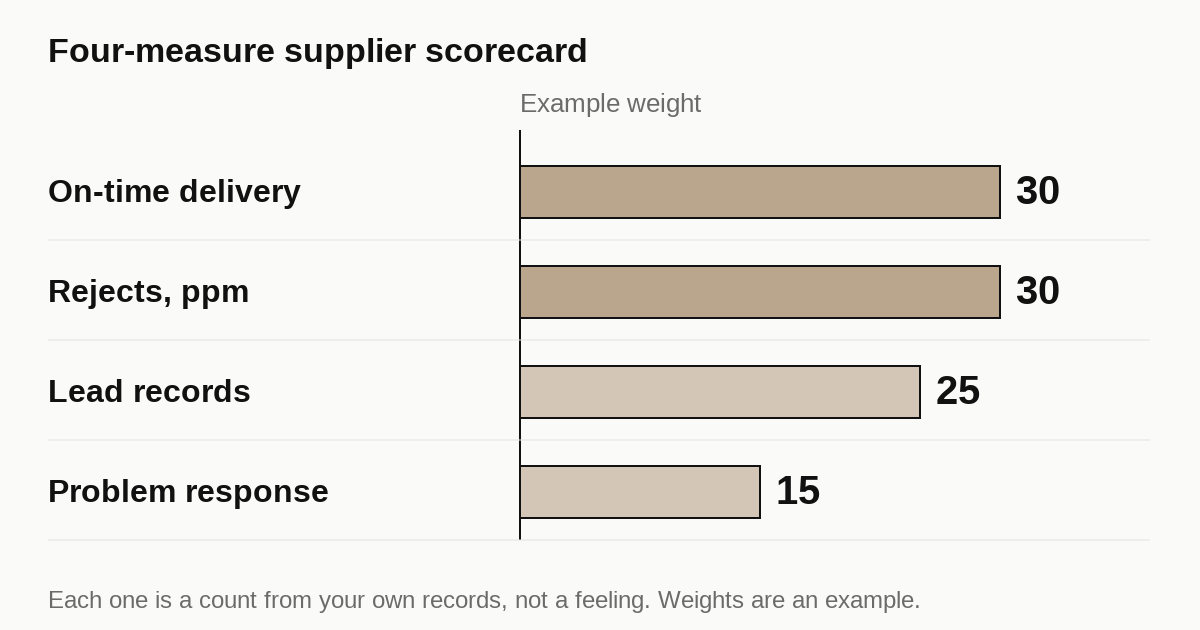
A composite number is optional. If you want one, convert each measure to points with bands you set once, then apply weights. The bands below are an example, not a standard.
| Points | On-time | Rejects per million | Lead records | Days to written reply |
|---|---|---|---|---|
| 100 | 95 percent or more | Under 500 | 100 percent | 3 or fewer |
| 70 | 90 to 94 percent | 500 to 2,000 | 95 to 99 percent | 4 to 7 |
| 40 | 80 to 89 percent | 2,001 to 5,000 | 90 to 94 percent | 8 to 14 |
| 0 | Under 80 percent | Over 5,000 | Under 90 percent | Later, or none |
| Example weight | 30 | 30 | 25 | 15 |
A worked quarter. The shop delivered 92 percent of lines on time (70 points) and had 1,200 rejects per million (70). Every lot carried a lead value (100) and the one problem was answered in 3 working days (100). The weighted score is 0.30 x 70 + 0.30 x 70 + 0.25 x 100 + 0.15 x 100 = 82.
Pick bands that fit your parts. A safety-critical fitting deserves tighter reject bands than a decorative knob. Agree them with the supplier before the quarter starts, so the card is a shared tool and not a surprise.
A rule that overrides the score
A single number can hide a serious gap. Add one rule above the score: a lot that arrives with no measured lead value on a lead-free order is held, whatever the score says, and the supplier is told why in writing. The same goes for a reject that traces to a wrong alloy.
Review rhythm
- Monthly: update the four counts from receiving and purchasing records. Ten minutes in a spreadsheet.
- Quarterly: share the card with the supplier and discuss the one measure that moved most.
- Yearly: decide whether the shop stays on your approved list, and whether to qualify a second source.
- On any change: new bar heat or bar source, new tooling, a revision, or a new plating house. Return to hard inspection for the first lot after the change and score it separately. A pilot lot approval is the formal version of that.
If you are still choosing between shops, how to choose a brass machining shop covers the questions to ask before the first order.
What to write on the RFQ
Supplier delivers with each lot: mill certificate with measured lead
value and heat number, inspection record, packing list by order line.
Delivery date confirmed in writing per order line.
Problems answered in writing: cause, fix and prevention.
Buyer reviews on-time delivery, rejects, material records and
response time every quarter.
Need brass parts quoted from shops that can meet records like these? Send the drawing. We quote the finished parts within 24 business hours and place the work with one of the partner shops that turn brass.
A note on this site. Brass CNC Parts does not score or rate shops. Keep your own records, because the scorecard is only as good as the counts behind it.
Frequently asked questions
What should a supplier scorecard for brass parts measure?
Start with four counts: on-time delivery by order line, rejects in parts per million at incoming inspection, lots that arrived with a mill certificate showing a lead value, and days to a written corrective action reply. All four come from your own receiving and purchasing records, so no extra system is needed beyond a spreadsheet.
How is parts per million calculated for rejects?
Divide the pieces rejected at incoming inspection by the pieces received, then multiply by 1,000,000. If you receive 8,000 pieces and reject 16, the result is 2,000 parts per million. With small lots one reject moves the figure a long way, so judge it over a quarter, not a single shipment.
How often should I review a brass supplier?
Review every quarter while the relationship is young and the volumes are small, then at least once a year. Supplier evaluation is described as a continual process with periodic re-evaluation, often annual. Add an ad hoc review after any serious reject or a change of bar source, tooling or plating house.
Should lead records be part of a scorecard for non-water brass parts?
Yes, if the order calls for lead-free or restricted material. A missing lead value means you cannot show what the bar was. For parts with no lead requirement, replace the measure with whatever record the drawing asks for, such as heat numbers or plating thickness. The point is to score the paper the drawing demands.
Alloys in this guide
| Alloy | Lead % | Mach. | DZR |
|---|---|---|---|
| C360 free-cutting brassC36000 · CuZn36Pb3 / CW603N | 2.5 to 3.7 | 100 | Poor |
| C69300 silicon brassC69300 · CuZn21Si3P / CW724R | under 0.09 | 80 | High |
Published typical values for the alloy. Machinability against C360 at 100. Not a promise from a shop.
Sources
- Wikipedia, Supplier evaluation en.wikipedia.org
- Wikipedia, Lead time en.wikipedia.org
- Wikipedia, Eight disciplines problem solving en.wikipedia.org
- Wikipedia, Corrective and preventive action en.wikipedia.org
- Wikipedia, Mill test report en.wikipedia.org
Need a quote for this part?
Send the drawing. We read it, send one itemised quote for the finished parts within 24 business hours and place the work with a partner shop that turns brass. Brass only.
Get a quote for your brass parts