Guides / For Shops
Fixture and Gauge Charges on a First Brass Order Without Losing the Buyer
Published November 21, 2026. Reviewed for the facts in the corrections log.
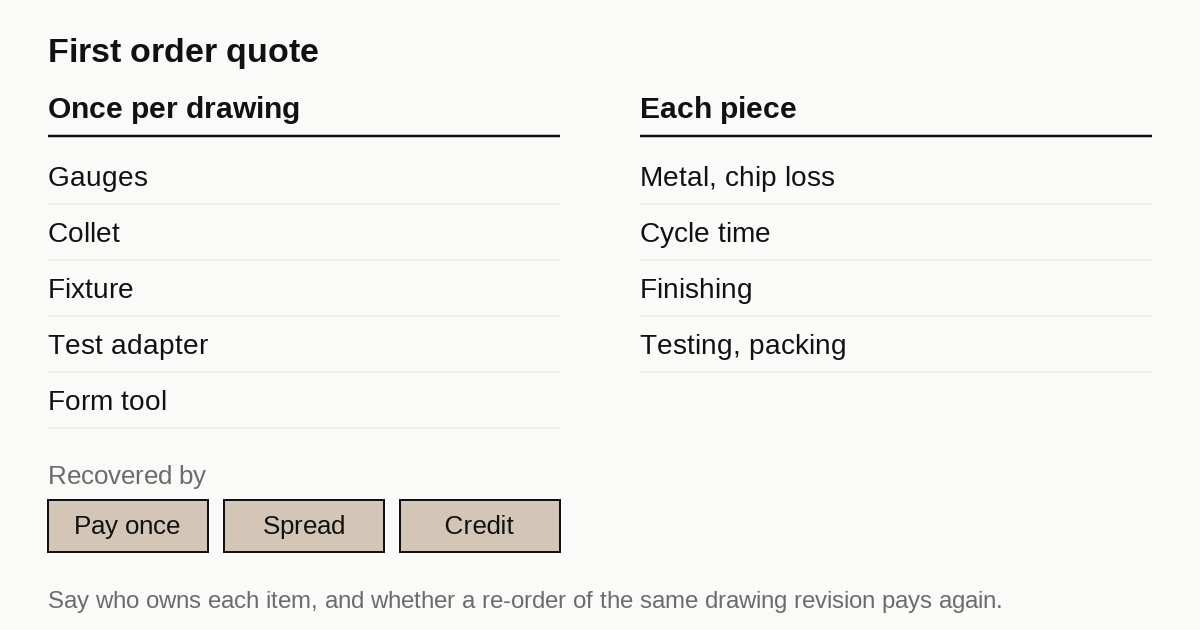
Quote fixture and gauge charges on a first brass order as separate lines, listed item by item, so the buyer sees one-time cost apart from the piece price. Offer a clear route to recover it: pay once, spread over agreed pieces or credit against volume. State who owns each item and what happens if the order stops.
A buyer sends a drawing for a brass fitting body and asks for a price on 500 pieces. You know the first run needs a thread ring gauge for the sealing thread, a collet for a hex bar you do not stock and a set of soft jaws for the second operation. Put all of that into the piece price and the quote is too high for a first order. Leave it out and you pay for it yourself. Quote it as one lump called “tooling” and the buyer cannot tell what is real.
This post is for the owner or export sales engineer of a turning shop. It shows which items belong on the list, how to split them from the piece price and three ways to recover them without losing the buyer. The general split of fixed and variable cost is in quoting a brass fittings family; here the subject is the specific items on a first order.
What counts as a fixture or gauge charge
Fictiv lists fixture design and qualification, workholding setup, tool offset verification and first article inspection as parts of the fixed cost paid before production starts. Not all of that is a separate charge. Programming and setup normally sit in your setup share. The items below are physical things made or bought for this part, which is why a buyer can see them as separate lines.
| Item | Why it comes up on brass work | How to treat it |
|---|---|---|
| Thread ring and plug gauges | Sealing threads are gauged, not measured. Pipe threads have their own gauge standards: ISO 228-2 for parallel G threads and ISO 7-2 for tapered R threads, and ASME B1.20.1 is the NPT standard | Charge only if made or bought for this thread or class. A standard gauge you own is overhead |
| Special collet or guide bushing | Hex and special profile bar needs support on the flats. A bushing supplier quoted by Cutting Tool Engineering says custom shapes are possible and that non-round profiles generally do not need ground bar | Charge if you do not stock the size or profile |
| Soft jaws, pie jaws or a second-operation fixture | Brass is soft and thin walls move under clamp pressure | Charge only if the geometry needs more than your standard jaws |
| Leak test adapter | A pressure test needs a fixture that seals on the part | Charge when the buyer’s test needs a part-specific adapter. See leak test and gauge station setup |
| Special form tool or marking fixture | One drawing, one tool | Charge if no other job will use it |
The right-hand column matters more than the left. A buyer who sees that you charge for a ring gauge made for this thread and not for the micrometers on your bench takes the other lines as honest.
Do you need a fixture at all on the first order
A first order is often a small run. JLCCNC describes standard workholding as better suited to varied jobs, changing designs, prototypes and lower quantities, and custom fixturing as best suited to recurring production, demanding tolerances and specialized geometries. Read that as a rule for your own quote: on a first lot, try standard vises, collets and soft jaws first, and propose a dedicated fixture when the buyer commits to repeat volume.
There are cases where the dedicated item is right from the start. JLCCNC names two: critical features that depend on one controlled datum scheme, and reclamping that could add alignment variation. Makera warns that improper clamping applies uneven pressure and distorts delicate parts, and recommends soft jaws or multiple-point supports. A thin-walled brass body that goes oval in the jaws is that case, and the fixture is not an extra. It is what makes the part pass.
Say which case you are in. “Standard jaws, no charge, review after the pilot lot” is a legitimate quote line. It also links to pilot lot approval for brass fittings, where a buyer decides whether to release volume.
Three ways to recover the cost
Fictiv shows why the question exists. A fixed cost does not shrink with a bigger order, it divides. If the one-time charge is C and the order is Q pieces, the adder per piece is C divided by Q. Ten times the quantity makes the adder ten times smaller. On a first order of a few hundred pieces it is large. On a year of releases it is small.
| Route | What you write | Risk for you | Risk for the buyer |
|---|---|---|---|
| Pay once with the order | A separate line, invoiced on the first order | None on recovery. You may lose the quote | Pays full cost before knowing the part works |
| Spread over agreed pieces | A stated number of pieces, with an adder on each | Balance left if the buyer stops early | Higher piece price during the spread |
| Credit against volume | Charged once, credited back at a stated total quantity | You carry the cost until the volume arrives | Needs the volume to get the credit |
Pick the route by how sure the volume is. For a buyer with a forecast and release dates, spreading works. For a buyer with only a first prototype order, ask for payment once, and keep the amount small by choosing standard items where you can. For a buyer who wants to commit but not yet, the credit route turns a charge into a reason to place the next order with you.
Whichever you use, write the true-up. If the spread covers 3,000 pieces and the buyer stops at 1,200, say that the unrecovered balance is invoiced. It is a normal sentence on a quote, and the buyer who sees it knows the shop has done this before.
Turn brass every week? Apply as a partner shop
Gauges: whose gauge counts
Gauges bring a second question that fixtures do not: whose gauge is the reference. A go/no-go gauge is pass or fail. Wikipedia describes the GO end entering fully and the NOT GO end not entering, and notes that toolmakers often make custom designs. Two gauges that are both good can still disagree at the limit.
Settle it on the first order:
- Write the thread standard and class on the quote, with the gauge standard that goes with it. A G thread and an R thread are gauged to different parts of different standards.
- If the buyer has its own gauge, agree to compare one master pair before the first article. If it does not, say that your calibrated gauge is the reference and send the gauge identity and calibration record with the first article.
- Expect to hand over the record. In the production part approval process described on Wikipedia, a checking aids element shows the tool and its calibration records, and measurement system analysis often contains a gauge R&R for the critical characteristics. A buyer who asks for these is asking for the paperwork you should already have.
Plating changes the reading on a thread. See thread gauging brass fittings for when to gauge, before or after the finish.
How to write it on the quote
Keep the lines plain and keep amounts next to each one. A layout that works:
One-time items for drawing 1234 rev B, quoted separately
1. Thread ring gauge, 1/2-14 NPT, 1 pc, shop-owned, used on every lot
2. Collet for 22 mm hex bar, 1 pc, shop-owned
3. Soft jaws for second operation, 1 set, shop-owned
Recovery: spread over the first 3,000 pieces; balance invoiced if stopped sooner
Re-order: no charge for the same drawing revision
Ownership: items stay at the shop and are used for this drawing only
Each line has an item, a quantity, an owner and a use. The recovery line and the re-order line are one sentence each. The amounts go in a column beside them from your own cost data.
What loses the buyer
- One lump called tooling with no breakdown. The buyer cannot compare it with other quotes.
- Charging for items you already own and will use on other work.
- A fixture where soft jaws would do. Buyers learn this from the next quote they receive.
- Silence on ownership and on re-orders. If the buyer must ask, the answer will be read as an afterthought.
- Charging again on a re-order of the same revision. A buyer who sees the same charge twice for the same part will start asking other shops for a quote.
- Piece price that quietly includes the fixture while a separate line also shows it.
For the rest of the quote, quoting brass parts: what machine shops get wrong most and brass parts minimum order quantity cover the mistakes that show up around it.
Checklist
- Every one-time item listed on its own line with quantity, owner and use.
- Standard items you already own left out of the charge.
- A statement of whether standard jaws and collets are used for the first lot.
- One recovery route chosen: pay once, spread over agreed pieces or credit against volume.
- A true-up sentence if the cost is spread.
- Thread standard, class and gauge standard written on the quote.
- Gauge identity and calibration record ready for the first article.
- Ownership and re-order of the same revision stated in one line each.
Talk to us
If you turn brass fittings and want to be considered for first orders with gauge and fixture requirements, apply through the shop page. We reply within 24 business hours.
Sources
- Fictiv, manufacturing cost per quantity
- JLCCNC, custom fixturing: design principles and workholding methods
- Makera, 7 CNC strategies to minimize distortion in thin walled parts
- Cutting Tool Engineering, let precision be your guide
- Wikipedia, Go/no-go gauge
- Wikipedia, British standard pipe thread
- Wikipedia, National pipe thread
- Wikipedia, Production part approval process
Frequently asked questions
Should a shop charge for thread gauges on a first brass order?
Charge only for gauges made or bought for that drawing, such as a special thread or a custom check fixture. A standard go/no-go plug or ring you already own and will use on other work is a cost of doing business. List the new items one by one so the buyer can see what is specific to the part.
Is it better to charge fixtures up front or spread them over the piece price?
Each has a cost to you. Up front removes your risk but can lose the quote. Spreading it over the piece price wins more first orders but leaves a balance if the buyer stops early. Many shops choose a middle route: a stated number of pieces, with the unrecovered balance invoiced if the order ends sooner.
Who owns a fixture the buyer has paid for?
Decide it before the order, in writing. Ownership is a different question from where the item is kept. A common reading is that the buyer owns what it paid in full, and the shop keeps it for that buyer's work only. If the buyer paid a share, say what the share buys. Silence causes the arguments.
Do I charge again when the buyer re-orders the same part?
Not for the same drawing revision, if the item is still in good condition. Fictiv notes that a job re-quoted and re-run from scratch resets the fixed cost clock, even for an identical part. Buyers know it. A written no-charge re-order for the same revision gives the buyer a reason to place the first order with you.
Alloys in this guide
| Alloy | Lead % | Mach. | DZR |
|---|---|---|---|
| C360 free-cutting brassC36000 · CuZn36Pb3 / CW603N | 2.5 to 3.7 | 100 | Poor |
Published typical values for the alloy. Machinability against C360 at 100. Not a promise from a shop.
Sources
- Fictiv, manufacturing cost per quantity fictiv.com
- JLCCNC, custom fixturing: design principles and workholding methods jlccnc.com
- Wikipedia, Production part approval process en.wikipedia.org
Turn brass every week?
Brass CNC Parts sends brass work requests and nothing else. We are your customer: you quote us and we place the purchase order. No fee to join.