Guides / For Shops
Faster Changeovers on Swiss and Multi-Spindle Brass Work by Grouping Part Families
Published November 21, 2026. Reviewed for the facts in the corrections log.
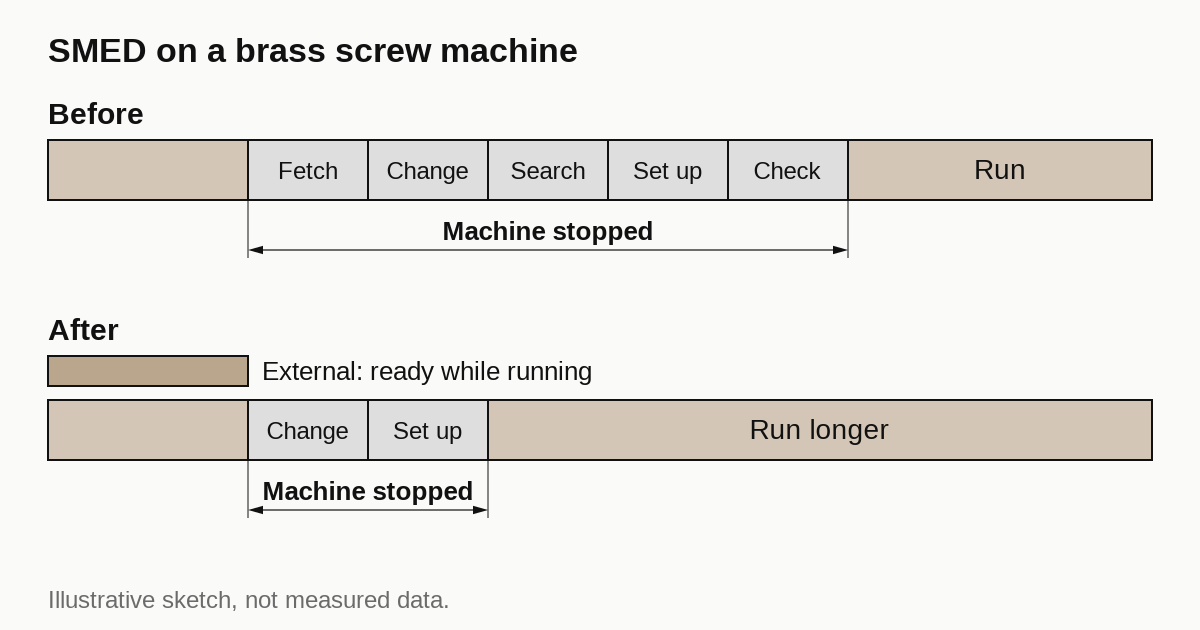
To cut changeover time on a brass screw machine, time one changeover step by step, then separate the tasks done while the machine runs from those that need it stopped, and move as many as possible into the first group. Group fittings into part families that share bar size, collet, thread and tools so each switch is small.
On a screw machine making brass fittings, the cut is fast and the changeover is slow. A part that takes seconds to make can sit behind a changeover that takes much longer. That ratio decides whether a small lot pays, and whether a shop can run what the buyer needs this month instead of what is cheapest to set up.
This guide applies the lean setup-reduction method SMED to Swiss-type and multi-spindle brass work. It shows how to time one changeover, how to group fittings into part families, what to prepare before the machine stops and how to sequence families on the schedule. A part-family matrix and an observation sheet are included.
Why changeover decides brass part cost
Single-minute exchange of die, or SMED, is a lean method for cutting the time to switch a process from one product to the next. Shorter changeovers allow smaller lots, which lowers inventory and evens out flow (Wikipedia). The name refers to a changeover in single-digit minutes, not literally one minute. Shigeo Shingo developed the approach.
For a brass shop, three costs follow from a long changeover.
- The machine is idle. Every hour stopped is an hour not cutting.
- Lots get larger. To spread the setup, the shop runs more parts than the buyer needs now, and the extra becomes stock.
- Small orders get refused or priced high. A buyer who wants a few hundred pieces pays for the whole setup.
Screw machines are where this bites. Multispindle machines commonly have six spindles, each station can hold several tools on a turret or slide and complex shapes often use form tools carrying the reverse of the part contour (Wikipedia). Switching a six-station machine to a new part can change a lot of tools. Swiss-type machines carry fewer tools but still need the bar size, collet and guide bushing to match each diameter. See Swiss machining of brass parts and multi-spindle screw machines for brass for the machines themselves.
Measuring one changeover step by step
Do not guess. SMED targets the time between the last good piece of one product and the first good piece of the next (Wikipedia). Measure exactly that.
- Pick a changeover you do often.
- Film it from the stop to the first good piece, or have one person time each step with a stopwatch.
- Write every step on the observation sheet below, with who did it and how long it took.
- Mark each step as internal (machine stopped) or external (could be done while running).
- Review it with the operator. Operators know which steps are waiting, fetching or searching.
Expect to find that the tool changes themselves are only part of the stop. Fetching a collet, finding the program, waiting for a gauge or waiting for the first-piece check often fill a good share of it. Only the stopwatch will tell you for your machine.
Changeover observation sheet
| Step | Who | Internal or external | Start | End | Minutes | Notes |
|---|---|---|---|---|---|---|
| Last good piece off, machine stopped | Operator | Internal | ||||
| Remove remaining bar, clear feed tube | Operator | Internal | ||||
| Fetch collet, guide bushing, tools | Operator | External | Could this be done before the stop? | |||
| Change collet and bar feed fittings | Operator | Internal | ||||
| Change tools in stations | Operator | Internal | ||||
| Load program | Operator | External | ||||
| Set first-piece offsets | Operator | Internal | ||||
| First-piece measurement and thread gauge | Inspector | Internal | Gauge ready? | |||
| First good piece released | Inspector | Internal |
Copy this sheet for each changeover you study and keep the filled sheets. They are your baseline.
Part families by bar size, thread and length
A part family is a group of parts that need almost the same setup. Group brass fittings by what actually changes at the machine.
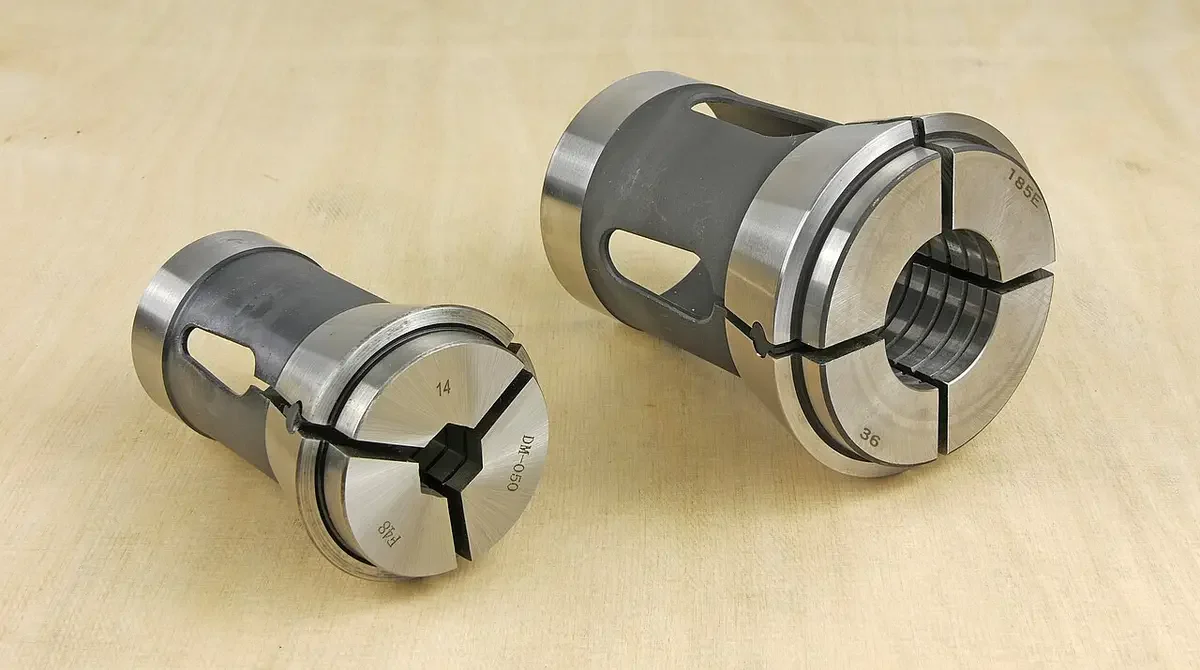
- Bar size and shape. Collets have a narrow clamping range, so many sizes are needed to cover a range of stock (Wikipedia). Parts on the same bar share the same collet, feed tube and often the guide bushing.
- Thread type. Tapered NPT, parallel G and metric threads need different taps, dies or thread rolls. Parts with the same thread series share them.
- Length and feature set. Parts of similar overall length with the same cross-drilled or milled features share stops and live tools.
Build a matrix. The entries below are examples.
| Family | Bar diameter | Collet | Thread | Shared tools |
|---|---|---|---|---|
| A: 1/4 NPT male adapters | 14 mm hex | 14 mm hex collet | 1/4 NPT | Threading tool or die, drill, chamfer tool |
| B: 3/8 NPT male adapters | 17 mm hex | 17 mm hex collet | 3/8 NPT | Same tool types, larger size |
| C: G 1/4 parallel unions | 14 mm hex | 14 mm hex collet | G 1/4 | Parallel thread tool, shared drill with family A |
| D: M10 metric connectors | 12 mm round | 12 mm collet | M10 x 1 | Metric thread tool |
Families A and C share the collet and the bar, so moving between them is a small changeover. Moving from A to B changes the collet and the bar. The matrix shows that at a glance, and the schedule can use it.
Turn brass every week? Apply as a partner shop
External setup: tools, collets and programs ready before the stop
The central move in SMED is converting internal work to external work. Shingo describes four stages: do external tasks while the machine still runs; separate external from internal tasks and check that parts work; convert internal tasks into external ones; then streamline what remains (Wikipedia).
For a brass screw machine the external list looks like this:
- The next job’s tool kit pulled, checked and placed on a cart beside the machine.
- Collet, guide bushing and feed tube for the next bar size on the cart, cleaned and inspected.
- Program loaded to the control and checked on screen before the stop, not after.
- Gauges for the next first piece checked for calibration and placed by the machine.
- Bar for the next job staged at the feeder, tagged with alloy and heat. See keeping leaded and lead-free bar apart.
- Job card filled in with the first-piece sign-off lines.
Prepare a kit per family, in a labelled tray or on a shadow board. A kit that is always complete removes the search step.
Standard tooling for brass families
Standardize what does not need to differ. Use the same tool holder style across a family. Keep the same stop positions where the part design allows. Hold one tool list per family and one setup sheet that names the tools, the starting offsets and the first-piece checks. The sheet becomes the plan for the next changeover and the first record for an operator who has not run the family before.
Standard tooling also shrinks the kit. Fewer unique tools means fewer to stock, check and misplace.
Sequencing families on the schedule
A good schedule meets due dates and also reduces changeovers and inventory (Wikipedia). With families defined, sequence them so the large changes happen least often: the same bar size together, then the same thread series within that, and the big changes at natural breaks such as the end of a shift.
Heijunka-style leveling interleaves products that share a process in small batches. It works only when changeovers are short enough for small batches to pay (Wikipedia). Aim for it after the first round of SMED, not before.
Due dates stay in charge. If a job in a family block will miss its date, pull it out and run it early. See production scheduling for a brass turning shop for the weekly board that holds these sequences.
Re-time a changeover every few months. The first improvement is rarely the last, and a new operator or a new part can bring old delays back. Keep the observation sheets and the family matrix in one place, update the matrix when a new part number arrives and ask at each quote whether the part fits an existing family. A part that fits a family is cheaper to run and easier to schedule, and a part that does not fit tells you the quote should carry a full setup.
If you run brass on Swiss or multi-spindle machines and want work that fits your families, apply as a partner shop. We are your customer, and there is no fee to join.
Frequently asked questions
What is SMED?
SMED stands for single-minute exchange of die. Shigeo Shingo developed it as a method to cut the time to switch a machine from one product to the next. The name means a changeover in single-digit minutes, not one minute. The core move is to turn work done with the machine stopped into work done while it still runs.
What is the difference between internal and external setup?
Internal setup tasks can only be done while the machine is stopped, such as swapping a collet. External setup tasks can be done while it is still running, such as fetching tools, checking gauges or loading the next program. Moving tasks from internal to external is the central step of the method.
What is a part family?
A part family is a group of parts that share bar size, collet, thread type and most tools, so switching between them needs few changes. For brass fittings a family is often a thread series on one bar size. Running a family together on the schedule means fewer large changeovers and more small ones.
Does faster changeover help a small brass shop?
Yes, mainly because shorter changeovers make smaller lots practical. A shop can then run what the buyer needs this month instead of building large lots to spread the setup. Measure first, because the longest delay in a changeover is often waiting for tools or a program, not the machine work itself.
Alloys in this guide
| Alloy | Lead % | Mach. | DZR |
|---|---|---|---|
| C360 free-cutting brassC36000 · CuZn36Pb3 / CW603N | 2.5 to 3.7 | 100 | Poor |
| C69300 silicon brassC69300 · CuZn21Si3P / CW724R | under 0.09 | 80 | High |
Published typical values for the alloy. Machinability against C360 at 100. Not a promise from a shop.
Sources
- Wikipedia, Single-minute exchange of die en.wikipedia.org
- Wikipedia, Automatic lathe en.wikipedia.org
- Wikipedia, Collet en.wikipedia.org
- Wikipedia, Heijunka en.wikipedia.org
- Wikipedia, Scheduling (production processes) en.wikipedia.org
Turn brass every week?
Brass CNC Parts sends brass work requests and nothing else. We are your customer: you quote us and we place the purchase order. No fee to join.