Guides / For Shops
Keeping Leaded and Lead-Free Brass Apart: Poka-Yoke From Bar Rack to Shipping Bin
Published November 21, 2026. Reviewed for the facts in the corrections log.
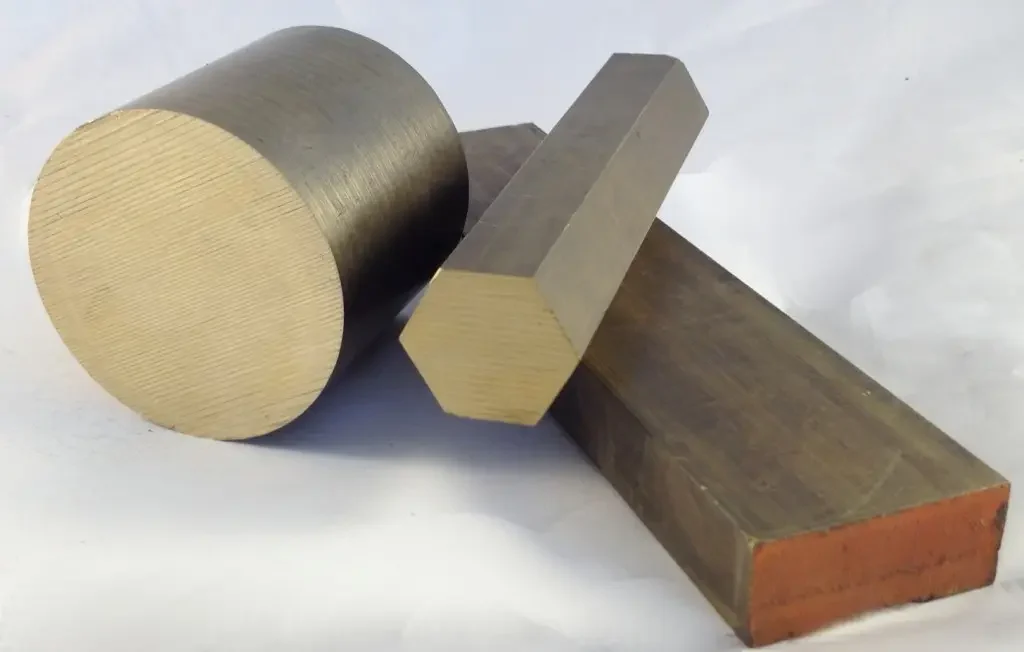
A shop that cuts both leaded and lead-free brass loses a lead-free order when one leaded bar or part gets into it. Poka-yoke means mistake-proofing: design each step so the wrong alloy cannot pass unnoticed. Use an XRF check at receiving, colour-coded racks and bins, a job-card alloy tag, a first-piece check and labels printed from the job card.
A shop that cuts both leaded C360 and lead-free C69300 holds two materials that look much alike. The bars are the same colour in the rack. The chips look the same in the bin. A leaded part in a lead-free order is easy to make and costly to find.
This guide gives a set of mistake-proofing steps from receiving to packing, an area-by-area checklist and a colour-code and label scheme you can copy. It is practical advice for shop floors, not a compliance claim. We do not say that any shop is certified.
What a mix-up costs in a lead-free order
For potable water parts, a fitting is judged by the lead content of its wetted surfaces. In the United States the statute sets a weighted average of 0.25 percent lead or less, calculated across the wetted components (Cornell Law School). In Europe, the four-country 4MS initiative maintains a common approach with a positive list of approved metal compositions, and has submitted it to the European Commission as a basis for rules under the revised Drinking Water Directive (Umweltbundesamt). Both are context, not advice. Your buyer’s drawing says which applies.
Whatever the rule, a leaded part in a lead-free lot has the same effects. The lot is suspect. You sort every part, test a sample or scrap the whole lot. The buyer asks how it happened and what else might be affected. Your lot records, which are the proof of every other shipment, get doubted. No sorting step after the fact is as good as preventing the mix.
Poka-yoke, in one line
Poka-yoke is Japanese for mistake-proofing: simple, low-cost devices or methods that help a worker avoid errors such as using the wrong part, and that catch defects at the source (Lean Enterprise Institute). Shigeo Shingo, who formalized the idea in the Toyota Production System, distinguished control methods, which physically prevent the mistake, from warning methods, which alert the worker (Wikipedia). Prefer control over warning wherever you can. A rack that physically takes only one bar diameter is a control. A sign on the wall is a warning.
Receiving: XRF check and colour coding by alloy
The first place to stop a mix is the dock.
Check every delivery against the certificate. Read the heat number on the bar tag, match it to the mill certificate and take an XRF reading on a bar from each bundle. Record the reading. If the reading and the certificate disagree, the bundle goes to a hold area. See XRF checks on brass bar for how to read the result and when to send a sample to a laboratory.
Mark the bar before it leaves receiving. Paint a band on each bar end in the alloy colour and write the heat number and alloy name on a tag. A mark added at receiving survives cutting and handling better than a label on the bundle.
Never use the supplier’s tag as the only identity. Tags fall off. Paint does not.
Bar racks, remnants and chips kept apart
Bar sits in the rack for weeks, and remnants sit in boxes for months. That is where mixes are born.
- Separate racks by alloy family. Leaded and lead-free bar live in different racks, in different bays if possible. A rack label shows the alloy name, the colour band and the word LEAD-FREE or LEADED in plain text.
- Remnants get a tag the day they are cut. A bar end without a tag goes to a scrap bin, not back to the rack. The rule is simple: no tag, no use.
- Chips go to a bin per alloy. The same discipline protects the scrap value, as brass chip scrap value explains: one labelled bin per alloy, and a mixed bin for the first minutes after a changeover.
- Machines are cleaned between families. Chip conveyor, pan and floor are cleaned and the cleaning is signed on the job card before a lead-free job starts after a leaded one.
At the machine: job card, alloy tag, first-piece check
The machine is where the wrong bar finally gets cut. Three controls help.
An alloy field on the job card. The card names the alloy and the colour. The operator ticks that the bar in the feeder matches both, and writes the heat number from the bar tag.
An alloy tag on the machine. A tag in the alloy colour, with the shape for that family, hangs on the machine door for the whole job. Take it away only when the job ends.
A first-piece check. Before the run starts, take an XRF reading on the first piece and sign it on the card. For a lead-free job, a leaded reading stops the machine. This is a shutdown-type control, the strongest kind, because the process does not continue on a failed check. See what a shop needs for lead-free brass work for the capability side.
Turn brass every week? Apply as a partner shop
Deburr, wash and baskets
After the lathe, parts move through deburring, tumbling or washing in baskets. Mixes happen here when two jobs share a basket or a tub.
- Use baskets and totes in the alloy colour. Do not put a lead-free job into a leaded-colour basket.
- Dedicate a wash or tumbling line to an alloy family for a shift, or clean and sign off between families.
- Count parts in and out of each stage and compare with the job card. A count that does not match is a signal to stop.
Packing and labels that cannot be swapped
The last mistake is at the shipping bin.
- Print the label from the job card. The label shows the part number, alloy, heat number and the words LEAD-FREE or LEADED, taken from the same record. A label written by hand at packing can say anything.
- Label before the parts arrive. A pre-printed label at the packing station forces the packer to match the parts to the label, not the label to the parts.
- One job at the packing bench at a time. Clear the bench and sign it clear before the next job.
- A last check. A second person compares the label, the job card and a part. For lead-free lots, add an XRF reading on a sample from the finished carton.
A colour-code and label scheme to copy
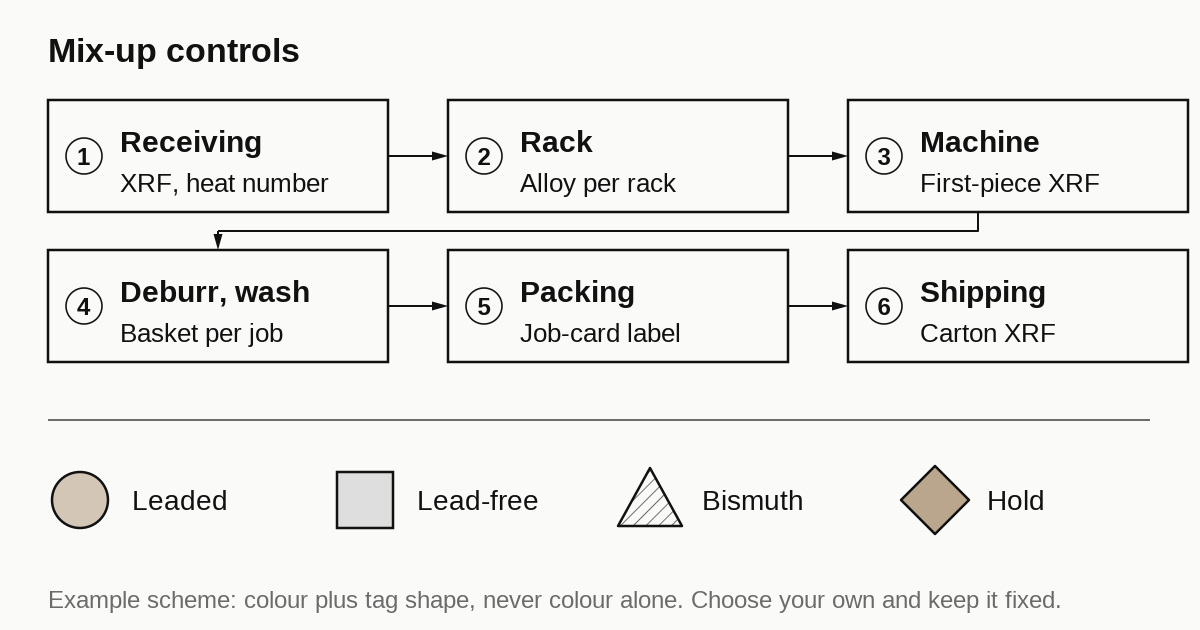
Colour is a visual control: it makes deviations visible so someone can act at once, but it needs feedback when procedures are not followed (Wikipedia). Pair it with a second signal. The scheme below is an example. Pick your own and keep it fixed.
| Alloy family | Colour band | Tag shape | Text on tag | Example alloys |
|---|---|---|---|---|
| Leaded free-cutting | Red | Square | LEADED | C360, C385 |
| Lead-free silicon brass | Green | Round | LEAD-FREE | C69300 |
| Bismuth brass | Blue | Round | LEAD-FREE BI | C49300 |
| Hold or unknown | Yellow | Triangle | HOLD | Anything unmatched |
Use the same colours on racks, bins, baskets, job cards and labels. Print the scheme on a card at every station.
Segregation checklist by area
| Area | Check | Evidence |
|---|---|---|
| Receiving | Heat number matches certificate; XRF reading taken per bundle | Receiving log with reading |
| Receiving | Alloy colour band painted on each bar end; tag attached | Visual check |
| Rack | Rack holds one alloy family; label with colour and text | Rack label |
| Remnants | Every bar end tagged; untagged ends scrapped | Weekly bin check |
| Chips | One bin per alloy; mixed bin for changeover | Bin labels |
| Machine | Alloy and heat on job card; alloy tag on machine; machine cleaned between families | Signed job card |
| First piece | XRF reading on first piece before the run | Reading on card |
| Deburr and wash | Coloured baskets; one job per basket; count in equals count out | Count on card |
| Packing | Label printed from job card; one job at the bench; second-person check | Signed card; label |
| Shipping | XRF on a sample from the finished carton for lead-free lots | Reading on packing list |
Audit the checklist monthly for a few jobs, walking one job from the rack to the dock. Where the chain is weak, add a control, not a reminder.
If you cut lead-free brass and want work that matches your alloys and quantities, apply as a partner shop. We are your customer, and there is no fee to join.
Frequently asked questions
What is poka-yoke?
Poka-yoke is a Japanese term for mistake-proofing. It means a simple device or method that stops a worker making an error, or warns at once when one is about to happen. The strongest versions stop the process; weaker ones give a warning. In a brass shop it can be as simple as a tag, a colour or a rack that fits only one alloy.
Why is a leaded part in a lead-free order a serious problem?
Lead-free orders for potable water parts are judged against a lead limit, and a leaded part does not meet it. In the United States the statute sets a weighted average of 0.25 percent lead on wetted surfaces. One wrong part means the whole lot must be sorted, checked or scrapped, and the buyer's trust in your records takes the hit.
Is colour coding enough on its own?
No. A colour is a visual control that makes a deviation easy to see, but it needs an action behind it and feedback when it fails. Use colour with a second signal such as a tag shape or text, and with a check that someone signs. Some people cannot tell some colours apart, so never rely on colour alone.
Do I need XRF to run lead-free brass?
XRF is the fastest way to confirm an alloy at receiving and at the first piece, but it is not the only record. The mill certificate and your lot record still matter. A handheld analyzer helps you catch a mislabelled bar before it reaches a machine. Borderline readings can go to a laboratory.
Alloys in this guide
| Alloy | Lead % | Mach. | DZR |
|---|---|---|---|
| C360 free-cutting brassC36000 · CuZn36Pb3 / CW603N | 2.5 to 3.7 | 100 | Poor |
| C69300 silicon brassC69300 · CuZn21Si3P / CW724R | under 0.09 | 80 | High |
| Bismuth brassC49300 / C49350 · No single EN equivalent, see supplier spec | under 0.25 | 80 | Moderate |
Published typical values for the alloy. Machinability against C360 at 100. Not a promise from a shop.
Sources
- Lean Enterprise Institute, Poka-yoke lean.org
- Wikipedia, Poka-yoke en.wikipedia.org
- Wikipedia, Visual control en.wikipedia.org
- Cornell Law School, 42 U.S.C. 300g-6, prohibition on use of lead pipes, solder and flux law.cornell.edu
- Umweltbundesamt, 4MS initiative and the Common Approach on metallic materials umweltbundesamt.de
Turn brass every week?
Brass CNC Parts sends brass work requests and nothing else. We are your customer: you quote us and we place the purchase order. No fee to join.