Guides / For Shops
Quoting a Family of Brass Fittings: Price Matrix and Break Points
Published November 21, 2026. Reviewed for the facts in the corrections log.
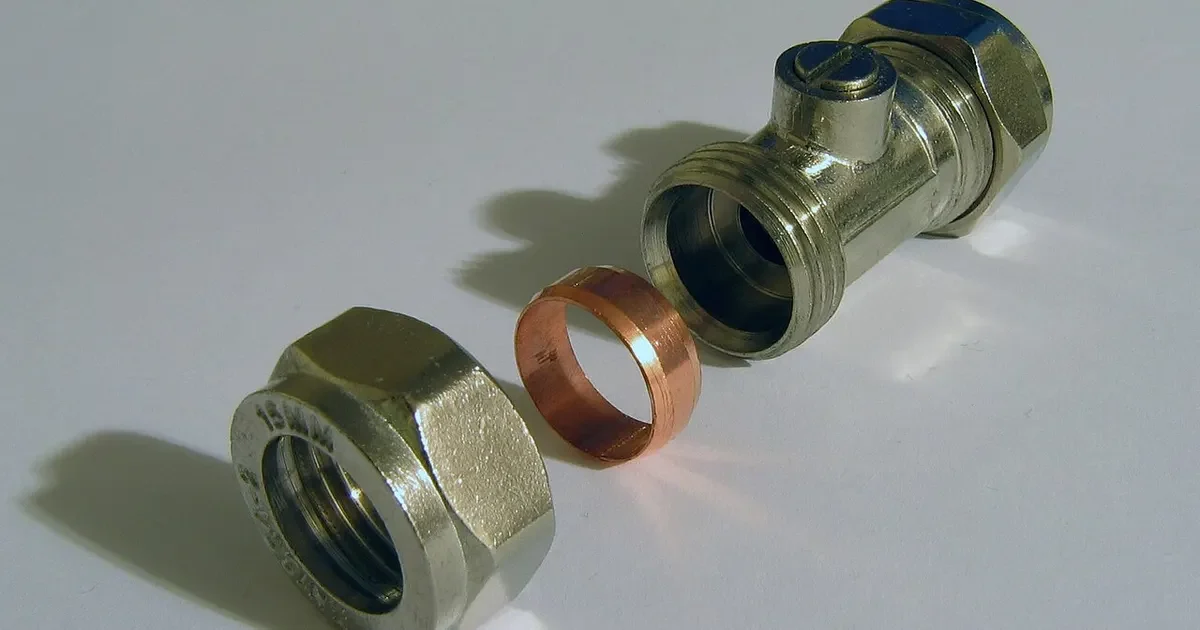
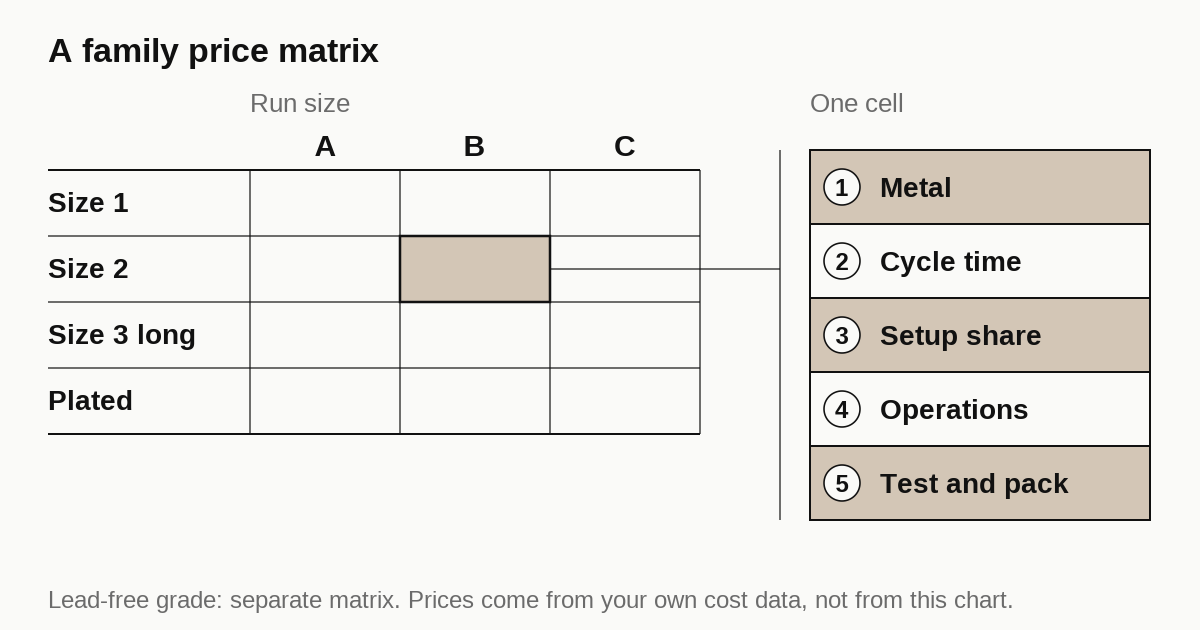
Quote a family of brass fittings as a matrix: one row per size or variant, one column per run size. Split each cell into metal, cycle time, setup shared over the run, secondary operations and packing. Keep metal on its own line so a copper move does not reopen the whole quote.
A buyer who sends a drawing for one fitting often has a dozen more like it: the same body in four sizes, a long and a short version, a plated and a bare one. If you quote each as a separate job, you waste estimator time and hand the buyer twelve numbers that do not agree with each other. If you quote them as one family with a price matrix, the buyer sees how price moves with size and quantity, and you see where you make or lose money.
This post is for the owner or export sales engineer of a turning shop. It shows how to build the matrix, where to put the break points and how to keep the metal price from reopening the quote every month. For the mistakes shops make on single quotes see quoting brass parts: what machine shops get wrong most.
What counts as a family
A family is a group of parts you can make with the same bar, the same tooling and the same inspection method. On a brass fitting that usually means:
- The same bar diameter range and the same alloy.
- The same main operations: face, turn, drill, thread, cross hole.
- Differences that change cycle time and not the process: length, hex size, thread size within one standard, a second port.
A plated version of the same part is a variant of the family. A part that needs another machine or another alloy is not. Put a lead-free grade in its own matrix, because the cycle time and the bar are different. Lead-free brass cost per part covers why the two should be separate lines.
Fixed cost and variable cost
Fictiv separates cost into two kinds. Fixed costs are incurred once per job whatever the number of parts, and include programming, process planning, machine setup, first article inspection and setup for finishing. Variable costs scale with output: raw material per part, cycle time per part and per part finishing and inspection. In its words, fixed costs do not shrink when you order more, they divide.
That gives you the first rule for the matrix: never fold setup into the per part price as a flat number. Treat it as a share of the run.
Fictiv shows the effect with an illustration of a 300 dollar setup and 20 dollars variable per part. The per part cost goes from 320 at one piece to 80 at 5, 50 at 10, 26 at 50 and 23 at 100. The same page says the curve flattens, and going from 25 to 100 parts saves only a few percent more per unit. These are illustrative figures from one source, not brass rates. They show the shape: a steep fall at small runs and a long flat tail.
Your own version is easier. If the setup share is S for a run of 500, it is a quarter of S per part at 2,000 and one twentieth of S at 10,000. After a certain run size the setup is a small part of the price and a further break buys the buyer little.
Build one cell
Each cell of the matrix, one size at one run size, has five parts. Write them on a worksheet before you write a price.
| Part of the price | What goes in | How it changes with run size |
|---|---|---|
| Metal | Bar weight per part plus the chip and parting loss, times the bar price | Does not change, except for bar bundles |
| Cycle time | Machine minutes per part times your machine rate, including loading | Does not change, unless a longer run lets you use a faster tool plan |
| Setup share | Setup and first article time times the rate, divided by the run size | Falls with run size |
| Secondary operations | Deburring, tumbling, wash, plating, marking | Mostly per part, with a setup element for plating or tumbling batches |
| Test, gauge and pack | Leak test, thread gauging, certificate, packing | Per part for testing, per lot for paperwork |
Two points on the metal line. Brass is generally about two thirds copper to one third zinc, so bar weight per part matters. Wikipedia gives C360 free machining brass as about 61.5 percent copper, 35.5 percent zinc and 2.5 to 3.7 percent lead. The bar weight calculator gives bar mass per part from the alloy density. And the chip loss is real money, so see brass chips scrap value for how much comes back.
The test and gauge line should reflect what the buyer asks for. A part with a 100 percent leak test carries that cost on every piece. If you need a station for that, see setting up a leak test and gauge station.
Run size, not annual volume
A buyer says “20,000 a year”. You can cut that as one run, or four of 5,000, or twelve of 1,700. The price you quote must say which. Fictiv makes the point that re-ordering resets the fixed cost: every time a job is re-quoted and run from scratch, the fixed cost clock starts again, and two orders of 5 usually cost more in total than one order of 10.
So write the matrix on run size, and add a line that states the assumed annual volume and the number of releases. A blanket order with scheduled releases gives you a way to recover setup if the releases follow your plan. See forecast and release schedules for brass turned parts.
Turn brass every week? Apply as a partner shop
Where to put the break points
Toolpath describes quotes that show per part prices at several volumes, for example 10, 100 and 1,000, so the volumes are not recalculated by hand each time, and quantity tiers with a cap so you never discount past your limit. Fictiv shows up to five quantity tiers side by side. The idea carries over: three to five columns is enough.
Choose them with three tests:
- Cost curve. Place a break where the price per part has fallen enough that a larger run changes the buyer’s decision. Where the curve is flat, another column adds nothing.
- Practical lots. Align with how you really buy and ship: a bar bundle, a tumbling load, a plating batch, a carton or a pallet. A break at a number that leaves half a bundle of bar is a break you will pay for.
- Buyer behaviour. If a buyer orders 2,000 at a time, a column at 500 helps nobody. Ask what the real release is.
Put a column for a first order or trial lot as well. Pilot lot approval for brass fittings explains why a first order is often a small run, and the setup share at that size is high. State it plainly so the buyer sees why the price per part is higher.
Keep the metal on its own line
Fitting price moves with the metal. A matrix that bakes in today’s bar price starts to go wrong the next time the market moves. The cleaner way is to split each cell into a metal part and a conversion part. The conversion part, which is cycle time, setup share, operations and packing, stays fixed for the quote. The metal part is recalculated from an agreed index at an agreed interval.
LAPP publishes one real example of such a clause, though it is a cable and fitting maker and not a brass bar mill. It derives its copper price from the LME cash settlement in US dollars per tonne, converts at the ECB reference rate, generally bases the price on the previous month’s daily averages and adds surcharges. It sets a separate brass base. Your clause need not look like that, but it should name the index, the date or averaging period and the adjustment interval. The longer treatment is in why brass prices move.
What to write under the matrix
A matrix without terms invites argument. Under it, list:
- Alloy, bar size range and the standard for the bar.
- Certificate type included, such as a 3.1 certificate, and what it covers.
- Tests included: thread gauging, leak test method and share of lot.
- Finish and packing included.
- Run size each column assumes, and how many releases a year.
- What triggers a re-quote: drawing revision, thread or tolerance change, alloy change, a run below the smallest column.
- Metal basis: index, date and interval.
- A validity date for the quote.
If the buyer sends a part that does not fit the family, say so and quote it on its own. A matrix is only useful if every cell can be defended.
Checklist
- Parts grouped into a family with the same bar, tooling and inspection.
- Lead-free grade in its own matrix.
- Each cell built from metal, cycle time, setup share, operations and test and pack.
- Matrix written on run size, with annual volume and releases stated separately.
- Three to five columns, chosen from the cost curve and practical lots.
- A trial lot column with its higher setup share explained.
- Metal on its own line with an index, a date and an interval.
- Terms and re-quote triggers written under the matrix.
Talk to us
If you turn brass fittings and want to be considered for work on family RFQs, apply through the shop page. We reply within 24 business hours.
Sources
- Fictiv, manufacturing cost per quantity
- Toolpath, flexible quoting and estimating
- Wikipedia, Brass
- LAPP, metal price and surcharges
Frequently asked questions
Why does the price per fitting fall as the run gets bigger?
Setup, programming and first article checks are paid once per run, whatever the quantity. Spread over more parts, each part carries a smaller share. Fictiv calls this arithmetic, not a discount. The curve flattens: in its illustrative example, going from 25 to 100 parts saves only a few more percent per unit.
Should the quote follow the annual volume or the run size?
Quote the run size you will actually cut and state the annual volume as a second line. A buyer who orders 20,000 a year in four releases of 5,000 pays setup four times. If the price assumes one run of 20,000, you lose the setup on every release after the first.
How many quantity breaks should a quote show?
Three to five is usual, chosen where the price per part stops moving much. Toolpath shows quotes at several volumes such as 10, 100 and 1,000. Pick breaks from your own cost curve and from practical lot sizes such as bar bundles, plating batches and cartons.
How do I keep a copper price move from breaking the quote?
Put metal on its own line, priced from an agreed index at an agreed date, and keep conversion fixed. LAPP is one published example: it derives its copper price from the LME cash settlement and bases it on the previous month's daily averages. Agree the index and interval with the buyer in writing.
Alloys in this guide
| Alloy | Lead % | Mach. | DZR |
|---|---|---|---|
| C360 free-cutting brassC36000 · CuZn36Pb3 / CW603N | 2.5 to 3.7 | 100 | Poor |
| C69300 silicon brassC69300 · CuZn21Si3P / CW724R | under 0.09 | 80 | High |
Published typical values for the alloy. Machinability against C360 at 100. Not a promise from a shop.
Sources
- Fictiv, manufacturing cost per quantity fictiv.com
- Toolpath, flexible quoting and estimating toolpath.com
- Wikipedia, Brass en.wikipedia.org
- LAPP, metal price and surcharges lapp.com
Turn brass every week?
Brass CNC Parts sends brass work requests and nothing else. We are your customer: you quote us and we place the purchase order. No fee to join.