Guides / Compliance
How to Verify an Overseas Brass Supplier's Lead-Free Claim
Published November 21, 2026. Reviewed for the facts in the corrections log.
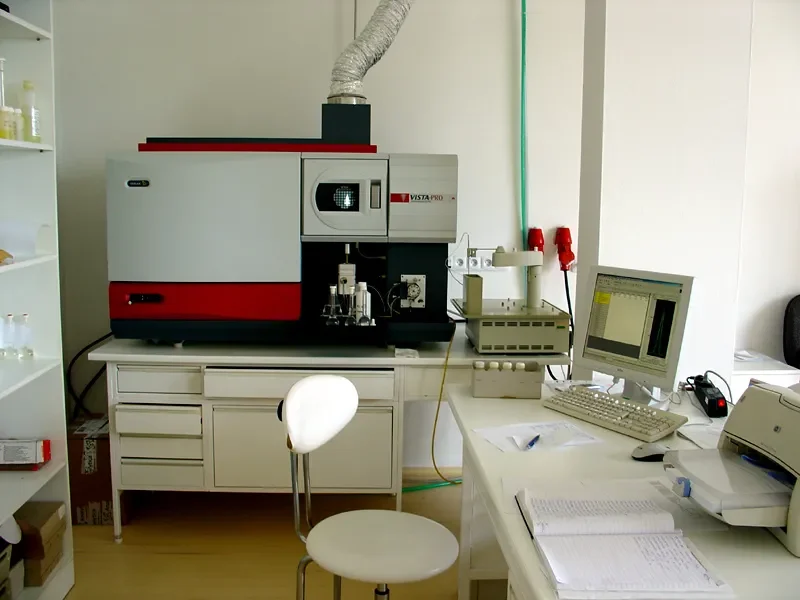
Treat 'lead free' as a claim to be matched with a document. Ask which limit the supplier means, get the paper that fits that limit, read the mill certificate by heat number and test the first lot on arrival with XRF, sending any borderline reading to a laboratory. A datasheet alone proves nothing.
A supplier writes that its brass is lead free. The sentence costs nothing to write and says very little. It does not say which limit, for which market, measured on which bar, by whom. For a part that will carry drinking water, that gap is where compliance claims fall apart.
This guide gives an importer four steps to close it. They apply to a supplier in any country, and they work before any money moves.
Step 1: Pin down which limit the supplier means
“Lead free” has no single meaning, and suppliers use it for several different limits.
For drinking water products in the United States the Safe Drinking Water Act defines lead free as a weighted average of 0.25 percent lead across the wetted surfaces of a pipe, fitting or fixture, and 0.2 percent for solder and flux (EPA). The figure is a weighted average over the whole product, not a rating of one bar.
RoHS is a different instrument. It sets a maximum of 0.1 percent lead in each homogeneous material, and it carries an exemption for copper alloy containing up to 4 percent lead by weight (Wikipedia summary of the directive). A leaded free-cutting brass can therefore be described as RoHS compliant and still be far from lead free for water. The exemption has an expiry date that has moved before, so read RoHS exemption 6(c) and leaded brass for the current position before you rely on it.
So the first question to the supplier is plain: which limit, which standard, which market. A supplier that cannot answer in one sentence is guessing.
Step 2: Match the document to the claim
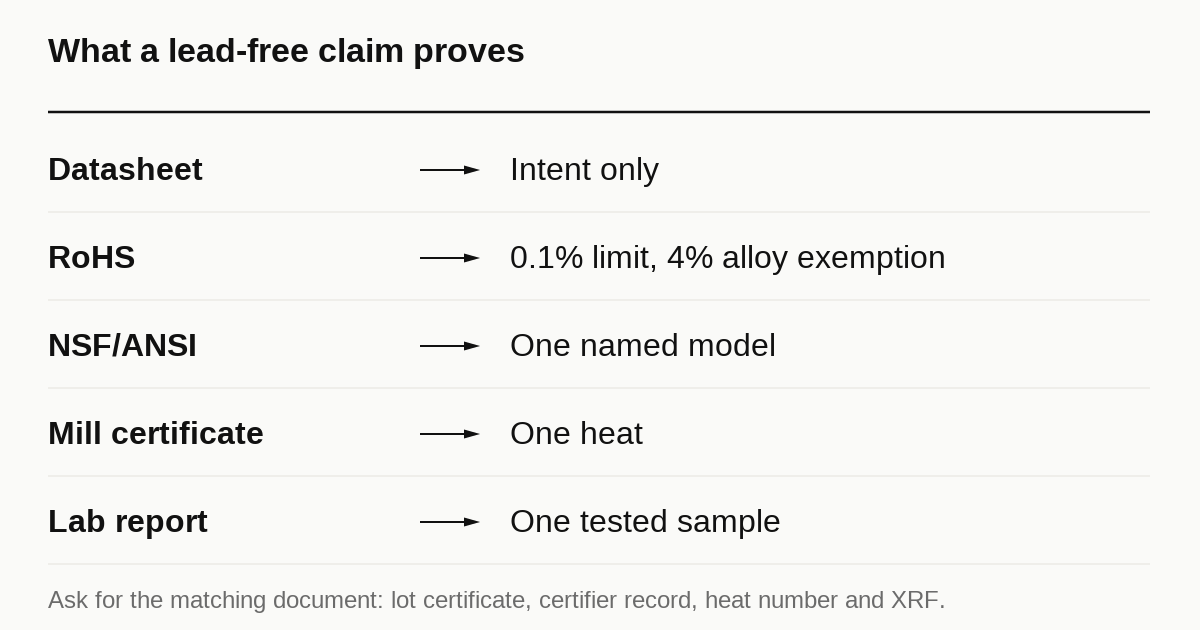
Each claim has one document that can support it, and the document proves less than the claim sounds. The table in the figure above sets them side by side. Three points matter most.
A certifier’s mark proves a listing, not your parts. A mark such as NSF/ANSI 61 and 372 points to a record for one named model made at one named facility. Confirm it in the certifier’s own directory, not on a PDF the supplier sends. The steps are in how to verify an NSF/ANSI 61 or 372 listing on brass.
A mill certificate proves the bar. An EN 10204 3.1 certificate is issued by the manufacturer and gives test results for the material supplied (Wikipedia). It speaks for one heat of bar and nothing downstream of it.
A laboratory report proves its sample. It covers the piece that was tested, on the day it was tested. Useful, but only if you can tie the sample to your lot.
Step 3: Read the mill certificate like an auditor
Most overseas brass work stands or falls on this one sheet. Check these points before you accept it.
- Heat number. The number on the certificate must appear on the bar tags or on the shop’s lot record for your parts. A certificate with no heat number cannot be linked to anything.
- Issuer. It should come from the mill that made the bar, not from a trader that re-types the figures. Ask for the mill’s name.
- Alloy designation. It must name the alloy you ordered, in the same system as your drawing, such as UNS C69300 or CW511L.
- A lead value. Look for a measured percentage for lead. A line that says only “conforms” or “RoHS” gives you nothing to compare.
- Zinc and copper agree with the grade. If lead looks right but zinc sits far from the range for the alloy, the bar is the wrong alloy.
- Dates and signature. Test date, issue date, a named signatory.
Material certificates for brass parts explains the four EN 10204 types and what a 3.1 does and does not prove.
Step 4: Test the first lot yourself
A paper chain can be broken by a mislabelled bundle. A short test on arrival catches that for little cost.
A handheld XRF analyzer reads lead, zinc and copper in seconds and is a screening tool (Wikipedia). Read a fresh cut face, not the skin of the bar, and take several readings. Our guide to XRF checks on brass bar covers the method and its limits near 0.25 percent.
When a reading is close to the limit, or the certificate and the reading disagree, send a sample to a laboratory. Spark and arc emission spectrometry are standard ways to analyse metals in a lab (Wikipedia). Ask the laboratory which method it used and the uncertainty of the result, and keep a retained sample from each lot so a later question can be answered.
| Evidence on the first lot | What to do |
|---|---|
| Certificate and XRF agree, heat number matches the tag | Accept and file both |
| XRF reading close to the limit | Hold the lot and send a sample to a laboratory |
| Certificate and XRF disagree | Hold, ask the supplier for the heat record, test again |
| No heat number anywhere | Reject the paper and ask for the real certificate |
An example decision table, not a standard. Agree your own thresholds with the supplier before the order.
Need a quote for this part? Get a quote for your brass parts
What the supplier’s papers cannot show
Two limits are worth knowing before you sign off.
A bar is not a finished part. The US definition is a weighted average over the wetted surfaces of the finished product, so plating, other wetted components and assembly all count. A lead-free bar is the start of compliance for a fitting, not the end. Components of an assembled product need not be certified one by one if the finished product is (40 CFR 143.19).
Who carries the duty. Under that rule manufacturers and importers that introduce covered plumbing products into commerce must have them certified, and keep the records. Third-party certification is the norm. Makers with fewer than 10 employees, and makers of a custom fabricated product, may self-certify with a signed certificate of conformity, which must be in English and say how conformance was checked. If your supplier offers such a certificate, read it as a signed statement, then ask for the supporting lead calculation and material records it rests on. This is not legal advice. Confirm your own position with a customs broker or compliance adviser.
Red flags in a lead-free claim
- A datasheet or brochure offered in place of a lot certificate.
- A certificate with no heat number, or a heat number that matches nothing on the bar.
- “Lead free” with no limit and no standard named.
- A listing number the supplier cannot place in a certifier’s directory.
- A refusal to let you test the first lot or to keep a retained sample.
- Certificate figures rounded to one clean number on every lot.
Lines for your RFQ
Material: lead free brass, limit and standard named: [your limit].
Mill certificate EN 10204 3.1 with a measured lead value, heat number
printed on bar tags and on the lot record.
Supplier gives the mill name with the quotation.
Buyer may test the first lot by XRF and laboratory analysis.
Supplier keeps a retained sample from each lot.
For the full document list at each stage, see lead-free brass compliance documents: what to ask a shop for. The reasons the line sits where it does are in leaded vs lead-free brass.
Need brass parts quoted with these checks written in? Send the drawing. We quote the finished parts within 24 business hours and place the work with one of the partner shops that turn brass.
A note on this site. Brass CNC Parts holds no certificate and cannot verify a supplier’s claim for you. Ask for the original documents and check them with the certifier or a laboratory.
Frequently asked questions
Is a supplier's datasheet enough to prove brass is lead free?
No. A datasheet describes the alloy the supplier means to use. It carries no heat number, no measured lead value and no signature. Ask for the mill certificate of the bar your parts were cut from, matched to your lot, and treat the datasheet as an introduction to that paper.
Does RoHS compliant mean lead free?
Not for drinking water parts. RoHS sets 0.1 percent lead per homogeneous material but exempts copper alloy with up to 4 percent lead, so a leaded free-cutting brass can be RoHS compliant. A drinking water fitting for the US needs the 0.25 percent weighted average of the Safe Drinking Water Act instead.
Who must certify an imported brass fitting as lead free in the US?
Under 40 CFR 143.19 manufacturers and importers that introduce covered plumbing products into commerce must have them certified. Third-party certification is the norm. Makers with fewer than 10 employees and makers of custom fabricated products may self-certify with a signed certificate of conformity.
How many bars should I test on a first lot?
No standard fixes the number. A sensible rule is to read one bar or part from every bundle or heat in the lot, record the heat number, and send a retained sample to a laboratory when any reading falls close to the limit. Agree the rule with the supplier before the first shipment, not after a failure.
Alloys in this guide
| Alloy | Lead % | Mach. | DZR |
|---|---|---|---|
| C360 free-cutting brassC36000 · CuZn36Pb3 / CW603N | 2.5 to 3.7 | 100 | Poor |
| C69300 silicon brassC69300 · CuZn21Si3P / CW724R | under 0.09 | 80 | High |
| Bismuth brassC49300 / C49350 · No single EN equivalent, see supplier spec | under 0.25 | 80 | Moderate |
Published typical values for the alloy. Machinability against C360 at 100. Not a promise from a shop.
Sources
- EPA, Use of lead free pipes, fittings, fixtures, solder and flux for drinking water epa.gov
- 40 CFR 143.19, certification of lead free status (Cornell LII) law.cornell.edu
- Wikipedia, Restriction of Hazardous Substances Directive en.wikipedia.org
- Wikipedia, Mill test report en.wikipedia.org
- Wikipedia, X-ray fluorescence en.wikipedia.org
- Wikipedia, Atomic emission spectroscopy en.wikipedia.org
Need a quote for this part?
Send the drawing. We read it, send one itemised quote for the finished parts within 24 business hours and place the work with a partner shop that turns brass. Brass only.
Get a quote for your brass parts