Guides / Materials
Which Brass Grade for a Machined Part: How to Choose It, Write It on the Drawing and Check the Bar
Published November 21, 2026. Reviewed for the facts in the corrections log.
Start from the part, not the alloy. Turned from bar with no special rule: free-cutting brass C360 (CW603N). Starting from a profile, C385. Hot forged then machined, C377 or CW617N. Hot or aggressive water needs a dezincification-resistant grade, and US drinking water parts need lead-free under the Safe Drinking Water Act. Cite the grade and the bar standard.
Start from the part, not from the alloy. If the part is turned from bar and no rule limits lead or corrosion, the grade is free-cutting brass: C360 on a US drawing, CW603N on a European one. If it starts as an extruded profile, C385. If it is hot forged and then machined, C377 or CW617N. Hot or aggressive water points to a dezincification-resistant grade, and a US drinking water part points to a lead-free one (Safe Drinking Water Act section 1417, as of October 2026). This guide is for buyers and designers who must pick a brass grade, name it so a shop cannot misread it and decide whether a substitute is acceptable.
We name no shop and we do not certify parts or give legal advice. Alloy figures are published typical values and lead percentages are nominal composition, not a lot certificate.
Last reviewed: October 2026. Standards and datasheets carry the date they were checked; confirm the edition on your own order before you rely on a limit.
- Pick the grade from the part
- How brass grades are named
- Free-cutting brass
- C385 and CW614N for profiles
- Forging brass
- Cartridge, red and yellow brass
- Lead-free grades
- Dezincification resistance
- Stress corrosion cracking
- Strength, seawater and heat exchange
- Grade substitution
- Check the bar and write the callout
- Send the drawing
Pick the grade from the part
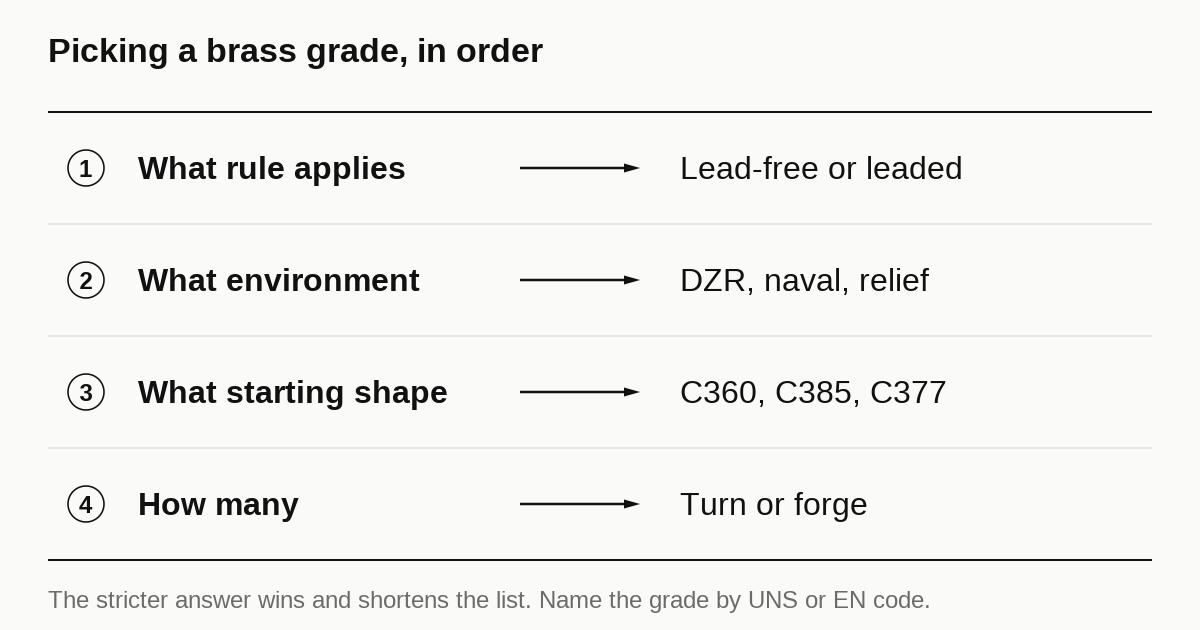
Most grade mistakes start with a copied material field. A drawing keeps the alloy of an older design long after the process changed. The fastest way to avoid that is to answer four questions in order: what rule applies to the part, what environment it lives in, what shape it starts from and how many are made.
| The part | Grade to look at first | Machinability (C360 = 100) | Why |
|---|---|---|---|
| Turned from bar, dry service, no lead rule | C360 or CW603N | 100 | Short chips, stocked everywhere |
| Cut from an extruded profile, visible hardware | C385 or CW614N | 90 | Profile form, polishes well |
| Hot forged, then machined on faces and threads | C377 or CW617N | 80 | Forges where C360 tears |
| Machined, then drawn, crimped or spun | C260 | 30 | Formability, not cutting |
| Hot or aggressive water, leaded grade allowed | CW602N (DZR) | 80 | Arsenic addition and heat treatment |
| US drinking water, wetted | C69300 or bismuth brass | 80 | Lead-free route under the Act (see Lead-free grades) |
| Seawater, marine hardware | C464 naval brass | 30 | Tin addition |
| Heavily loaded stems and nuts | High-tensile brass | 30 | Strength, not speed |
Published typical values for the alloys, as on this site’s datasheets and the Copper Development Association (CDA) alloy pages opened October 2026. They describe the material, not a promise from any shop.
Four short cases show the order at work. A turned hex fitting for compressed air has no lead or corrosion rule and starts as bar, so the question is only free-cutting brass and which bar standard. A hot forged valve body for hot water in Europe starts as forging stock, and the grade has to carry its dezincification resistance through the forging, which is a heat treatment question more than an alloy one. A door handle blank polished next to extruded trim is a color and form question, so it follows the profile grade. A ferrule for a condenser is cut from tube, so the starting form decides before anything else.
If more than one row applies, the stricter rule wins, and the cost goes up with it. A hot water, lead-free, forged fitting is three requirements, and the grade that meets all three is a short list. The grade selector tool asks five questions and returns the grades and the standard to write.
Read more: Brass alloys for machined parts: C360, C385 and C464
How brass grades are named
A drawing may carry a UNS number (C36000), a European code (CW603N), the chemical name (CuZn36Pb3), an older DIN number, a JIS or Chinese grade or a trade name. They are not interchangeable labels. UNS numbers belong to the US system and EN codes to the European one, each tied to its own standard. The Copper Development Association’s alloy pages list the ASTM and SAE specifications under each UNS number, and a mill datasheet lists the EN standard under each CW code.
Two habits cause most trouble. The first is treating the closest match as the same alloy. A mill datasheet I opened lists CW603N next to UNS C36000, but the CDA gives C36000 and C36010 different lead ranges, and the European code covers both. The cluster posts below show more cases, such as CW617N, whose nearest UNS number differs from one source to the next. The second is dropping the standard: a grade name says the chemistry, and the bar standard says the temper, tolerance and tests.
The product form picks the standard, and the standard is half of the callout. The CDA lists the US specifications under each UNS number, and mill datasheets list the European ones under each CW code.
| Product form | US specification (CDA lists) | European standard (mill datasheets) |
|---|---|---|
| Free-cutting rod, bar, wire, shapes | ASTM B16/B16M (C36000, C36010) | EN 12164 |
| Forging rod, bar and shapes | ASTM B124/B124M (C37700, C46400, C67500, C69300 and others) | EN 12165 (the 2024 edition is current per DIN Media, which lists it as replacing 2016) |
| Die forgings, hot pressed | ASTM B283/B283M (C37700) | Not listed on the sheets I opened |
| Extruded leaded-brass shapes | ASTM B455 (C38500) | EN 12167, profiles for general purposes |
| Hollow rod for machining | Not listed | EN 12168 |
Sources: CDA alloy pages for C36000, C37700 and C38500 (applicable specifications), the ASTM catalogue pages for B16 and B124 and a mill datasheet listing EN 12164, 12165, 12167 and 12168, all opened October 2026. The standard texts were not read, and “not listed” means only that the pages I opened did not list one.
Read more: Brass grade equivalents: UNS, EN, JIS and GB
Free-cutting brass
Free-cutting brass is the benchmark for machinability. The CDA alloy page for C36000 gives 60.0 to 63.0 percent copper, 2.5 to 3.0 percent lead, iron up to 0.35 percent, zinc as the remainder and a machinability rating of 100. CDA lists a second number, C36010, with the same copper and iron limits and a higher lead range, given in our ASTM B16 post as 3.1 to 3.7 percent. This site’s datasheets and tables show C360 at 2.5 to 3.7 percent lead, which is the two UNS numbers taken together. The distinction matters only when a drawing names one of them or a lead limit is tight, and then the certificate should show the number.
The US bar standard is ASTM B16/B16M. The 2024 edition, approved in July 2024, covers rod, bar, wire and shapes of C36000 and C36010 for high-speed screw machining and moderate thread rolling. The standard text is paywalled and I did not read it, so every figure here comes from the catalogue pages and CDA. CDA lists tempers for C36000 including soft anneal (O60), half hard (H02) and hard (H04), and a typical half-hard rod tensile strength near 57 ksi, about 390 MPa.
On the European side, the rod standard is EN 12164, and a mill datasheet lists CuZn36Pb3 (CW603N) against C36000 with a reference composition of 61.0 percent copper and 2.8 percent lead. That datasheet rates machinability 90 on a scale where CuZn39Pb3 is 100, so the same alloy carries two different numbers depending on the scale. Never compare ratings from two scales.
Read more: ASTM B16 Brass Rod: What It Covers and How to Cite It
Read more: EN 12164 Brass Rod: The Standard and Its 2024 Edition
C385 and CW614N for profiles
C385 is a leaded brass with a historic name. CDA gives it 55.0 to 59.0 percent copper and 2.5 to 3.5 percent lead, a machinability rating of 90 and hot forging and hot forming among its fabrication processes. Its listed specification is ASTM B455, copper-zinc-lead extruded shapes. That is the point: C385 is the profile grade. Door and window hardware, trim and anything that starts as an extruded shape is cut from it.
Its European partner is CW614N (CuZn39Pb3), the nearest match on this site’s cross reference. A bar of CW614N is the common European free-machining stock, so a drawing that says C360 and lands in a European shop often returns as CW614N. For most turned parts that is harmless and shortens the wait. If the part is polished next to extruded trim, color matching is the reason to name the grade rather than leave it open. The longer comparison is in the post below.
The two European codes that get confused are CW614N and CW617N. Per our CW614N post, CW614N is the usual turning stock and CW617N the one sold for forging, though the split is a habit and not a rule. A drawing that says only MS58 leaves it open, because the trade name has been used for both. EN 12164 was revised in 2024 and the DIN catalogue page’s list of changes (see our EN 12164 post) includes new composition limits for both grades, so any composition table copied from an older source should be checked against the edition you order to.
Read more: C360 vs C385 brass: bar stock against extruded shapes
Read more: CW614N vs CW617N: European brass grades on a drawing
Forging brass
A hot forged part starts as a billet squeezed in a die and then machined only where a face or a thread needs it. The grade for that is not free-cutting brass. CDA gives C37700 58.0 to 61.0 percent copper, 1.5 to 2.5 percent lead, a machinability rating of 80, a forgeability rating of 100 and describes its capacity for hot forming as excellent and cold working as poor. Its listed specifications include ASTM B124/B124M for forging rod, bar and shapes and B283/B283M for die forgings.
B124 is worth knowing by name. The 2020 edition, which ASTM lists as active, covers rod, bar and shapes intended for hot forging, in tempers H50, M20 and M30, in a list of UNS grades that includes C37700, naval brass C46400, C67500 and silicon brass C69300. So a forging stock standard exists for the lead-free route too. Our forging post notes that availability and shop experience are thinner for the lead-free grades, so a switch needs a check on stock before it needs a check on price.
The reason free-cutting brass is poor at the die is lead. A mill datasheet I read rates CW603N hot formability as good, and CDA rates C36000 fair against excellent for C37700. The long version, including the machinability trade, is in the cluster post. The arithmetic of when forging pays, with the volume break, is in our forging post.
Read more: C360 vs C377 Brass: Which to Turn From Bar, Which to Forge
Cartridge, red and yellow brass
The color names are trade names. Red brass, yellow brass and cartridge brass sit on one copper-to-zinc scale, and none of them is a specification. The grades behind the names are single-phase alpha brasses with little or no lead. This site’s datasheets give C260 cartridge brass (70 percent copper, 30 percent zinc) and C230 red brass a machinability rating of 30, against 100 for C360.
A rating of 30 means long, stringy chips and slow cycles. These grades exist for forming: deep drawing, spinning and stamping. If a machined part arrives specified in C260, ask what happens to it after machining. If nothing bends, draws or crimps it, the grade is a leftover from a formed design, and C360 usually does the job for less. The reverse also holds: a part that is formed after machining needs the formable grade, and the extra machining cost belongs to the forming requirement.
Name the UNS or EN code, the form and the temper. A color alone leaves the mill to choose.
Read more: C360 vs C260 brass: machining and forming compared
Read more: Red, yellow and cartridge brass: what the color names mean
Lead-free grades
Lead-free is a rule, not a grade. The rule differs by market and by use, and the rule picks the alloy. As of October 2026, Safe Drinking Water Act section 1417 (42 U.S.C. 300g-6) defines lead free for the wetted surfaces of pipes, fittings and fixtures as a weighted average of not more than 0.25 percent lead, and exempts fittings used exclusively for nonpotable service. This is not legal advice; confirm with the product maker or counsel. This site’s data rate silicon brass C69300 (lead under 0.09 percent) and bismuth brass (under 0.25 percent) at 80 for machinability, and CW511L (under 0.2 percent) at 40. Silicon brass is also listed in the ASTM forging standard, as noted above.
The long answer, which rule applies to which part, how the EU positive list works and what to write on the drawing, is in our lead-free guide. It is the pillar of this site’s compliance section, and a grade table here would only repeat it. The point for grade choice is narrow: if a lead rule applies, settle the rule first and the shortlist follows.
Read more: Lead-free brass for machined parts: which alloy, which rule and what to write on the drawing
Need a quote for this part? Get a quote for your brass parts
Dezincification resistance
Dezincification is the loss of zinc from brass in some waters, leaving a weak, porous copper structure. It is a property of the grade and its heat treatment, and it is tested, not assumed. ISO 6509-1:2014 specifies a method for determining dezincification depth in copper alloys with more than 15 percent zinc. By its catalogue entry it does not set acceptance criteria; those are in ISO 6509-2. So a certificate that says “tested to ISO 6509” is incomplete until it says which part and which limit.
The grade names to know are CW602N (CuZn36Pb2As, with arsenic added) and silicon brass. Mill datasheets show how much the form matters. One lists CW602N rod for machining as dezincification-resistant as delivered, with a warning that processing above 600 degrees Celsius impairs it and that annealing between 500 and 550 degrees restores it. The sheet for the same alloy as forging stock says the rod is not resistant as delivered and that a heat treatment of 2 hours at 500 to 550 degrees after forging is required. The same grade name, two products, two answers.
For a part that sees hot or aggressive water, write the requirement and the test: material resistant to dezincification per ISO 6509, with the depth limit and the product the result applies to, and ask for the result on the certificate. Note that CW602N is still a leaded grade. Our older post on dezincification-resistant brass treats CW602N as one grade and does not separate the two product forms.
Read more: Dezincification-resistant brass: DZR, CW602N and C464
Stress corrosion cracking
According to our post on season cracking, stress corrosion cracking, once called season cracking, needs three things together: residual tensile stress, a susceptible brass and a chemical agent such as ammonia or an amine. The grade matters because high-zinc brasses are the susceptible ones, and the process matters because cold work, crimping, staking and interference fits put the stress in. A grade that resists dezincification does not automatically resist this.
ISO 6957:1988 specifies a test in an ammoniacal atmosphere for detecting applied or residual stresses that can cause cracking in service or storage, with the severity adjusted by the pH of the solution. The catalogue summary I opened gives no duration or acceptance criterion, so the drawing must state them. The usual remedy is a stress relief anneal after the last cold-working step, and the temperature on the sheet depends on the grade. Mill datasheets I opened give 250 to 350 degrees Celsius for CW603N and CW602N, and one of them advises 280 to 320 degrees for 1 to 2 hours after cold forming CW602N rod, while our cracking post gives 330 to 350 degrees for two to four hours. Treat all of these as starting points and let the mill or the shop state the cycle it will run, then verify on the part.
Read more: Season cracking in brass parts: stress corrosion cracking
Strength, seawater and heat exchange
Three families sit outside the free-cutting and forging grades, and all three machine slowly. This site’s datasheets and posts rate them near 30 against 100 for C360, which is the price of the property they were chosen for.
| Family | Grade | What is added | Machinability (C360 = 100) | Used for |
|---|---|---|---|---|
| Naval brass | C464 | About 1 percent tin | 30 | Seawater and hot water, marine hardware |
| Admiralty brass | C443 | Tin and an arsenic inhibitor | 30 | Condenser tube, ferrules, tube plugs |
| High-tensile brass | C67500 (in ASTM B124’s list), CW721R (our high-tensile post) | Manganese, iron, aluminum and tin, per our high-tensile post | About 30 | Loaded stems, nuts, hot forged blanks |
Published typical values for the alloys, as on this site’s datasheets and in the posts linked below. They describe the material, not a promise from any shop. ASTM B124 names C46400 and C67500 among its forging stock alloys, per the catalogue page.
Naval brass carries tin against dezincification and is the traditional marine answer. Admiralty brass is a tube alloy with an arsenic inhibitor, so ferrules and plugs are usually cut from tube, not bar, and the form decides the part before the grade does. High-tensile brass is a strength alloy that is easy to hot forge and slow to cut, and a designer can sometimes cut the section because the metal is stronger, which pays back part of the machining time.
In each case the grade is chosen for the environment or the load, never because it sounds stronger, and the quote will reflect a longer cycle. If the part is a one-off and the environment is mild, ask whether a free-cutting grade with a plated or coated surface does the job at a fraction of the cost. If the environment is the reason for the grade, write the environment on the drawing next to the alloy, so that a shop proposing a cheaper bar can see what it has to survive. Each of these three has its own post.
Read more: High-tensile manganese brass for load-bearing parts
Read more: Admiralty and arsenical brass for heat exchanger parts
Grade substitution
A shop that offers an equivalent is making a claim, and approving it is your decision. The risks are not in the headline alloy but in the details: a different lead range, a different temper system, a different tolerance class, an older edition of the standard or a different heat treatment. The cases above show it. C360 splits into two UNS numbers on CDA’s pages, with different lead ranges. The nearest UNS number for a European code can differ from one source to the next, as the C360 vs C377 post shows for CW617N. And one mill’s datasheet for a dezincification-resistant grade gives different answers for rod and for forging stock.
The safe pattern is short. Name one primary grade with its standard. List the grades you will accept, say what evidence you need (the mill certificate with composition, the temper and the standard edition) and require written approval before shipment. The cluster post sets out the steps, the sign-off wording and the checks for a threaded part.
Read more: Brass Grade Substitution: When to Accept a Shop’s Equivalent
Check the bar and write the callout
Receiving a bar is the last chance to catch a wrong grade before it becomes parts. Check these against the order.
- The grade on the tag and certificate matches the order, in the code you wrote.
- The bar standard and its edition year are on the certificate or the delivery note.
- The temper matches: H02 or the EN tensile class you named, not whatever was cheapest.
- The certificate shows composition against the limits, including lead, with the heat number.
- Diameter or across-flats tolerance and straightness meet the class on the order, which matters when the bar surface stays on the part.
- For lead-free or dezincification-resistant grades, the extra results (lead, ISO 6509) are on the certificate for the product you ordered.
- Bars of different grades are kept apart and tagged, because the bars look alike.
A certificate is evidence about a lot of bar, and it has limits worth knowing before you rely on it.
| It can show | It cannot show |
|---|---|
| Composition of the lot against the grade limits, with the heat number | That the finished part meets a product rule |
| The temper and the standard and edition the bar was made to | That bars were not mixed after delivery |
| Mechanical results where the standard calls for them | Dezincification or stress corrosion results unless those tests were run and reported |
A reading guide, not a standard. The certificate for your lot is the document that counts.
The certificate types are covered in our post on EN 10204 certificates.
Material: free-cutting brass C36000 (CuZn36Pb3, CW603N)
per ASTM B16/B16M-24 or EN 12164, half-hard rod.
CW614N (CuZn39Pb3) acceptable only with written approval.
Mill certificate EN 10204 3.1 with composition and heat number.
Read more: Material certificates for brass parts: EN 10204 3.1
Send the drawing
Have a brass part to quote? Send the drawing with the grade, the standard and the temper marked, or write what the part must survive and leave the grade open. We quote the finished parts within 24 business hours and place the work with one of the partner shops that turn brass.
Frequently asked questions
What is the most common brass grade for machined parts?
Free-cutting brass, C36000 in the US system and CW603N (CuZn36Pb3) in the European one. It is rated 100 for machinability on the scale most US data use, it is stocked as round and hex bar almost everywhere, and the lead in it breaks the chip. Other grades are chosen when a rule, an environment or the starting shape rules it out.
Is C360 the same as CW603N?
They are close, not identical. A mill datasheet I opened lists CW603N against UNS C36000, but the two standards write the composition limits and tempers in their own terms. For most turned parts the swap is harmless. For a part with a lead limit, a plating step or a certificate, name the grade you need and approve the other one in writing.
Which brass resists dezincification?
Dezincification-resistant grades such as CW602N (CuZn36Pb2As) carry an arsenic addition and a controlled heat treatment, and silicon brass C69300 resists it as well. A mill datasheet I read says CW602N bar is resistant as delivered but forging stock is not until it is heat treated after forging. Ask for the ISO 6509 result, not only the grade name.
Can a shop swap one brass grade for another?
Only with your approval. A grade swap can change the lead content, the temper, how a thread cuts and which paperwork applies. Write on the order which grades are acceptable and what evidence you need, usually the mill certificate with composition. A swap that is silent on the drawing is a decision made for you.
Do I need to name the standard as well as the grade?
Yes. The grade says the composition. The bar standard, such as ASTM B16/B16M or EN 12164, says the tempers, tolerances and tests, and each is revised from time to time. Name the standard with its edition year, the temper and the certificate type, or the shop will pick the cheapest bar that fits the words.
Should I specify a grade or a requirement?
Both, in that order. State the requirement that matters, for example lead-free to a named rule, or dezincification resistant to ISO 6509, then give a suggested grade. That lets the shop offer any bar that meets the requirement, and it keeps you from locking a drawing to a grade that is hard to buy.
Alloys in this guide
| Alloy | Lead % | Mach. | DZR |
|---|---|---|---|
| C360 free-cutting brassC36000 · CuZn36Pb3 / CW603N | 2.5 to 3.7 | 100 | Poor |
| C385 architectural bronzeC38500 · CuZn39Pb3 / CW614N | 2.5 to 3.5 | 90 | Poor |
| C377 forging brassC37700 · CuZn39Pb2 / CW612N | 1.5 to 2.5 | 80 | Poor |
| C260 cartridge brassC26000 · CuZn30 / CW505L | trace | 30 | Poor |
| CW602N DZR brassNo direct UNS equivalent · CuZn36Pb2As / CW602N | 1.7 to 2.8 | 80 | High |
| C69300 silicon brassC69300 · CuZn21Si3P / CW724R | under 0.09 | 80 | High |
| C464 naval brassC46400 · CuZn38Sn1 / CW712R | under 0.20 | 30 | High |
| C443 admiralty brassC44300 · CuZn28Sn1As / CW706R | under 0.07 | 30 | High |
Published typical values for the alloy. Machinability against C360 at 100. Not a promise from a shop.
Sources
- Copper Development Association, alloy data C36000 free-cutting brass alloys.copper.org
- Cornell LII, 42 U.S.C. 300g-6, Safe Drinking Water Act section 1417, prohibition on use of lead pipes, solder and flux law.cornell.edu
- Copper Development Association, alloy data C37700 forging brass alloys.copper.org
- Copper Development Association, alloy data C38500 architectural bronze alloys.copper.org
- ASTM International, B16/B16M-24 free-cutting brass rod, bar and shapes for use in screw machines (catalogue page) store.astm.org
- ASTM International, B124/B124M-20 copper and copper alloy forging rod, bar and shapes (catalogue page) store.astm.org
- DIN Media, DIN EN 12165:2024-12 forging stock (catalogue page, replaces the 2016 edition) dinmedia.de
- Diehl Brass Solutions, material datasheet 205 (CuZn36Pb3, CW603N, UNS C36000) diehl.com
- Diehl Brass Solutions, material datasheet 410 (CW602N, rods for machining) diehl.com
- Diehl Brass Solutions, material datasheet 402 (CW602N, forging stock) diehl.com
- SIS, EN ISO 6509-1:2014 determination of dezincification resistance of copper alloys with zinc, Part 1 (catalogue page) sis.se
- Standards New Zealand, ISO 6957:1988 copper alloys, ammonia test for stress corrosion resistance (catalogue page) codehub.building.govt.nz
Need a quote for this part?
Send the drawing. We read it, send one itemised quote for the finished parts within 24 business hours and place the work with a partner shop that turns brass. Brass only.
Get a quote for your brass parts