Guides / Materials
C360 or C377: Which Brass for a Part You Could Either Turn or Forge
Published November 21, 2026. Reviewed for the facts in the corrections log.
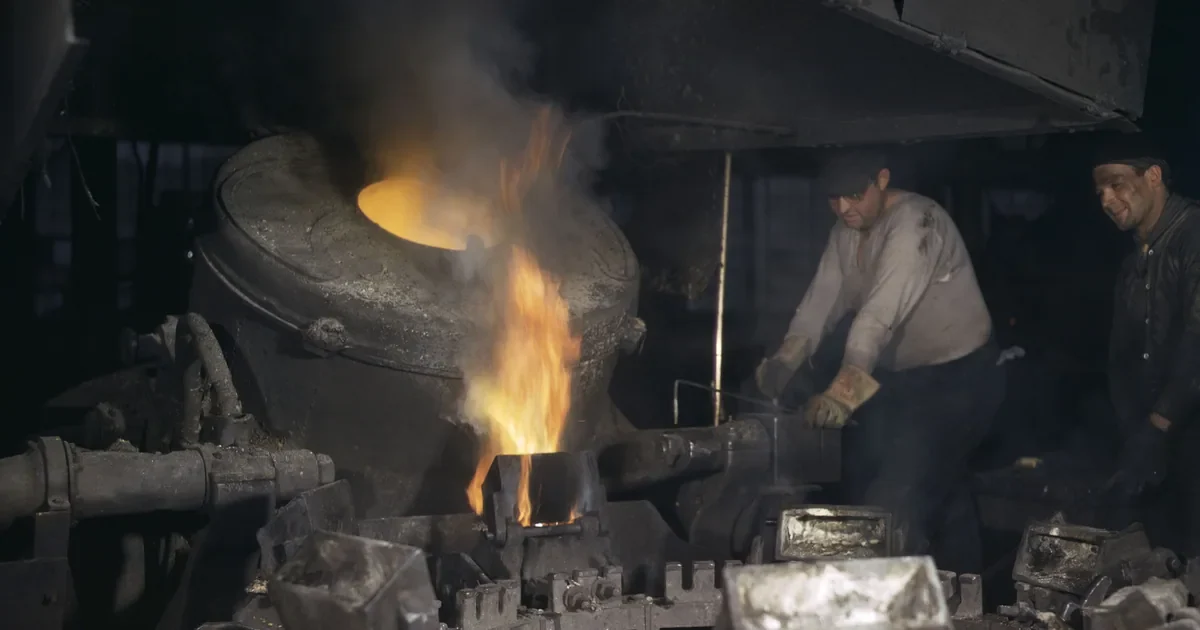
C360 is free-cutting brass for turning from bar, machinability 100 with 2.5 to 3.0 percent lead (CDA). C377 is forging brass with 1.5 to 2.5 percent lead, machinability 80 and an excellent hot forming rating. Turn C360 when the part is slender or the volume is low. Forge C377 when the part is bulky and the design is stable.
C360 is the brass you turn and C377 is the brass you forge. The Copper Development Association (CDA) lists C36000 at 2.5 to 3.0 percent lead with a machinability rating of 100, and C37700 at 1.5 to 2.5 percent lead with a rating of 80 and an excellent capacity for hot forming. The choice follows the process. This post is part of our guide to brass grades, and it compares the two on lead, hot forming, machinability, standards and cost, and says when each is the right answer.
We do not certify parts or give legal advice. Figures are CDA alloy-page values and mill datasheet values opened in October 2026. They describe the alloy, not any shop.
Checked October 2026.
The two grades at a glance
| C36000 free-cutting brass | C37700 forging brass | |
|---|---|---|
| Copper | 60.0 to 63.0 percent | 58.0 to 61.0 percent |
| Lead | 2.5 to 3.0 percent | 1.5 to 2.5 percent |
| Machinability rating (C360 = 100) | 100 | 80 |
| Capacity for hot forming | Fair | Excellent |
| Forgeability rating | Not listed | 100 |
| Capacity for cold working | Fair | Poor |
| Hot working temperature | 1300 to 1450 degrees F (about 704 to 788 C) | 1200 to 1500 degrees F (about 649 to 816 C) |
| Product standard listed by CDA | ASTM B16/B16M | ASTM B124/B124M, B283/B283M |
| European near match | CW603N (UNS C36000 on a mill sheet) | CW617N (see below); this site’s datasheet also pairs C377 with CW612N, I found no mill sheet for it |
CDA lists C36000 at 2.5 to 3.0 percent lead and a separate number, C36010, at 3.1 to 3.7. This site’s datasheet, shown in the box on this page, gives the two combined as 2.5 to 3.7.
Source: Copper Development Association alloy pages for C36000 and C37700, opened October 2026. Temperatures converted from the degrees F listed there. Iron limits are 0.35 percent for C36000 and 0.30 percent for C37700.
Lead and what it does at two temperatures
The same element does opposite jobs at room temperature and at forging heat. In the lathe, lead particles break the chip short and lubricate the edge, which is why C36000 carries the most of it and rates 100. At forging temperature lead is liquid between the grains, and a metal with liquid between its grains tears when it is stretched. Our post on hot shortness in brass covers the mechanism. The CDA’s ratings show the result: fair for hot forming on C36000 and excellent on C37700, with a forgeability rating of 100 for C37700.
C377 is the compromise. Less lead gives a thinner liquid film at the grain boundaries, and the copper range puts more plastic beta phase in the structure at forging heat, according to the same post. It still machines at 80, which is why a forged part can be finished on a lathe without a second alloy.
Standards and where each is made
C36000 bar is made to ASTM B16/B16M, which covers rod, bar, wire and shapes for screw machines. C37700 appears in ASTM B124/B124M, the specification for rod, bar and shapes intended for hot forging. The 2020 edition, listed as active, names C37700 along with naval brass C46400, C67500 and silicon brass C69300 in its alloy list, and sets tempers H50, M20 and M30. C36000 is not among the UNS numbers on that catalogue page. CDA also lists ASTM B283/B283M, die forgings (hot pressed), against C37700.
So a drawing for a forged part should name the forging stock standard, not the bar standard. A bar certificate to B16 for C36000 is not a forging certificate, and the reverse is also true. The standard texts are paywalled and I did not read them, so check the clauses on the edition you order to.
Strength and form after the process
Both grades come off the mill with similar strength. In the as hot extruded temper (M30), CDA lists a typical tensile strength of 52 ksi (about 359 MPa) for C37700 rod and 49 ksi (about 338 MPa) for C36000 shapes, with typical elongation near 45 and 50 percent. Strength is not the reason to pick between them. The form is.
A bar-turned part has its grain running along the bar. A forging has grain that follows the die, which our forging post says gives better fatigue behavior for pressure fittings and parts loaded in bending. For a part that sees only a seal and a thread, that is a small point. For a loaded part, it can be worth the die.
Machinability and how the scales differ
A rating of 100 against 80 is an ordering, not a cycle time. The CDA scale sets C36000 at 100. A mill datasheet I opened uses a different scale where CuZn39Pb3 (CW614N) is 100, and on it CW603N, the European partner of C36000, is 90 and CW617N is 95. On that scale the forging grade rates above the free-cutting one. On the CDA scale it rates below. Both are correct on their own scale, and mixing them gives a wrong answer.
If you do want a number for a quote, ask the shop for the cycle time of your part on each grade. Our lead-free cost post scales cutting time with the rating for illustration only, which would turn a 60 second cycle on C360, of which 45 seconds is cutting, into about 71 seconds on a grade rated 80. That is an assumption, not a measurement, and on a forging the cutting may be a fraction of the cycle.
Need a quote for this part? Get a quote for your brass parts
C377 and CW617N are not the same
Tables on this site pair C37700 with CW617N, and so do many suppliers. A mill datasheet I opened lists UNS C38000 against CW617N instead, with a reference composition of 58 percent copper and 2 percent lead and a rating of very good for hot forming at 650 to 760 degrees Celsius. The CDA gives C38000 55.0 to 60.0 percent copper, 1.5 to 2.5 percent lead and up to 0.30 percent tin, a different range from C37700. For forging stock the European standard is a separate document, EN 12165. DIN Media lists DIN EN 12165:2024-12 as current, replacing the 2016 edition. I did not read the text, so name the edition on your order. A drawing that needs one of these should name its grade and standard edition.
For the CW614N and CW617N pair on European drawings, see CW614N vs CW617N.
Cost and volume
Forging replaces metal removal with a die. The saving is metal and machine time, and the price is the die. Our forging post gives about 5,000 pieces a year for a bulky part as a planning figure. I found no published survey behind that number, and it moves with the shape, the die and how stable the design is. The method is better than the number: send the drawing, the annual quantity and the repeat horizon, and let shops quote the route they would choose. The arithmetic is in forging or machining a brass part.
Which to choose
Choose C360 when:
- The part is turned from bar and is slender, so little metal is wasted.
- The quantity is low or the design may change.
- The bar standard is B16 or EN 12164 and the shop holds the bar.
- Tight tolerance runs over most of the surface.
Choose C377 (or CW617N) when:
- The part is bulky compared with its finished size and the volume repeats.
- The design is stable enough to pay for a die.
- The part is a valve body, fitting or hardware blank that is machined only on faces and threads.
- The forging stock standard (B124, or EN 12165 with its edition year) is named on the order.
Neither, when the part touches drinking water in the US. Both are far over the limit in the Safe Drinking Water Act. As of October 2026, Safe Drinking Water Act section 1417 (42 U.S.C. 300g-6) defines lead free for the wetted surfaces of pipes, fittings and fixtures as a weighted average of not more than 0.25 percent lead, and exempts fittings used exclusively for nonpotable service. This is not legal advice; confirm with the product maker or counsel. Silicon brass C69300, which is also in B124, is the forging route there. The guide to brass grades shows how the lead rule changes the shortlist.
What picking the wrong one costs
Forged from C360, the part risks tears at the flash and rim. The CDA rates the grade fair for hot forming, and our post describes the failures as showing at trim, or as a small tear machined over and found at the pressure test. Turned from C377, the part costs more cycle time and wastes the metal a forging would have saved. Neither mistake is a quality problem in the alloy. Both are a mismatch between the alloy and the process.
What to write on the drawing
Process: hot forged, then machined on sealing faces and threads.
Material: forging brass C37700 (CuZn39Pb2 or CuZn40Pb2 acceptable)
per ASTM B124/B124M, or EN 12165 forging stock (edition year as ordered).
C36000 free-cutting bar not acceptable for the forging.
Mill certificate EN 10204 3.1 with composition.
Have a bulky brass part with a stable design? Send the drawing with the annual quantity and say whether a forging route is wanted or left open. We quote the finished parts within 24 business hours and place the work with one of the partner shops that turn brass. If you are still choosing the grade, start from the guide to brass grades.
Frequently asked questions
Can I forge C360 brass?
It is the wrong grade for it. The Copper Development Association rates C36000 fair for hot forming and C37700 excellent. C360 carries more lead, and lead is liquid at forging heat, which is why free-cutting bar is extruded at the mill but tears in a forging die. Use a forging grade such as C377 or CW617N and machine the forging afterwards.
Is C377 the same as CW617N?
They are close, not identical. Tables on this site pair them, but a mill datasheet I opened lists UNS C38000 against CW617N, and the CDA gives C38000 a copper range of 55.0 to 60.0 percent against 58.0 to 61.0 for C37700. For forging stock name the grade you need, and let the shop propose an equivalent for approval.
Is C377 harder to machine than C360?
Slightly. The CDA machinability rating is 80 for C37700 against 100 for C36000, because there is less lead to break the chip. On a forging the cutting is usually limited to faces, threads and cross holes, so the lower rating costs little. On a part turned entirely from bar it is a cycle-time penalty with no benefit.
At what volume does forging brass pay?
I found no published survey of the break-even point. Our forging post uses about 5,000 pieces a year for a bulky part as a planning figure, and it moves with part shape, die cost and design stability. Ask shops to quote the route they would choose on your drawing and quantity instead of assuming one.
Alloys in this guide
| Alloy | Lead % | Mach. | DZR |
|---|---|---|---|
| C360 free-cutting brassC36000 · CuZn36Pb3 / CW603N | 2.5 to 3.7 | 100 | Poor |
| C377 forging brassC37700 · CuZn39Pb2 / CW612N | 1.5 to 2.5 | 80 | Poor |
| CW617N CuZn40Pb2C37700 (nearest) · CuZn40Pb2 / CW617N | 1.6 to 2.5 | 80 | Poor |
Published typical values for the alloy. Machinability against C360 at 100. Not a promise from a shop.
Sources
- Copper Development Association, alloy data C36000 free-cutting brass alloys.copper.org
- Copper Development Association, alloy data C37700 forging brass alloys.copper.org
- ASTM International, B124/B124M-20 copper and copper alloy forging rod, bar and shapes (catalogue page) store.astm.org
- Copper Development Association, alloy data C38000 alloys.copper.org
- DIN Media, DIN EN 12165:2024-12 forging stock (catalogue page, replaces the 2016 edition) dinmedia.de
- Cornell LII, 42 U.S.C. 300g-6, Safe Drinking Water Act section 1417, prohibition on use of lead pipes, solder and flux law.cornell.edu
- Diehl Brass Solutions, material datasheet 205 (CuZn36Pb3, CW603N, UNS C36000) diehl.com
- Diehl Brass Solutions, material datasheet 003 (CuZn40Pb2, CW617N) diehl.com
Need a quote for this part?
Send the drawing. We read it, send one itemised quote for the finished parts within 24 business hours and place the work with a partner shop that turns brass. Brass only.
Get a quote for your brass parts