Guides / Materials
CW614N or CW617N: Reading the European Brass Grade on a Drawing
Published November 21, 2026. Reviewed for the facts in the corrections log.
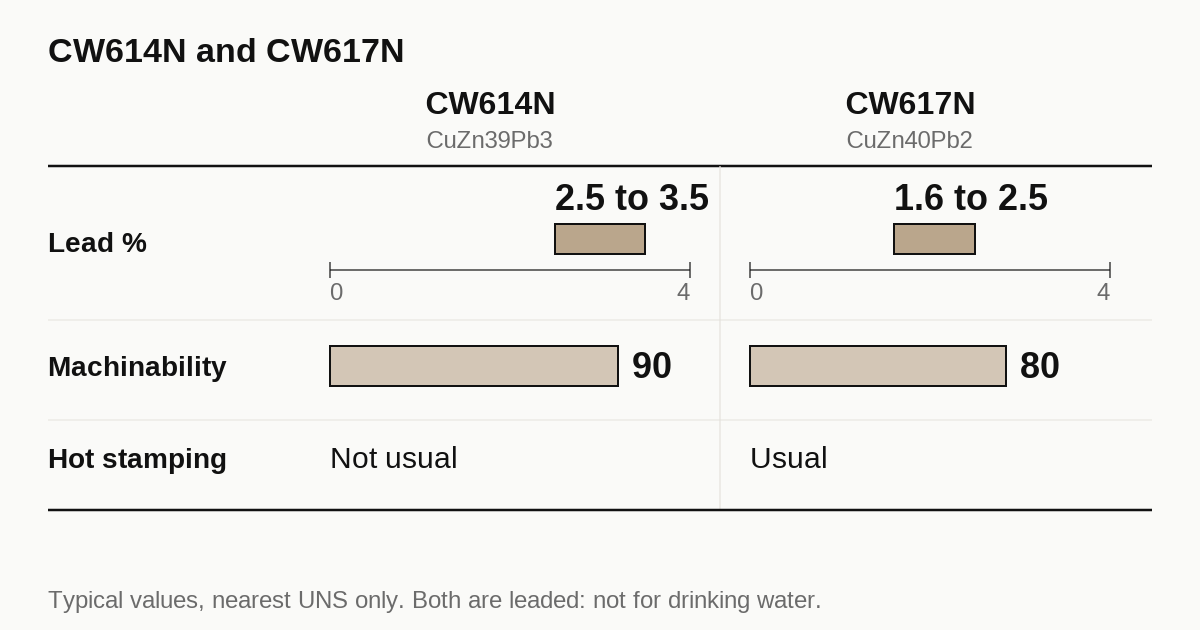
CW614N is CuZn39Pb3, a free-cutting rod and extrusion brass with 2.5 to 3.5 percent lead and machinability near 90. CW617N is CuZn40Pb2, the standard hot stamping brass with 1.6 to 2.5 percent lead and machinability near 80. For a turned part either usually works, but a forged blank wants CW617N.
European drawings name brass by a code, and two codes show up more than any others: CW614N and CW617N. They look alike, they are both leaded yellow brass, and a buyer can read them as interchangeable. They are close, but not the same. One is the turning grade. The other is the forging grade. The difference decides which one a shop can cut quickly, which one a forger can stamp and which one is safe to substitute.
This post explains the two grades, what the code letters and numbers mean, and how to write a drawing so that the right bar arrives. The figures are published typical values for the alloys, not a promise from any shop.
How to read a CW code
The European system for copper alloys uses a code of letters and numbers. The first letter C means copper. The second, W, means wrought. Then comes a three-digit number, and a final letter that groups the alloy by type. N is used for copper-zinc-lead alloys. The chemical name, such as CuZn39Pb3, spells out the composition: copper, then 39 percent zinc, then 3 percent lead.
So CuZn39Pb3 and CW614N are the same alloy, and so are CuZn40Pb2 and CW617N. A drawing may carry either form, plus an older number from the German DIN system, 2.0401 and 2.0402, or an old British grade, CZ121 and CZ122. The cross reference page lists these side by side.
CW614N: the turning grade
CW614N, CuZn39Pb3, carries 2.5 to 3.5 percent lead and about 57 to 59 percent copper. It is the leaded brass of choice for rod, bar and extruded sections that will be turned, drilled and milled in volume. The lead content is high, so chips break short and tools last. Machinability sits near 90 on the scale where C360 is 100. The nearest UNS grade is C38500, and the JIS match is C3604.
It is also the common brass for profiles. Extruded shapes in this grade end up as hinges, handles, lock hardware and trim. That is why it is sold under the name architectural bronze in the US, even though it is a brass.
CW617N: the forging grade
CW617N, CuZn40Pb2, carries 1.6 to 2.5 percent lead and about 57 to 59 percent copper. The slightly higher zinc and the lower lead move it into the range where the metal is plastic at forging temperature. Hot stamped valve bodies, fittings and fixtures in Europe are made from it, and machined only where a sealing face or thread needs it. Machinability is near 80. The nearest UNS grade is C37700, which is the subject of the C377 forging brass datasheet.
Lead helps cutting and hurts hot working, because lead melts at forging temperature and can open cracks between grains. This is why the forging grade has less lead than the turning grade. The full story is in hot shortness in brass.
Side by side
| Property | CW614N CuZn39Pb3 | CW617N CuZn40Pb2 |
|---|---|---|
| DIN number | 2.0401 | 2.0402 |
| Lead, nominal | 2.5 to 3.5 percent | 1.6 to 2.5 percent |
| Copper | 57 to 59 percent | 57 to 59 percent |
| Machinability (C360 = 100) | About 90 | About 80 |
| Tensile strength, typical | 380 to 480 MPa | 360 to 480 MPa |
| Density | About 8.47 g/cm3 | About 8.44 g/cm3 |
| Hot stamping | Not the usual choice | The usual choice |
| Typical forms | Rod, bar, extruded sections | Rod, bar, hot stamping billet |
| Nearest UNS | C38500 | C37700 |
| Old British grade | CZ121 Pb3 | CZ122 |
| Nearest JIS | C3604 | C3771 |
Published typical values for the alloys, with UNS and JIS entries as nearest matches only. The standard named on the drawing takes precedence.
Cost and cutting speed
On a CNC lathe the machinability gap shows up as a modest difference. CW614N may run roughly 10 percent faster at the same tool life, and a shop that has priced a turned part on CW614N will see a slightly higher cycle on CW617N. On a 20 second cycle that is about two seconds a part. At 50,000 parts it is a day and a half of machine time. Bar price follows the copper market and is close for the two grades. See brass bar price and the copper market for what drives it.
For hot stamped parts the picture reverses. A forger will stamp CW617N and will refuse or charge more for CW614N, because the extra lead cracks the part. A buyer who has a forged part drawn in CW614N should expect a question.
Where MS58 causes trouble
MS58 is a German trade name that has been used for both alloys. Older drawings say MS58, newer ones say CW614N or CW617N. In some catalogues MS58 is CuZn39Pb3. In others it is CuZn40Pb2. A drawing with only MS58 leaves the buyer, the shop and the mill guessing. The fix is a one-line question to the drawing owner, and a note on the revised drawing that names the code.
The same care applies to the old British CZ numbers. CZ121 and CZ122 look nearly the same and are two different alloys.
Need a quote for this part? Get a quote for your brass parts
What neither grade is for
Both grades are leaded, with lead far above the 0.25 percent weighted average limit that NSF/ANSI 372 sets for wetted potable water parts, and above the limits applied to drinking water fittings in Europe. They suit gas, heating, hardware and other non-potable service. For drinking water see NSF 61 and 372 brass fittings and leaded vs lead-free brass. Neither grade resists dezincification well, so hot water or aggressive water points to a different alloy, covered in dezincification-resistant brass. This is not legal advice.
Temper, bar tolerance and straightness
The grade code is only half of a bar order. European rod is supplied in tempers named by minimum tensile strength, for example R360 or R430, or by hardness, and the temper changes how the part cuts and how it springs back. Drawn bar also has a diameter tolerance class, h9 and h11 being common, and a straightness limit. A turned part that needs most of the bar diameter left in place, for instance a hex fitting cut from hex bar, depends on the bar tolerance as much as on the grade. Name the temper or tensile minimum if the part is loaded, and name the bar tolerance if the original surface stays on the finished part. A shop that buys the cheapest bar that fits the code may deliver a temper that is correct on paper and awkward on the machine.
Mixing the two on one floor
A shop that runs both grades faces a small risk of mixed stock. The bars look alike, the tags are small and a hand scan with a handheld analyzer is the only quick check. The lead difference, about one percentage point, is large enough for a screening instrument to see. See XRF checks on brass bar for how that screening is done. If your part allows only one grade, ask the shop how it keeps the two apart.
How to write it on the drawing
Material: CuZn39Pb3 (CW614N) per EN 12164. CW617N (CuZn40Pb2) acceptable by written approval.
Mill certificate EN 10204 3.1 with chemistry and heat number.
For a forged part:
Material: CuZn40Pb2 (CW617N) hot stamping stock per EN 12165. No substitution.
Naming both the code and the chemical symbol removes most misreads. If either grade is acceptable, say so, because a shop with CW617N in stock can quote sooner and cheaper.
Checklist
- Grade named by CW code and by chemical symbol.
- No bare MS58 or CZ number without the composition.
- Substitution rule stated: allowed, allowed with approval, or not allowed.
- Forged parts specify CW617N or C377 stock.
- Potable water parts moved to a lead-free grade.
- Mill certificate with chemistry requested.
EN 12164 was revised in 2024; see the guide to brass grades and our EN 12164 post for what the catalogue pages say changed.
Have a European drawing to quote? Send it with the grade marked. We quote the finished parts within 24 business hours and place the work with one of the partner shops that turn brass.
Frequently asked questions
Can CW617N replace CW614N on a turned part?
Usually yes, if the drawing has no strength or hardness limit that rules it out. The two have close tensile strength and similar corrosion behavior. CW617N cuts a little slower, because it has less lead, so a shop may quote a longer cycle. Get written approval for the substitution and ask the buyer's engineer to confirm there is no drawing note that names one grade only.
What does MS58 mean on a drawing?
MS58 is an older German trade name, and it is used loosely for both grades. Depending on the supplier and the era it can mean CuZn39Pb3 (CW614N) or CuZn40Pb2 (CW617N). If a drawing says only MS58, ask which composition is meant before ordering bar.
Is either grade lead free for drinking water?
No. Both are leaded brasses, with 1.6 to 3.5 percent lead, and both sit far above the 0.25 percent weighted average limit of NSF/ANSI 372 and the stricter European drinking water rules. For wetted potable water parts use a lead-free brass, and treat these two as grades for gas, heating, hardware and other non-potable service.
Alloys in this guide
| Alloy | Lead % | Mach. | DZR |
|---|---|---|---|
| C385 architectural bronzeC38500 · CuZn39Pb3 / CW614N | 2.5 to 3.5 | 90 | Poor |
| CW617N CuZn40Pb2C37700 (nearest) · CuZn40Pb2 / CW617N | 1.6 to 2.5 | 80 | Poor |
| C377 forging brassC37700 · CuZn39Pb2 / CW612N | 1.5 to 2.5 | 80 | Poor |
Published typical values for the alloy. Machinability against C360 at 100. Not a promise from a shop.
Sources
- Copper Development Association copper.org
- Wikipedia, Brass en.wikipedia.org
Need a quote for this part?
Send the drawing. We read it, send one itemised quote for the finished parts within 24 business hours and place the work with a partner shop that turns brass. Brass only.
Get a quote for your brass parts