Guides / Materials
What Red Brass, Yellow Brass and Cartridge Brass Mean on a Purchase Order
Published November 21, 2026. Reviewed for the facts in the corrections log.
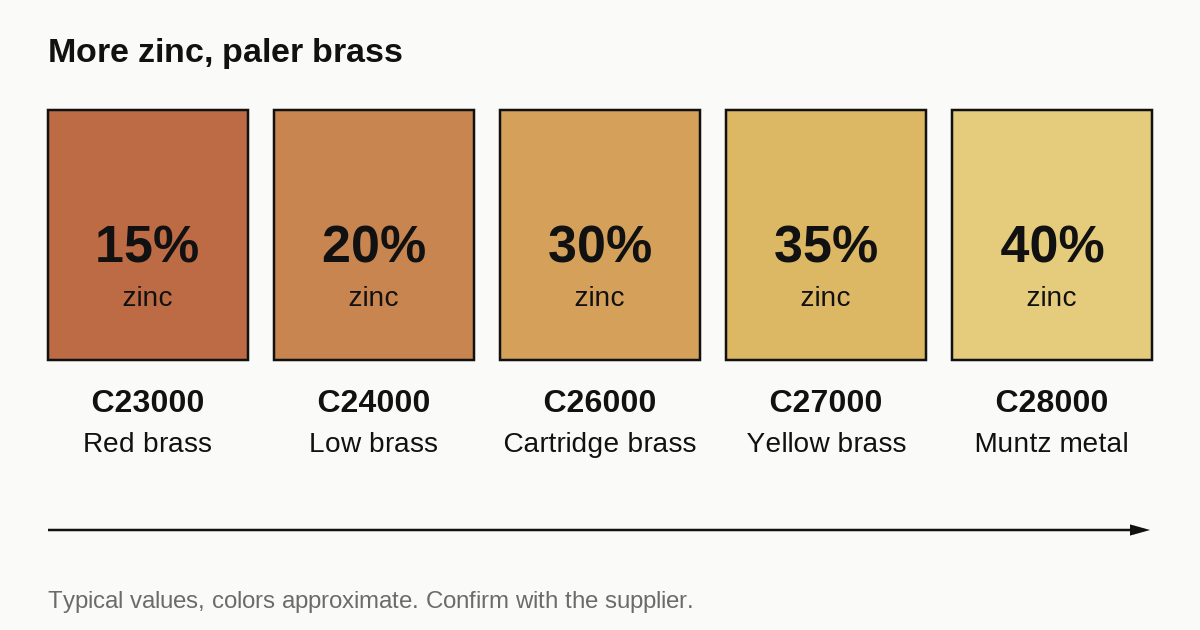
Brass changes color with zinc content. Red brass has about 15 percent zinc, cartridge brass 30 percent, yellow brass about 35 percent and Muntz metal 40 percent. More zinc means a paler yellow, more strength and lower cost, but also a higher risk of dezincification. None of these names is a specification, so give the UNS or EN grade.
Three color names turn up on purchase orders more than any others: red brass, yellow brass and cartridge brass. They sound like three metals. They are three points on one scale. The scale is the ratio of zinc to copper, and it sets the color, the strength, the cost and, importantly for a buyer, how well the alloy machines and how it fails in water.
None of the names is a specification. A buyer who writes “red brass” and nothing else has told the shop very little. This post explains the scale, gives the UNS and EN grades behind each name and shows what to write instead.
One system, one scale
Brass is copper alloyed with zinc. Pure copper is salmon red. Adding zinc shifts the color first to a reddish gold, then to a warm yellow, then to a pale lemon yellow at around 40 percent zinc. Strength rises with zinc up to about 40 percent, and the metal gets cheaper because zinc costs far less than copper. That is the whole explanation for the names. The color is a rough readout of the zinc.
Trade names grew up around the end uses. Cartridge brass is called that because it was the alloy for drawing ammunition cases: it is the best balance of strength and cold ductility. Red brass was the plumbing and condenser alloy. Yellow brass was the general purpose sheet and wire alloy. Muntz metal was a high-zinc alloy for ship sheathing.
The grades behind the names
| Common name | Copper to zinc | UNS | EN | Machinability (C360 = 100) | Lead |
|---|---|---|---|---|---|
| Red brass | 85 / 15 | C23000 | CW502L | About 30 | Under 0.05 percent |
| Low brass | 80 / 20 | C24000 | CW503L | About 30 | Trace |
| Cartridge brass | 70 / 30 | C26000 | CW505L | About 30 | Trace |
| Yellow brass | 65 / 35 | C27000 | CW507L | About 30 | Trace |
| Muntz metal | 60 / 40 | C28000 | CW509L | About 40 | 0.30 percent max |
| Free-cutting brass | 61 / 36 / 3 Pb | C36000 and C36010 | CW603N | 100 | 2.5 to 3.7 percent |
Published typical values for the alloys. Machinability for C27000 is a typical figure for unleaded alpha brass. The standard named on the order takes precedence.
The datasheets for C230 red brass, C260 cartridge brass and C280 Muntz metal carry the full composition and DIN, JIS and British cross references.
Color by zinc content
Zinc content gives the following rough progression. Real color also depends on surface condition, oxide and finish, so treat this as a guide and not a match standard.
- About 15 percent zinc. Warm reddish gold, close to a pale bronze. Red brass.
- About 20 percent zinc. Golden. Low brass, sometimes called gilding brass.
- About 30 percent zinc. Clear gold-yellow. Cartridge brass.
- About 35 percent zinc. Yellow. Yellow brass and also the base of free-cutting brass.
- About 40 percent zinc. Pale yellow. Muntz metal.
A buyer matching color on visible hardware needs more than a name. Give the grade, the finish and a physical sample, and expect lot to lot variation of the kind covered in decorative brass hardware and finish consistency.
How each machines
Machinability is where the color names mislead. Red, cartridge and yellow brass without lead are all single-phase alpha brass. They are soft and ductile, and that is the problem. The chip does not break. It curls into long strings, gums on the tool edge and leaves a torn surface. All three rate about 30 against C360 at 100.
Adding lead changes everything, which is why free-cutting brass is the standard turned alloy. Muntz metal at 40 percent zinc has a second phase that breaks the chip a little better and rates about 40. Even so, none of the unleaded grades is what a shop picks for a part that is mostly turned. Brass rod for screw machines is leaded for that reason. See C360 vs C260 for a comparison of cartridge and free-cutting brass on the lathe.
So why are these grades used? Because the work is forming. Cartridge brass draws deeply without cracking. Red brass bends into pipe and forms into tube. Yellow brass stamps into sheet parts and wire. The machine shop sees them when a drawn or stamped blank needs a small amount of cutting.
Dezincification and cracking
Zinc content also sets the corrosion behavior, and here the story reverses.
Dezincification. In some waters, particularly warm, soft or chlorinated water, the zinc leaches out of a brass and leaves a weak, porous copper skeleton. Brass with about 15 percent zinc or less resists this well, which is why red brass was the choice for water pipe. Cartridge brass, yellow brass and Muntz metal have no such immunity. Muntz metal, with its second phase, is the most vulnerable. See dezincification-resistant brass.
Stress corrosion cracking. Cartridge brass is the classic case. Cold-formed parts hold residual stress, and in an ammonia or amine atmosphere they crack along the grain, a failure once called season cracking. Brasses with more zinc crack more readily. A stress relief anneal removes the risk. See brass stress corrosion cracking.
Need a quote for this part? Get a quote for your brass parts
Where each name is used
| Name | Typical uses |
|---|---|
| Red brass | Plumbing pipe and fittings, condenser tube plates, decorative hardware, jewelry findings |
| Low brass | Flexible hose, musical instrument parts, decorative trim |
| Cartridge brass | Drawn cases, radiator parts, zippers, lamp bases, deep-drawn shells |
| Yellow brass | Sheet stampings, wire, general hardware, rivets |
| Muntz metal | Heat exchanger tube plates, ship sheathing, condenser parts |
Typical uses. Specific parts depend on the standard and the designer.
Names that mislead
A few traps are worth knowing.
Red brass in the foundry trade. Cast plumbing alloys sold as red brass, such as the 85-5-5-5 family, carry tin, lead and zinc. They are a different family of copper alloy from the wrought red brass above. A drawing that says red brass and a foundry that quotes it are not always talking about the same metal. Check the UNS number. A cast part of that family is outside the scope of this site, which quotes brass only.
Yellow brass as a catch-all. In casual use, yellow brass means any brass that is yellow, including free-cutting C360. If the part is turned, a shop will assume the leaded grade unless told otherwise. If the part must be unleaded, say so.
Architectural bronze. A brass despite the name. See C385 architectural bronze.
Buying by form, not only by grade
Because these grades are formed more than turned, they usually reach a shop as sheet, strip, tube or drawn wire, and each form has its own standard and temper. Sheet and strip follow ASTM B36 in the US and EN 1652 in Europe. Tube has its own standards. Temper names such as quarter hard, half hard and spring describe how much cold work the strip has had, and they control how far it bends before it cracks. A part cut from half-hard cartridge brass behaves very differently from the same shape cut from soft. If a drawing leaves the temper open, the mill chooses, and the first lot may form well and the second may not. Write the temper in the order and ask for a hardness or tensile check on the certificate.
Thin strip also carries a rolling direction. Bends across the grain are safer than bends along it, and a small part cut the wrong way can crack at the bend. A drawing for a bent brass part should show the rolling direction relative to the bend line.
What to write on the drawing
Material: brass C26000 (CuZn30, CW505L), half hard, per ASTM B36 or EN 1652.
Lead: trace only, not a free-cutting grade.
Mill certificate EN 10204 3.1 with chemistry.
Name the UNS or EN grade, the product form and the temper, and say whether lead is allowed. Never rely on a color name alone.
Checklist
- Grade named by UNS or EN code, not by color.
- Product form and temper stated: rod, tube, sheet, wire and hardness.
- Lead allowed or not allowed, written out.
- Environment checked for dezincification and cracking risk.
- Turned parts moved to a free-cutting grade where lead is permitted.
- A sample or color tolerance agreed for visible parts.
For choosing a grade from the part rather than from a color name, see our guide to brass grades.
Need brass parts from any of these grades? Send the drawing. We quote the finished parts within 24 business hours and place the work with one of the partner shops that turn brass.
Frequently asked questions
Is red brass a different metal from yellow brass?
It is the same copper and zinc system with a different ratio. Red brass has about 85 percent copper and 15 percent zinc, which gives a reddish gold color. Yellow brass has about 65 percent copper and 35 percent zinc and looks clearly yellow. The extra zinc also raises strength and lowers price.
Which of these machines best?
None of the unleaded grades machine well. Red brass, cartridge brass and yellow brass without lead are gummy and rated about 30 on a scale where free-cutting C360 is 100. If the part is mostly turned, a leaded free-cutting grade is the better choice. These unleaded grades are chosen for forming, drawing and corrosion, not for fast cutting.
Does red brass resist dezincification?
Yes. Brass with roughly 15 percent zinc or less resists dezincification well, which is why red brass is used for water pipe and fittings. Higher-zinc grades such as yellow brass and Muntz metal are more vulnerable, particularly in hot or soft water.
Alloys in this guide
| Alloy | Lead % | Mach. | DZR |
|---|---|---|---|
| C230 red brassC23000 · CuZn15 / CW502L | under 0.05 | 30 | High |
| C260 cartridge brassC26000 · CuZn30 / CW505L | trace | 30 | Poor |
| C280 Muntz metalC28000 · CuZn40 / CW509L | 0.30 max | 40 | Poor |
| C360 free-cutting brassC36000 · CuZn36Pb3 / CW603N | 2.5 to 3.7 | 100 | Poor |
Published typical values for the alloy. Machinability against C360 at 100. Not a promise from a shop.
Sources
- Wikipedia, Brass en.wikipedia.org
- Copper Development Association, C23000 alloy data alloys.copper.org
Need a quote for this part?
Send the drawing. We read it, send one itemised quote for the finished parts within 24 business hours and place the work with a partner shop that turns brass. Brass only.
Get a quote for your brass parts