Guides / Materials
Brass Grade Equivalents Between UNS, EN, JIS and GB Designations
Published October 27, 2026. Reviewed for the facts in the corrections log.
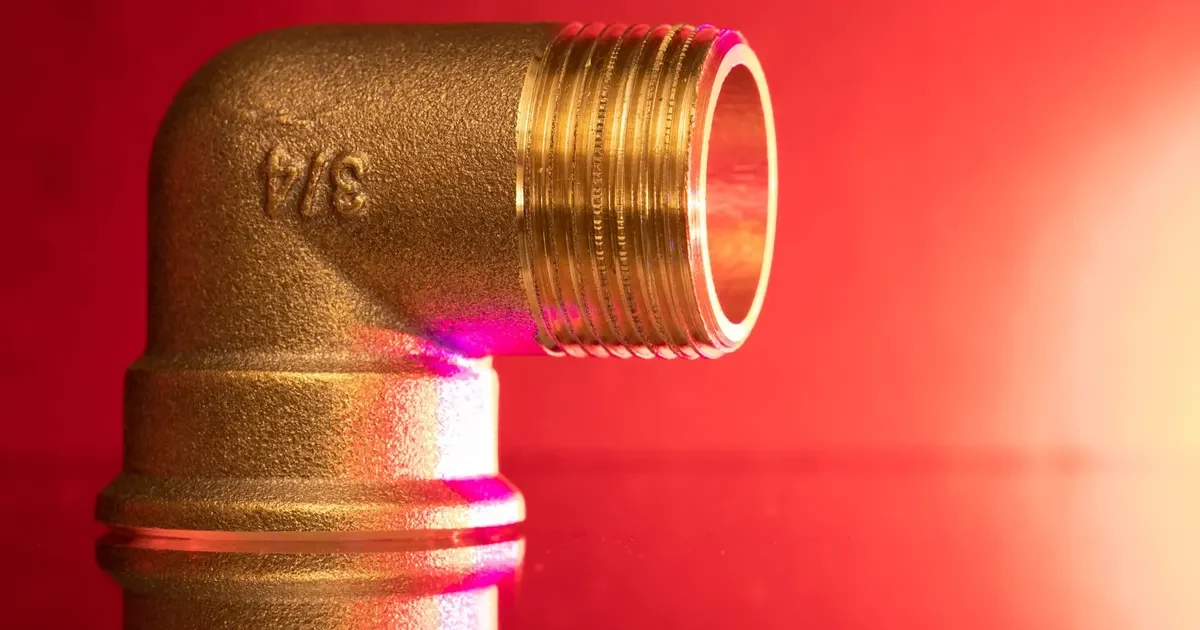
A brass grade equivalent is the nearest match between national systems, not an identical alloy. C36000, CW603N, JIS C3601 and Chinese HPb63-3 are close but have different lead limits and tolerances. Write the main designation, the chemistry limits that matter and a rule for substitution, so a mill cannot ship a near match you did not approve.
A drawing from a US customer says C36000. A mill in Europe quotes CW603N. A shop in Japan offers C3601. A supplier in China quotes HPb63-3. All four can be called free-cutting brass, and all four are close, but they are not the same alloy. The differences are small, yet small differences in lead, iron or temper are how a good order turns into a rejected lot.
This post explains how the four systems are built, gives a cross-reference for the grades buyers meet most often and sets out how to write an RFQ so an equivalent is a decision and not a surprise. For a bigger table with DIN and British numbers, see the brass cross-reference page.
How each system names brass
UNS (United States). The Unified Numbering System gives a letter and five digits. C means copper alloy, and the digits place the alloy in a family. C36000 is free-cutting brass. C26000 is cartridge brass. The number says nothing about the composition by itself, so the datasheet matters.
EN (Europe). The CW code, such as CW603N, is a short code. The chemical name, such as CuZn36Pb3, tells the composition: copper, 36 percent zinc and 3 percent lead. Both appear on drawings, and the name is easier to check.
JIS (Japan). Codes such as C3601 and C2600 echo the UNS style, which is why they are easy to mistake for UNS numbers. They belong to a separate standard, JIS H3250 for rod and bar.
GB (China). Names such as HPb63-3 build the composition into the label. H means brass. Pb means lead is added. The first number is the copper percentage and the second the lead percentage. HSn62-1 is brass with 62 percent copper and 1 percent tin.
Older systems. DIN numbers such as 2.0401 and British CZ numbers such as CZ121 still sit on drawings that predate EN. They map to EN grades, as the cross-reference page shows.
The cross-reference
| Grade | UNS | EN | JIS (nearest) | GB (nearest) |
|---|---|---|---|---|
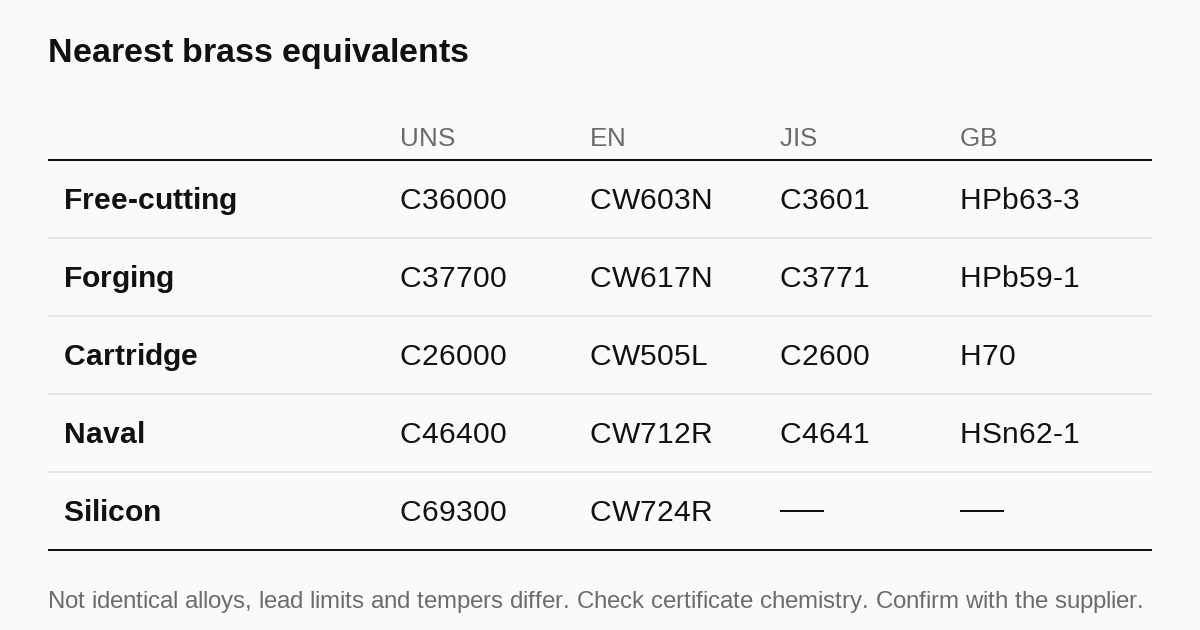
| Free-cutting brass | C36000 | CW603N | C3601, C3602 | HPb63-3 |
| Leaded brass for profiles | C38500 | CW614N | C3604 | HPb59-3 |
| Forging brass | C37700 | CW612N, CW617N | C3771 | HPb59-1 |
| Cartridge brass 70/30 | C26000 | CW505L | C2600 | H70 |
| Red brass 85/15 | C23000 | CW502L | C2300 | H85 |
| Naval brass | C46400 | CW712R | C4641 | HSn62-1 |
| Admiralty brass | C44300 | CW706R | C4430 | HSn70-1 |
| Silicon brass, lead free | C69300 | CW724R | None | None close |
| Lead-free brass with arsenic | None direct | CW511L | None | None |
Published nearest matches, compiled from common supplier practice. They are not identical alloys. The standard named on the order and the mill certificate take precedence.
Where the match is close and where it is not
Some pairs are near twins. C26000 and JIS C2600 and Chinese H70 all describe 70 percent copper, 30 percent zinc cartridge brass, with the same limits on lead and iron within small margins. C46400 and HSn62-1 are similar. For these, an equivalent is usually safe.
Other pairs hide differences that matter.
Lead. CDA lists C36000 at 2.5 to 3.0 percent lead and C36010 at 3.1 to 3.7, which is the 2.5 to 3.7 range this site shows for C360. HPb59-1, offered as an equivalent for forging brass, typically runs about 0.8 to 1.9 percent lead, below C37700 and far below C36000. It machines slower, and the lower lead content can matter for a part that depends on chip breaking. JIS C3601 and C3602 set a lower minimum lead, about 1.8 percent, than C36000. See C360 free-cutting brass for the US figure.
Trace elements. Standards cap iron, nickel, aluminum and tin at different values. A drawing that relies on a low iron figure for polishing or plating may not get it from a near match.
Temper names. US rod is sold by temper such as H02 under ASTM B16. European rod is sold by tensile class such as R430 under EN 12164. JIS H3250 uses its own symbols. A temper in one system may not map one to one onto another.
Dimensional tolerance. Each standard sets its own bar diameter and straightness limits. A bar that meets one may be at the edge of another.
Grades with no match. Silicon brass C69300 has no JIS or GB twin. Chinese HSi80-3 is a silicon brass with higher copper and a different silicon range, so it is not the same alloy. Lead-free bismuth brass has no single EN code. For lead-free alloys, write the composition limit and the drinking water standard, and let the shop propose the grade. See bismuth brass vs silicon brass.
Leaded grades and the compliance line
A cross-reference tells you which names belong together. It does not tell you whether an alloy is allowed in your market. All the leaded rows above sit far over the 0.25 percent weighted average limit that NSF/ANSI 372 applies to wetted drinking water parts. A Chinese or Japanese equivalent of a leaded grade is leaded too. The compliance side is in NSF 61 and 372 brass fittings. This is not legal advice.
Need a quote for this part? Get a quote for your brass parts
A worked case
A US buyer sends a drawing for a hex fitting in C37700 forging brass and asks for quotes abroad. One supplier answers with HPb59-1 at a lower price and calls it the equivalent. On paper the two look alike: copper near 58 to 60 percent, a leaded alpha-beta brass, similar strength. In practice the lead is lower, so the chip breaks less cleanly, and the quoted cycle time on the thread and cross hole is longer than the buyer expected. The lower lead also changes how the part behaves in hot stamping, which can help the forger and hurt the turner. Nothing is wrong with the alloy. It is a different alloy with a different cost on the machine.
The buyer can resolve this in one email. Ask for the certificate chemistry from the last heat, compare lead, copper and iron with the C37700 limits, and ask the shop to confirm cycle time on the same drawing for both grades. If the price still wins, write the approved substitution on the purchase order with the chemistry range, so the next lot is held to the same limits and not to whatever the mill ships.
Why buyers get caught
Three habits cause most substitution trouble. The first is reading a code as a family name: a buyer sees C36 and assumes any C36xxx grade will do. The second is trusting a table without a source, since an online cross-reference may mix exact and nearest matches in the same column. The third is treating the supplier’s word equivalent as approval. Equivalent is a claim, and approval is a decision the buyer makes after seeing the chemistry. Keep the two apart and the table in this post becomes a good starting point, not a trap.
Using equivalents on an RFQ
A good order writes the primary designation and states what is acceptable in its place.
Material: C36000 per ASTM B16 (CuZn36Pb3, CW603N per EN 12164).
Equivalents JIS C3601 or GB HPb63-3 acceptable only with chemistry on the certificate
inside the C36000 limits and written approval before shipment.
Mill certificate EN 10204 3.1 with heat number and chemistry.
Three rules keep it safe. Name one primary grade. List the equivalents you will accept and the evidence you need. Ask for the chemistry on the certificate, not just the designation, so you can compare it with the limits. See material certificates under EN 10204 for what a 3.1 certificate shows.
Reading a supplier quote
When a quote names a grade you did not write, ask for the datasheet or the standard it quotes against. Compare lead, copper, iron and any element your part is sensitive to. Check the temper. Check the diameter tolerance class. If any of them differ, ask for the effect on your part in writing. Many equivalents are fine, and the check takes minutes.
For a deeper look at two European grades that are often confused, see CW614N vs CW617N.
Checklist
- One primary grade named with its standard.
- Acceptable equivalents listed, with the evidence required.
- Chemistry limits written for the elements that matter to the part.
- Temper or tensile class named in the standard’s own terms.
- Bar tolerance class stated if the original surface stays.
- Certificate with chemistry required on every lot.
- Lead-free requirement stated as a standard, not a grade.
Approving an equivalent is a decision with steps; they are set out in our guide to brass grades.
Have a drawing with a foreign grade code? Send it with the designation marked. We quote the finished parts within 24 business hours and place the work with one of the partner shops that turn brass.
See also: JIS C3604 free-cutting brass and its nearest grades.
Frequently asked questions
Is a brass grade equivalent the same alloy?
Usually not exactly. Equivalents are the nearest match between standards, and the composition ranges overlap without being identical. A lead limit, a trace element cap or a temper name can differ. Treat any equivalent as acceptable only after comparing the chemistry limits that matter to your part and writing the acceptance on the order.
What is the Chinese equivalent of C36000?
HPb63-3 is the usual match, a leaded brass of about 63 percent copper and 3 percent lead. The designation reads as H for brass, Pb for lead, 63 for copper content and 3 for lead content. Check the supplier's certificate for the actual chemistry and the standard it is made to.
Why does the same brass have so many names?
Each country built its own system. The US uses UNS numbers such as C36000. Europe uses EN codes such as CW603N and chemical names such as CuZn36Pb3. Japan uses JIS codes such as C3601. China uses names such as HPb63-3. Older DIN and British numbers also stay on drawings. They were set separately, so the matches are approximate.
Alloys in this guide
| Alloy | Lead % | Mach. | DZR |
|---|---|---|---|
| C360 free-cutting brassC36000 · CuZn36Pb3 / CW603N | 2.5 to 3.7 | 100 | Poor |
| C385 architectural bronzeC38500 · CuZn39Pb3 / CW614N | 2.5 to 3.5 | 90 | Poor |
| C377 forging brassC37700 · CuZn39Pb2 / CW612N | 1.5 to 2.5 | 80 | Poor |
| C260 cartridge brassC26000 · CuZn30 / CW505L | trace | 30 | Poor |
| C464 naval brassC46400 · CuZn38Sn1 / CW712R | under 0.20 | 30 | High |
Published typical values for the alloy. Machinability against C360 at 100. Not a promise from a shop.
Sources
- Wikipedia, Unified numbering system en.wikipedia.org
- Wikipedia, Brass en.wikipedia.org
Need a quote for this part?
Send the drawing. We read it, send one itemised quote for the finished parts within 24 business hours and place the work with a partner shop that turns brass. Brass only.
Get a quote for your brass parts