Guides / Materials
Bismuth Brass or Silicon Brass: Which Lead-Free Route Fits the Part
Published October 8, 2026. Reviewed for the facts in the corrections log.
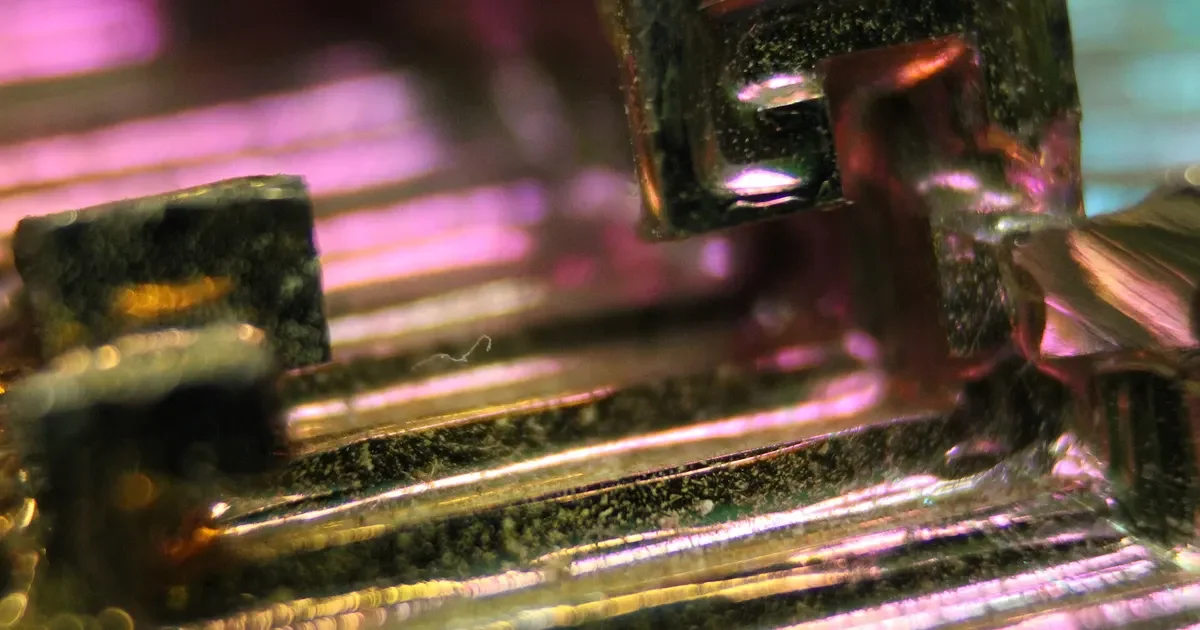
Bismuth brass swaps lead for bismuth as the chip breaker, so it machines closest to C360 and suits a quick lead-free conversion of a turned part. Silicon brass is about twice as strong, resists dezincification and forges well, but cuts tougher. Pick by the job: bismuth for drop-in turning, silicon for hot water, load or forged blanks.
When the lead has to go, a buyer meets two main alternatives for machined parts. One replaces lead with bismuth. The other drops lead altogether and uses silicon to do a different job. Both end up under the 0.25 percent weighted average lead limit of NSF/ANSI 372, and both cut on a normal lathe. After that the two diverge, and picking the wrong one costs either money or a failed part.
This post compares them side by side and gives a rule for picking. The alloy figures are published typical values for the alloy, not a promise from any shop.
What each alloy does in place of lead
Lead in C360 free-cutting brass works as a soft particle that breaks the chip and lubricates the cutting edge. Taking it out leaves ordinary brass that forms long, stringy chips and drags on the tool.
Bismuth brass replaces lead with bismuth, which behaves in a similar way. Bismuth sits at the grain boundaries as soft particles and snaps the chip. Typical composition is 73 to 79 percent copper, 1.5 to 2.5 percent bismuth, lead under 0.25 percent and the rest zinc. Machinability is about 80 on the scale where C360 is 100.
C69300 silicon brass goes a different way. Silicon, about 2.7 to 3.4 percent, stiffens the alloy and forms hard particles that break the chip by making it brittle. Copper is 73 to 77 percent, lead is under 0.09 percent and the rest is zinc. Machinability is also rated about 80, but the cutting experience is different, as the next sections show.
Head to head
| Property | Bismuth brass C49300 | Silicon brass C69300 |
|---|---|---|
| Lead, nominal | Under 0.25 percent | Under 0.09 percent |
| Machinability (C360 = 100) | About 80 | About 80 |
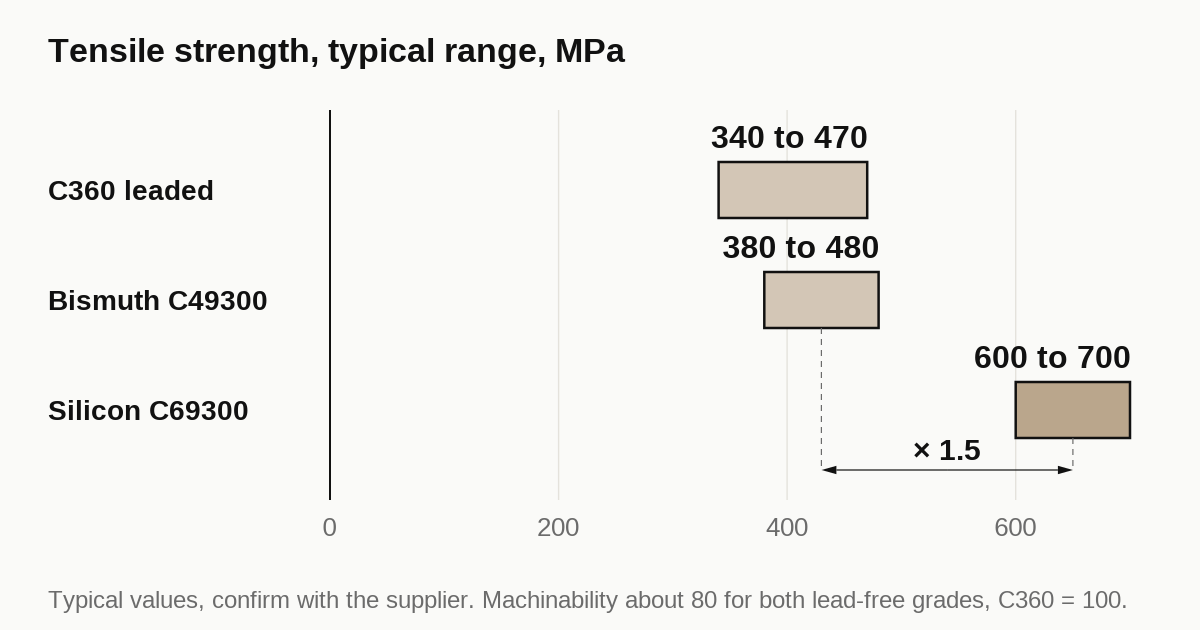
| Tensile strength, typical | 380 to 480 MPa | 600 to 700 MPa |
| Hardness, typical | 65 to 85 HRB | 90 to 100 HRB |
| Dezincification resistance | Moderate | High |
| Density | About 8.40 g/cm3 | About 8.30 g/cm3 |
| Hot forging | Difficult, bismuth embrittles | Good |
| Weldability | Poor | Not a strength of the grade, ask the shop |
| Bar stock | Narrower range of sizes | Wider range, round and hex |
| Chip form | Short, close to C360 | Short but tough, harder on tools |
Published typical values for the two alloys. The mill’s data sheet and the standard on the drawing take precedence.
On the lathe
A shop converting a C360 turning program to bismuth brass can usually keep the same tool geometry. The chip breaks cleanly, surface finish is good and tool life is a little shorter than on leaded brass. Speeds and feeds step down modestly. That is the reason bismuth brass is called a near drop-in, and why a shop that has never run lead-free often tries it first.
Silicon brass asks more of the shop. It is stronger and harder, so cutting forces are higher and tools wear faster. It also work hardens, so a dull tool or a feed that rubs instead of cutting hardens the surface and makes the next pass harder. Sharp positive-rake inserts, a firm feed and good coolant matter more here than on bismuth brass. Small deep holes and tapped threads are the usual trouble spots. The roll tap vs cut tap guide and brass speeds and feeds cover the tools and settings. Ask a supplier whether it has shipped the grade, not whether it can run it.
Strength and what it buys
Silicon brass is roughly twice as strong as C360 and about one and a half times stronger than bismuth brass at the top of its range. For thin walls, fine threads, press fits and parts that see cyclic load, that gap is real. A thread in silicon brass resists stripping better, and a thinner wall does the same job.
Bismuth brass has strength close to C385 and C360, so it works for any part that was already designed in leaded brass and not stressed. It is the right answer for a plain fitting body, a hose barb or a fitting nut.
Corrosion and hot water
Silicon brass has high dezincification resistance, which means hot water that would eat the zinc out of ordinary yellow brass leaves it largely intact. This is a second reason to choose it for potable water, beyond the lead limit. See dezincification-resistant brass for how the ISO 6509 test works.
Bismuth brass resists dezincification only moderately. For cold water and dry service this is fine. For hot water or aggressive water supplies it needs a check against the water chemistry. Bismuth brass can also hold high residual stress after solidification, so stress corrosion cracking becomes a risk on cold-worked parts, and a stress relief step is often written in.
Need a quote for this part? Get a quote for your brass parts
Forging, welding and recycling
Hot working is where the two part ways. Bismuth segregates at grain boundaries and embrittles the metal at forging temperature, so bismuth brass is a bar-turning alloy, not a forging alloy. Silicon brass forges well, and hot-stamped blanks in C69300 are common in plumbing. If your part starts as a forging, the choice is made. The wider topic is in hot shortness in brass.
Bismuth brass also welds poorly, so assemblies that are welded after machining point away from it. Bismuth is also a contaminant in recycled leaded brass scrap, which is one reason shops keep bismuth chips in their own bin. See brass chips and scrap value.
Stock and price
Both alloys carry more copper than C360, 73 to 79 percent against about 60 to 63, so the metal costs more per kilogram. Silicon brass is stocked more widely in round and hex bar. Bismuth brass comes in fewer diameters, and an odd size can mean waiting for a mill run. Check stock before fixing a diameter on the drawing. Brass bar stock sizes and forms lists what is common.
A rule for choosing
Choose bismuth brass when the part is turned from bar, was designed in C360, sees modest load, runs in cold or moderate water and needs the shortest path to lead-free. Choose silicon brass when the part is for hot water, carries load, starts as a forging, needs a stock size bismuth does not offer, or must resist dezincification. When both would work, ask for quotes on each and let price and lead time decide. C360 vs C69300 covers the leaded comparison for silicon brass.
First article and changeover
Whichever grade you pick, the first lot deserves a closer look than a repeat of a leaded job. Ask for a first article report that covers the thread gauges, the sealing faces and the surface finish, and a mill certificate that shows the chemistry of the bar. Check that the bar in the rack matches the paper, since mixed stock is a real risk when a shop runs leaded and lead-free grades on the same machines. A handheld analyzer check is described in XRF checks on brass bar. Also ask how the shop clears chips between jobs, because a few leaded chips left in a lead-free run can raise the measured lead of the part surface. A shop with a written changeover step for lead-free work is a better bet than one that says it never mixes them.
What to write on the drawing
Material: lead-free brass, lead under 0.25 percent weighted average per NSF/ANSI 372.
Suggested grades: C69300 or bismuth brass C49300. Shop to state grade quoted.
Mill certificate EN 10204 3.1 with chemistry. No substitution without written approval.
Naming the standard and suggesting grades gives the shop room to quote the cheaper route.
Checklist
- Part route stated: turned, forged or both.
- Water temperature and chemistry stated for wetted parts.
- Strength or thread loading stated.
- Stock diameter checked for both grades.
- Lead limit written as a standard, grades as suggestions.
- Stress relief step discussed for bismuth brass parts that are cold worked.
Which markets accept which lead-free grade is covered in the guide to lead free brass.
Want lead-free brass parts quoted? Send the drawing. We quote the finished parts within 24 business hours and place the work with one of the partner shops that turn brass.
Frequently asked questions
Is bismuth brass a true drop-in for C360?
It is the closest thing to one for a turned part, because bismuth breaks the chip much as lead does and the machinability rating is about 80 against 100. Feeds and speeds need a small step down and the shop should confirm that bar is available in your diameter. It is not a drop-in for forged blanks, because bismuth makes hot forming difficult.
Why is silicon brass stronger?
Silicon forms hard particles and strengthens the copper-zinc matrix, which gives typical tensile strength of 600 to 700 MPa against 340 to 470 for C360. The same hard particles make the alloy tougher on tools. It work hardens, so it wants sharp tooling and a feed that keeps cutting rather than rubbing.
Can both grades go in drinking water parts?
Both are made to sit under the 0.25 percent weighted average lead limit of NSF/ANSI 372. Whether a given part passes depends on the standard and the test, not on the alloy name alone. Silicon brass has a stronger record in hot water because of its dezincification resistance. Name the standard on the drawing and let the shop propose the grade.
Alloys in this guide
| Alloy | Lead % | Mach. | DZR |
|---|---|---|---|
| Bismuth brassC49300 / C49350 · No single EN equivalent, see supplier spec | under 0.25 | 80 | Moderate |
| C69300 silicon brassC69300 · CuZn21Si3P / CW724R | under 0.09 | 80 | High |
| C360 free-cutting brassC36000 · CuZn36Pb3 / CW603N | 2.5 to 3.7 | 100 | Poor |
Published typical values for the alloy. Machinability against C360 at 100. Not a promise from a shop.
Sources
- Copper Development Association, C49300 alloy data alloys.copper.org
- Copper Development Association, C69300 alloy data alloys.copper.org
Need a quote for this part?
Send the drawing. We read it, send one itemised quote for the finished parts within 24 business hours and place the work with a partner shop that turns brass. Brass only.
Get a quote for your brass parts