Guides / Materials
High-Tensile Brass (CZ114 and Manganese Bronze) for Load-Bearing Machined Parts
Published November 21, 2026. Reviewed for the facts in the corrections log.
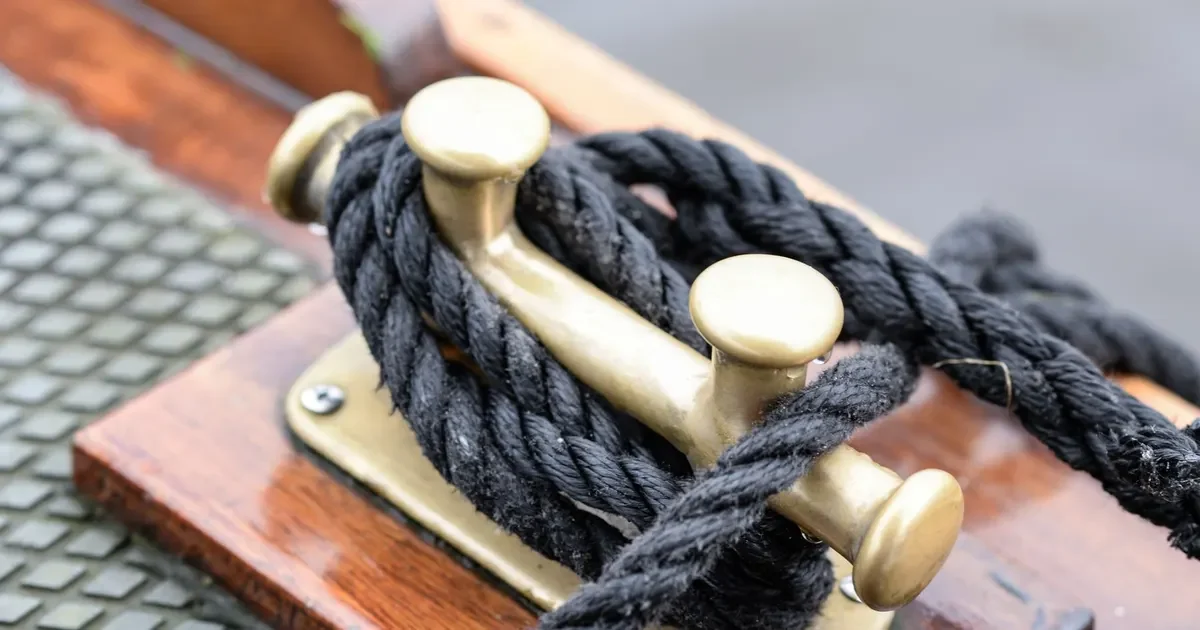
High-tensile brass, sold as CZ114 or CW721R and often called manganese bronze, is a brass with manganese, aluminum and iron that lifts strength to about 440 to 500 MPa in bar. It hot forges well but machines poorly, near 30 against 100 for free-cutting brass. Choose it for load, not for fast turning.
Ordinary free-cutting brass is soft. It is chosen for how quickly it cuts, not for what it carries. When a part has to take real load, such as a valve stem, a marine fitting, a gear blank or a heavy nut, a different alloy takes over: high-tensile brass. It is stronger, harder wearing and tougher in water, and it costs you in machining time.
This post covers what the alloy is, the grade codes you will see, how it behaves in the shop and when it is the right choice. The figures are published typical values for the alloy, not a promise from any shop.
The name problem
Buyers meet this alloy under three names: high-tensile brass, HT brass and manganese bronze. They all mean a copper-zinc alloy strengthened with small additions of manganese, aluminum, iron and tin. It is a brass by composition, since zinc is the main alloying element. The word bronze is a trade habit. Brass and bronze names in the copper alloy world are historical, not logical, and the site treats these parts as brass for that reason. If a drawing says manganese bronze, ask for the UNS or EN number before quoting.
Grade codes
On British and European drawings the usual grade is CZ114 in the old BS 2874 system, CW721R in the European EN 12164 system for rod. They are the same alloy under two names.
| Element | CZ114 / CW721R, typical limits |
|---|---|
| Copper | 57.0 to 59.0 percent |
| Lead | 0.8 to 1.6 percent |
| Manganese | 0.8 to 1.8 percent |
| Aluminum | 0.3 to 1.3 percent |
| Iron | 0.2 to 1.2 percent |
| Tin | 0.2 to 1.0 percent |
| Zinc | Remainder |
Published composition limits for the grade. The standard named on the order takes precedence.
A stronger relative also exists in Europe, CW713R, which carries more aluminum, manganese and silicon and less lead. In the US the nearest wrought grades are in the C67xxx family, with C67500 the one usually sold as manganese bronze A. These are near matches, not identical alloys, so confirm the chemistry before treating them as a substitute. See brass grade equivalents for how to write that approval.
What the additions do
Manganese and iron refine the grain and raise strength. Aluminum forms a thin protective oxide and also strengthens the matrix. Tin adds resistance to water attack. Together they push the structure to a duplex alpha and beta mix, harder and stronger than the single-phase brasses and hot workable in the way C377 forging brass is.
Typical bar properties for CW721R, for a bar of 5 to 40 mm diameter, are tensile strength of 440 to 500 MPa, proof stress of 180 to 270 MPa, hardness up to about 140 HB and elongation of 12 to 20 percent. Density is about 8.6 g/cm3, a little above C360. Typical values from published mill datasheets, and the mill certificate for the actual lot takes precedence.
How it compares
| Property | C360 free-cutting | CZ114 / CW721R | C69300 silicon brass |
|---|---|---|---|
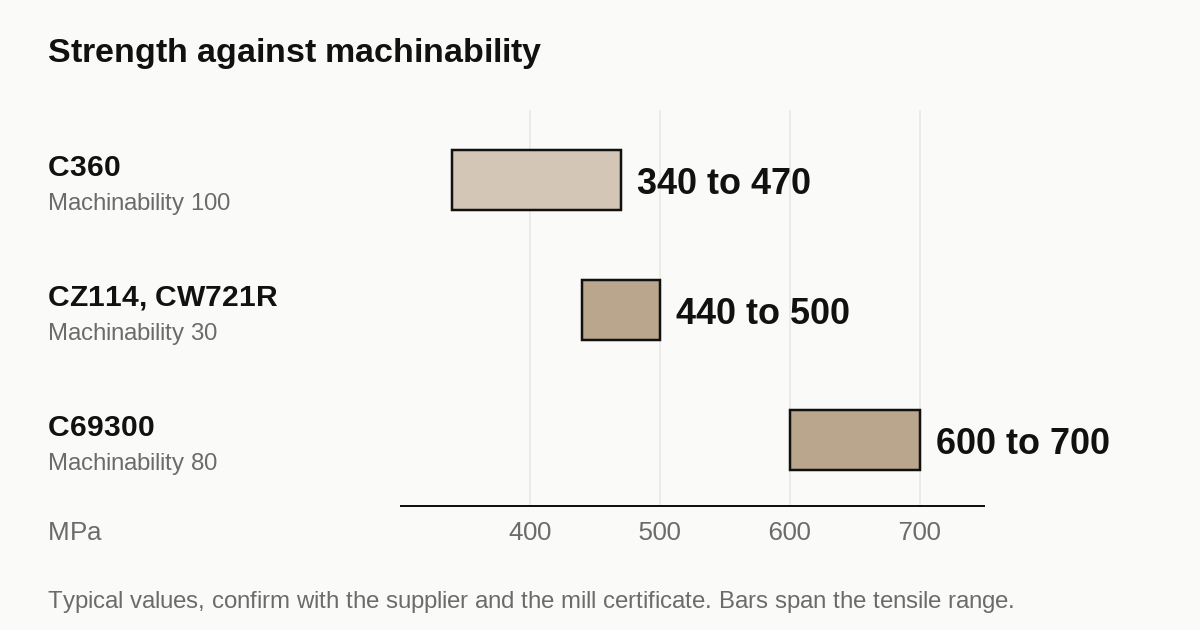
| Tensile strength, typical | 340 to 470 MPa | 440 to 500 MPa | 600 to 700 MPa |
| Machinability (C360 = 100) | 100 | About 30 | About 80 |
| Lead | 2.5 to 3.7 percent | 0.8 to 1.6 percent | Under 0.09 percent |
| Hot forging | Poor | Excellent | Good |
| Cold forming | Fair | Poor | Fair |
| Marine and mild acid service | Poor | Better | High dezincification resistance |
Published typical values for the three alloys. The mill’s data sheet takes precedence.
The table shows the trade. CZ114 beats C360 on strength and water resistance, but loses badly on machinability. If strength is the only need and lead is a concern, silicon brass gives more strength and far better machinability, at a higher bar price. See C360 vs C69300.
On the lathe and mill
Machinability sits near 30 against 100 for C360. The hard particles in the duplex structure wear tools faster, chips are tougher and surface finish takes more care. Shops cut it with carbide, sharp edges, positive rake and a feed that keeps the tool cutting. Speeds fall well below free-cutting brass, and tool life shortens. The cycle for a given part may be two or three times longer than in C360, and the quote will reflect it. The pricing logic is in brass parts cost drivers.
Threads cut well enough but rolled threads are hard, because the alloy does not cold form easily. Tapping needs more care than in leaded brass. See roll tap vs cut tap for the choice.
Need a quote for this part? Get a quote for your brass parts
Forging first, machining second
The alloy’s strong point in production is hot forging. It deforms easily at forging temperature, so shops stamp near net blanks and machine only the sealing faces and threads. That is the same logic as forged vs machined brass parts. For a heavy part made in volume, a forged blank cuts material waste and also avoids the slow machining of a large amount of metal.
Corrosion and stress
CZ114 resists general water attack better than ordinary yellow brass, thanks to the tin and aluminum, and it has a long record in marine hardware. It is still a duplex alloy, and the beta phase can lose zinc in hostile water. It is not rated as dezincification resistant in the way arsenical or silicon brasses are. See dezincification-resistant brass. Like most brasses it is also prone to stress corrosion cracking when stressed in ammonia or amine atmospheres. Brass stress corrosion cracking covers the stress relief that reduces the risk.
Where it is used
Typical parts include valve stems and spindles, marine fittings and propeller hardware, heavy nuts and bolts, gear and worm blanks, bearing cages, pump shafts and architectural fittings. In each case the buyer wants strength or wear resistance first. If the part is mainly decorative or low load, a cheaper and faster grade is the better pick.
Sizing a part for the alloy
Because the alloy is stronger, a designer can often cut section size, which partly offsets the higher machining cost. A stem or boss that needs 12 mm in free-cutting brass for a given load may carry it at 10 mm in CZ114, and the saving in bar, in cycle time and in weight can bring the part cost back toward the leaded price. Run the comparison on the finished part, not on the bar price per kilogram. Remember that strength is not the only limit: wear and fatigue depend on surface finish, thread root radius and the stress concentration at shoulders, and a sharp internal corner in a strong alloy still cracks. Ask the designer to give the load, the duty cycle and the failure mode that matters, so the shop can suggest the temper and the surface treatment.
Size also affects the bar. Mechanical properties fall as the bar diameter rises, and published tensile figures usually come with a diameter range. A part cut from a 60 mm bar will not reach the figure quoted for a 20 mm bar. State the bar size on which the strength requirement applies.
What to write on the drawing
Material: high tensile brass CW721R (CZ114), rod per EN 12164, temper as drawn.
Mill certificate EN 10204 3.1 with chemistry and mechanical properties.
Forged blank allowed if dimensions and properties are met. Not for drinking water contact.
State the temper or minimum tensile strength if the part is loaded, and say whether a forged blank is acceptable.
Checklist
- Grade named by EN or BS code, not as manganese bronze.
- Strength requirement written as a minimum, with the temper.
- Lead content reviewed against the end market.
- Forged blank allowed or not, stated.
- Longer machining time accepted in the price and lead time.
- Stress relief and water chemistry reviewed for marine or ammonia service.
- Certificate with chemistry and mechanical properties requested.
For how high-tensile brass compares with the free-cutting and forging grades, see our guide to brass grades.
Need a load-bearing brass part? Send the drawing with the strength requirement marked. We quote the finished parts within 24 business hours and place the work with one of the partner shops that turn brass.
Frequently asked questions
Is manganese bronze a bronze?
No. The trade name is historical. The alloy is mainly copper and zinc with a little manganese, aluminum, iron and tin, which makes it a high-tensile brass. Read the UNS or EN grade, not the name. CZ114 and CW721R are the codes you will meet on European and British drawings.
How strong is CZ114 compared with free-cutting brass?
Typical bar strength is about 440 to 500 MPa for CW721R against 340 to 470 MPa for C360, so it is stronger by a modest margin at the bottom of the range. The bigger gain is proof stress and wear resistance. Silicon brass C69300 reaches 600 to 700 MPa and is the higher-strength option where lead is a concern.
Can high-tensile brass be used for drinking water parts?
Not as a rule. CW721R carries about 0.8 to 1.6 percent lead, far above the 0.25 percent weighted average limit that NSF/ANSI 372 sets for wetted drinking water surfaces. Use it for marine hardware, valve stems, gear blanks and structural fittings, and choose a lead-free grade for potable water.
Alloys in this guide
| Alloy | Lead % | Mach. | DZR |
|---|---|---|---|
| C360 free-cutting brassC36000 · CuZn36Pb3 / CW603N | 2.5 to 3.7 | 100 | Poor |
| C377 forging brassC37700 · CuZn39Pb2 / CW612N | 1.5 to 2.5 | 80 | Poor |
| C69300 silicon brassC69300 · CuZn21Si3P / CW724R | under 0.09 | 80 | High |
Published typical values for the alloy. Machinability against C360 at 100. Not a promise from a shop.
Sources
- Wikipedia, Brass en.wikipedia.org
- Copper Development Association copper.org
Need a quote for this part?
Send the drawing. We read it, send one itemised quote for the finished parts within 24 business hours and place the work with a partner shop that turns brass. Brass only.
Get a quote for your brass parts