Guides / Materials
Admiralty and Arsenical Brass for Heat Exchanger Ferrules, Plugs and Fittings
Published October 5, 2026. Reviewed for the facts in the corrections log.
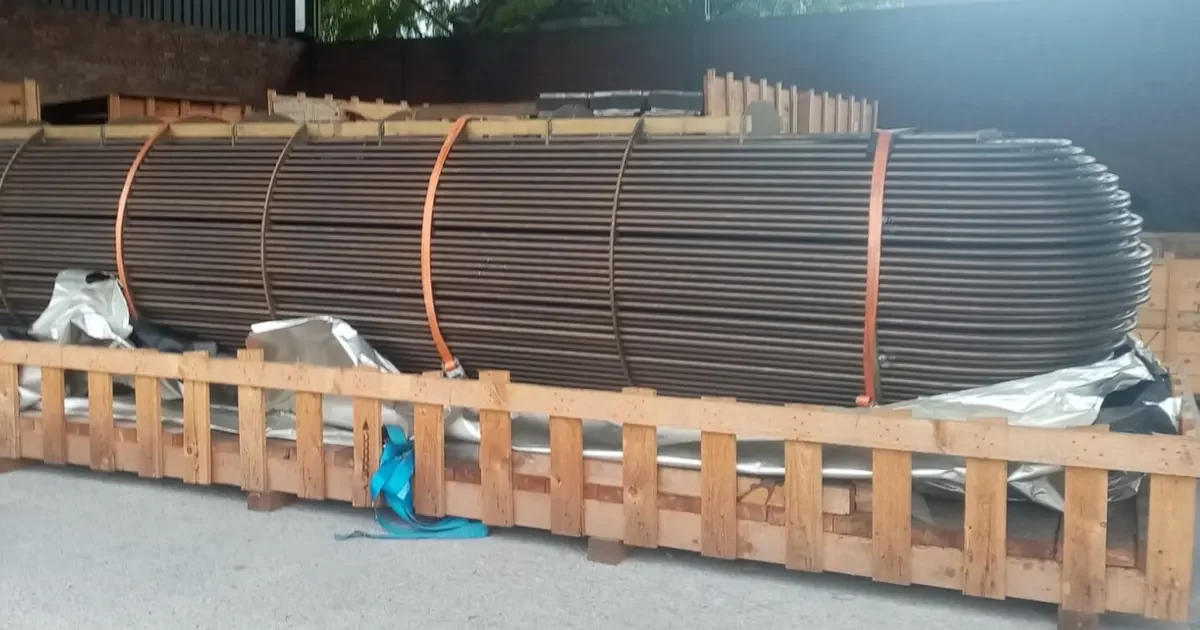
Admiralty brass is a 70/30 brass with about 1 percent tin and a trace of arsenic. The arsenic inhibits dezincification and the tin helps in water, which made it the classic condenser tube alloy. It is rated about 30 for machinability and comes mainly as tube, so ferrules and fittings are cut from tube.
Walk past a steam condenser or an old ship’s engine room and you will find banks of brass tubes. The tubes are admiralty brass, one of the oldest engineered copper alloys, and the parts that fit them, such as ferrules, tube plugs, sleeves and header fittings, are often the same alloy. A buyer who needs those parts has to deal with a grade that few shops stock as bar and that cuts slowly.
This post explains what admiralty and arsenical brass are, what the added elements do, how the parts are made and where the alloy stops being the right answer. Figures are published typical values for the alloy, not a promise from any shop.
What the alloy is
Admiralty brass is cartridge brass with a tin addition. Typical composition is 70 to 73 percent copper, 0.9 to 1.2 percent tin, a trace of arsenic and the rest zinc, with lead held under 0.07 percent. The standard grade is UNS C44300, which matches the European CuZn28Sn1As, code CW706R. The C443 datasheet has the full composition and cross reference.
It is an unleaded brass, so it is not free-cutting. The structure is single-phase alpha, which makes it ductile and easy to form, and that is why it is made as tube. Typical annealed tensile strength is 330 to 380 MPa and hardness 40 to 60 HRB.
What the arsenic and tin do
In some waters, brass loses zinc and leaves a porous, weak copper structure behind. This is dezincification. A 70/30 brass without inhibitors is vulnerable. Adding about 0.02 to 0.06 percent arsenic stops the process in most fresh and brackish waters. The arsenic does not stop the zinc from dissolving everywhere. It prevents the copper from redepositing in the plug form that eats through a tube wall. Tin, at about 1 percent, adds resistance to general water attack.
The inhibited family has three members, named by the inhibitor.
| Alloy | UNS | Inhibitor | Note |
|---|---|---|---|
| Arsenical admiralty | C44300 | Arsenic, 0.02 to 0.06 percent | The standard and the most common |
| Antimonial admiralty | C44400 | Antimony | Less common |
| Phosphorized admiralty | C44500 | Phosphorus | Less common |
Typical designations. The standard on the drawing takes precedence.
A related alloy is the lead-free CW511L, a 62/38 brass with arsenic, which European water fitting makers adopted for drinking water. The arsenic does the same dezincification job there. Different alloy, same mechanism. See dezincification-resistant brass for the ISO 6509 test and the grades that pass it.
What the parts are
Heat exchanger and condenser work uses a small family of brass parts.
- Ferrules and sleeves that seal or protect tube ends.
- Tube plugs that close a failed tube.
- Nipples and short fittings for water boxes and vent lines.
- Tube sheet bushings and sleeves.
- Sample taps and thermowell sleeves on service water lines.
- Spacers and baffle supports in small units.
Tube sheets themselves are usually naval brass or another stronger alloy, because they carry load. The machined admiralty parts are small and light.
How they are made
Admiralty brass is a tube alloy. It arrives as drawn tube in annealed or light-drawn temper, and a shop cuts ferrules and short fittings from the tube. Bar stock is seldom held, and a mill may need a minimum run to supply it. If a part has to be turned from bar, ask first whether naval brass will do. See C464 naval brass and the comparison in brass alloys C360, C385 and C464.
Machinability is rated about 30 on the scale where free-cutting C360 is 100. The soft alpha structure gives long stringy chips that gum on the tool and tear the surface. Shops handle it with sharp tools, positive rake, a moderate feed, chip breakers, good coolant and sometimes a slightly work-hardened temper that breaks the chip better than a dead soft one. Cycle times are longer and tool life is shorter than on leaded brass, which shows up in the price. The cost story is in brass parts cost drivers.
Where it fits and where it does not
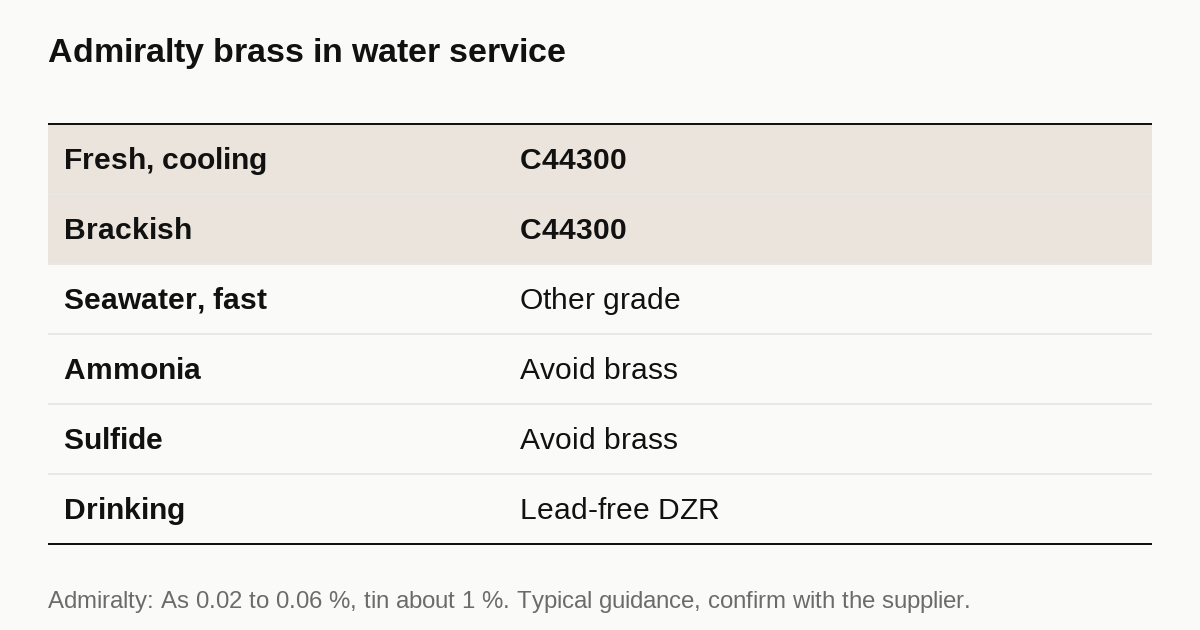
Admiralty brass is a good alloy for tubes carrying fresh water, cooling water and mildly brackish water at moderate velocity. It has limits.
| Service | Typical choice | Note |
|---|---|---|
| Fresh and cooling water | Admiralty brass C44300 | The classic fit |
| Mildly brackish water | Admiralty brass C44300 | Keep velocity moderate |
| Seawater, high velocity | Aluminum brass or a copper-nickel | Admiralty erodes at high velocity |
| Water with ammonia | Avoid brass | Stress corrosion cracking risk |
| Water polluted with sulfides | Avoid brass | Attack on the copper |
| Drinking water | Lead-free DZR grades | Check the market’s rules |
Typical guidance only. Water chemistry, temperature and velocity decide the real answer, and the exchanger designer owns the choice.
Two environmental hazards deserve a note. Ammonia and amines crack cold-worked or stressed brass along the grain, a failure covered in brass stress corrosion cracking. Sulfides, found in polluted harbors and stagnant water, attack copper alloys and form dark scale. Neither is a machining fault, but both are reasons a designer picks another alloy.
Seawater at high velocity erodes admiralty brass. Aluminum brass and copper-nickel alloys are the usual answers there. Copper-nickel is outside what this site quotes, and aluminum brass is a different grade you would need to specify separately.
Need a quote for this part? Get a quote for your brass parts
Handling arsenic
The arsenic in the alloy is a small trace, and finished parts are safe to handle. The issues arise in processing. Machining dust, grinding swarf and fume from welding or brazing carry arsenic. A shop should extract dust and fume at source, keep chips in a marked bin and send waste to a recycler that accepts arsenical brass. A shop that runs the grade regularly will have a procedure. If a buyer is shipping to a market with limits on arsenic in goods, such as drinking water or toys, check the rule against the end use. This is not legal advice.
Tolerances, wall thickness and tube quality
Drawn tube has its own tolerances on outside diameter and wall, and the wall is rarely perfectly concentric. A ferrule bored and turned from tube can end up with one side thinner than the drawing shows. For a part that seals or carries pressure, state the minimum wall and the concentricity the part needs, and ask the shop to check wall thickness at the first article with a tube micrometer or an ultrasonic gauge. Tube also arrives in a defined temper, and a part cut from a light-drawn tube holds stress that can warp thin walls as material is removed, which is a reason to rough and finish in two steps. Stress left in the tube is also what makes ammonia cracking possible later, so a low-temperature stress relief is sometimes written on the order for parts that will see hostile water. The relief range used for brass is covered in the cracking guide linked above.
Surface condition counts too. Mill-drawn tube has a thin oxide skin, and some services want it left alone while others want it pickled off. Say which.
What to write on the drawing
Material: admiralty brass UNS C44300 (CuZn28Sn1As, CW706R), tube, annealed.
Lead under 0.07 percent. Mill certificate EN 10204 3.1 with chemistry.
Machined from tube, outer and inner diameters per drawing, wall minimum 1.5 mm after machining.
Name the form, because a ferrule from tube and a ferrule from bar are different parts. State the minimum wall after machining. If a turned bar version would also be accepted, say so, and give the alternative grade.
Checklist
- Grade named as UNS and EN code with the inhibitor stated.
- Form stated: tube, with outside diameter, wall and temper.
- Minimum wall after machining written.
- Service water chemistry, temperature and velocity shared with the shop.
- Ammonia and sulfide risk reviewed.
- Alternative alloy allowed for bar-turned parts, named.
- Dust, fume and waste handling for arsenic agreed.
Where admiralty brass sits next to naval and high-tensile brass is covered in our guide to brass grades.
Need heat exchanger parts or ferrules in brass? Send the drawing with the service conditions. We quote the finished parts within 24 business hours and place the work with one of the partner shops that turn brass.
Frequently asked questions
Why does admiralty brass contain arsenic?
A trace of arsenic, about 0.02 to 0.06 percent, stops dezincification, the process in which water leaches zinc out of brass and leaves a weak copper skeleton. Tin, about 1 percent, adds resistance to water attack. Together they made the alloy suitable for condenser tubes carrying fresh or brackish water.
Can admiralty brass be turned from bar?
It can, but it is awkward. The grade is rated about 30 for machinability, chips gum on the tool and bar stock is seldom held. Most parts, such as ferrules, are cut from tube. For a turned part that needs good corrosion resistance, naval brass is easier to find in bar form and cuts a little better.
Is arsenical brass safe to handle?
Solid parts are safe in normal handling. Arsenic is toxic as dust or fume, so machining dust, grinding swarf and welding or brazing fume need extraction and a plan for waste. Ask the shop how it handles them. Regulations on arsenic in finished goods vary by market and by product, so check the rule for the end use.
Alloys in this guide
| Alloy | Lead % | Mach. | DZR |
|---|---|---|---|
| C443 admiralty brassC44300 · CuZn28Sn1As / CW706R | under 0.07 | 30 | High |
| C464 naval brassC46400 · CuZn38Sn1 / CW712R | under 0.20 | 30 | High |
| CW511L lead-free brassC27450 (nearest, without arsenic) · CuZn38As / CW511L | under 0.2 | 40 | High |
Published typical values for the alloy. Machinability against C360 at 100. Not a promise from a shop.
Sources
- Copper Development Association, C44300 alloy data alloys.copper.org
- Wikipedia, Admiralty brass en.wikipedia.org
Need a quote for this part?
Send the drawing. We read it, send one itemised quote for the finished parts within 24 business hours and place the work with a partner shop that turns brass. Brass only.
Get a quote for your brass parts