Guides / Compliance
The EU Forced Labour Regulation and Machined Brass Parts: Which Origin Records to Ask For
Published November 21, 2026. Reviewed for the facts in the corrections log.
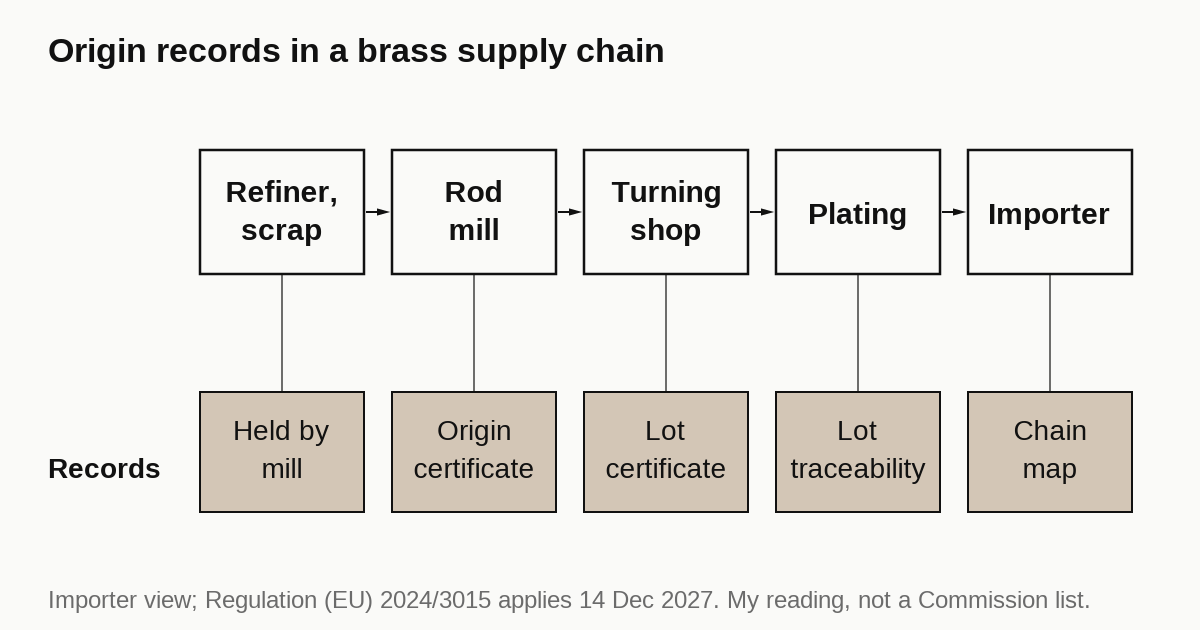
Regulation (EU) 2024/3015 bans products made with forced labour from the EU market from 14 December 2027, however small the part. For a brass part, the importer asks the turning shop for rod mill, lot and volume records, and asks the mill for what sits behind them. The rule sets a result, not a paperwork duty.
From 14 December 2027 the EU bans products made with forced labour, and a turned brass part is as much a product as a finished tap. The ban sits on whoever places or makes the product available on the EU market, and it applies whatever share of the product was affected. For a buyer of machined brass parts the practical question is narrow: which records can a turning shop show, and which ones only the rod mill holds? This guide answers it from the Commission’s own guidelines.
We do not audit or certify any shop and this is not legal advice. The facts below come from the Commission guidelines of 26 June 2026 and three law-firm notes, all opened in October 2026. The EUR-Lex pages for the Regulation itself did not open from my automated access, so the date and scope come from the guidelines and those notes. Check the Official Journal text before you rely on any date.
Checked 22 October 2026.
What the Regulation says, in four lines
- Regulation (EU) 2024/3015 entered into force on 13 December 2024 and applies from 14 December 2027 (Clifford Chance; Squire Patton Boggs).
- It bans placing on the EU market, making available and exporting products made with forced labour. The ban applies at any stage of extraction, production or manufacturing, in or outside the EU, and whatever the share of the product involved (Commission guidelines, section 3).
- “Product” is wider than manufactured goods. It includes minerals and other raw materials, so the metal behind a brass bar is a product too (guidelines, section 3).
- Penalties come through decisions: a prohibition, withdrawal or disposal of the products. Products already with end users are not recalled (Clifford Chance).
The guidelines add one point that matters for stock. The Regulation applies to everything still being made available on the market after 14 December 2027, even if it was produced or imported before. Brass parts sitting in an importer’s warehouse in January 2028 are in scope.
What the rule does not require
The Regulation does not impose a due diligence duty. The guidelines say so twice, and they add that supply chain due diligence is “a useful approach” to show a product was not made with forced labour, while product traceability, responsible purchasing and certification schemes can also work (sections 4.5.1 and 6). It is a rule of result. If an authority finds forced labour in the chain of a product you placed on the market, the lack of paperwork does not help you, and good paperwork is the evidence you have.
Osborne Clarke reports the same reading of the notice. It also reports two gaps as of September 2026: only ten Member States had designated a competent authority, and the forced labour risk database the Commission promised was not yet available. The Baker McKenzie summary of the guidelines, dated 24 August 2026, gives no launch date for it either.
How an investigation would reach a brass part
The guidelines describe a risk-based process. Four points shape who gets looked at:
- Importers are likely targets. For forced labour outside the EU, the guidelines say importers are likely to be key economic operators for authorities, and the Regulation extends to downstream operators such as distributors inside the EU.
- Parts and factories are valid scopes. An investigation may concern parts, components or products from a specific factory or facility, not the whole business.
- Complex chains draw more analysis. Several stages, transits and jurisdictions reduce traceability. The guidelines say authorities may need more extensive analysis there.
- Outsourcing to small firms is watched. The guidelines mention the risk of circumvention through outsourcing to smaller enterprises, so a small shop is not exempt from questions.
In the preliminary phase an authority can ask an operator what it did to prevent and end forced labour risks, and it has 30 working days after it receives the answers to decide whether a substantiated concern exists. A substantiated concern means a reasonable indication, based on objective and verifiable information, that a product was likely made with forced labour.
The brass supply chain and where records sit
A turned brass part usually passes through four hands before it reaches an EU importer: the refiner or scrap source that supplies copper and zinc, the rod mill that casts and extrudes the bar, the turning shop and the plating or finishing house. Each holds different records. The table is my reading of what an importer can reasonably ask each to show, built on the examples of product evidence the guidelines list in section 4.7.3. It is not a Commission list.
| Link | Records it can normally show | What it usually cannot show |
|---|---|---|
| Turning shop | Rod purchase invoices and delivery notes, mill certificate per lot with heat or lot number, production orders, bar issued against parts shipped, packing lists, plating subcontractor name | Mine or refinery conditions |
| Rod mill | Certificate of origin of the rod, supplier names for cathode, zinc and scrap, mass balance of input against output | Worker conditions at its suppliers, unless it runs its own checks |
| Plating house | Process order, lot traceability, name and address of site | Anything upstream of the part it received |
| Importer | Purchase orders, invoices, shipping documents, HS code of the goods, this chain mapped | Direct evidence of any link beyond tier 1 |
Two items in that table come straight from the guidelines. They list “bills of materials”, “certificates of origin from the sites from which products originate” and “documentation linking the finished product to its raw-material source” as product evidence. They also list “evidence demonstrating consistency between input volumes and output volumes”. For a turning shop that is a simple record: the kilograms of rod it bought, the kilograms of parts it shipped and the chips it returned.
Need a quote for this part? Get a quote for your brass parts
Bar from a mill, bar from scrap
Brass rod is cast from refined copper, zinc and, at many mills, recycled brass. The mix matters here for one reason. The guidelines say that “the complete lack of, or inability to provide, traceability information where a product, raw material or component may have been mixed with one at high risk of forced labour may weigh negatively” in an authority’s overall view. Scrap-heavy billet blends material from many sources, so the mill’s record of what went into the cast is the only place where traceability can be shown. If you buy parts with a recycled-content claim, read our post on recycled content in brass rod and ask the same mill for its input records.
The same mill certificate you already ask for on lead-free orders carries part of this. A 3.1 certificate with the heat or lot number links the parts to a bar and the bar to a cast. It does not show conditions at the mill, but it fixes the first link in the chain, which every later record hangs on.
Questions to put to a turning shop
Keep the list short enough that a small shop will answer it. These come from the evidence categories in the guidelines, not from a template I invented:
- Name and address of the rod mill for each alloy and bar size you buy, and the mill certificate number for each lot.
- Name of every subcontractor that touches the part, such as plating, heat treatment or cleaning.
- Kilograms of rod purchased and kilograms of parts shipped for the order, with scrap returned.
- A statement from the shop that it does not use forced labour in its own plant, and the indicators it checks, for example wage payment records and whether workers hold their own identity documents.
- Whether the shop has asked its rod mill the same question, and what it received.
The guidelines list the forced labour indicators an authority may use, including withholding of wages, retention of identity documents, deception about the job and onerous working hours. A shop that already keeps payroll and time records can answer question 4 with those.
What an audit does and does not show
Many buyers reach for a social audit report. The guidelines say an audit does not count as credible evidence where workers are under threat or constant surveillance by management, or where access to the production site is limited. A report from a short announced visit therefore has limits. Use it next to the purchase, production and traceability records above, and ask who did the audit and whether workers were interviewed away from management.
Putting it in the contract
Add the five questions to the supplier file and write the answer into your quality agreement: the shop notifies you of a change of rod mill, keeps the lot and volume records for a stated period and answers a written request within a set number of days. Score the answers on your supplier scorecard so a late or empty reply shows up in the numbers. For the full list of dates that hit brass importers in 2027, see the regulation calendar.
Where to go next
This rule joins a short list of dated duties for importers of brass parts. Start your file with the lead and drinking water rules in lead-free brass compliance documents, then add the origin records above. Have a drawing and an EU destination? Send the drawing with the market named. We quote the finished parts within 24 business hours and place the work with one of the partner shops that turn brass.
Frequently asked questions
When does the EU forced labour ban apply to brass parts?
Regulation (EU) 2024/3015 applies from 14 December 2027. The Commission guidelines say it covers every product placed or made available on the EU market from that date, even if the product or its components were made or imported earlier. Brass fittings already sold to an end user are not recalled.
Do I have to run due diligence on my brass supplier?
Not as a legal duty. The Commission guidelines say the Regulation imposes no due diligence obligation. They also say due diligence is a useful way to show a product was not made with forced labour, and that traceability, responsible purchasing and certification can work as well. Keep the records either way.
Does a small brass part matter if the rest of the product is clean?
Yes. The guidelines say the Regulation covers products made in whole or in part with forced labour, whatever the size of the share. Investigations can target a single part or component, or the products of one factory, so a turned brass part is in scope like any other.
Can a social audit report prove a brass shop is clean?
Only in part. The guidelines say an audit does not count as credible evidence where workers are under surveillance, under constant supervision by management or where access to the production site is limited. Treat an audit as one input next to purchase, production and traceability records.
Sources
- European Commission, Guidelines on the application of Regulation (EU) 2024/3015, Commission Notice C(2026) 4386 final of 26 June 2026 (copy on service.betterregulation.com) service.betterregulation.com
- Clifford Chance, EU ban on products made with forced labour makes its way into law (February 2025) cliffordchance.com
- Osborne Clarke, Regulatory Outlook September 2026 osborneclarke.com
- Baker McKenzie, EU publishes guidelines on the application of the EU Forced Labour Regulation (24 August 2026) globalimportblog.bakermckenzie.com
- Squire Patton Boggs, EU Forced Labour Regulation: what you need to know (January 2025) squirepattonboggs.com
Need a quote for this part?
Send the drawing. We read it, send one itemised quote for the finished parts within 24 business hours and place the work with a partner shop that turns brass. Brass only.
Get a quote for your brass parts