Guides / Materials
Recycled Brass Rod: What the Scrap Does to Lead Content, Impurities and Machining
Published November 21, 2026. Reviewed for the facts in the corrections log.
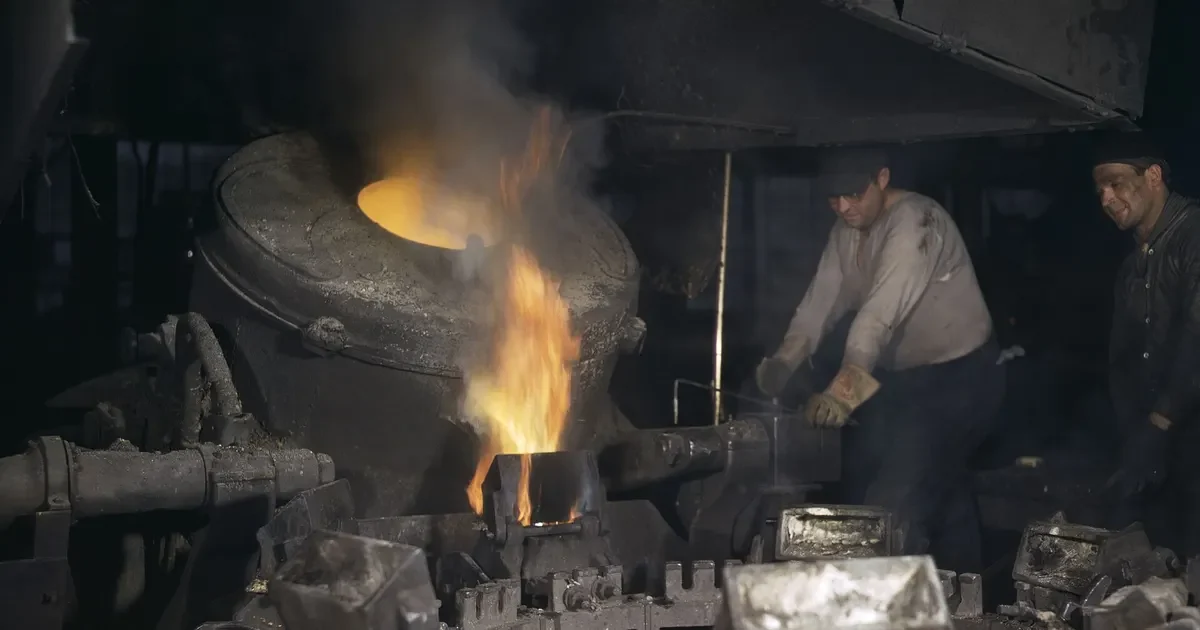
Most brass rod is made from recycled scrap, and good mills sort and test it so the chemistry stays inside the grade. Quality problems come from tramp elements such as aluminum, silicon, iron and bismuth, and from lead drifting into lead-free melts. A mill certificate with chemistry per heat is the control, not the recycled percentage.
Brass is one of the most recycled engineering metals. Copper and zinc remelt without losing their properties, and a large share of the brass rod sold today comes from scrap: old fittings, turnings from machine shops, offcuts from stamping and returned castings. Buyers sometimes hear recycled and worry about quality. Others hear it and assume it is a plus. Neither reaction tells you much.
What matters is how the mill controls the melt. This post explains where the problems arise, what they do on the lathe and what a buyer can ask for.
How scrap becomes rod
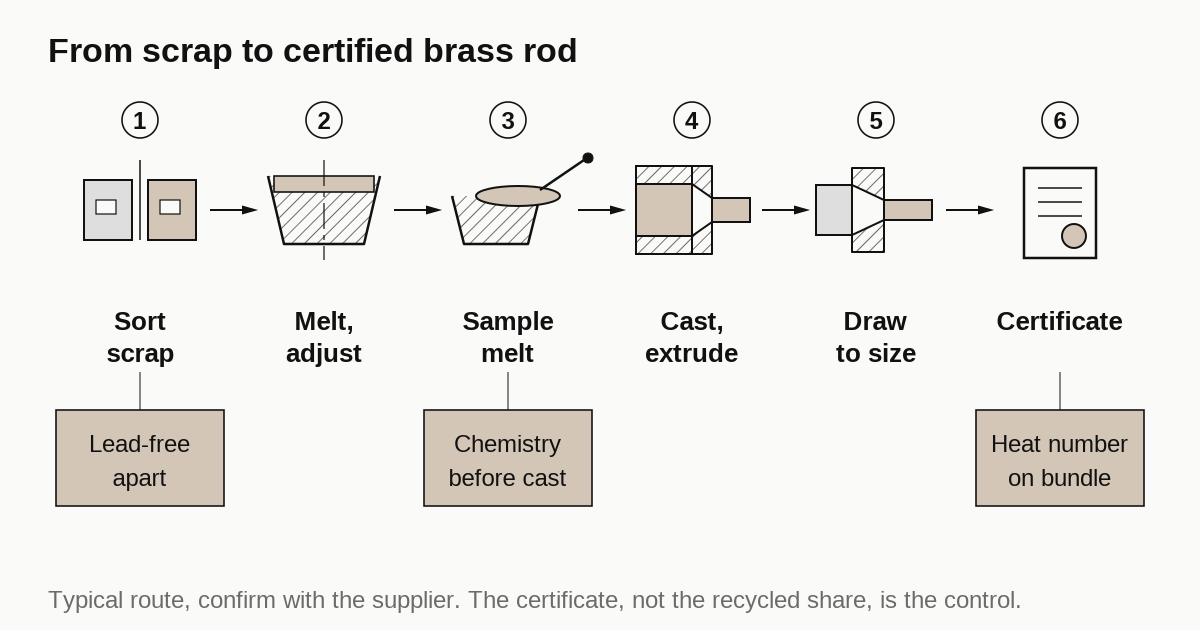
A brass mill buys scrap by type: clean turnings of a known alloy, plumbing scrap, mixed brass and rejects from its own process. The scrap is sorted, often by a handheld analyzer or by sampling from the load. It is melted in a furnace with fresh copper and zinc added to bring the chemistry to the target grade. The melt is cast into billet, the billet is hot extruded into rod and the rod is drawn to final size. Copper recycling is an old industry, and brass fits it well.
The mill samples the melt before casting and adjusts. Each cast gets a heat number. The chemistry of that heat is what appears on the mill certificate, and it is the record that links a bar in your rack to a measured composition.
Where quality goes wrong
The scrap itself is not the problem. The problem is what scrap carries that the grade does not allow. These are tramp elements.
| Element | Typical source in scrap | Effect in rod and on the lathe |
|---|---|---|
| Aluminum | Aluminum brass, die cast fragments | Hard oxide particles, tool wear, torn surface |
| Silicon | Silicon brass scrap | Hard phases, tool wear, can raise strength |
| Iron | Steel fittings, tools in the scrap | Hard spots, magnetic particles |
| Bismuth | Bismuth brass scrap | Embrittles at hot working, cracks in extrusion |
| Tin | Bronze and tin brass scrap | Changes hardness and color |
| Nickel | Plated scrap | Raises hardness, changes color |
| Lead in a lead-free melt | Leaded scrap | Can push lead over a limit |
Typical effects described in the metallurgy of brass. The grade standard and the mill’s own specification take precedence.
Grade limits exist to keep these out. The European grade CW617N, for example, limits aluminum to 0.05 percent maximum, and iron, nickel and tin to 0.3 percent each. Those small figures show how tightly a free-machining brass is held. A mill working to them sorts scrap carefully and tests each heat.
Lead drift
Lead needs separate treatment because it is wanted in some grades and forbidden in others.
In a leaded grade such as C360 free-cutting brass, scrap with lead is normal feedstock. The mill adds or trims lead to land inside the range of 2.5 to 3.7 percent. Too little lead gives long chips and a slower cut. Too much can cause segregation, with lead pooling and causing soft spots. A run-to-run variation inside the range is normal and does not mean a defect, though a shop with a tuned program will see it as small changes in chip form.
In a lead-free grade the risk is the other way. Scrap that includes leaded brass puts lead into the melt, and it cannot be removed by melting. This is why mills making grades like C69300 silicon brass use dedicated scrap streams, often their own offcuts and clean turnings of the same alloy, plus fresh copper. A lead-free bar made on a furnace that last ran leaded brass needs a controlled cleanout. Ask a supplier how it separates the two. The compliance side is in leaded vs lead-free brass.
What shows up on the lathe
A shop sees poor bar in a few ways. Tools wear faster than expected on one lot and not the next. A surface that is smooth on most parts shows torn patches. Threads on a few parts come out rough. Chips change form between bars. A part fails inspection for hardness or color in one lot only. Any of these can have causes unrelated to the bar, such as a worn tool or coolant problems, but when a pattern follows a heat number, the bar is the first thing to check.
Hard inclusions are the worst case, because one can chip a carbide insert and ruin a run of parts. They are rare in bar from a well-run mill.
Need a quote for this part? Get a quote for your brass parts
Recycled content claims
Some buyers ask for a recycled content statement, often for environmental reporting. The standard that defines the terms is ISO 14021, which separates pre-consumer and post-consumer material. Most brass rod carries a high recycled share, and a mill can state a percentage for its production, but the figure describes the mill’s melt, not a single bar. Do not use it as a quality measure. A bar with 90 percent recycled content and tight chemistry is better than a bar from virgin metal with loose control. Ask for a statement if you need one, and ask for the chemistry as well.
How to check a lot
A buyer or shop can use four layers.
- Mill certificate with chemistry per heat. See EN 10204 3.1 certificates for what it proves.
- Incoming check with a handheld analyzer on a clean cut face. See XRF checks on brass bar.
- First-article machining on a new heat, watching tool wear and surface.
- Retained sample from each heat, so a later problem can be traced.
For parts with a strict lead limit, add a laboratory analysis for borderline readings.
Cost, supply and why it matters to a buyer
Scrap is cheaper than primary metal, but the rod price follows the copper and zinc markets, not the scrap share, as the mill prices on the metal content plus a conversion charge. When copper moves, so does bar. Clean, well-sorted scrap costs more than mixed scrap, and mills that invest in sorting pass some of that into the price. A very cheap bar can mean loose sorting. That shows up later as tool wear, scrap parts and rework, which cost more than the bar saving. For the market side see brass bar price and the copper market.
Supply follows scrap flows too. In a tight scrap market, lead times for a specific alloy can stretch, and a mill running a lead-free campaign may schedule it in batches. If your part needs a lead-free grade in an unusual diameter, ask early and expect a minimum run. The shop’s own turnings are also part of the loop, since clean chips of one alloy sold back to the mill are among the best feedstock. Clean sorting at the shop helps the whole chain, a point developed in brass chips and scrap value.
What to write on an RFQ
Material: brass rod, grade as drawn. Mill certificate EN 10204 3.1 with chemistry per heat.
Maximum tramp elements per the grade standard. Heat number marked on each bundle.
Lead-free parts: lead under 0.25 percent weighted average, verified on incoming bar.
Recycled content statement per ISO 14021 on request.
Checklist
- Certificate with chemistry per heat on every lot.
- Heat number traceable to the bar rack and the parts.
- Lead-free melts run separately, confirmed by the supplier.
- Incoming bar screened and borderline readings sent to a laboratory.
- Recycled content asked for only as a report, never as a quality test.
- Tool wear and surface watched on the first parts from a new heat.
The rules that make lead drift matter are in the guide to lead free brass.
Need brass parts with material records? Send the drawing. We quote the finished parts within 24 business hours and place the work with one of the partner shops that turn brass.
Frequently asked questions
Is recycled brass rod lower quality than new brass?
Not by itself. Brass remelts without losing its properties, and mills have used scrap as the main feedstock for generations. What matters is how well the mill sorts the scrap and checks each melt. A well-run mill ships recycled bar that meets the same chemistry limits as bar made from virgin metal.
Why does recycled brass sometimes machine badly?
Usually because of hard inclusions or tramp elements that scrap carried in. Aluminum forms hard oxide particles, silicon from silicon brass scrap forms hard phases and iron can form hard spots. They wear tools and leave torn patches on the surface. The grade limits on these elements exist to keep them out.
How do I make sure lead-free bar is really lead free if it is recycled?
Ask for the heat chemistry on an EN 10204 3.1 certificate and check lead against the 0.25 percent limit. Mills that make lead-free brass run it on separate melts and scrap streams. A shop can verify incoming bar with a handheld analyzer and send borderline results to a laboratory.
Alloys in this guide
| Alloy | Lead % | Mach. | DZR |
|---|---|---|---|
| C360 free-cutting brassC36000 · CuZn36Pb3 / CW603N | 2.5 to 3.7 | 100 | Poor |
| CW617N CuZn40Pb2C37700 (nearest) · CuZn40Pb2 / CW617N | 1.6 to 2.5 | 80 | Poor |
| C69300 silicon brassC69300 · CuZn21Si3P / CW724R | under 0.09 | 80 | High |
Published typical values for the alloy. Machinability against C360 at 100. Not a promise from a shop.
Sources
- Wikipedia, Brass en.wikipedia.org
- Wikipedia, Copper recycling en.wikipedia.org
Need a quote for this part?
Send the drawing. We read it, send one itemised quote for the finished parts within 24 business hours and place the work with a partner shop that turns brass. Brass only.
Get a quote for your brass parts