Guides / Compliance
Which HS Code Fits Machined Brass Parts: Chapter 74, 83 or 84?
Published November 21, 2026. Reviewed for the facts in the corrections log.
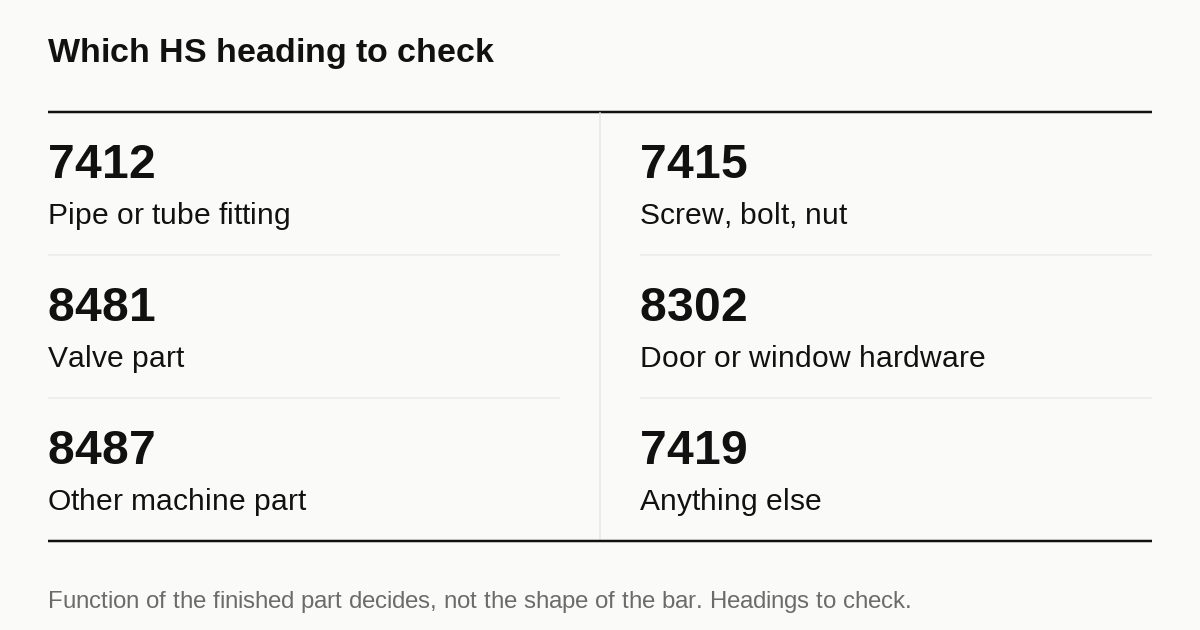
Brass is a copper alloy, so a machined brass part starts in Chapter 74. Whether it stays there depends on what the finished part is. A valve part usually moves to heading 8481 in Chapter 84, a fastener stays in 7415 and door hardware goes to 8302. Check the chapter notes, then confirm with your customs broker.
An importer asking for a quote on machined brass parts is often asked in return for the HS code. The shop wants it for the export paperwork. The buyer wants it to plan landed cost. Both of them tend to type “Chapter 74” for copper and brass, then stop.
That is where the question gets interesting, because the Harmonized System (HS) does not classify a turned brass part only by its metal. This post walks through how the legal notes sort a part between the copper chapter, the base metal hardware chapter and the machinery chapters. It names headings to check and gives no duty rates. Rates change and depend on origin.
How the code is built
An HS code starts with six digits. The first two give the chapter, the next two the heading and the last two the subheading. Countries add their own digits beyond the sixth for tariff and statistics, so the first six match worldwide and the rest does not (Wikipedia). Every section and chapter has legal notes that decide the cases the headings leave open.
The headings and notes quoted below come from the US schedule (HTSUS), Revision 21 of 2026. The notes at section and chapter level follow the international HS, but your importing country’s own schedule and your broker have the last word.
Step 1: brass counts as copper
Section XV Note 5 says an alloy of base metals is classified as the metal that predominates by weight over each of the others (USITC). In brass, copper is the larger share, so brass goes with copper. Chapter 74 defines brasses as alloys of copper and zinc, with or without other elements, where zinc predominates over each other element, nickel is under 5 percent and tin is under 3 percent (USITC).
That settles the material. It does not settle the heading, because Chapter 74 is not the final stop for every brass part.
Step 2: ask what the finished part is
The test that decides the heading is the identity and use of the finished part. These are the headings a turned brass part most often meets.
| Heading | What it covers | Typical brass parts |
|---|---|---|
| 7412 | Copper tube or pipe fittings such as couplings, elbows and sleeves. A subheading covers copper alloys | Threaded adapters, unions, bushings and nipples for pipe or tube |
| 7415 | Nails, screws, bolts, nuts, rivets, washers and similar articles of copper | Brass screws, studs, nuts and washers |
| 8481 | Taps, cocks, valves and similar appliances, with parts thereof | Valve bodies, stems, seats and handles made to a valve drawing |
| 8302 | Base metal mountings and fittings for furniture, doors, windows and similar uses | Hinges, door and cabinet hardware |
| 8536 | Electrical apparatus for connecting circuits at up to 1,000 V | Connectors and terminals, where the part is an electrical apparatus |
| 8487 | Machinery parts with no electrical features and not named elsewhere | A machine part that fits no more specific heading |
| 7419 | Other articles of copper | A plain turned part with no more specific heading |
The descriptions are shortened from the tariff text. Use the table to know where to look, not as a ruling on your part.
Step 3: apply the notes that move parts between chapters
Three notes do most of the work.
Parts of general use stay in the metal chapters. Section XV Note 2 defines parts of general use. They include articles of headings 7307, 7312, 7315, 7317 and 7318 and similar articles of other base metal, springs, and articles of headings 8301, 8302, 8308 and 8310. Section XVI Note 1(g) then says Section XVI, which holds Chapters 84 and 85, does not cover those parts of general use (USITC). A brass screw or nut is therefore not a machine part, even if it was made for one.
Parts that have their own heading go there. Section XVI Note 2(a) says parts that are goods included in a heading of Chapter 84 or 85 are in all cases classified in that heading, with a short list of exceptions that includes 8487. Heading 8481 names parts of taps, valves and similar appliances, so a part identified as a valve part points to 8481.
Other machine parts follow the machine. Note 2(b) sends parts suitable solely or principally for one kind of machine to the heading of that machine, and Note 2(c) sends everything left to the residual heading 8487 or 8548. That is why 8487 appears in the table as a last resort, not a first choice.
Need a quote for this part? Get a quote for your brass parts
Four cases from the shop floor
These are illustrations of the reasoning, not rulings.
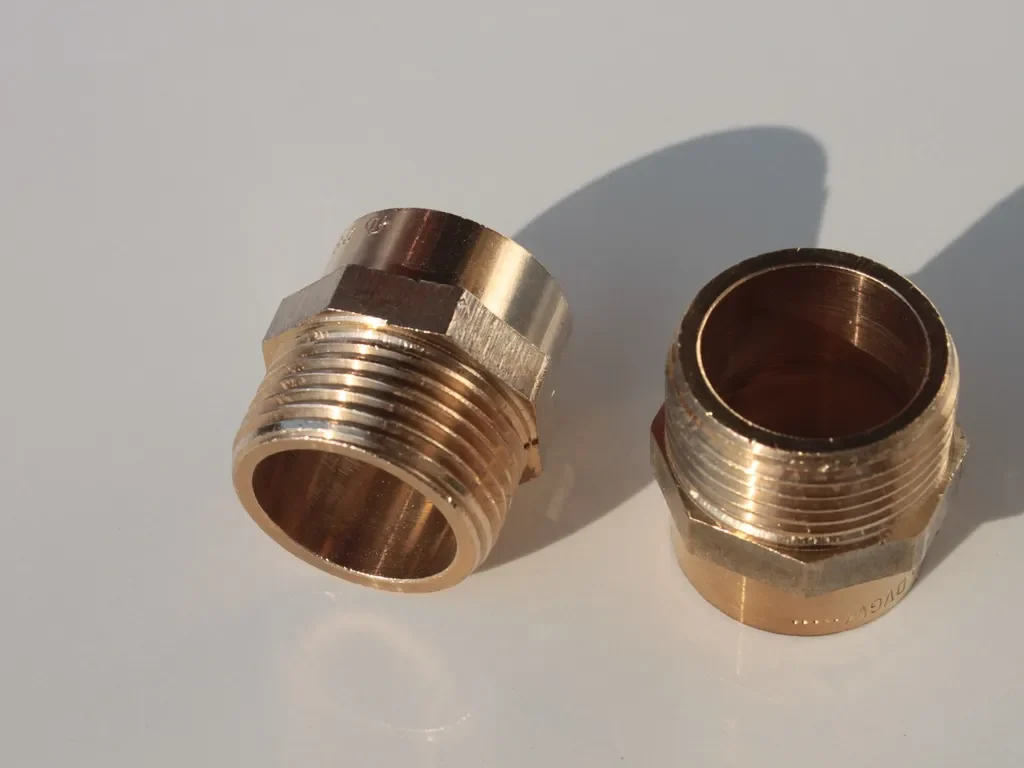
- A brass hex adapter with a male thread and a solder socket. It is a fitting for tube, so heading 7412 is the place to start. It is not a machine part.
- A brass valve stem turned to a drawing for a ball valve. The part is identifiable as a valve part, which points to heading 8481, which covers parts of valves, not to Chapter 74.
- A knurled brass thumb screw. It is a fastener, which is a part of general use, so Chapter 74 (7415) is the area to check, not Chapter 84.
- A plain brass spacer turned to a customer drawing with no stated use. It may fall to the residual copper heading 7419, or to 8487 if it is identifiable as a machine part. The description on the drawing and the purchase order matters here.
The same bar and the same machine can give parts that land in four different chapters. The code follows the finished part, not the route to it.
What to give the shop and the broker
A good classification starts with a good description. Write these items on the RFQ and keep them identical on the commercial invoice.
- A plain name for the finished part and what it does, such as “threaded brass pipe adapter” or “brass valve stem for ball valve”.
- The alloy, such as C360 free-cutting brass or C69300 silicon brass, and the form (turned, forged and finished, or only roughed).
- The drawing with the part number.
- The industry or product it goes into, if that decides the heading.
- Whether the part is sold alone or as part of an assembly, because the answer can change when parts arrive together as a machine or set (see Section XVI Note 4 for machines made of components).
A quote that carries only “brass part, Chapter 74” gives your broker nothing to check.
Get a second opinion cheaply
Customs authorities publish decisions. In the United States, CBP issues binding advance rulings that may address the tariff classification of goods, and it publishes ruling letters in its Customs Rulings Online Search System, CROSS (CBP). Searching past rulings for a similar brass part shows how a heading has been applied. If the part is high in volume or on the border between two headings, ask your broker whether an advance ruling is worth the wait.
A classification can also affect other rules, such as what origin or compliance documents apply. As of October 2026 this is general information, not advice. Confirm every code with a licensed customs broker in the country of import before you rely on it.
Lines for your RFQ
Part: [plain name and function], brass, alloy [grade].
Drawing: [number and revision]. End use: [product or industry].
Supplier states its proposed HS code for the export documents.
Buyer's broker confirms the import classification before first shipment.
For the other paperwork a brass order needs, see lead-free brass compliance documents and material certificates for brass parts. The brass thread chart helps you name the fitting and its thread on the drawing.
Need machined brass parts quoted with a clear part description? Send the drawing. We quote the finished parts within 24 business hours and place the work with one of the partner shops that turn brass.
A note on this site. Brass CNC Parts does not classify goods or give customs advice. HS headings in this guide point you to the right place to look. Your customs broker decides the code.
Frequently asked questions
Is a machined brass part classified by its material or by its use?
Both, in order. The material places the part in a chapter for copper articles, but the chapter notes then send parts of general use, fittings and parts of machines to their own headings. A turned brass valve stem is therefore judged as a valve part first and as a brass article second.
What HS heading covers brass pipe fittings such as couplings and elbows?
Heading 7412 covers copper tube or pipe fittings such as couplings, elbows and sleeves, with a subheading for copper alloys, which includes brass. In the US schedule it is 7412.20. A fitting with a valve function belongs to heading 8481 instead. Confirm with a customs broker for your own part.
Will my supplier's HS code be the one my customs broker uses?
Not necessarily. A supplier picks a code for its export documents and may use a different heading from the importing country's broker. Give your broker a plain description of the finished part, its material, form and use, along with the drawing. The broker classifies for the import side.
Can I get a binding answer on the HS code before I order?
In the United States, CBP issues binding advance rulings that can address tariff classification, and publishes ruling letters in its CROSS database. Many other customs authorities offer advance rulings too, so ask your broker. A search of past rulings for a similar brass part is a cheap first check.
Alloys in this guide
| Alloy | Lead % | Mach. | DZR |
|---|---|---|---|
| C360 free-cutting brassC36000 · CuZn36Pb3 / CW603N | 2.5 to 3.7 | 100 | Poor |
| C69300 silicon brassC69300 · CuZn21Si3P / CW724R | under 0.09 | 80 | High |
Published typical values for the alloy. Machinability against C360 at 100. Not a promise from a shop.
Sources
- USITC, Harmonized Tariff Schedule, Section XV notes (Chapter 72 file) hts.usitc.gov
- USITC, Harmonized Tariff Schedule, Chapter 74 copper and articles thereof hts.usitc.gov
- USITC, Harmonized Tariff Schedule, Section XVI notes and Chapter 84 hts.usitc.gov
- Wikipedia, Harmonized System en.wikipedia.org
- CBP, Rulings and legal decisions cbp.gov
Need a quote for this part?
Send the drawing. We read it, send one itemised quote for the finished parts within 24 business hours and place the work with a partner shop that turns brass. Brass only.
Get a quote for your brass parts