Guides / Compliance
Brass Hose Barbs and Garden Fittings: Which Lead Rule Applies in Which Market
Published November 1, 2026. Reviewed for the facts in the corrections log.
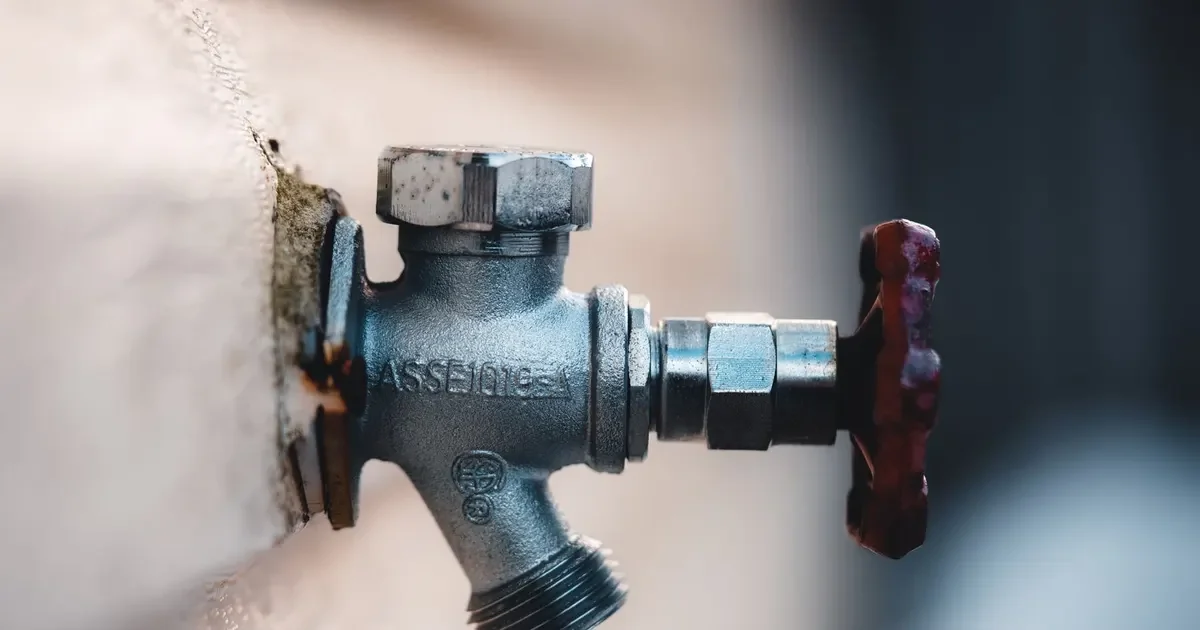
A brass hose barb carries a lead rule that depends on what flows through it. Drinking water use in the US falls under the 0.25 percent weighted average limit. Garden hose use has no federal composition limit, but warning rules such as California Proposition 65 can apply. Name the use, the market and the grade on the drawing.
A hose barb is a simple part: a short brass body with a ribbed spigot on one end for the hose and a thread on the other for the fitting. Millions are made, and the machining is easy. The hard part is the lead rule, because the same barb can be legal in one use and not in another, and the answer depends on the water it carries and the market it goes to.
This post sorts the rules by use, then covers the design points that make a barb grip, seal and last. It is a guide to the questions a buyer should ask, not legal advice.
What decides the lead rule
Three questions decide it.
- What flows through the fitting? Drinking water, other water, air, fuel or chemicals.
- Who uses it, and how? A fitting for a kitchen tap is different from one on a garden spray hose.
- Where is it sold? Rules differ by country and, in the US, by state.
A barb that passes through only garden water has fewer rules than one on a drinking water line. A buyer who labels the use on the drawing gets the right grade quoted the first time.
Rules by use, simplified
| Use and market | Typical rule | What it means for brass |
|---|---|---|
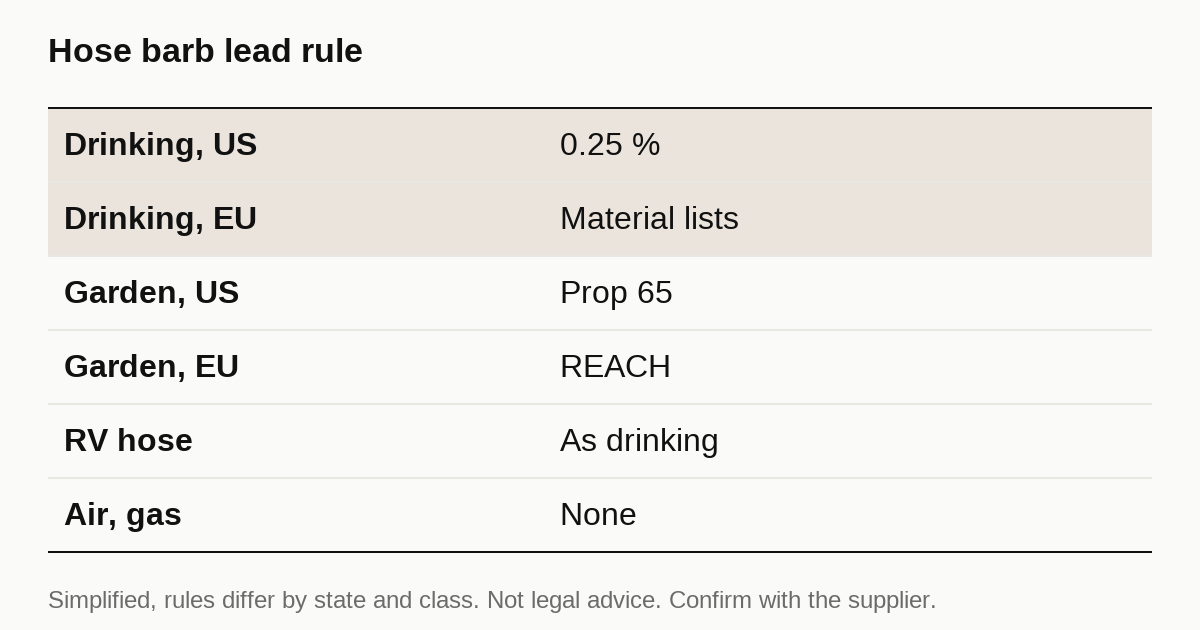
| Drinking water, US | 0.25 percent weighted average lead on wetted surfaces, NSF/ANSI 372 and the Safe Drinking Water Act | Lead-free grade needed, such as C69300 or bismuth brass |
| Drinking water, EU | National and EU lists of accepted materials, set under the common approach | Lead-free grades such as CW511L or CW724R |
| Garden hose, US | No federal composition limit for non-potable use. Warning rules such as California Proposition 65 can apply to lead | Leaded brass is common, with a warning or a lead-free option |
| Garden hose, EU | No composition limit specific to garden hose fittings. General REACH limits on lead in some consumer articles | Check the current rules for the product class |
| RV and drinking-safe hose | Treated as drinking water in many markets | Lead-free grade and often a test report |
| Air, compressed gas | No drinking water rule | Leaded brass is usual |
A simplified summary of published rules as of late 2026. Rules change and differ by state and product class, so check the current text for your market. This is not legal advice.
The EPA page on lead free pipes, fittings and fixtures sets out the US drinking water definition. The NSF 61 and 372 guide explains how the composition and the leaching standards differ.
The garden hose gray area
Garden hoses are not meant for drinking, and the US has no federal composition limit on their fittings. Yet people do drink from them, kids and pets included. For that reason, many hose makers print a warning not to drink from the hose, and some offer lead-free brass or polymer fittings. California’s Proposition 65 requires a warning for products that expose users to listed chemicals, and lead is on the list, so leaded brass hose products sold there often carry one. The rules for the warning and its safe harbor levels change, so a buyer who sells into California should check the current text with counsel.
A buyer who wants to avoid the question picks a lead-free alloy. C69300 silicon brass is the usual choice. Leaded vs lead-free brass covers the alloys and the machining cost.
Grades
| Grade | Lead | Typical use for barbs |
|---|---|---|
| C360 | 2.5 to 3.7 percent | Garden, air and non-potable fittings |
| CW617N | 1.6 to 2.5 percent | Hot stamped bodies and fittings, non-potable |
| C69300 | Under 0.09 percent | Drinking water and lead-free hose fittings |
| Bismuth brass | Under 0.25 percent | Lead-free turned barbs |
Published typical values for the alloys. The standard named on the order takes precedence.
Design points for the barb
Barb sizing. The barb crest diameter is a little larger than the hose inside diameter, so the hose stretches over it. A typical interference is a fraction of a millimeter to about a millimeter, set by the hose maker. Too much interference makes the hose hard to push on and can crack stiff hose. Too little leaves the hose loose.
Barb shape. A gentle lead-in taper, a steep back face and a rounded crest give grip without cutting. Two to four barbs are common. A sharp crest cuts the hose bore. A burr on the crest does the same.
Wall and bore. The bore sets flow. A restrictive bore throttles a garden hose. Wall thickness at the barb must carry the hose clamp force without collapsing.
Hose clamp seat. A band clamp bears on the hose over the barb. A smooth, burr-free surface protects it.
Need a quote for this part? Get a quote for your brass parts
Threads
US garden hose thread is 3/4 inch with 11.5 threads per inch, written 3/4-11.5 NH, and covered by ASME B1.20.7. It is a straight thread that seals on a washer in the female coupling, not on the thread flanks. It does not mate with NPT, which is tapered and has 14 threads per inch at that size. Adapters convert between them, and a mix-up leaks. See NPT vs BSP brass fittings and the thread chart. For hose coupling basics, the article gives the history. The end of a hose thread should have a smooth, flat sealing face, since a rough face cuts the washer. Thread gauging is covered in thread gauging brass fittings.
Machining and finishing
Barbs are made in huge volumes on multi-spindle machines. See multi-spindle screw machines for brass for when that makes sense. Burrs on the barb crest and on thread starts should be removed. Parts for the consumer market are often nickel plated or left as machined, and tumbling gives a uniform finish. See tumbling brass parts.
Proof for a lead-free claim
A seller who labels a barb lead free should be able to show why. For drinking water the proof is a composition report on the alloy and a test report to the standard of the market, issued by an accredited laboratory, for the actual part or a family of parts. A mill certificate shows the bar chemistry, and it matters, but it does not replace a product test. Ask the shop whether the lot is traceable to a bar heat, since a lead-free claim rests on keeping lead-free bar apart from leaded bar from the cutting line to the packing bench. A handheld analyzer check on incoming bar is described in XRF checks on brass bar. Wording on packaging should match the proof. Words such as lead free carry a defined meaning in drinking water rules, so a label that uses them for a leaded garden fitting can cause trouble.
Seals, washers and hose type
A brass barb is only half the joint. The hose material, the clamp and the washer decide whether the joint holds. Soft vinyl hose grips a barb well but can creep under a clamp. Rubber and reinforced hose need a clamp seated over the barb ribs. A garden thread seal relies on a washer, usually rubber or a similar elastomer, and it wears out long before the brass does, so many fittings ship with a spare. Tell the shop which hose and washer the fitting is for, and whether the washer is supplied with the part or fitted by the customer.
What to write on the drawing
Brass hose barb for 13 mm (1/2 inch) hose, 3/4-11.5 NH female swivel end per ASME B1.20.7.
Use: garden water, not for drinking. Material C360. Market: US.
Barb crest rounded, free of burrs. Bore 9.5 mm minimum.
Mill certificate EN 10204 3.1. Lead-free version C69300 quoted as an option.
Checklist
- Use named: garden, drinking water, air or other.
- Market named, including any state or country rule.
- Grade chosen for the lead rule, with a lead-free option quoted.
- Hose inside diameter and barb crest interference stated.
- Thread named by standard, not by a nickname.
- Burr-free crest and thread start required.
- Volume quoted at two or three price breaks.
The same rules apply to other brass parts; see the guide to lead free brass.
Need hose barbs or garden fittings machined in brass? Send the drawing with the use and market marked. We quote the finished parts within 24 business hours and place the work with one of the partner shops that turn brass.
Frequently asked questions
Does a garden hose fitting have to be lead free?
It depends on the use and the market. Fittings sold for drinking water, such as for an RV or a drinking-safe hose, fall under drinking water lead rules. A fitting sold for watering plants has no federal US composition limit, but a warning requirement such as California Proposition 65 may apply to leaded brass. Check the rule for your market and end use, and ask for legal advice where it matters.
What thread do garden hoses use?
Garden hose thread in the US is 3/4 inch with 11.5 threads per inch, often written 3/4-11.5 NH and covered by ASME B1.20.7. It is a straight thread that seals on a washer, not on the thread. It does not mate with NPT, which is tapered and has 14 threads per inch at that size. Many adapters convert between them.
How do I stop a hose barb from cutting the hose?
Specify the barb diameter against the hose inside diameter, a rounded barb crest and burr-free edges, and the number of barbs. Sharp or burred barbs cut the hose bore and start a leak. A smooth barb with a modest taper grips well and does not cut. Deburring after machining is a drawing item.
Alloys in this guide
| Alloy | Lead % | Mach. | DZR |
|---|---|---|---|
| C360 free-cutting brassC36000 · CuZn36Pb3 / CW603N | 2.5 to 3.7 | 100 | Poor |
| C69300 silicon brassC69300 · CuZn21Si3P / CW724R | under 0.09 | 80 | High |
| CW617N CuZn40Pb2C37700 (nearest) · CuZn40Pb2 / CW617N | 1.6 to 2.5 | 80 | Poor |
Published typical values for the alloy. Machinability against C360 at 100. Not a promise from a shop.
Sources
- US EPA, Use of lead free pipes, fittings and fixtures epa.gov
- Wikipedia, Hose coupling en.wikipedia.org
Need a quote for this part?
Send the drawing. We read it, send one itemised quote for the finished parts within 24 business hours and place the work with a partner shop that turns brass. Brass only.
Get a quote for your brass parts