Guides / Materials
Machined Brass Lock Cylinder Parts: Plug, Pins, Housing and Finish
Published November 21, 2026. Reviewed for the facts in the corrections log.
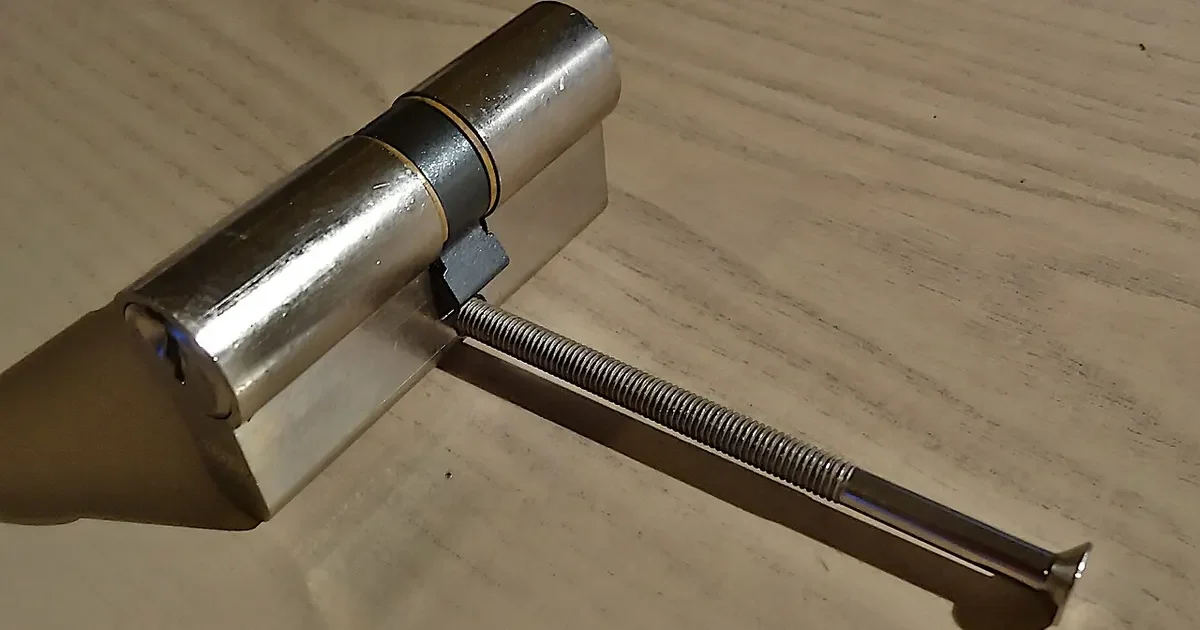
Pin tumbler lock cylinders use brass for the plug, housing and pins because it machines to small, closely spaced holes, resists corrosion, slides without galling and takes plating well. C360 suits plugs and pins and C385 suits extruded housings. Springs are spring wire, not brass. Name EN 1303 or ANSI/BHMA A156.5 where the product needs it.
Open almost any door lock and the part your key turns is a brass cylinder. The plug, the housing and the small pins inside are turned, drilled and milled from brass bar. The lock maker designs the security. The machined parts decide whether that design works smoothly for years or sticks after a winter.
This post stays at the manufacturing level. It covers the parts of a pin tumbler cylinder, the grades, the tolerances that matter, burrs, plating and the standards a buyer may need to name. It does not cover how locks are opened without a key.
The parts of a pin tumbler cylinder
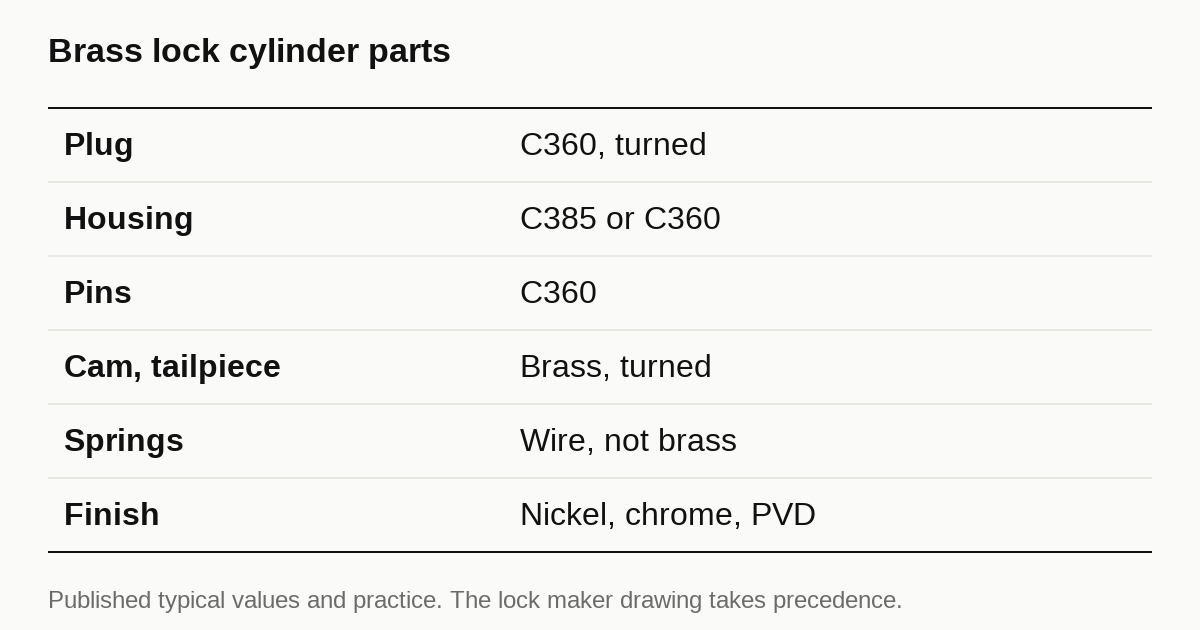
A pin tumbler cylinder has a plug that turns inside a housing. A row of drilled chambers runs through the housing into the plug. Each chamber holds a key pin, a driver pin and a spring. The right key lifts each pair so the gap between the pins lines up with the shear line, the boundary between plug and housing. The plug can then turn, and a cam or tailpiece at the back moves the bolt.
| Part | Typical material | Typical process | Critical feature |
|---|---|---|---|
| Plug | C360 brass | Turned, keyway broached or wire cut, chambers drilled | Outside diameter, chamber position, keyway |
| Housing or shell | C385 extruded profile or C360 | Cut from profile or bar, bored, drilled | Plug bore, chamber position, fixing screw hole |
| Key pins | C360 brass | Turned on a sliding head or cam lathe | Diameter, length steps, tip form |
| Driver pins | C360 brass, sometimes steel | Turned | Diameter, length, edge break |
| Springs | Spring wire, often stainless | Coiled | Free length, rate |
| Cam or tailpiece | Brass, zinc die cast or steel | Turned and milled, stamped or cast | Drive slot, angle, fit to plug |
| Retaining clip or screw | Steel | Stamped or turned | Groove fit |
Typical practice. The lock maker’s drawing takes precedence.
Springs are coiled from spring wire, commonly stainless steel. They are not brass and this site does not quote them. The same goes for steel cams, steel driver pins and zinc die cast cams. Send the brass parts and source the rest elsewhere.
Why brass
Four properties keep brass in this job.
Machinability. A cylinder is a set of small holes and fine features in tight positions. C360 free-cutting brass rates 100 on the machinability scale as a published typical value, and its lead breaks chips into short pieces. Small drills clear the chips and leave clean chamber walls. A plug can be turned, drilled and cross milled in one cycle on a sliding head lathe. See Swiss machining of brass parts for how that works.
Corrosion resistance. Front doors sit outside. Brass does not rust, so pins stay free in their chambers through rain, salt air and cleaning products. It does tarnish, which is why most visible faces are plated.
It slides without galling. Brass on brass runs smoothly with a light lubricant, and the lead in leaded grades helps. Pins move up and down thousands of times a year. A material that galled would bind the lock.
It takes plating. Nickel, chrome and PVD all bond well to clean brass. That lets the face of the cylinder match the door hardware.
C385, also called architectural bronze though it is a brass, rates 90 as a published typical value. It extrudes well into the profile shapes used for euro cylinder housings. The trade-off between the two grades is in C360 vs C385.
Key blanks and nickel silver
Key blanks are made in brass and in nickel silver. Nickel silver is a copper, nickel and zinc alloy, harder than brass and silver in colour. It contains no silver. Because it carries a large share of nickel, it is not brass in this site’s scope. This site does not quote nickel silver blanks or parts.
A brass key blank is usually stamped or milled from strip or flat bar, then the profile is milled. If your blank drawing calls for brass, it fits here. Say so on the drawing and name the grade.
Tolerances on the pin chambers
The function of a cylinder depends on a few dimensions. The lock maker sets them, often to a few hundredths of a millimetre. The shop holds them.
Chamber position. The chambers in the plug must line up with the chambers in the housing. A small offset makes pins bind at the shear line. Position is usually given relative to the plug axis and a datum face.
Chamber diameter and straightness. Pins must slide freely without rocking. The drill or reamer sets the size, and the hole must run straight through the plug and into the housing. A drill that wanders in a long chamber leaves a pin that sticks.
Plug outside diameter and housing bore. The running clearance between plug and housing decides how smoothly the plug turns. It also affects how the cylinder behaves in the product test. The lock maker specifies the fit.
Pin lengths. Key pins come in steps of length. Each step must be held tight, since a long or short pin moves the gap away from the shear line. Pin sorting and mix-ups are a real risk, so each length should be packed and labelled apart.
Keyway. The keyway is a narrow slot with a profile, cut by broaching or wire cutting. Its width and form must match the key blank.
A general tolerance block, such as ISO 2768, covers the rest. See brass machining tolerances for what free-cutting brass holds routinely.
Need a quote for this part? Get a quote for your brass parts
Burrs
Burrs are the most common defect in cylinder parts. A drill leaves a burr where a chamber breaks into the plug bore or the keyway. That burr catches a pin or a key. On a plug, it can also raise a ridge at the shear line that makes the plug drag.
Shops remove these with brushes, vibratory finishing, thermal deburring or a final light pass with a tool. Each has limits on small parts. The cross hole deburring guide covers the methods. Ask the shop how it checks for burrs inside the chambers and at the keyway edge, and ask for samples from the first batch.
Plating and finish
Most cylinders carry a decorative and protective finish on the face and the visible end of the housing.
| Finish | What it gives | Watch for |
|---|---|---|
| Nickel, bright or satin | Silver tone, wear and tarnish resistance | Thickness on the plug diameter |
| Chrome over nickel, satin or polished | Hard, bright or satin silver face | Edge build-up, masking |
| PVD over nickel | Brass, black or bronze tones with high wear resistance | Surface prep, colour match |
| Natural brass, lacquered | Gold tone | Lacquer wear at the keyway |
Typical practice. The finish specification on the drawing takes precedence.
Plating adds thickness. On a plug, even a few micrometres on the outside diameter changes the fit in the housing. The drawing should say whether a dimension applies before or after plating, and which surfaces are masked. Pin chambers and the plug bore are usually left unplated or controlled closely.
Plating also needs clean parts. Cutting oil in a chamber leaves a stain or poor adhesion. The shop should wash and dry parts before they go to the plater. See brass surface finishes and plating. US hardware finishes are often named by BHMA finish codes listed in ANSI/BHMA A156.18. Use the code your customer expects.
Standards the product may need
A cylinder is sold to a product standard that sets durability, strength and security grades. The two most often named are:
- EN 1303, the European standard for cylinders for locks, with requirements and test methods.
- ANSI/BHMA A156.5, the US standard for cylinders and input devices for locks.
Both apply to the finished cylinder. The lock maker designs and tests to them, and any certificate belongs to the maker and the product. A shop machining the plug works to the drawing, not to the standard. The drawing should carry what the standard needs from each part: material, dimensions and finish. The standards index lists other standards that brass part drawings often name.
Lead is a separate question. Mechanical door hardware is generally outside drinking water rules. An electronic cylinder or a lock with electronics falls under RoHS in the EU, where the exemption for lead in copper alloys runs to 30 June 2027. See RoHS exemption 6(c) before you choose a leaded grade for an electronic product.
What to write on the drawing
Material: C360 (CuZn36Pb3 / CW603N), mill certificate EN 10204 3.1.
Chamber positions per datum A (plug axis) and B (front face). Chambers burr-free at plug bore and keyway.
Plug OD 12.00 -0.01/-0.03 after plating. Chambers and keyway masked.
Finish: satin nickel, face and front end only. Pins packed by length step, labelled.
Checklist
- Grade named for each part: plug, housing, pins, cam.
- Parts that are not brass (springs, steel pins, zinc cams) sourced elsewhere.
- Chamber position, diameter and straightness toleranced from clear datums.
- Plug and bore fit stated, before or after plating.
- Burr limits stated at chambers, keyway and shear line.
- Finish, thickness and masking stated.
- Product standard named for the finished cylinder, if any.
- Pin length steps packed and labelled apart.
Need machined brass lock cylinder parts? Send the drawing with the grade and finish marked. We quote the finished parts within 24 business hours and place the work with one of the partner shops that turn brass.
Frequently asked questions
Why are lock cylinders made of brass?
Brass turns and drills fast to the small, closely spaced holes a cylinder needs. It does not rust, it slides against itself without galling and it takes nickel, chrome and PVD finishes well. Free-cutting brass also leaves short chips, so pin chambers come out clean. Steel and zinc are used for some parts, but the plug and housing are usually brass.
Are key blanks brass?
Many are brass and many are nickel silver, a copper, nickel and zinc alloy that is harder and looks silver. Nickel silver is not brass in the scope of this site, so it is not quoted here. If your blank drawing says brass, send it with the profile and the grade.
Does a lock cylinder need a certificate to EN 1303 or A156.5?
The finished cylinder may need to meet EN 1303 in Europe or ANSI/BHMA A156.5 in the US, depending on the market and the customer. The test and any certificate belong to the lock maker and the complete product. A shop that machines the plug or the housing works to the lock maker's drawing and does not certify the cylinder.
Alloys in this guide
| Alloy | Lead % | Mach. | DZR |
|---|---|---|---|
| C360 free-cutting brassC36000 · CuZn36Pb3 / CW603N | 2.5 to 3.7 | 100 | Poor |
| C385 architectural bronzeC38500 · CuZn39Pb3 / CW614N | 2.5 to 3.5 | 90 | Poor |
Published typical values for the alloy. Machinability against C360 at 100. Not a promise from a shop.
Sources
- Wikipedia, Pin tumbler lock en.wikipedia.org
- Wikipedia, Nickel silver en.wikipedia.org
Need a quote for this part?
Send the drawing. We read it, send one itemised quote for the finished parts within 24 business hours and place the work with a partner shop that turns brass. Brass only.
Get a quote for your brass parts