Guides / Materials
Galvanic Corrosion With Brass Fittings: Which Metals to Keep Away From Brass and How to Isolate a Joint
Published November 21, 2026. Reviewed for the facts in the corrections log.
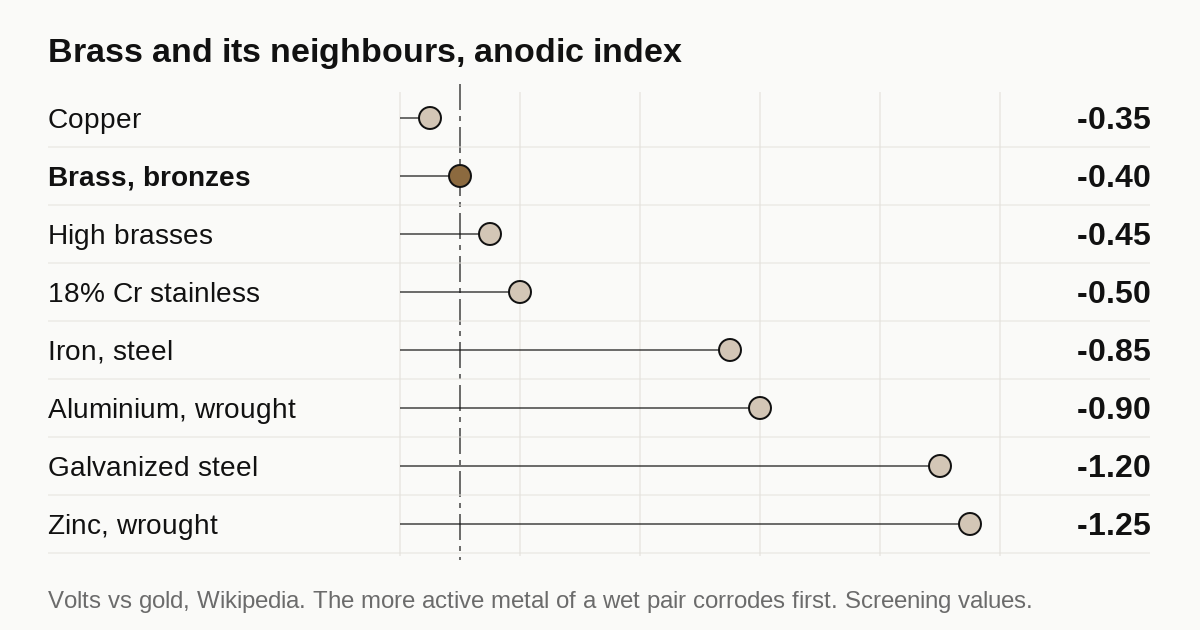
Galvanic corrosion needs two different metals in contact and a wet path between them. In a wet brass joint the more active metal is the one that corrodes. On the anodic index brass is 0.05 V from copper, 0.45 V from steel, 0.50 V from aluminum and 0.85 V from zinc.
Galvanic corrosion needs two different metals in electrical contact and a wet path between them. When a brass fitting meets another metal in a wet joint, the more active of the two corrodes. On the anodic index brass sits close to copper and stainless and far from steel, aluminum and zinc. This post shows the gaps, how to read them and how to isolate a joint, as a companion to the brass grades guide.
The figures come from the three pages listed under Sources, read on 25 October 2026. They are screening numbers for the alloy families, not a service life and not a plumbing code.
The conditions
The Wikipedia galvanic corrosion page says the presence of an electrolyte and an electrical conducting path between the metals is essential. Without both there is no corrosion. Water in a pipe is an electrolyte, and Wikipedia’s dielectric union page notes that ordinary tap water is conductive. A dry gas line has no electrolyte inside. The outside of a joint can still get wet, from condensation or washdown, so the same rule applies there.
How far apart brass and its neighbours are
| Metal in contact with brass | Anodic index V | Gap to brass V | Seawater series place | Which side corrodes |
|---|---|---|---|---|
| Copper | -0.35 | 0.05 | 29 | Close partners, small gap |
| 18% chromium stainless steel | -0.50 | 0.10 | 7 and 8 passivated, 25 active | Depends on whether the stainless is passive |
| Iron and plain carbon steel | -0.85 | 0.45 | 32 | Steel |
| Aluminum, wrought, not 2000 series | -0.90 | 0.50 | 34 | Aluminum |
| Galvanized steel | -1.20 | 0.80 | 38 (zinc plating) | The zinc coating |
| Zinc, wrought or die cast | -1.25 | 0.85 | 38 (zinc plating) | Zinc |
Source line: anodic index in volts against gold for “brass and bronzes” at -0.40, from the Wikipedia galvanic corrosion table; the gap column is my subtraction. The seawater series place is from the Wikipedia galvanic series list of 39 entries in stagnant seawater, where 1 is the most noble, and where admiralty brass is 13, red brass 16, yellow brass 18 and naval brass 19. The page says the order may change in different environments. It lists stainless 316 and 304 in a passive state at 7 and 8 and 304 in an active state at 25, which is why the stainless row depends on the surface state.
Reading the gap
The Wikipedia page gives limits for the difference in anodic index between two metals in contact: 0.25 V for normal storage, 0.50 V for controlled temperature and humidity and 0.15 V for harsh outdoor or salty conditions. Copper and 18% chromium stainless fall inside even the harsh limit. Steel falls inside the controlled limit but outside the other two. Aluminum sits at the controlled limit. Zinc and galvanized steel are outside all three.
A water pipe or wet joint is closer to the harsh case than to storage, so do not treat the 0.25 V line as a green light for a wet pair. These are guidance figures for a screening decision, not a pass or fail test.
Need a quote for this part? Get a quote for your brass parts
Area matters as much as the gap
The same page notes that a small exposed anode area next to a large cathode area corrodes at a high rate. In a brass joint that means a small steel screw, washer or insert in a large brass body is the case to avoid, because the active metal is small and the noble metal is large. The reverse, a small brass part on a large steel or aluminum body, spreads the attack over a larger area.
How to isolate a joint
The Wikipedia page lists these measures:
- Electrically insulate the two metals from each other. For piping that means a plastic or internally coated spool long enough to be effective.
- Keep the electrolyte out with coatings or water-repellent compounds. If only one metal can be coated, coat the more noble one, which in a brass and steel pair is the brass.
- Choose metals with similar potentials.
- Use sacrificial anodes where the system allows them. The page notes they are commonplace in water heaters and usually not an option in most HVAC systems.
A dielectric union does the insulating job in a threaded line. The Wikipedia page describes a plastic liner between the two halves that breaks the electrical path, with copper and galvanized steel as its example. It describes the liner as limiting galvanic corrosion, not removing the risk.
The page also warns that corrosion inhibitors which raise water conductivity can greatly increase galvanic corrosion, so an additive is not a free fix.
What to write on the drawing and the RFQ
State the mating materials and the environment, wet or dry, fresh or salt water, and name the brass grade by UNS or EN number. If the joint touches steel, aluminum or zinc, say whether the design isolates it and how. A shop can supply plating or a coating when you name it, and you decide whether the joint is isolated.
Galvanic attack is separate from the zinc loss that can happen inside a brass part in some waters. That one is handled by choosing a dezincification-resistant grade. For the zinc side of the comparison, brass against zinc die cast fittings covers the trade.
Next step
Choose the brass grade first with the brass grades guide. When the drawing is ready, send your RFQ , and we quote the finished parts and place the work with one of the partner shops that turn brass.
Frequently asked questions
Which metal corrodes when brass touches steel in water?
The steel. In a wet joint the more active metal is the one that is attacked, and on the anodic index steel sits at minus 0.85 volts against minus 0.40 for brass. A small steel part against a large brass part is the worst case, because a small exposed active area next to a large noble one corrodes fast. The brass is not the part at risk.
Can brass fittings be used with copper pipe?
The table puts copper only 0.05 volts from brass, the smallest gap in the list, so they are close partners. The two sources do not order copper and brass the same way, which is itself a sign the gap is small. Follow the plumbing code and the fitting standard for your market, and use a dielectric union where it is required.
Is dezincification the same as galvanic corrosion?
No. Galvanic corrosion needs a second metal in contact. Dezincification is zinc loss from the brass itself in some waters, and it is handled by choosing a dezincification-resistant grade. A joint can have one problem, the other or both. The separate guide on dezincification-resistant brass covers the grade choice and the test.
Alloys in this guide
| Alloy | Lead % | Mach. | DZR |
|---|---|---|---|
| C360 free-cutting brassC36000 · CuZn36Pb3 / CW603N | 2.5 to 3.7 | 100 | Poor |
| CW602N DZR brassNo direct UNS equivalent · CuZn36Pb2As / CW602N | 1.7 to 2.8 | 80 | High |
Published typical values for the alloy. Machinability against C360 at 100. Not a promise from a shop.
Sources
- Wikipedia, Galvanic corrosion (anodic index table, limits and prevention) en.wikipedia.org
- Wikipedia, Galvanic series (order in stagnant seawater) en.wikipedia.org
- Wikipedia, Dielectric union en.wikipedia.org
Need a quote for this part?
Send the drawing. We read it, send one itemised quote for the finished parts within 24 business hours and place the work with a partner shop that turns brass. Brass only.
Get a quote for your brass parts