Guides / For Shops
What Scrap and Rework Really Cost a Brass Turning Shop, Counted by Cause
Published November 21, 2026. Reviewed for the facts in the corrections log.
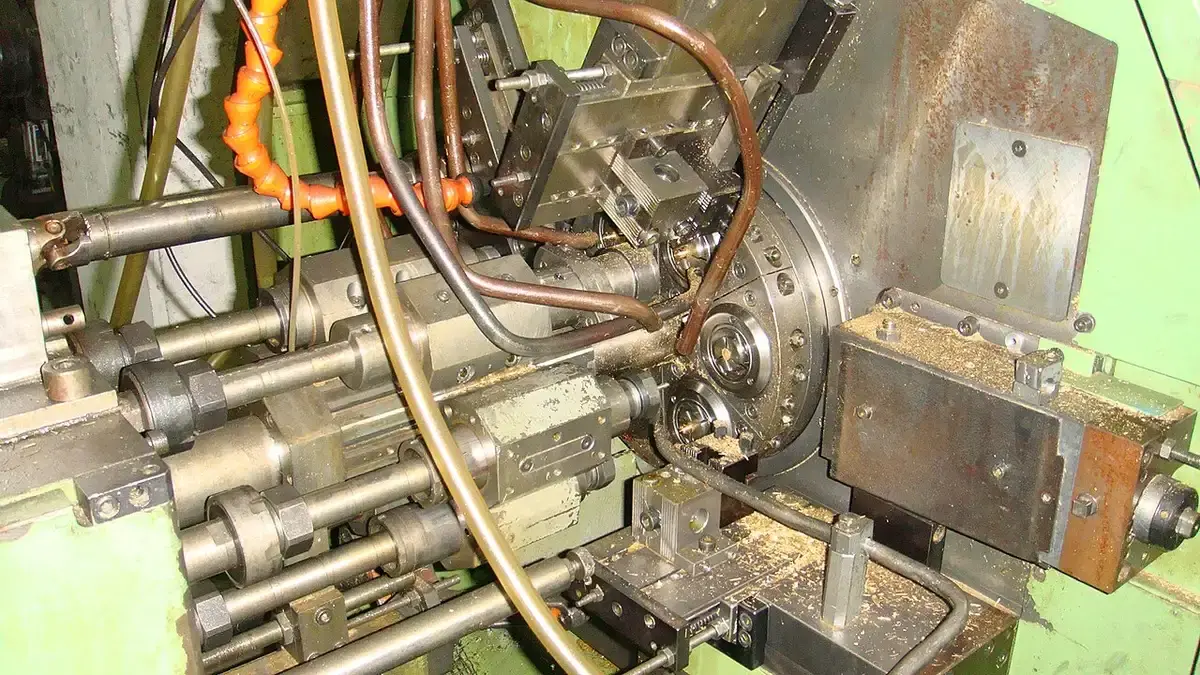
A scrapped brass part costs more than its bar, because the machine time, plating and test already spent on it are lost too, and the later the defect is found the more it carries. Log every scrap and rework event with a cause code and the stage where it was found, price it, then rank causes in a Pareto chart.
Brass scrap looks harmless. The swarf sells, the bar was not expensive per part and a few rejects a week feel like the cost of doing business. The numbers are different once you add what the part had already absorbed when it failed.
This guide shows how to put a price on scrap and rework in a brass turning shop, how to log them by cause, how to find the two problems worth fixing first and how often to review the numbers. A log template and a worked cost example for a plated fitting are included. All figures in the example are illustrations. Use your own.
Why brass scrap looks cheap and is not
Cost of poor quality is the cost that would disappear if systems, processes and products were perfect. It is usually split into prevention and appraisal costs, which you control, and internal and external failure costs, which result from defects. Scrap and rework found before shipment are internal failure; returns and complaint handling after shipment are external failure (Wikipedia). That is the framework this guide uses.
Two things make brass scrap look cheap. First, chips and rejected parts return some metal value, so the loss seems small. See what brass chips are worth for how yards price swarf. Second, the machine cycle on a screw machine is short, so one part’s machine time looks like a rounding error. Multiply by a lot and add the outside steps and the picture changes.
The cost of a scrapped part: bar, machine time, plating, test
A scrapped part carries every cost spent on it up to the point it was found. Build the figure up by stage. The inputs below are examples for a turned C360 (UNS C36000) fitting that is plated and leak tested. Replace them with yours.
| Input (example) | Value |
|---|---|
| Gross bar per part | 0.085 kg |
| Bar price | 9.00 USD per kg |
| Machine cost | 60 USD per hour |
| Cycle time | 45 seconds |
| Plating | 0.18 USD per part |
| Leak test and handling | 0.06 USD per part |
| Scrap return | 3.50 USD per kg |
Per part: bar is 0.085 x 9.00 = 0.77 USD. Machine time is 45 / 3600 x 60 = 0.75 USD. Scrap return is 0.085 x 3.50 = 0.30 USD.
| Where the defect is found | Cost carried | Less scrap return | Net loss |
|---|---|---|---|
| At the machine, first piece or in process | 0.77 + 0.75 = 1.52 USD | 0.30 | 1.22 USD |
| After plating, before test | 1.52 + 0.18 = 1.70 USD | 0.30 | 1.40 USD |
| At final leak test | 1.70 + 0.06 = 1.76 USD | 0.30 | 1.46 USD |
| After shipment | Full part cost plus freight, handling, replacement and the customer’s time | Usually nil | Not in this table |
Plated scrap may price lower than clean brass at a yard. Ask yours before you assume the same return.
The loss per part still looks small. The cost that hurts is the one that multiplies. A lot found bad at final test may have to be sorted piece by piece. In this example, sorting 5,000 parts at 6 seconds each is about 8.3 hours of labour, and the sorted parts are late. Count the sort as part of the cost, and count the late shipment too.
A scrap and rework log by cause
You cannot fix what you cannot sort. One log, filled in the moment a part is set aside, does the job.
| Date | Part | Quantity | Cause code | Stage found | Action (scrap or rework) | Cost |
|---|---|---|---|---|---|---|
| 02 Nov | BF-1042 | 40 | THR (thread fail) | Final gauge | Scrap | 58.40 |
| 03 Nov | BF-1042 | 120 | DBR (burr in cross hole) | Final inspection | Rework | 21.00 |
| 05 Nov | AD-0215 | 300 | PLT (plating reject) | After plating | Scrap | 420.00 |
| 06 Nov | BF-1042 | 15 | LEAK (leak test fail) | Leak test | Scrap | 21.90 |
The rows are examples. Fill in each column the same way every time. The cause code is the column that matters most. A starter set that fits brass work:
- BAR: defect in the bar, such as a seam, a void or the wrong alloy.
- TOOL: tool wear or breakage.
- THR: thread out of gauge or damaged.
- LEAK: fails the leak or pressure test.
- PLT: plating or finish reject.
- DBR: burrs or cross-hole debris.
- SET: setup scrap and first-piece trials.
- HND: handling damage, dings and tarnish.
Add a code only when a real event does not fit an existing one. Pick one cause per event. If a part has two causes, use the first one found.
Turn brass every week? Apply as a partner shop
Pareto: finding the two causes worth fixing
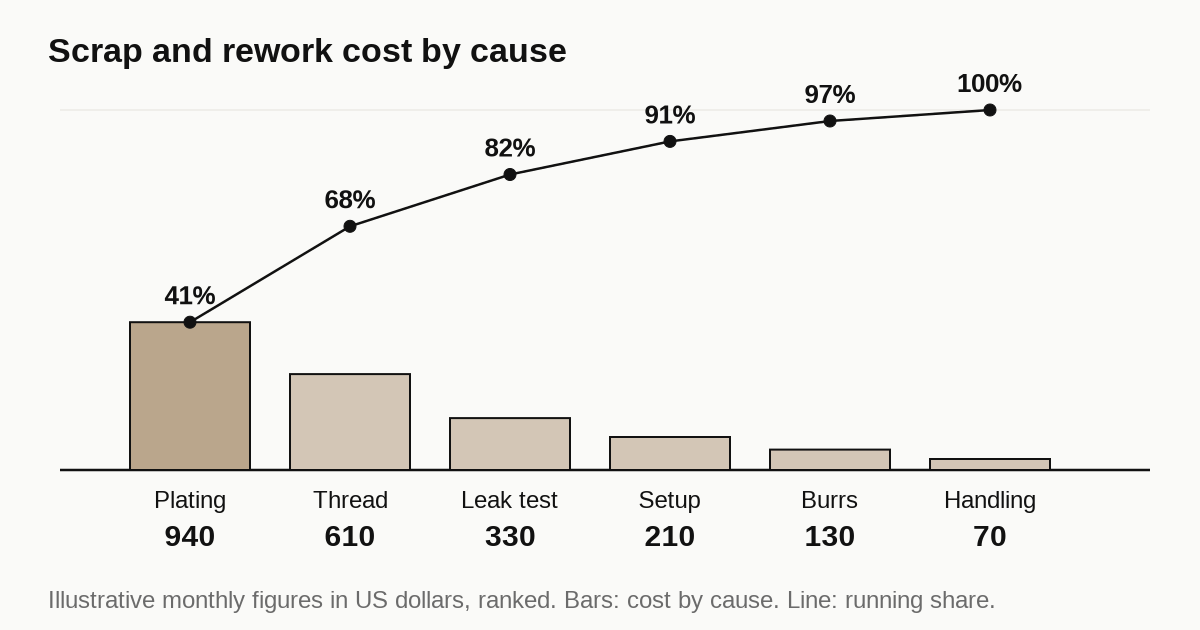
A Pareto chart ranks causes from largest to smallest with a line for the running total. Its job is to highlight the most important among a large set of factors so effort goes where it pays most (Wikipedia). Joseph Juran applied the rough idea that about 80 percent of problems come from 20 percent of causes to quality control, and later preferred the phrase “the vital few and the useful many” (Wikipedia). The 80/20 split is a rule of thumb, not a law. Your own log will show what your shop’s split is.
Sort the monthly log by cost, not by count. A few plated-part rejects can outweigh many cheap setup scraps. Here is an example month:
| Cause | Cost (USD) | Running share of total |
|---|---|---|
| PLT | 940 | 41 percent |
| THR | 610 | 68 percent |
| LEAK | 330 | 82 percent |
| SET | 210 | 91 percent |
| DBR | 130 | 97 percent |
| HND | 70 | 100 percent |
The figures are illustrative. In this example two causes, plating rejects and thread failures, account for more than two thirds of the cost. Fix those first. The next month’s chart will show whether it worked.
Leak test fails and thread fails as special cases
Two failures deserve their own line because they are found late and hurt most.
Thread failures are found at final gauging. Check what caused them before you scrap: a worn threading tool or die, a wrong tap, a setup that drifted. See thread gauging for brass fittings for how to read a go and no-go result. A thread failure that appears in a run means more are coming, so stop and check the whole lot.
Leak test failures are expensive because the part has absorbed everything. Log the leak location when you can: thread, seat, cross hole or porosity in a casting or forging. The location points to the cause. See leak and pressure testing.
For both, record the stage where the defect first could have been seen, not only where it was found. If a thread failure could have been caught at first piece, the real cost is a missed check.
Reviewing the numbers monthly
ISO 9001 asks a company to control nonconforming outputs, with actions such as containment and correction and a record of what was done (Advisera, on clause 8.7), and to analyze its monitoring results to evaluate its processes (clause 9.1.3 in the 2015 edition, Analysis and evaluation, per Advisera). A monthly review of the log meets the spirit of both without extra paperwork.
Hold it in 30 minutes with the person who runs the floor. Check three things: the Pareto chart, the two largest causes and what was changed last month. Write down one action for each of the two causes, with an owner and a date. If a cause drops out of the top two, take the next one.
Do not chase scrap to zero on every code. Choose the causes where a fix is cheap and the cost is large, and accept the rest for now. Keep the monthly charts in one folder. After half a year they show whether the fixes held, which causes keep coming back and whether the cost per shipped part is falling. They also give you something concrete to show a buyer who asks how you control quality, without claiming anything you cannot document.
If you turn brass and want work that matches your machines and alloys, apply as a partner shop. We are your customer, and there is no fee to join.
Frequently asked questions
What counts as scrap and what counts as rework?
Scrap is a part that cannot be used and is thrown away or sold as metal. Rework is a part that is fixed and re-inspected, such as a re-deburred or re-threaded fitting. Both are internal failure costs, because they are found before the part reaches the customer. Count both, because rework uses the same machine and labour time you could have sold.
Is brass scrap cheap because the metal can be sold?
The metal comes back at a scrap price below what you paid for bar. The machine time, plating, testing and handling spent on the part do not come back. On a part that has been plated and tested, those later costs can outweigh the bar. Count the scrap return as a credit, not as the whole answer.
How many causes should I track?
Start with six to eight cause codes that match how brass work fails: bar defect, tool wear, thread failure, leak test failure, plating reject, handling damage and set-up scrap. Add a code only when a real event does not fit. Too many codes make the log hard to fill in and the chart hard to read.
What is a Pareto chart?
A Pareto chart is a bar chart with the causes ranked from largest to smallest and a line showing the running total. It shows which few causes make up most of the cost or count. The idea is that effort goes first to the largest causes, which is where improvement is greatest.
Alloys in this guide
| Alloy | Lead % | Mach. | DZR |
|---|---|---|---|
| C360 free-cutting brassC36000 · CuZn36Pb3 / CW603N | 2.5 to 3.7 | 100 | Poor |
| C69300 silicon brassC69300 · CuZn21Si3P / CW724R | under 0.09 | 80 | High |
Published typical values for the alloy. Machinability against C360 at 100. Not a promise from a shop.
Sources
- Wikipedia, Cost of poor quality en.wikipedia.org
- Wikipedia, Pareto chart en.wikipedia.org
- Wikipedia, Pareto principle en.wikipedia.org
- Advisera, clause-by-clause explanation of ISO 9001:2015 info.advisera.com
- Advisera, ISO 9001:2015 versus ISO 9001:2026, main differences advisera.com
Turn brass every week?
Brass CNC Parts sends brass work requests and nothing else. We are your customer: you quote us and we place the purchase order. No fee to join.