Guides / Materials
Brass Marine Hardware: Where Brass Works on a Boat and Where It Does Not
Published November 21, 2026. Reviewed for the facts in the corrections log.
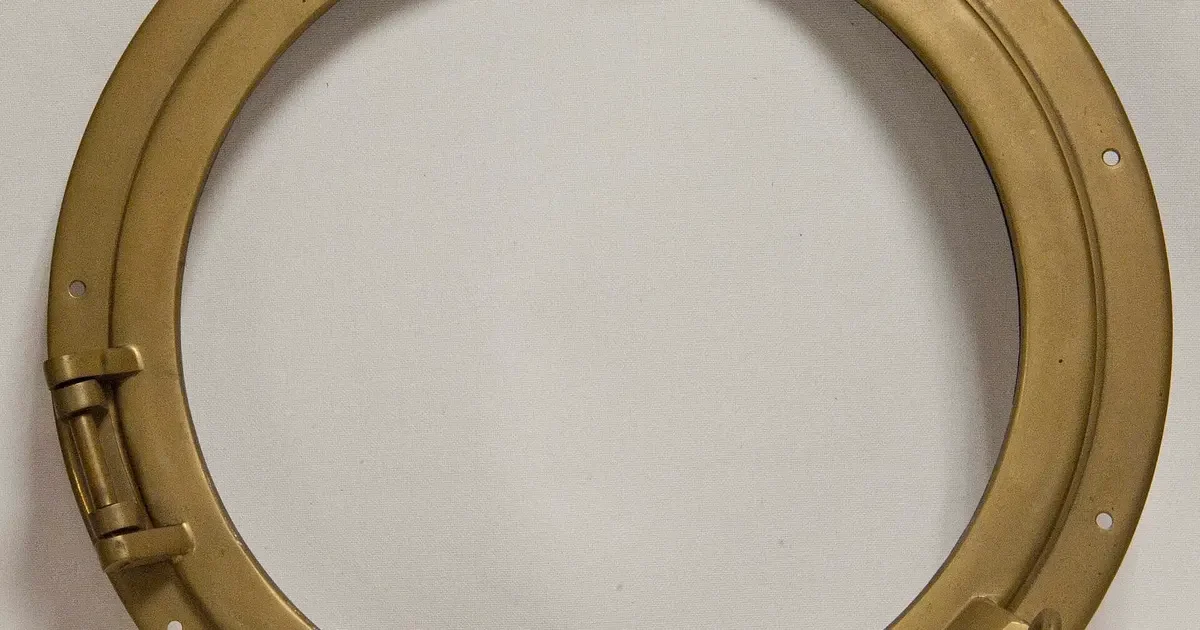
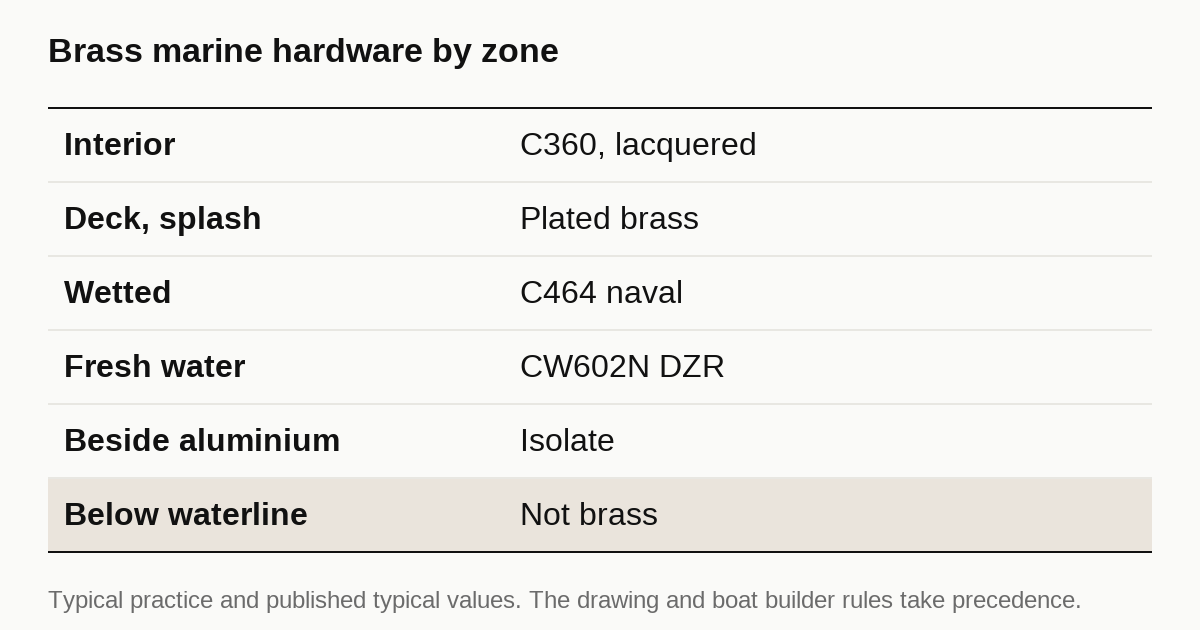
Brass works on boats above the waterline and in splash zones when the grade fits the exposure. Ordinary yellow brass dezincifies in seawater, so wetted parts need naval brass C464, admiralty C443 or a DZR grade such as CW602N. Through-hulls and seacocks below the waterline are normally bronze, and brass must be isolated from aluminium.
Brass has a long history on boats. Cleats, hinges, lamps, clocks, barometers and portholes were all brass for generations. Brass machines and polishes well, and it resists damp air far better than steel. Seawater is a different matter. Ordinary yellow brass loses zinc in salt water and turns into a weak copper sponge.
So the question for marine work is not brass or no brass. It is which brass, in which zone of the boat, next to which other metal. This post covers the grades, the zones, the galvanic pairs, the parts that should not be brass at all and what to write on the drawing.
Why yellow brass fails in seawater
Free-cutting brass C360 and forging brass CW617N carry about 36 to 40 percent zinc. In seawater the zinc dissolves out of the alloy and leaves porous copper behind. This is dezincification. The part keeps its shape, so it looks sound. It has lost most of its strength, so a thread strips or a body cracks when someone tightens it.
Chloride, warmth, low flow and stagnant water speed it up. A boat gives all four. Bilge water sits still, engine cooling water runs warm and spray dries to concentrated salt on deck. The mechanism and the test are covered in dezincification resistant brass.
Brass grades for marine use
| Grade | Seawater behaviour | Machinability | Typical marine use |
|---|---|---|---|
| C360 free-cutting | Dezincifies | 100 | Interior parts, plated or lacquered deck items |
| CW617N forging | Dezincifies | 80 | Plated deck hardware, interior fittings |
| CW602N DZR | Resists dezincification | 80 | Fresh water system fittings, above-waterline fittings |
| C464 naval brass | Resists dezincification | 30 | Seawater-wetted turned parts, fasteners, fittings |
| C443 admiralty | Resists dezincification | 30 | Heat exchanger tube and its ferrules |
Published typical values, machinability against C360 at 100. The drawing and the material standard take precedence.
C464 naval brass is the traditional seawater brass. About 0.5 to 1 percent tin holds the zinc in place. Lead is under 0.20 percent. It machines slowly, at 30 against 100, with long chips and lower speeds. Specify it because the part is wetted by salt water, not because the name sounds strong.
CW602N DZR brass carries a small arsenic addition and a controlled heat treatment. It machines at 80 and hot stamps well. It was developed for water fittings, so it suits the fresh water system on board and fittings above the waterline. It is leaded, at 1.7 to 2.8 percent, so it does not meet the US drinking water lead limit.
C443 admiralty brass is a 70/30 brass with tin and arsenic. It arrives as tube for condensers and engine heat exchangers. Machined parts from it are ferrules and short fittings cut from that tube. See admiralty brass heat exchanger parts.
Propellers are a separate topic. Small propellers and some fittings use high-tensile brass, often sold as manganese bronze. It is a strong brass with its own corrosion limits. See high-tensile manganese brass parts.
Zones of the boat
Interior. Lamps, clocks, barometers, door hardware and instrument cases see damp air and some salt. Free-cutting brass works here. Lacquer or plating keeps the color, and dezincification is not a concern in dry service.
Deck and splash zone. Cleats, hinges, hatch fittings, rail ends and vents see spray and drying salt. Plated brass is common. Chrome over nickel protects the surface while it lasts. Once the plating wears through at an edge, the base metal is exposed, so naval brass or a DZR grade lasts longer under thin or damaged plating.
Wetted, above the waterline. Deck drains, cockpit scuppers above the waterline and fresh water system fittings see water most of the time. Here the grade matters most. Use naval brass for salt water and a DZR grade for fresh water.
Below the waterline. Through-hull fittings and seacocks hold the sea out of the boat. If one fails, the boat can sink. Industry practice is bronze or a marine composite for these parts. Small craft standards such as ISO 9093 cover seacocks and through-hull fittings, and surveyors commonly flag brass below the waterline. Bronze is outside what this site quotes, so a below-waterline seacock should go to a bronze supplier, not to a brass shop.
Fresh water and engine systems
The fresh water system on board is a drinking water system. Tank fittings, pump unions and tap parts are wetted by water that people drink. A DZR grade handles the corrosion side. The lead side depends on the market. In the US, wetted drinking water parts must meet the 0.25 percent weighted average lead limit of NSF/ANSI 372, and CW602N does not. Use a lead-free grade such as C69300 silicon brass where that rule applies.
Engine raw water circuits see warm seawater at flow. Strainer bodies, hose tails, drain plugs and heat exchanger end fittings sit in that circuit. Yellow brass fails here faster than on deck, because heat speeds dezincification. Naval brass or admiralty brass suits these parts. Hose tails should have a smooth bore and a burr-free barb, since a chip left inside travels to the pump impeller.
Small fasteners deserve their own decision. A brass screw holding a fitting is a small part in a large assembly. If it sits next to stainless or in wet salt air, it becomes the anode and goes first. Many builders use naval brass, bronze or stainless screws for that reason. This site quotes the brass ones only.
Need a quote for this part? Get a quote for your brass parts
Galvanic pairs
Two different metals in seawater form a battery. The less noble metal corrodes faster and protects the more noble one. The galvanic series in seawater ranks them.
| Pair in seawater | What happens | Typical practice |
|---|---|---|
| Brass and passive stainless steel | Brass corrodes faster | Large brass part with small stainless fastener is acceptable, the reverse is not |
| Brass and aluminium | Aluminium corrodes fast | Isolate with washers, sleeves and bedding, or avoid |
| Brass and bronze | Small difference | Usually acceptable |
| Brass and zinc anode | Zinc corrodes, brass is protected | Intended, keep the anode bonded and replaced |
| Brass and carbon steel | Steel corrodes | Avoid wetted contact |
Typical practice. The boat builder’s isolation and bonding rules take precedence.
Area matters as much as the pair. A small anode next to a large cathode corrodes fast. A brass screw in a stainless plate fails quickly. A stainless screw in a large brass casting usually lasts. On aluminium hulls and masts many builders avoid copper alloys entirely. Where brass must sit on aluminium, insulate every contact and keep water out of the joint.
Plating, lacquer and stress
Chrome over nickel is the usual deck finish. Nickel under chrome gives the corrosion barrier, and the chrome gives hardness and color. Plating thickness and the standard should be named on the drawing. Interior brass is often polished and lacquered. Lacquer fails in sunlight and salt, so outdoor parts wear it badly. See brass surface finishes and plating.
Cold-worked brass under load can crack in the presence of ammonia. Bilge cleaners, some deck cleaners and bird droppings contain ammonia compounds. A cleat bolted down hard and washed with an ammonia cleaner is a candidate. Stress relief at 330 to 350 C lowers the risk on parts with heavy cold work. See brass stress corrosion cracking.
Inspection in service
Dezincification gives itself away by color. A pink or copper colored patch on a yellow brass part means zinc has left. Scrape the surface with a knife. Sound brass shows yellow under the scratch. Dezincified brass shows copper red and may crumble.
Check every brass part that sees water at each haul-out. Look at threads, at the waterline of any wetted fitting and under plating that has blistered. White crusty deposits on a fitting are zinc corrosion products and a warning sign. A fitting with pink metal should be replaced, not polished.
For new parts, the material is checked before machining. Ask for a mill certificate to EN 10204 3.1 with the composition and, for DZR grades, the ISO 6509 dezincification result. See brass material certificates.
What to write on the drawing
Material: C464 naval brass (CuZn38Sn1, CW712R) for seawater-wetted parts.
Alternative: CW602N DZR brass for fresh water fittings, ISO 6509 result on certificate.
Mill certificate EN 10204 3.1. Service: seawater splash and immersion, above waterline.
Finish: nickel then chrome, standard and thickness stated. Edges broken 0.2 to 0.4.
Not for below-waterline through-hull or seacock use.
Checklist
- Zone of the boat stated: interior, deck, wetted above waterline.
- Water named: seawater, fresh water or both.
- Grade chosen for the exposure, not for the name.
- Mating metals listed, with isolation where brass meets aluminium or a small brass part meets stainless.
- Plating, thickness and standard named.
- Stress relief stated for cold-worked load-bearing parts.
- Certificate with composition and, for DZR grades, the ISO 6509 result.
- Below-waterline through-hulls and seacocks sent to a bronze supplier.
Need machined brass marine hardware? Send the drawing with the zone of the boat and the water named. We quote the finished parts within 24 business hours and place the work with one of the partner shops that turn brass.
Frequently asked questions
Can I use brass fittings below the waterline?
Industry practice says no for through-hulls and seacocks. Ordinary brass dezincifies in seawater and can fail without warning, and surveyors commonly flag it. These parts are normally made in bronze or a marine composite and are sold to small craft standards such as ISO 9093. This site quotes brass only, so it does not quote those parts.
Is naval brass the same as bronze?
No. C464 naval brass is a copper zinc alloy with about 0.5 to 1 percent tin added to resist dezincification. It is still a brass. It suits seawater-wetted turned parts better than yellow brass, but it machines slowly, rated 30 against 100 for free-cutting brass, so specify it only where the exposure needs it.
Can brass hardware go on an aluminium boat?
Only with care. Brass is more noble than aluminium in seawater, so the aluminium corrodes where the two touch in wet conditions. Isolate the brass with insulating washers, sleeves and a bedding compound, keep the joint dry where possible, and follow the boat builder's isolation rules. Many builders avoid copper alloys on aluminium hulls entirely.
Alloys in this guide
| Alloy | Lead % | Mach. | DZR |
|---|---|---|---|
| C464 naval brassC46400 · CuZn38Sn1 / CW712R | under 0.20 | 30 | High |
| CW602N DZR brassNo direct UNS equivalent · CuZn36Pb2As / CW602N | 1.7 to 2.8 | 80 | High |
| C443 admiralty brassC44300 · CuZn28Sn1As / CW706R | under 0.07 | 30 | High |
| C360 free-cutting brassC36000 · CuZn36Pb3 / CW603N | 2.5 to 3.7 | 100 | Poor |
Published typical values for the alloy. Machinability against C360 at 100. Not a promise from a shop.
Sources
- Wikipedia, Dezincification en.wikipedia.org
- Wikipedia, Galvanic series en.wikipedia.org
Need a quote for this part?
Send the drawing. We read it, send one itemised quote for the finished parts within 24 business hours and place the work with a partner shop that turns brass. Brass only.
Get a quote for your brass parts