Guides / Materials
Melting Point of Brass by Alloy: Solidus, Liquidus and What a Buyer Needs From Them
Published November 21, 2026. Reviewed for the facts in the corrections log.
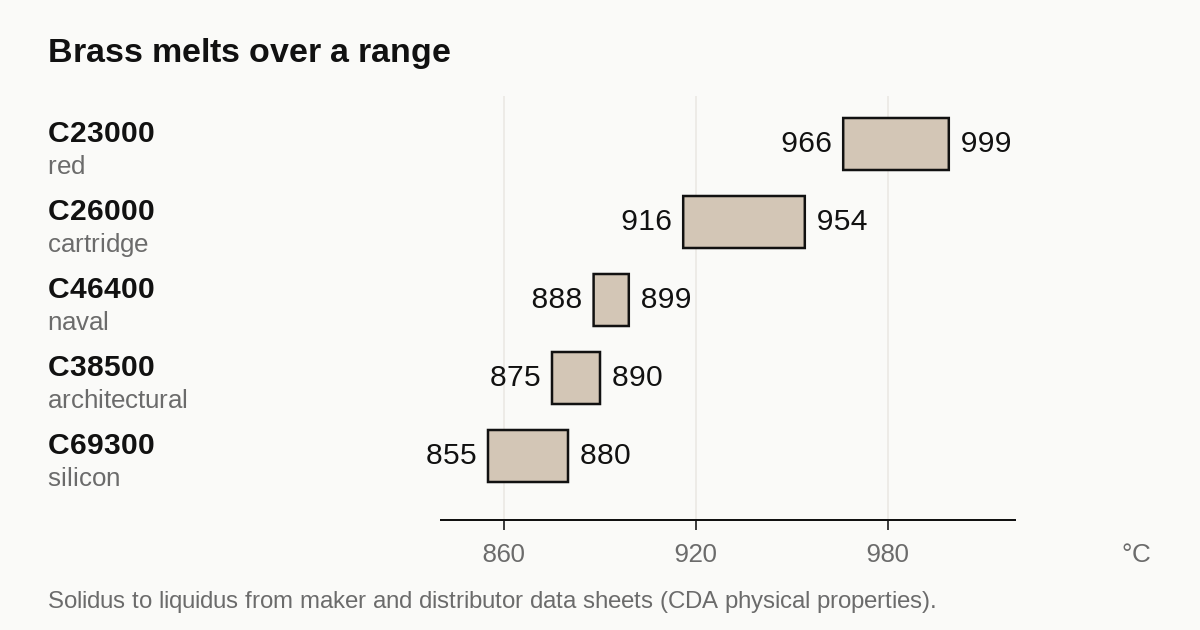
Brass has no single melting point. It starts to melt at the solidus and is fully liquid at the liquidus. Published values run from 855 to 880 C for silicon brass C69300 up to 966 to 999 C for red brass C23000. Naval brass C46400 melts between 888 and 899 C.
Brass has no single melting point. Every grade starts to melt at one temperature, the solidus, and is fully liquid at a higher one, the liquidus. On the pages listed under Sources the machining grades run from a solidus of 855 C for silicon brass C69300 to a liquidus of 999 C for red brass C23000, and the exact pair depends on the alloy. For choosing a grade, start from the brass grades guide and use this page for the temperatures.
The figures below are published typical values read on the pages named in the table on 25 October 2026. They describe the alloy, not a lot, and not a shop.
Solidus and liquidus by alloy
| Alloy | Solidus C | Liquidus C | Solidus F | Liquidus F | Source |
|---|---|---|---|---|---|
| C69300 silicon brass | 855 | 880 | 1571 | 1616 | Wieland Concast |
| C38500 architectural bronze | 875 | 890 | 1610 | 1635 | Austral Wright |
| C46400 naval brass | 888 | 899 | 1630 | 1650 | Wieland Concast, Austral Wright, AMS 4611 sheet |
| C26000 cartridge brass | 916 | 954 | 1680 | 1750 | Wieland Concast |
| C23000 red brass, 85 percent | 966 | 999 | 1770 | 1830 | Wieland Concast |
Source line: Wieland Concast prints “physical properties provided by CDA” on each product page. Austral Wright prints its own datasheet values. Temperatures are as printed on each page, so a few Fahrenheit figures are rounded differently from the Celsius ones. The Copper Development Association alloy pages could not be opened when this article was written, so none of the figures is quoted from them directly.
Two further sources give single ranges without a split. Austral Wright prints 885 to 910 C for dezincification-resistant machining brass C35330. EngineeringToolbox lists 990 to 1025 C for red brass, 905 to 932 C for yellow brass and 900 to 940 C for admiralty brass.
Why the grades differ
The range follows composition. Red brass holds 84 to 86 percent copper and starts melting at 966 C. Naval brass holds 59 to 62 percent copper and starts at 888 C. Cartridge brass sits between them with 68.5 to 71.5 percent copper and 916 C.
Copper level is not the whole story. Silicon brass C69300 holds 73 to 77 percent copper and still has the lowest solidus in the table, 855 C, which is 33 C below naval brass. The silicon, about 2.7 to 3.4 percent on the same page, and the other additions pull the range down.
One source can disagree with the rest
Fisk Alloy prints a solidus of 1750 F (954 C) and a liquidus of 1920 F (1049 C) for its C36000 free-cutting brass. That is far above the 875 to 890 C that Austral Wright prints for C38500, another leaded free-cutting brass. We could not open a second page with melting figures for C36000, so C36000 is not in the table. If a process depends on its melting range, ask the supplier for the figure on the lot’s data sheet.
Need a quote for this part? Get a quote for your brass parts
When the number matters
For turning, milling and drilling it does not. Cutting parameters come from machinability and tool wear, not from the melting range, and the brass stays far below its solidus at the cutting edge. The number matters in four places:
- Hot forging. The forging window is set below the solidus of the grade. Hot shortness in forging brass covers the tearing, and forging against machining covers when to forge.
- Brazing and soldering. The filler must melt well below the part’s solidus. The grade sets the ceiling.
- Remelting scrap. Each grade in the table has its own range, so a melt of mixed grades has no single figure.
- Heat treatment and stress relief. These happen far below the solidus, but the process temperature is set by the grade’s own guidance, not by the melting range.
What to write on the drawing and the RFQ
Do not specify a melting point. Name the alloy by UNS or EN number, such as C46400, and the temperature follows from the alloy. If your process heats the part, say so in the RFQ with the maximum temperature and ask the shop to confirm the grade suits it. A shop can answer that from the mill data sheet for the bar it buys.
Mistakes to avoid
- Quoting one melting point for all brass. Wikipedia’s 900 to 940 C is a general range, and the grades in the table sit both below and above it.
- Mixing Celsius and Fahrenheit. Fahrenheit is Celsius times 1.8 plus 32, so 888 C becomes 1630 F, the naval brass solidus in the table.
- Treating the liquidus as a working temperature. A process that heats the part should stay below the solidus of the grade.
- Reading a distributor page as a specification. These are typical values for the alloy. For a lot, use the mill data sheet for the bar.
Next step
Once the grade is chosen, the brass grades guide shows how to name it on the drawing. When you have the drawing, send your RFQ , and we quote the finished parts and place the work with one of the partner shops that turn brass.
Frequently asked questions
Is there one melting point for brass?
No. Brass is an alloy of copper and zinc, and an alloy melts over a range. It begins to melt at the solidus and is fully liquid at the liquidus. Wikipedia gives 900 to 940 C for brass in general, depending on composition, and the alloy pages in this article show the range moving from about 855 C to 999 C between grades.
Does the melting point matter for CNC machining brass?
Not for cutting. The chip and the tool edge stay far below the solidus of any grade in the table, so no brass cutting parameter is set by it. It matters where the part is heated on purpose, such as brazing, soldering, hot forging or remelting scrap, and then the grade and the supplier's own figure decide the working temperature.
Which brass in this article has the lowest melting range?
Silicon brass C69300, with a solidus of 855 C and a liquidus of 880 C on the Wieland Concast page. Silicon is part of the reason, because C69300 holds 73 to 77 percent copper and still starts melting about 33 C below naval brass C46400, which holds 59 to 62 percent copper. Composition beyond the copper level moves the range.
Alloys in this guide
| Alloy | Lead % | Mach. | DZR |
|---|---|---|---|
| C464 naval brassC46400 · CuZn38Sn1 / CW712R | under 0.20 | 30 | High |
| C69300 silicon brassC69300 · CuZn21Si3P / CW724R | under 0.09 | 80 | High |
| C385 architectural bronzeC38500 · CuZn39Pb3 / CW614N | 2.5 to 3.5 | 90 | Poor |
| C260 cartridge brassC26000 · CuZn30 / CW505L | trace | 30 | Poor |
| C230 red brassC23000 · CuZn15 / CW502L | under 0.05 | 30 | High |
Published typical values for the alloy. Machinability against C360 at 100. Not a promise from a shop.
Sources
- Wieland Concast, C46400 naval brass product page, physical properties provided by CDA concast.com
- Wieland Concast, C69300 lead-free brass product page concast.com
- Wieland Concast, C26000 cartridge brass product page concast.com
- Wieland Concast, C23000 red brass product page concast.com
- Austral Wright Metals, free cutting brass alloy 385, UNS C38500 australwright.com.au
- Austral Wright Metals, naval brass uninhibited, UNS C46400 australwright.com.au
- Aircraft Materials, naval brass AMS 4611 (UNS C46400) data sheet aircraftmaterials.com
- Wikipedia, Brass en.wikipedia.org
Need a quote for this part?
Send the drawing. We read it, send one itemised quote for the finished parts within 24 business hours and place the work with a partner shop that turns brass. Brass only.
Get a quote for your brass parts