Guides / Materials
What Free-Cutting Brass Is: How Lead Changes the Chip, What C360 Means and What to Write on a Drawing
Published November 21, 2026. Reviewed for the facts in the corrections log.
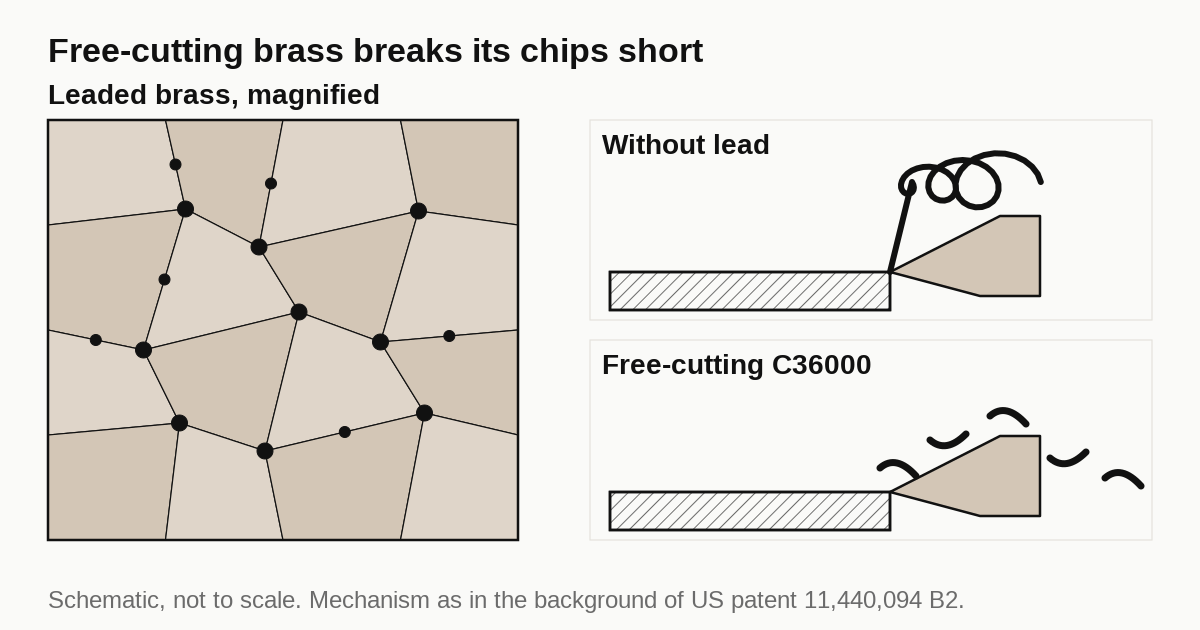
Free-cutting brass is brass with about 2.5 to 3.0 percent lead added so it machines fast. The lead sits between the grains and breaks the chip. The standard grade is C36000, also written C360, and every other copper alloy is rated against it at 100. It is not suited to US drinking water parts.
Free-cutting brass is a brass with about 2.5 to 3.0 percent lead added so it machines fast and cleanly. The standard grade is C36000, called C360 in shops, and the lead is the reason it is the grade most turned brass parts are made from. The rest of this post covers what the lead does, the numbers on the datasheets, where the grade does not belong and what to write on the drawing. For choosing between grades, start with the brass grades guide.
The figures come from the pages listed under Sources, read on 25 October 2026, and they are published typical values for the alloy.
How the lead changes the chip
Lead does not dissolve in brass. The background section of US patent 11,440,094 B2 says lead “is insoluble in brass” and collects at the grain boundaries, where it sits as a separate phase. From there it does two jobs while the tool cuts. It acts as a chip breaker, so the chip falls into short pieces rather than a long ribbon. It also coats the cutting edge, which lowers friction and heat and extends tool life.
The effect shows at the machine. Short chips clear from a bar-fed lathe without wrapping the part or the tool. Without the lead, ordinary brass such as cartridge brass C26000 is rated 30 on the Wieland Concast page, against 100 for C36000.
What the datasheets say about C36000
| Item | Value | Source |
|---|---|---|
| Copper | 60.0 to 63.0 percent | Fisk Alloy, National Bronze |
| Lead | 2.5 to 3.0 percent | Fisk Alloy, National Bronze |
| Lead, wider printed range | 2.5 to 3.7 percent | E-Z LOK |
| Iron | 0.35 percent max | Fisk Alloy, National Bronze |
| Zinc | remainder | Fisk Alloy, National Bronze |
| Machinability rating | 100 | Fisk Alloy, Anchor Bronze, National Bronze |
| Density | 8.5 g/cm3 (0.307 lb/in3), see the density chart | Fisk Alloy |
| Specifications named | ASTM B16, SAE J461, AMS 4610 | Anchor Bronze |
Source line: values as printed on each page, read 25 October 2026. E-Z LOK prints a wider lead range than the other two pages. ASTM B16 names C36010 as well as C36000 in its scope, and we did not read the standard text, only the catalogue page, so we cannot say which UNS number the wider range belongs to. Ask the shop which number it is quoting.
What ASTM B16 covers
The ASTM catalogue page describes B16 as the specification for free-cutting brass rod, bar and shapes for use in screw machines. It says the specification covers rod, bar, wire and shapes of any specified cross section, for high-speed screw machining and moderate thread rolling. That is the purchase specification to cite for turned parts made from bar. The catalogue page does not show the chemical limits, so write the UNS number as well. Paid standards are not reproduced here.
What 100 means
The 100 is a convention. Anchor Bronze states that the C36000 rating of 100 is the standard against which all other copper alloys are rated. Austral Wright shows the same idea when it prints C38500 as 90 percent and C35330 as 80 percent “of free cutting brass”. The steel scale has its own reference. Wikipedia explains that the AISI scale assigned B1112 steel the value 100. A brass rating and a steel rating are therefore not comparable numbers.
A rating describes how easily the metal cuts. It is not a cycle time and not a price. Two grades with the same rating can still differ in bar price, in the sizes stocked and in what the end use allows, so use the rating to compare cutting ease and the other columns to decide.
Need a quote for this part? Get a quote for your brass parts
Free-cutting grades compared
| Alloy | Lead as printed | Machinability | Source |
|---|---|---|---|
| C36000 | 2.5 to 3.0 percent | 100 | Fisk Alloy |
| C38500 | 2.5 to 4.5 percent | 90 | Austral Wright |
| C35330 | 3.25 percent, single value printed | 80 | Austral Wright |
| C69300 silicon brass | 0.02 to 0.09 percent | 85 | Wieland Concast |
Source line: as printed. The first three are leaded. C69300 is a lead-free alternative, and its page prints 85 where our datasheet shows about 80, so sources differ by a few points. Confirm with the supplier for the bar in question.
Where free-cutting brass does not fit
- US drinking water parts. The patent background states C36000 is well above the 0.25 percent limit that US federal rules set for potable water components. Use a lead-free grade.
- Hot water. The alloy loses zinc in hot water, so a dezincification-resistant grade is the usual choice.
- EU electrical equipment. The RoHS exemption 6(c) for lead in copper alloys comes from Delegated Directive (EU) 2025/2364 and expires 30 June 2027.
For the choice between leaded and lead-free, read leaded against lead-free brass. For cutting parameters, see brass speeds and feeds.
What to write on the drawing
Write the full designation: C36000 (CW603N nearest) to ASTM B16, with the temper and the lead statement your market needs. Say if the part sees drinking water, because that decides the alloy. Do not write “free-cutting” alone, since several alloys use the term.
Next step
Choose the grade in the brass grades guide. When the drawing is ready, send your RFQ , and we quote the finished parts and place the work with one of the partner shops that turn brass.
Frequently asked questions
What does the 100 in C360 machinability mean?
It means C360 is the reference. Other copper alloys are rated as a percentage of how well C36000 machines, so naval brass C46400 at 30 is about a third as easy to cut. The 100 comes from the copper alloy scale and is not the same number as the 100 that the steel scale gives to B1112 steel. Never compare a brass rating with a steel rating.
Is free-cutting brass the same as C360 and C36000?
In everyday use yes. C36000 is the UNS number, C360 is the short form and the grade is also called free-machining or screw machine brass. ASTM B16 names C36010 as well as C36000 in its scope, so write the full UNS number on the drawing and not only the short name.
Can free-cutting brass go into drinking water parts?
In the United States, normally not. US federal rules limit potable water components to a 0.25 percent weighted average lead content, and C36000 at 2.5 to 3.0 percent is far above it. Parts for drinking water use a lead-free grade such as silicon brass C69300. Name the standard on the drawing and check each case; this is not legal advice.
Alloys in this guide
| Alloy | Lead % | Mach. | DZR |
|---|---|---|---|
| C360 free-cutting brassC36000 · CuZn36Pb3 / CW603N | 2.5 to 3.7 | 100 | Poor |
| C385 architectural bronzeC38500 · CuZn39Pb3 / CW614N | 2.5 to 3.5 | 90 | Poor |
| C69300 silicon brassC69300 · CuZn21Si3P / CW724R | under 0.09 | 80 | High |
Published typical values for the alloy. Machinability against C360 at 100. Not a promise from a shop.
Sources
- Fisk Alloy, MA36B C36000 free-cutting brass fiskalloy.com
- National Bronze, C36000 free cutting brass bar nationalbronze.com
- Anchor Bronze, C36000 anchorbronze.com
- E-Z LOK, brass material properties (C36000) ezlok.com
- ASTM International, B16/B16M-24 free-cutting brass rod, bar and shapes for use in screw machines (catalogue page) store.astm.org
- US patent 11,440,094 B2, background section on lead in brass patents.google.com
- Austral Wright Metals, free cutting brass alloy 385, UNS C38500 australwright.com.au
- Wikipedia, Machinability en.wikipedia.org
- Wieland Concast, C69300 lead-free brass product page concast.com
Need a quote for this part?
Send the drawing. We read it, send one itemised quote for the finished parts within 24 business hours and place the work with a partner shop that turns brass. Brass only.
Get a quote for your brass parts