Guides / Materials
Machined Brass Electrical Terminals and Connectors: Conductivity, Plating and Fit
Published October 19, 2026. Reviewed for the facts in the corrections log.
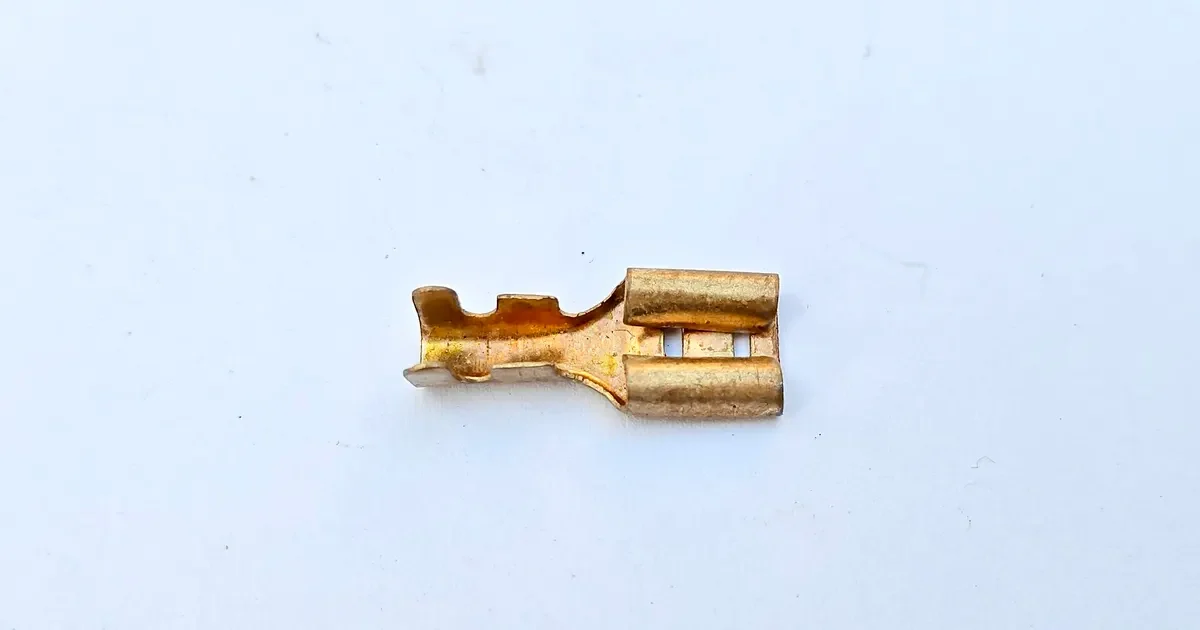
Brass carries about a quarter of the current of copper for the same section, so it suits turned pins, studs, sockets and screw terminals where strength and machinability matter more than conductivity. Plate it to stop tarnish and contact resistance, put nickel under gold or silver to block zinc, and hold fit tolerances tight.
Look inside a plug, a battery holder or a terminal block and you will find small brass parts: pins, sockets, studs, screw terminals, binding posts. They are brass because brass turns quickly, holds a thread, resists corrosion and carries current well enough. Its flaws are known, and good design works around them.
This post covers the conductivity trade, the plating choices, the zinc problem and the fit tolerances that decide whether a terminal makes a reliable contact for years. Figures are published typical values, not a promise from any shop.
Conductivity in context
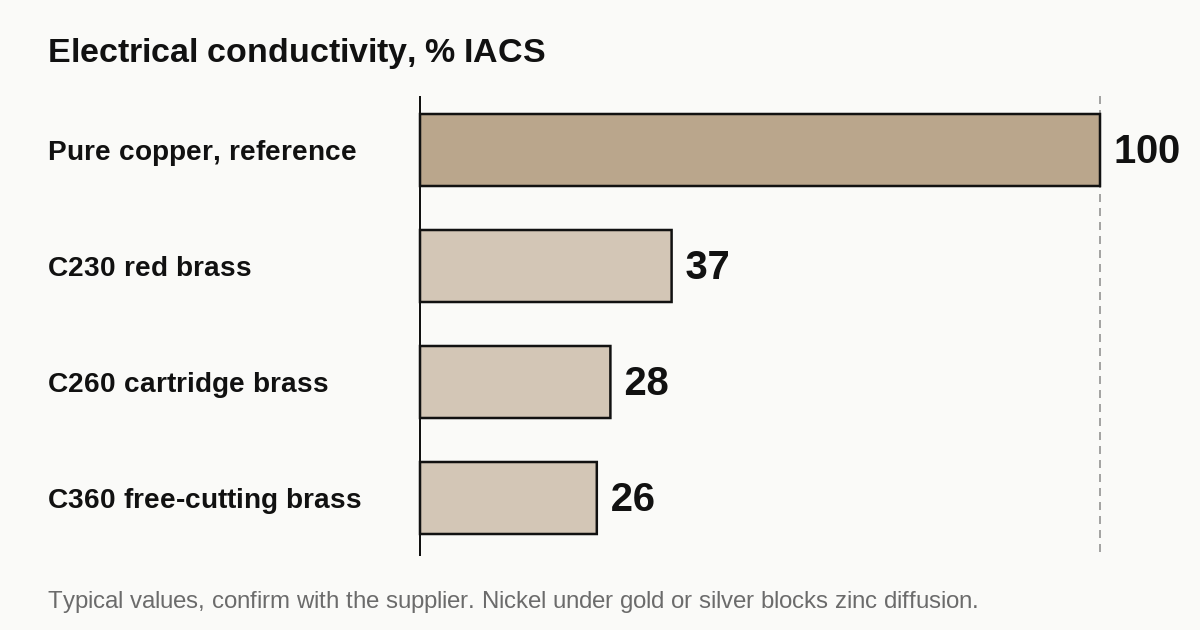
Conductivity is quoted as a percentage of the International Annealed Copper Standard, IACS, where pure copper is 100.
| Material | Typical conductivity, % IACS |
|---|---|
| Pure copper (reference) | 100 |
| C230 red brass | 37 |
| C260 cartridge brass | 28 |
| C360 free-cutting brass | 26 |
Published typical values for the alloys. The mill’s data sheet takes precedence, and temper and composition shift the figure by a few percent.
A brass section carries roughly a quarter to a third of the current of the same copper section at the same temperature rise. That is a design fact, not a defect. A turned terminal for a few amps needs only a modest cross-section. A terminal for tens or hundreds of amps either needs a much larger brass section or a different metal. High-current bus parts are normally copper, which this site does not quote. Check the current rating of the finished part, not the material alone.
Contact resistance matters more than bulk resistance for small terminals. A good brass pin with clean plating has a contact resistance of milliohms. A tarnished or corroded one can be many times that and heat up under load.
Which brass
For turned terminals the usual grade is C360 free-cutting brass, which turns fast and holds fine threads. Parts that are stamped from strip, such as ring terminals and flat tabs, use C260 cartridge brass or C230 red brass, which form without cracking. Red brass has the best conductivity of the three.
Brass is a poor choice for spring contacts. It loses spring force at elevated temperature and can stress-relax, so socket springs and clip contacts use phosphor bronze or beryllium copper. The turned pin that the spring grips can still be brass. This site quotes brass only.
Plating choices
Bare brass tarnishes and forms a surface film that raises contact resistance, so most terminals are plated. The choice depends on the duty.
| Finish | Typical thickness | Strengths | Watch for |
|---|---|---|---|
| Tin (matte) | 2 to 8 micrometres | Low cost, solderable, fine for power | Fretting wear, whiskers on bright tin |
| Nickel | 2 to 10 micrometres | Hard, corrosion barrier, stable | Higher contact resistance, not for low-level signals alone |
| Silver | 2 to 8 micrometres | Best conductivity, low contact resistance | Tarnishes with sulfur, migrates in humidity |
| Gold over nickel | 0.1 to 0.8 micrometre gold, 1 to 2.5 nickel | Low, stable contact resistance for signals | Cost, wear-through on a thin layer |
| Bare or clear passivate | None | Cheapest, fine for screw terminals in clean dry air | Tarnish, higher resistance over time |
Typical practice for brass electrical parts. ASTM B545 covers tin, B488 gold, B700 silver and B689 nickel. The plating standard named on the drawing takes precedence.
Thickness is a trade. Thin plating wears through at mating contacts, and thick plating fills threads and changes fit. State the layer, the standard and the areas that may stay bare. See brass surface finishes and plating for the options and cleaning brass before plating for the step that decides adhesion.
The zinc problem
Brass is about a third zinc. Over time, zinc diffuses outward through thin plating layers, especially when the part runs warm. It reaches the surface, oxidizes and forms a film that raises contact resistance. A gold or silver layer a micrometre thick can be defeated this way.
A nickel underplate is the usual cure. Nickel is a good diffusion barrier, and a layer of about 1 to 2.5 micrometres under gold or silver blocks most zinc movement over the product’s life. It also gives a hard base so the thin precious layer wears better. Tin over brass can also benefit from a nickel or copper underlayer where the part is hot or long-lived. A drawing that calls for gold or silver directly on brass invites a failure that shows up after a year in the field.
Whiskers are a second plating risk. Bright pure tin can grow fine metal whiskers that cause shorts in tight spaces. Matte tin and a nickel or copper underlayer reduce the risk, and designers of fine-pitch electronics often specify both. The supplier and the plating standard should be named.
Need a quote for this part? Get a quote for your brass parts
Fit tolerances
A terminal is a mechanical joint as well as an electrical one, and fit decides contact force.
Pins and sockets. A pin must slide into its socket with a controlled insertion force and then hold with enough contact pressure. Pin diameters are held to a few hundredths of a millimetre, and the socket bore or the spring that grips the pin sets the force. Plating adds to the pin diameter, so tolerances apply after plating. See brass machining tolerances for what a shop can hold.
Press fits into plastic or metal. A knurled or ribbed brass terminal pressed into a housing must hold against pull and rotation. See brass threaded inserts for plastic, as the same rules apply.
Screw terminals. A thread needs a clean start and a tolerance class, and a slotted or cross-drilled head must have burr-free edges so the wire does not fray. See thread gauging brass fittings for how threads are checked, and brass deburring for cross holes.
Surface finish. A smooth contact surface wears the plating less. A rough turned surface shows through thin plating. Typical contact surfaces are specified around Ra 0.8 micrometre or finer.
Corrosion, galvanic pairs and heat
Terminals live in damp air, vehicles, appliances and outdoor boxes, and the metal pair at a joint matters. Brass against copper is a mild pair and behaves well. Brass against aluminum wire is not: aluminum is the anodic partner and corrodes where moisture bridges the joint, and the oxide on aluminum adds contact resistance. Terminals for aluminum conductors use tin plating, a joint compound and a design that holds clamping force, and the terminal maker’s instructions should be followed. Salt and sulfur atmospheres tarnish silver and attack bare brass, so a coastal or industrial product wants nickel or tin, or a sealed housing.
Heat shortens plating life. Every ten degrees of extra temperature speeds zinc diffusion and film growth, and a terminal that runs warm because it is undersized fails sooner than one that runs cool. When a part overheats in service, the root cause is usually contact resistance, and the cure is clean plating, correct torque and enough contact area, not a thicker brass section alone.
Lead and compliance
Turned terminals are usually leaded free-cutting brass. In electronics sold in the EU, lead in copper alloys falls under RoHS exemption 6(c), which has an expiry date. See RoHS exemption 6(c) and leaded brass. Where a customer or market wants lead-free, silicon brass or bismuth brass replaces C360, with a longer machining time. This is not legal advice, and a part’s status depends on the rule in force for the product.
What to write on the drawing
Material: brass C360, or lead-free alternative where required.
Plating: nickel 2 to 3 micrometres, then gold 0.2 micrometre minimum, contact end only.
Plating standard ASTM B488 and B689. Dimensions apply after plating.
Pin diameter 3.00 +0.00/-0.02. Surface finish Ra 0.8 on the contact area.
Free of burrs. Thread M4 x 0.7, 6g. Packed in separate trays to avoid contact marks.
Checklist
- Current rating checked against brass conductivity and cross-section.
- Grade chosen for the part type: turned, stamped or lead-free.
- Plating, thickness and standard named, with nickel under gold or silver.
- Dimensions stated after plating.
- Contact surface finish and burr limits written.
- Packing that avoids scratches on contacts.
- Lead requirement and RoHS position stated.
Need machined brass terminals or connector parts? Send the drawing with the plating callout. We quote the finished parts within 24 business hours and place the work with one of the partner shops that turn brass.
Frequently asked questions
Is brass a good conductor for terminals?
It is a moderate one. Free-cutting brass C360 is about 26 percent of the conductivity of pure copper, and cartridge brass C260 about 28 percent. That is enough for signal and moderate current terminals when the cross-section is sized for it. High-current paths often use copper, and brass is chosen where machining, strength or cost drive the part.
Why put nickel under gold or silver on brass?
Zinc in brass diffuses through a thin precious metal layer over time and appears on the surface as an oxide, which raises contact resistance. A nickel underplate, commonly about 1 to 2.5 micrometres, blocks that diffusion. It also gives a hard, smooth base so the thin precious layer wears better.
Can leaded brass be used for electrical terminals?
Often yes. Leaded free-cutting brass is the usual grade for turned terminals and falls under the RoHS exemption 6(c) for lead in copper alloys, which has an expiry date. Customers in some markets ask for lead-free grades instead. State the lead requirement on the drawing.
Alloys in this guide
| Alloy | Lead % | Mach. | DZR |
|---|---|---|---|
| C360 free-cutting brassC36000 · CuZn36Pb3 / CW603N | 2.5 to 3.7 | 100 | Poor |
| C260 cartridge brassC26000 · CuZn30 / CW505L | trace | 30 | Poor |
| C230 red brassC23000 · CuZn15 / CW502L | under 0.05 | 30 | High |
Published typical values for the alloy. Machinability against C360 at 100. Not a promise from a shop.
Sources
- Wikipedia, Electrical connector en.wikipedia.org
- Wikipedia, Electroplating en.wikipedia.org
Need a quote for this part?
Send the drawing. We read it, send one itemised quote for the finished parts within 24 business hours and place the work with a partner shop that turns brass. Brass only.
Get a quote for your brass parts