Guides / Materials
Brass Machinability Rating Explained: Why C360 Is 100 and What the Other Numbers Tell a Buyer
Published November 21, 2026. Reviewed for the facts in the corrections log.
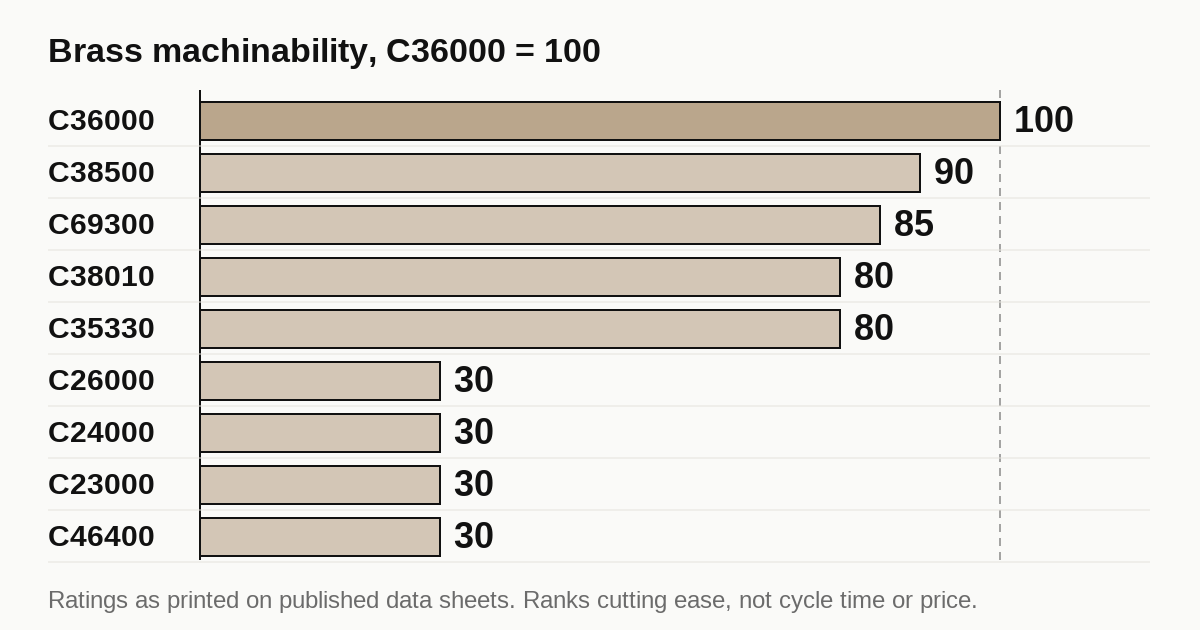
A brass machinability rating compares how easily an alloy cuts with free-cutting brass C36000, which is set at 100. On the pages listed below, C38500 is 90, C69300 is 85, C35330 is 80 and naval brass C46400 is 30. The scale ranks cutting ease. It does not give cycle time or price.
A brass machinability rating is a number that compares how easily an alloy cuts with free-cutting brass C36000, which is set at 100. A grade rated 90 cuts a little less easily and a grade rated 30 is far harder on the tool. This post lists the ratings printed for nine brasses, explains what the scale leaves out and shows how to use it when you choose a grade from the brass grades guide.
The figures are published typical values read on the pages listed under Sources on 25 October 2026, not a promise from a shop.
What the 100 refers to
Anchor Bronze states that the C36000 rating of 100 is the standard against which all other copper alloys are rated. Austral Wright prints its ratings as a percentage of free-cutting brass, for example “90% of free cutting brass (C36000)” for C38500. The copper pages do not say how the figures were measured.
The steel scale is defined differently. Wikipedia explains that the American Iron and Steel Institute assigned 160 Brinell B1112 steel a rating of 100 percent, and that the rating weighs cutting speed, surface finish and tool life. In its example a material rated 70 percent needs 70 surface feet per minute to match the 60-minute tool life that B1112 gets at 100. That is the steel definition. Do not carry a steel number over to brass.
Ratings of nine brasses
| Alloy | Rating | Lead as printed | Source |
|---|---|---|---|
| C36000 free-cutting brass | 100 | 2.5 to 3.0 percent | Fisk Alloy, Anchor Bronze |
| C38500 architectural bronze | 90 | 2.5 to 4.5 percent | Austral Wright |
| C69300 silicon brass | 85 | 0.02 to 0.09 percent | Wieland Concast |
| C38010 section brass | 80 | 1.5 to 3.0 percent | Austral Wright |
| C35330 DR machining brass | 80 | 3.25 percent, single value | Austral Wright |
| C26000 cartridge brass | 30 | 0.07 percent max | Wieland Concast |
| C24000 low brass | 30 | not read | Wieland Concast |
| C23000 red brass | 30 | 0.05 percent max | Wieland Concast |
| C46400 naval brass | 30 | 0.20 percent max | Wieland Concast, Austral Wright, AMS 4611 sheet |
Source line: ratings as printed on each page, read 25 October 2026. The Wieland Concast pages print them in a machinability table beside density. The Copper Development Association alloy pages could not be opened, so none of the figures is quoted from them directly.
What moves the number
Lead is the largest single lever in this table. The three grades with 2.5 percent lead or more are at 80 to 100, and C26000, C23000 and C46400, each with 0.20 percent lead or less, are at 30. Lead breaks the chip, and that is why free-cutting brass leads the scale.
Lead alone does not set the rating, though. C69300 holds 0.09 percent lead at most and is rated 85, because it relies on silicon instead. C38010, with 1.5 to 3.0 percent lead, is rated 80. Read the rating together with the lead range and the alloy family, not as a lead meter.
Need a quote for this part? Get a quote for your brass parts
What the rating does not tell you
- Cycle time. A rating compares cutting ease under the scale’s own conditions. A part with deep holes, fine threads or tight finishes takes the time it takes, whatever the rating.
- Price. Bar price, stocked sizes and the volume are separate lines of the quote.
- Compliance. The rating says nothing about lead limits. A part for US drinking water cannot use a high-lead grade because it cuts well.
- A promise. The figure is typical for the alloy. A lot, a bar temper or a worn tool changes what the machine sees.
Why the same grade shows two numbers
Ratings are rounded and each publisher prints its own. The C69300 figure is 85 on the Wieland Concast page and about 80 on our own datasheet. Neither is wrong; they are typical values from different tables. When two ratings differ by a few points, the ranking is the useful part: C69300 sits below C36000 and above the 30 group. Do not build a cost model on a five point gap.
Questions to put to a shop
- Which grade and which bar size are you quoting, and is that size stocked?
- If I allow a lead-free swap, what changes in your cutting data and tool life?
- Do you quote the two grades on the same drawing so I can see the difference?
A shop answers these from its own experience with the bar, which no table replaces.
Using the rating on an RFQ
Write the alloy by UNS or EN number, not by its rating. If you would accept a swap, say so and ask for a quote on both grades. Moving from C36000 to C69300 is a drop from 100 to 85 on the Wieland Concast figures, so the shop may slow the cutting or accept more tool wear. How much that costs depends on the part, which is why the quote on each grade is the answer and not a conversion factor. For the side-by-side detail, read C360 against C69300, and for cutting parameters see brass speeds and feeds.
Next step
Pick the grade in the brass grades guide. When the drawing is ready, send your RFQ , and we quote the finished parts and place the work with one of the partner shops that turn brass.
Frequently asked questions
Is a brass machinability rating the same as a steel rating?
No. The steel scale gives the value 100 to B1112 steel, as described on the Wikipedia machinability page. The copper alloy scale gives 100 to free-cutting brass C36000. A brass at 90 and a steel at 90 are each 90 against a different reference, so the two numbers cannot be compared or converted.
Does a higher rating mean a cheaper part?
Not by itself. The rating ranks how easily the alloy cuts. The price also depends on the bar price, the size stocked, the part geometry, the setup and the volume. A lower rating can mean slower cutting or more tool wear, and how much that costs depends on the part, so ask for a quote on each grade you would accept.
Why is lead-free silicon brass rated 85 here but about 80 elsewhere?
Sources print slightly different figures for the same grade. The Wieland Concast page for C69300 prints 85, while our own datasheet shows about 80. A few points of difference is normal between mills and tables. Treat the rating as a ranking, and confirm the bar and the cutting data with the shop that quotes.
Alloys in this guide
| Alloy | Lead % | Mach. | DZR |
|---|---|---|---|
| C360 free-cutting brassC36000 · CuZn36Pb3 / CW603N | 2.5 to 3.7 | 100 | Poor |
| C385 architectural bronzeC38500 · CuZn39Pb3 / CW614N | 2.5 to 3.5 | 90 | Poor |
| C69300 silicon brassC69300 · CuZn21Si3P / CW724R | under 0.09 | 80 | High |
| C464 naval brassC46400 · CuZn38Sn1 / CW712R | under 0.20 | 30 | High |
| C260 cartridge brassC26000 · CuZn30 / CW505L | trace | 30 | Poor |
| CW602N DZR brassNo direct UNS equivalent · CuZn36Pb2As / CW602N | 1.7 to 2.8 | 80 | High |
Published typical values for the alloy. Machinability against C360 at 100. Not a promise from a shop.
Sources
- Fisk Alloy, MA36B C36000 free-cutting brass fiskalloy.com
- Anchor Bronze, C36000 anchorbronze.com
- Austral Wright Metals, free cutting brass alloy 385, UNS C38500 australwright.com.au
- Austral Wright Metals, section brass alloy 380, UNS C38010 australwright.com.au
- Austral Wright Metals, dezincification resistant machining brass alloy 352, UNS C35330 australwright.com.au
- Wieland Concast, C69300 lead-free brass product page concast.com
- Wieland Concast, C46400 naval brass product page concast.com
- Wikipedia, Machinability en.wikipedia.org
Need a quote for this part?
Send the drawing. We read it, send one itemised quote for the finished parts within 24 business hours and place the work with a partner shop that turns brass. Brass only.
Get a quote for your brass parts