Guides / Process
Machined Brass Ferrules and Compression Fittings: What to Put on the Drawing
Published October 14, 2026. Reviewed for the facts in the corrections log.
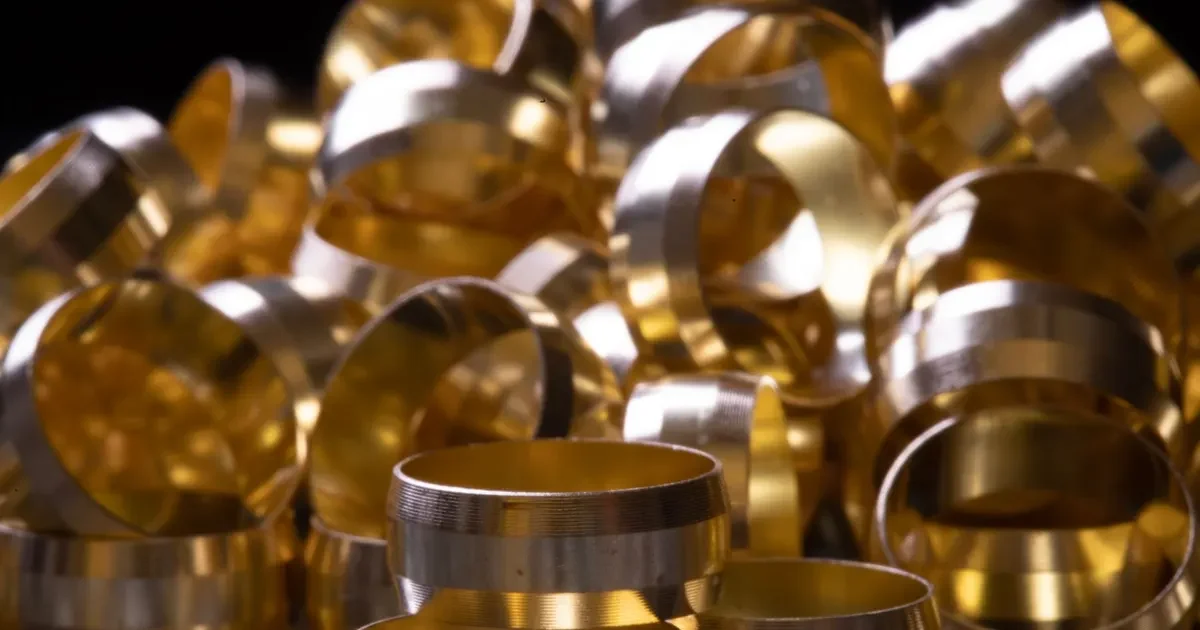
A brass compression ferrule, also called an olive, seals by being squeezed onto a tube between a nut and a body. Its bore clearance, cone angle, edge profile and hardness decide whether it bites and seals. Specify the tube size and material, the fitting system, the grade and the bore finish, and never mix ferrules between makers.
A compression fitting is simple to use. A nut is slid over a tube, then a small ring called a ferrule or olive, and the nut is tightened onto a body. The ferrule squeezes onto the tube and the body seat, and the joint seals without solder or a thread on the tube. That small ring is machined to tight limits, and a few tenths of a millimetre decide whether a joint holds at pressure or weeps.
This post covers what a ferrule does, which features matter, how to match it to tube and fitting system and how to write the drawing so a shop makes it right.
How a compression joint seals
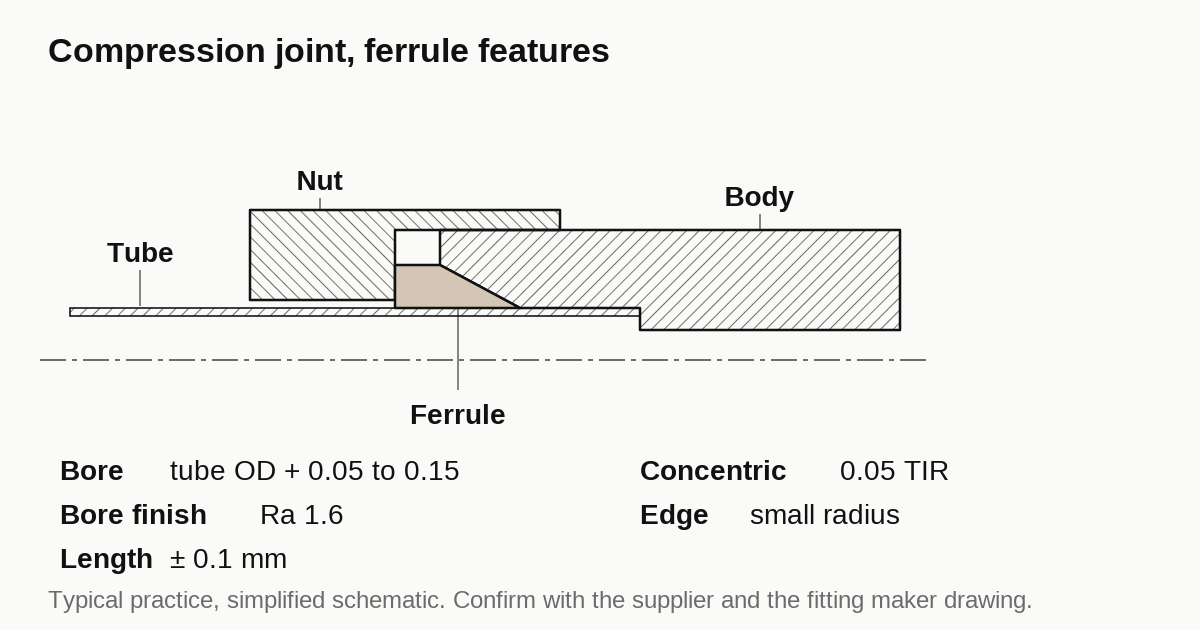
A compression fitting has three parts: a body with a tapered seat, a nut with an internal cone and the ferrule between them. As the nut tightens, it drives the ferrule into the narrowing gap. The ferrule deforms. Its front edge bites a little into the tube wall, and its outer cone seals against the body seat. Two seals result: ferrule to tube and ferrule to body. The thread of the nut only supplies the force.
A typical plumbing instruction is to tighten about one to one and a quarter turns past finger tight. The exact figure belongs to the fitting maker. Over-tightening swages the ferrule too far and can collapse a thin tube. Under-tightening leaves a seal that weeps.
In Europe, compression fittings for copper tube are covered by EN 1254-2. Other systems exist for fluid power and instrumentation. Each has its own geometry, so a ferrule is never defined in isolation.
The features that matter
| Feature | Typical practice | Why it matters |
|---|---|---|
| Bore diameter | Tube outer diameter plus about 0.05 to 0.15 mm clearance | Too tight and it will not slide on, too loose and it bites unevenly |
| Bore finish | Smooth, free of burrs, typically Ra 1.6 or better | A burr scores the tube |
| Outer cone angle | Set by the system, held within a small angular tolerance | Seals against the nut and body |
| Front edge profile | Controlled radius or small chamfer, no burr | Decides how the ring bites into the tube |
| Length | Held to about 0.1 mm | Sets how far the nut must travel |
| Concentricity, bore to cone | Held tightly, often 0.05 mm TIR or better | Uneven squeeze leaks on one side |
| Hardness | Softer or harder than tube depending on the system | A ferrule that is too hard cuts the tube. Too soft and it does not bite |
Typical practice for brass ferrules. The fitting system drawing and the maker’s tolerances take precedence.
These are small parts, often between 10 and 30 mm long, and made in large numbers on automatics or CNC lathes. A drawing that leaves the angles or the length to a general tolerance is asking for trouble. See brass machining tolerances and surface finish for the limits a shop can hold and what a tighter one costs.
Matching the ferrule to the tube
The ferrule has to suit the tube material, diameter and wall. A soft copper tube takes a brass ferrule well. A hard drawn copper tube needs a ferrule and a nut tightening sequence matched to it. Stainless steel tube is harder than brass and needs a harder ferrule, which is why instrumentation fittings in stainless use a different system. Plastic tube is too soft and needs an insert.
The tube must also be round and clean. A tube with an out of round end or a scratch at the contact zone defeats a well-made ferrule. Cut the tube square, remove burrs inside and out and wipe the end. The drawing cannot do this, but an installation note on the part sheet can.
Material choice
Brass is the usual ferrule material for water, heating and gas copper tube, since it machines fast and bites softer tube without damaging it.
- Leaded brass such as CW617N or C360 suits heating, gas and non-potable service. It turns quickly and holds a clean edge.
- Dezincification resistant brass is the usual pick for hot water and aggressive water, where ordinary brass would lose zinc. See dezincification-resistant brass.
- Lead-free brass such as CW511L or silicon brass is needed for drinking water in markets with lead limits. Machinability is lower, so tooling and the quote change. See NSF 61 and 372 brass fittings.
Ferrules are normally supplied bare. Nuts are often nickel plated. A plated ferrule can fail because the plating changes the bore and the edge. If a finish is required, state the limits after plating.
Need a quote for this part? Get a quote for your brass parts
Machining notes
Ferrules are turned from bar or tube. Typical sequence on an automatic: face, drill and bore to size, turn the outer cone with a form tool, break the edges and part off. The bore and the cone are cut in the same setup to hold concentricity, and a second operation on a part cut off from bar risks losing that. Multi-spindle screw machines do this in seconds on volume lots.
The leading edge and the bore entry need deburring. A fine burr inside a ferrule bore will score a tube, and the scratch can run into a leak path. See brass deburring for methods. Tumbling can round a sharp edge too far, so edge radius should be specified and checked, not left to a media choice.
Common faults
| Fault | Result | Typical cause |
|---|---|---|
| Burr inside bore | Scored tube, weeping joint | Missed deburring |
| Cone angle off | Seals on one line, leaks at pressure | Form tool worn or wrong |
| Bore too tight | Will not slide on tube | Tool undersize, plating |
| Bore too loose | Uneven bite | Tool oversize |
| Off-centre cone | Leak on one side | Second operation, poor chucking |
| Wrong ferrule for system | Poor seat | Mixed parts |
Typical causes only. A shop’s first article inspection catches most of them. See brass part quality checks for how to ask for it.
Packing, counting and mixing
Ferrules are small, cheap and easy to mix. A lot that ships with two bore sizes in one bag will cause field failures that no test at the shop would catch. Ask for each size to be packed and labeled separately, with the part number, the lot and the bore on the label. Loose parts in bulk bags scratch each other, and a scratched cone seals worse, so ask for bags or trays that keep parts from tumbling in transit. Count by weight only when the shop has a verified piece weight. A mixed lot is also the main reason to ask for a gauge check on bore at receiving: a go and no-go pin takes seconds. See brass tarnish prevention and packaging for packing that keeps bare brass clean.
Testing
Ferrule joints are proven by assembling a sample with the right tube and testing it at pressure. A drawing for a fitting should name the test, the pressure and the tube. See leak and pressure testing for how this is written.
What to write on the drawing
Brass ferrule for 15 mm copper tube, fitting system as drawing 1234 rev B.
Material CW617N (CuZn40Pb2), mill certificate EN 10204 3.1.
Bore 15.10 +0.05/-0. Bore and cone concentric within 0.05 TIR.
Cone angle per system drawing +/- 0.5 degrees. Front edge radius 0.2 max.
Free of burrs. Supplied bare, no plating.
Sample assembled and tested at 10 bar air, no leakage.
Checklist
- Tube material, outer diameter and wall named.
- Fitting system and maker’s drawing supplied.
- Grade chosen for water type and market rules.
- Bore, cone and length tolerances written, not general.
- Concentricity and edge profile stated.
- Plating and its effect on the bore stated.
- Sample test described.
Need ferrules or compression fittings machined in brass? Send the drawing with the system drawing attached. We quote the finished parts within 24 business hours and place the work with one of the partner shops that turn brass.
Frequently asked questions
Can ferrules from different makers be mixed?
No. The cone angles, lengths and bore sizes of the ferrule, nut and body are set as a system by each maker. A ferrule from another system may look the same and still seat at the wrong angle, so it can leak or damage the tube. Give the drawing of the full fitting, or the maker's part number, not just a ferrule drawing.
Can a ferrule be reused?
Generally not. The first tightening swages the ferrule onto the tube and leaves a permanent ring. Taking the joint apart and tightening again usually still seals if done once with care, but each cycle weakens it. Many fitting makers advise a new ferrule when a joint is remade, particularly on gas and high-pressure service.
Why does a brass ferrule leak on plastic tube?
Soft plastic tube collapses under the squeeze, so the ferrule has nothing firm to bite against. A metal or hard plastic insert inside the tube gives it support. Brass ferrules are designed for copper and similar tube, and plastic tube needs the fitting maker's insert and instructions.
Alloys in this guide
| Alloy | Lead % | Mach. | DZR |
|---|---|---|---|
| C360 free-cutting brassC36000 · CuZn36Pb3 / CW603N | 2.5 to 3.7 | 100 | Poor |
| CW617N CuZn40Pb2C37700 (nearest) · CuZn40Pb2 / CW617N | 1.6 to 2.5 | 80 | Poor |
| CW511L lead-free brassC27450 (nearest, without arsenic) · CuZn38As / CW511L | under 0.2 | 40 | High |
Published typical values for the alloy. Machinability against C360 at 100. Not a promise from a shop.
Sources
- Wikipedia, Compression fitting en.wikipedia.org
- Wikipedia, Ferrule en.wikipedia.org
Need a quote for this part?
Send the drawing. We read it, send one itemised quote for the finished parts within 24 business hours and place the work with a partner shop that turns brass. Brass only.
Get a quote for your brass parts