Guides / For Shops
Applying as a Partner Shop for Brass Work: What to Prepare
Published November 21, 2026. Reviewed for the facts in the corrections log.
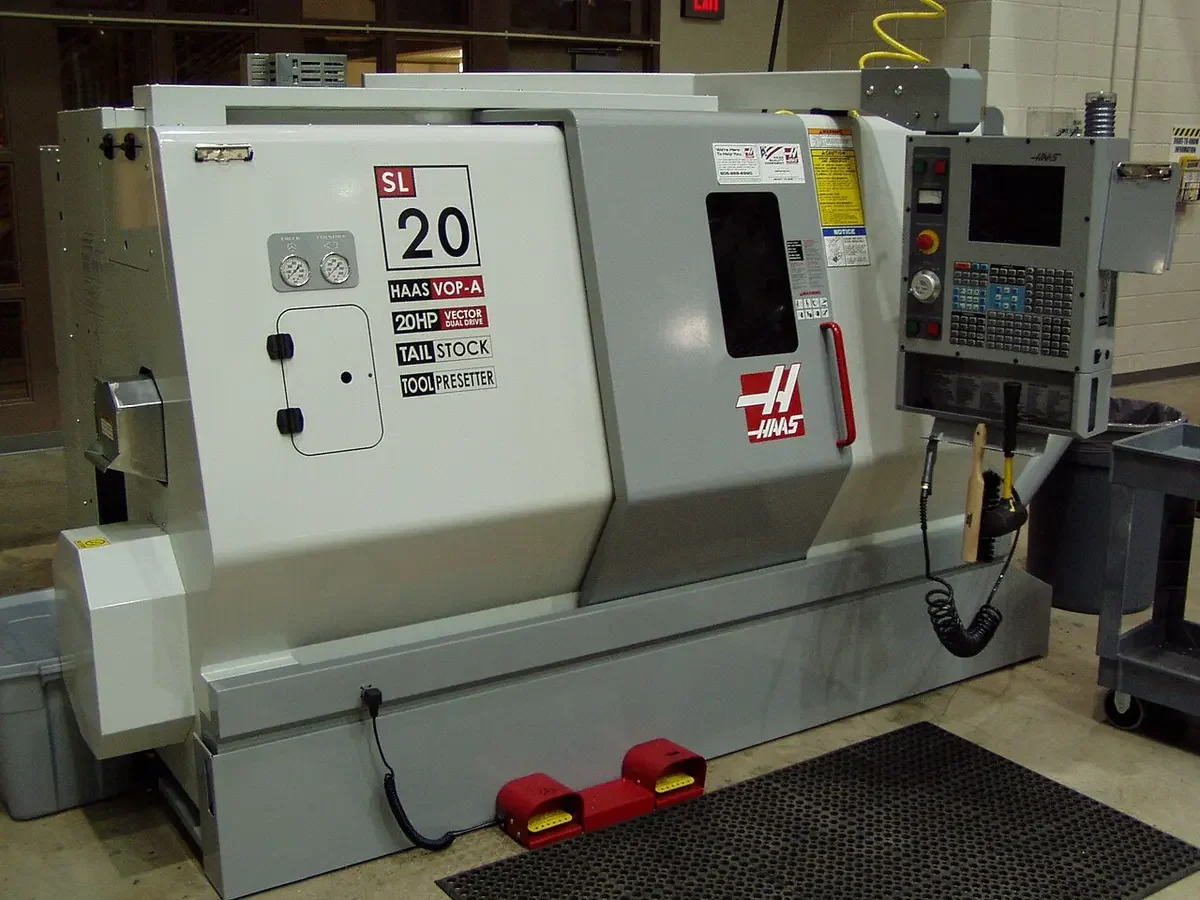
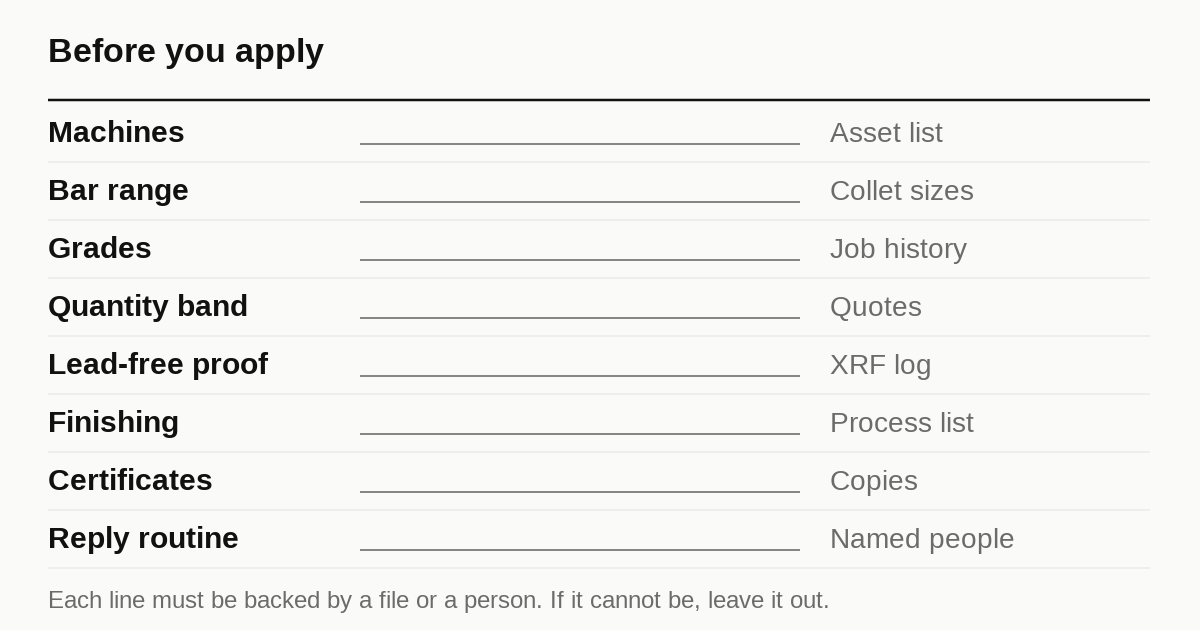
To apply as a partner shop for brass work, prepare one page first: the machines you run brass on, smallest and largest bar, grades cut in the last year, quantity band, lead-free papers you can show, finishing in house, certificates held and who replies. We choose which work to send from those entries, so vague ones bring vague requests.
We can only send work that fits what you tell us. If your entry says you run brass on a few lathes, quote small and large lots and hold the usual certificates, nothing in it separates you from any other shop, and the work you receive will be as mixed as the entry. If it says which machines, which bar sizes, which grades and what lead-free papers you can show, the work that reaches you fits.
This post is for the owner or export sales engineer of a turning shop. It is the page to write before you open the application form on the shop page: eight fields, how to fill each from facts you can check and what to leave out. For the public profile you put on your own website, see writing a machine shop capability profile buyers believe. This one is the working sheet behind an application.
What a work request looks like on the other side
The sample on the shop page shows how a work request reaches you. It has eight lines: part, grade, size, quantity, threads, finish, compliance and region. Your application is the mirror of those lines. The grade you list is compared with the request’s grade, your bar range with its size, your quantity band with its quantity and your lead-free entry with its compliance line.
So write each field so that it can be compared. “Various brass grades” cannot be compared with anything. “C360 and C464 weekly, C69300 in the last year” can.
The eight fields
1. Machines. Model and count, only for machines you would run brass on. A Swiss-type lathe supports the workpiece in a guide bushing near the cutting tool, so it is a different class of machine from a chucker, and a request for a long slender pin belongs to one and not the other. Name the class by listing the model. If a machine is bar fed, say so.
2. Bar range. The smallest and largest bar you can run, by machine group, taken from the collets and bushings you own and not from the machine’s brochure. Cutting Tool Engineering notes that ceramic guide bushings come in round profile only and that square and hex profiles are frequently requested as customs. If you run hex bar, say which sizes you have the support for. See brass bar stock sizes for how buyers specify it.
3. Grades. Grades you cut in the last twelve months, with the bar source if you can name it. Use the name the buyer will use: UNS and EN together, such as C36000 and CW603N. Brass grade equivalents lists the pairs. Do not list a grade you could run and have not. Field 5 is the place for lead-free grades you have only tested, and adding lead-free brass as a capability covers how to get from trial to shipped.
4. Quantity band. The lowest and highest release you will quote. It filters harder than material or tolerance. A buyer with 50 pieces and a buyer with 50,000 want different shops. See brass parts minimum order quantity for how buyers think about the low end.
5. Lead-free proof. Two lines: what you have shipped and what papers you can show. For papers, a mill test report states that the material’s chemical and physical properties meet the requirements of a recognized standard. An EN 10204 3.1 certificate, as Wikipedia describes it, is where the manufacturer declares the products meet the order and gives the test results. A handheld check is a separate matter: positive material identification measures how much of each element an alloy contains, with X-ray fluorescence as one typical method. EPA defines lead free under the Safe Drinking Water Act as a weighted average of 0.25 percent lead across wetted surfaces, and says manufacturers and importers who introduce regulated plumbing products must certify. A buyer in that position will ask you for the papers behind its own certification. See lead-free brass compliance documents and XRF checks on brass bar.
6. Finishing. In house against outsourced, named per process: tumbling, polishing, washing, plating, marking. If plating is outsourced, say so. We do not mind outsourcing. We mind finding out late. See brass surface finishes and plating.
7. Certificates. Only what the shop holds today, with the expiry date. If you hold none, write none. A pending certificate is not a certificate. Keep the shop’s own certificates apart from the material certificates you receive from your bar supplier.
8. Reply routine. Who reads the inbox, who decides to quote or decline and how fast. The shop page asks shops to answer our work requests within 48 hours. If the person who reads quotes is on the floor all day, name who covers. Include who may sign an NDA, because we ask. Wikipedia describes an NDA as covering the information the parties want to share while restricting access to it, in one-way or mutual form. Have your standard form ready and know which kind you will sign.
Test the page against a sample request
Take the sample on the shop page: a hex-body hose barb adapter in C69300, 22 mm across flats, 48 mm long, 2,500 pieces repeating twice a year, 1/2-14 NPT male thread gauge checked, tumbled with no burrs inside the bore, NSF/ANSI 61 and 372 with a 3.1 certificate, for North America.
Now answer in one minute each:
- Which machine would run it?
- Which bar do you buy and where is the support for 22 mm hex?
- Which gauge checks the thread? See thread gauging brass fittings.
- Which papers can you attach for the compliance line?
- Who quotes it, and by when?
Where you hesitate, that field on your page is not ready. Fix the page, not the answer.
Turn brass every week? Apply as a partner shop
Entries that read well and entries that do not
| Field | Weak entry | Better entry |
|---|---|---|
| Machines | Modern CNC equipment | 4 x Swiss-type, bar fed, and 2 x CNC turning centers, brass only |
| Bar range | Small to medium parts | 3 to 20 mm round, 8 to 22 mm hex |
| Grades | All brass grades | C36000 weekly, C46400 and C69300 in the last year |
| Quantity band | Any quantity | 500 to 50,000 per release |
| Lead-free | Lead-free capable | C69300 shipped, mill test reports with each bar lot |
| Finishing | Full finishing | Tumble and wash in house, nickel plating outsourced |
| Certificates | Fully certified | ISO 9001 certificate held, expires on a stated date, or none |
| Reply | Fast response | Quotes read daily by one named person, a second covers absence |
Every better entry can be checked against a file or a person. The sample figures are examples of the form, not a benchmark for your shop.
What to leave out
- Machines that would never run brass for an overseas buyer.
- Grades you could run but have not.
- Certificates in progress.
- Adjectives such as precision, state of the art and competitive. Use a number or a model name.
- Customer names you do not have permission to use.
What to expect after you apply
Work requests arrive only when they fall inside your entry, so a narrow honest entry brings fewer requests that fit better, and a broad one brings more that you decline. Nobody can promise a volume of work, since it depends on buyers ordering what you cut. We reply to an application within 24 business hours. We are your customer: you quote us, and if price and lead time work we place the purchase order. There is no fee to join.
Your entry is not fixed. When you ship a lead-free job, add a machine or change the quantity band you take, update it.
Checklist
- Machines listed by model and count, brass only.
- Bar range written by machine group from the collets and bushings you own.
- Grades cut in the last twelve months, in UNS and EN names.
- Quantity band with a lowest and a highest release.
- Lead-free line says what you shipped and which papers you can attach.
- Finishing split into in house and outsourced.
- Certificates held today with expiry dates, or none.
- Named people for replies and for NDAs.
- Page tested against the sample request on the shop page.
Talk to us
If you turn brass and want to be considered for work that matches your page, apply through the shop page. We reply within 24 business hours.
Sources
- Wikipedia, Mill test report
- US EPA, use of lead free pipes, fittings, fixtures, solder and flux for drinking water
- Wikipedia, Positive material identification
- Wikipedia, Non-disclosure agreement
- Wikipedia, Automatic lathe
- Cutting Tool Engineering, let precision be your guide
Frequently asked questions
How long does it take to prepare to apply as a brass partner shop?
Most of the time goes on facts you do not have in one place: bar sizes by machine group, grades cut in the last year and which lead-free papers you can find. Allow a working session with whoever runs the machines and whoever handles quotes. The form itself is quick once the page is written.
Should I list every machine in the shop?
List model and count for the machines that would run brass for an overseas buyer, and stop there. A manual mill that never touches brass work adds nothing. A request is sent on what you can cut, so a short accurate list brings better fits than a long one that includes machines you would not use.
What do I write if I have never shipped lead-free brass?
Write that plainly. Say which lead-free grades you have cut as trials, if any, and leave the shipped line empty. Buyers in plumbing and gas ask this first, and an honest no loses less than a claim a buyer later cannot back up. You can update the entry when you do ship.
Do I need certificates before I apply?
No. List only those you hold today, with expiry dates, and write none if you hold none. Do not list a certificate as pending. Material test reports from your bar supplier are a different thing from a shop certificate, so keep them in the lead-free line and keep the certificate line for what the shop itself holds.
Alloys in this guide
| Alloy | Lead % | Mach. | DZR |
|---|---|---|---|
| C360 free-cutting brassC36000 · CuZn36Pb3 / CW603N | 2.5 to 3.7 | 100 | Poor |
| C69300 silicon brassC69300 · CuZn21Si3P / CW724R | under 0.09 | 80 | High |
Published typical values for the alloy. Machinability against C360 at 100. Not a promise from a shop.
Sources
- Wikipedia, Mill test report en.wikipedia.org
- US EPA, use of lead free pipes, fittings, fixtures, solder and flux for drinking water epa.gov
- Wikipedia, Positive material identification en.wikipedia.org
Turn brass every week?
Brass CNC Parts sends brass work requests and nothing else. We are your customer: you quote us and we place the purchase order. No fee to join.