Types of Brass: Free-Cutting, Forging, Lead-Free, DZR, Naval and High-Tensile
Machined brass falls into six families: free-cutting leaded, forging, lead-free, dezincification resistant (DZR), high-tensile and the naval or tin brasses. A seventh, forming brass, is rarely turned. The family decides lead content, machining cost and whether the part may touch drinking water, so pick the family before the grade.
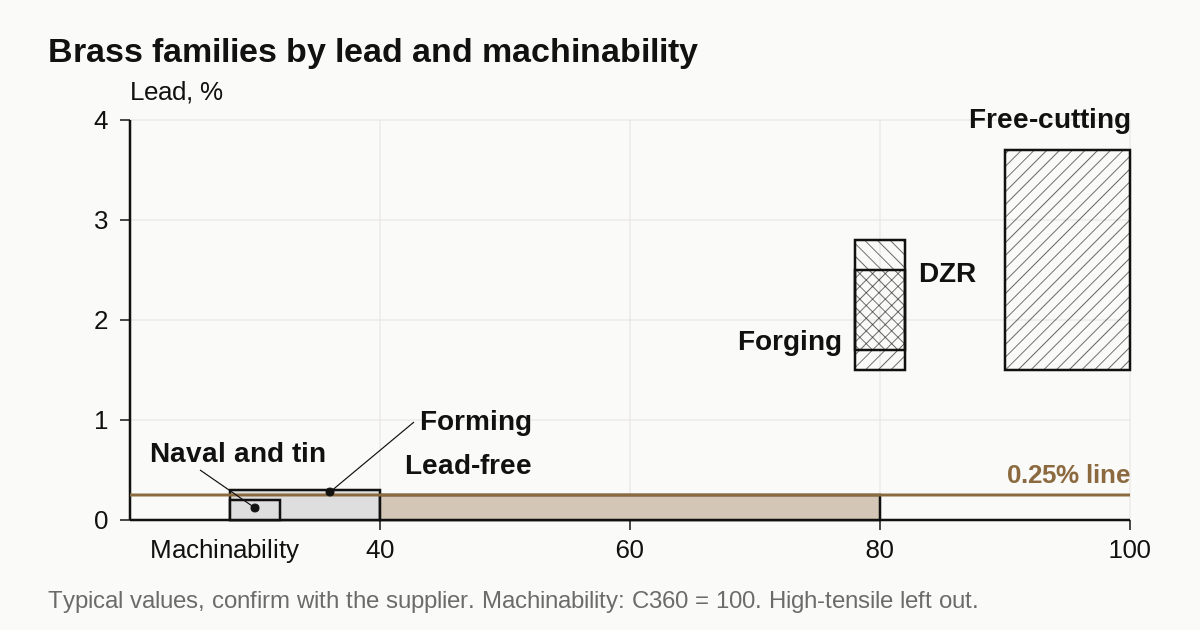
Published typical values for the alloys, labelled as such. Lead is nominal composition, machinability is rated against C360 at 100. Never a promise from a shop and never a lot certificate.
The family matrix
| Family | Copper, typical % | Lead, nominal % | Machinability | Drinking water | Typical machined part | Grades |
|---|---|---|---|---|---|---|
| Free-cutting leaded | 57 to 63 | 1.5 to 3.7 | 90 to 100 | No | Turned fittings for gas and air, inserts, terminals, screws | C360, C385, C345, C353, CW603N, CW614N, JIS C3604 |
| Forging | 57 to 61 | 1.5 to 2.5 | 80 | No, except listed entries until their end date | Hot stamped valve bodies and fittings, then machined | C377, CW617N, CW612N, JIS C3771 |
| Lead-free | about 60, silicon grades 73 to 77 | under 0.25 | 40 to 80 | Yes, where the market accepts the grade | Potable water bodies, stems, cartridges | C69300, CW724R, bismuth brass, CW511L |
| DZR | 61 to 63 plus arsenic | 1.7 to 2.8 for leaded DZR | 80 | Market by market, see below | Hot water fittings, valves in aggressive water | CW602N, CW625N, CW626N |
| Naval and tin | 59 to 62 plus about 1 tin | under 0.20 | 30 | Not their purpose | Marine fittings, condenser parts, shafts in seawater | C464, C485 leaded naval, C443 admiralty |
| High-tensile | 55 to 60 plus manganese, aluminium, iron | low to about 1.5, check grade | 30 to 50, check grade | No | Load-bearing bushes, marine and hydraulic parts | CW721R and similar, check grade |
| Forming (rarely turned) | 60 to 90 | trace to 0.30 | 30 to 40 | Some grades listed, check | Drawn shells, tube parts, plate | C260, C230, C280 |
Ranges are typical for the family and differ by grade. Datasheet links give the figures we hold for each alloy. Rows marked “check” are families we have not yet written a datasheet for.
How to read the matrix
The families are sorted by the job the alloy was developed for, not by colour or copper content. Three columns do most of the work for a buyer:
- Lead. Above about 0.25 percent the grade cannot carry a drinking water wetted surface under the NSF/ANSI 372 weighted average on its own, and the EU and German lists name compositions, not lead limits. Lead is also what makes brass cut fast.
- Machinability. The rating sets cycle time. A family at 30 takes roughly three times as long to turn as C360 for the same part, and tool wear rises with it.
- Drinking water. A yes here is never automatic. It depends on the market’s rule, see the country rules hub.
Free-cutting leaded brass
The default for turned parts. Lead sits in the brass as fine particles that break the chip, so the alloy runs at high spindle speed with short chips and long tool life. C360 is the benchmark at 100. CW614N and JIS C3604 are close European and Japanese counterparts of C385, not of C360. Use it for anything that never touches drinking water and never needs to be lead-free by contract: gas fittings, pneumatic bodies, electrical terminals, inserts, hardware.
Forging brass
Slightly lower lead and a microstructure that stays workable when hot. Bodies are hot stamped close to shape and then machined at the sealing faces and threads. C377 in the US and CW617N in Europe are the workhorses. Free-cutting grades crack when forged, see hot shortness. In Germany the listed leaded forging brasses may not be installed in new drinking water products from 12 January 2028; see the Germany page.
Lead-free brass
Brass with lead held under about 0.25 percent and something else to break the chip: silicon in C69300 and CW724R, bismuth in the C49300 family or nothing at all in CW511L, which simply machines slower. This is the family that potable water parts move to. Which lead-free grade a market accepts differs; the lead-free family page compares them.
Dezincification resistant (DZR) brass
Brass that resists the selective loss of zinc in aggressive water, by an arsenic addition and a controlled structure. CW602N is the common machining grade. DZR is a corrosion property, not a lead property: CW602N carries about 2 percent lead. It is proven by test, see ISO 6509 and dezincification resistant brass.
Naval and tin brass
About 1 percent tin added to a 60/40 or 70/30 brass for seawater and condenser service. C464 is the bar grade. C485 adds lead to make it machinable. These grades cost far more cycle time than C360, and their use is corrosion, not drinking water. See brass marine hardware.
High-tensile brass
Sometimes sold as manganese bronze, although it is a brass. Manganese, aluminium and iron additions give strength close to mild steel for bushes and load-bearing parts. See high-tensile brass for load-bearing parts.
Forming brass
Cartridge brass C260, red brass C230 and Muntz metal C280 were made for drawing, pressing and tube, and are slow to cut. A drawing that names one for a turned part is usually copied from a sheet metal part. Ask whether a free-cutting grade is acceptable. See C360 or C260.
Picking a family in five questions
| Question | If yes |
|---|---|
| Does the part touch drinking water? | Lead-free family, then check the market list |
| Hot water, aggressive water or seawater? | DZR or naval and tin family |
| Load-bearing like a steel part? | High-tensile family |
| Bulky body made in volume? | Forging family, near net shape |
| None of the above | Free-cutting leaded family, C360 or C385 |
The grade selector asks the same questions and returns grades. For the full grade-by-grade numbers, use the alloy reference and the cross reference.
Frequently asked questions
How many types of brass are there?
Hundreds of compositions exist, but for machined parts they sort into six working families by purpose: free-cutting leaded, forging, lead-free, dezincification resistant, high-tensile and the naval or tin brasses. Forming brasses such as cartridge brass are a seventh group used mostly for drawn and pressed parts.
What is the difference between red brass and yellow brass?
Those are colour names, not families. Red brass has more copper, around 85 percent, and yellow brass around 60 to 70 percent. A purchase order should carry a UNS, EN or JIS number instead. See red brass, yellow brass and cartridge brass on a purchase order.
Which type of brass is best for machining?
Free-cutting leaded brass, with C360 rated 100 as the benchmark. It is the wrong choice for drinking water parts, hot water parts or seawater, where a lead-free, DZR or naval grade is needed at a cost in cycle time.
Sources
- Copper Development Association, microstructures of copper alloys, brasses copper.org
- Wikipedia, Brass (alloy types and naming) en.wikipedia.org
- EUR-Lex, Commission Implementing Decision (EU) 2024/367, European positive lists eur-lex.europa.eu
Standards and rules are cited as references. Nothing here says that a part, a shop or this site meets them. Not legal advice.
Reference hub. Last reviewed 22 October 2026. Corrections log
Have a brass part to quote?
Send the drawing with the market and the rule it must meet. We reply within 24 business hours with one itemised quote for the finished parts, or a clear no.
Send your RFQ